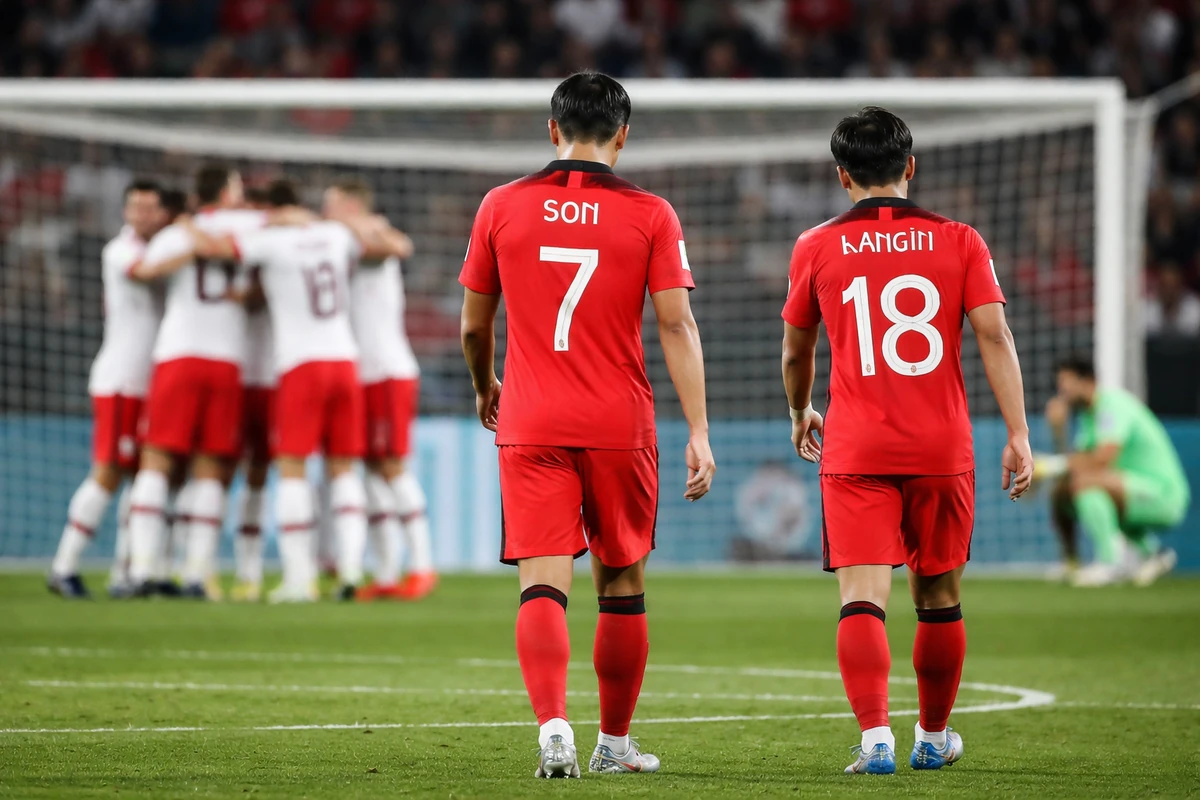
A narrow loss, but a revealing one
South Korea’s national soccer team left its June friendly against Austria with a result that looked manageable on paper and more troubling on closer inspection. The scoreline was only 1-0, hardly the kind of defeat that triggers panic, and friendlies by definition are not tournaments. They are laboratories. Coaches experiment. Lineups shift. Rhythm can be uneven. But for South Korea, this match did more than add one more loss to a summer schedule. It offered a sharply useful snapshot of where the team stands as it tries to turn elite individual talent into a repeatable, reliable attacking identity.
According to the Korean summary of the match, South Korea went scoreless despite fielding two of its most recognizable stars, captain Son Heung-min and Paris Saint-Germain midfielder Lee Kang-in. The game was tied 0-0 at halftime before Austria broke through in the second half and held on. There was no collapse, no multi-goal unraveling and no sign that South Korea was outclassed in every phase. In some ways, that is what makes the loss more instructive. The team was competitive enough to stay in the match, organized enough not to be overrun, but still short of the kind of attacking precision required to beat strong European opposition.
That distinction matters. In international soccer, especially for a country with South Korea’s ambitions, there is a significant difference between being difficult to beat and being good enough to impose a game against top competition. The Korea Football Association is not building for respectability alone. The benchmark is the World Cup, where South Korea has long sought not just qualification, which it has often achieved, but consistency against teams that play at a faster speed, defend with tighter spacing and punish small mistakes.
The Austria game appeared to underline a familiar truth in modern soccer: star power is necessary, but it is not sufficient. A team can have one forward who excels at timing runs behind the defense and another attacking midfielder who can unlock lines with his passing, but if the structure around them is not synchronized, those gifts stay isolated. That is what seemed to happen here. South Korea showed signs of composure getting through earlier phases of possession, but the closer it got to Austria’s penalty area, the more its options narrowed and its attacks lost their edge.
For an American audience, the easiest comparison may be a basketball team with two NBA-level shot creators but no coherent half-court offense. The talent is obvious. The highlights are possible. But against disciplined opponents who rotate well and make every possession uncomfortable, flashes do not add up unless the system consistently creates the right spacing, the right timing and the right second and third actions. South Korea’s loss to Austria felt like that kind of game.
Even the atmosphere around the match underscored how meaningful these tests remain. More than 200 South Korean supporters, including members of the Korean community and embassy personnel in Austria, were reported to be in attendance. That is not a massive crowd by World Cup standards, but for an overseas friendly it speaks to the enduring emotional draw of the national team. Fans did not simply come to see whether Korea could keep the game close. They came looking for evidence that this team, under coach Hong Myung-bo, is moving toward concrete answers in attack.
Why Son and Lee still matter — and why that alone is not enough
No discussion of South Korea’s attack starts anywhere but with Son and Lee. Son remains the country’s biggest soccer export, a globally recognized Premier League star whose speed, finishing and ability to attack open space have made him the face of modern Korean soccer. For many American fans who may know only one Korean player, Son is that player: dynamic, marketable, proven on the biggest club stages. Lee, meanwhile, represents a slightly different kind of promise. He is the creative connector, the player whose touch, vision and comfort in tight spaces can change the tempo and shape of an attack.
Put together, the theory is appealing. Son gives South Korea vertical threat and end product. Lee gives it craft, progression and unpredictability. One can stretch a back line. The other can pick it apart. On a team sheet, that pairing suggests a balance of speed and imagination that many national teams would envy.
But international soccer is full of pairings that make sense in theory and underdeliver in practice because the rest of the chain is incomplete. Son is most dangerous when runners, passers and midfield timing all align to create the exact windows he attacks best. Lee is most influential when teammates move decisively around him, offering angles, occupying defenders and turning his vision into actual openings instead of attractive but harmless possession. If either support system breaks down, the attack starts to look disconnected.
That appears to have been one of the central lessons from Austria. South Korea could get to certain areas, but it struggled to turn those moments into the kind of final actions that change matches. The issue was not simply whether Son got enough shots. It was whether the team created enough situations in which Son could do what he does best. Likewise, Lee’s effectiveness should not be measured only by individual moments of flair. Against a well-drilled European defense, one or two clever passes are rarely enough. Creativity has to be embedded in patterns that can be repeated under pressure.
This is a common tension for national teams, and not only in Asia. The United States men’s national team has had versions of this problem in different cycles: talented players in Europe, clear athletic upside, stretches of control, but uneven final-third cohesion against stronger opponents. South Korea’s challenge is similar, though its player profile is different. The question is not whether the stars are good enough. It is whether the collective movements around them can regularly produce dangerous sequences rather than occasional promise.
That means the criticism after this match should be more nuanced than reducing everything to finishing. A missed chance is easy to remember. A shortage of properly built chances is more important. In elite soccer, goals often come not from a spectacular strike out of nowhere but from a sequence of small, well-timed actions: a midfielder receiving on the half-turn, a fullback overlapping at just the right moment, a winger drawing a defender inside, a late-arriving runner attacking the second zone and a rebound being recovered before the defense resets. South Korea, at least in this friendly, did not do enough of those things in sustained fashion.
Hong Myung-bo’s real task may begin in the final 30 yards
Hong Myung-bo, one of the most recognizable figures in Korean soccer history, is trying to shape a national team that is organized, modern and flexible enough for the demands of World Cup qualification and beyond. For readers less familiar with Korean soccer, Hong is not just another coach. He is a former national team captain and a central figure in South Korea’s most celebrated soccer memory: the 2002 World Cup run, when the co-host nation reached the semifinals in one of the sport’s great modern upsets. That history gives him stature, but it also gives every tactical decision extra scrutiny.
Under Hong, the broad direction appears clear. South Korea wants more than survival soccer. Rather than simply clearing long from the back and hoping transitions fall kindly, the team is trying to build in a more controlled way, moving through the back line and midfield to establish rhythm and keep the ball with purpose. In the abstract, that is the right ambition. At the World Cup level, teams that cannot circulate under pressure are usually forced into reactive games they cannot sustain.
Still, the Austria match suggested that South Korea’s bigger issue may not be the first phase of buildup at all. It may be what happens in the final 30 meters, the last stretch before the goal where space tightens, decisions accelerate and technical details matter most. A team can pass neatly out of the back and still produce very little if its attacking shape becomes static near the box. That is the danger South Korea seemed to run into.
The Korean summary pointed specifically to a lack of movement after the pass, and that diagnosis feels important. Passing alone rarely breaks compact defenses. What opens them is the sequence after the first pass: the underlapping run, the third-man combination, the quick one-touch layoff, the second wave arriving at the top of the box. Without that layered movement, possession becomes safe but predictable. The ball moves, the opponent stays organized and attacks end with a sideways pass, a forced cross or a hopeful attempt from distance.
That sort of problem has consequences beyond offense. In soccer, attack and defense are linked more tightly than they appear. When a team cannot sustain pressure high up the field, it loses the ball sooner. When it loses the ball sooner, its defenders are forced into more transition moments and deeper territorial retreats. So even if South Korea’s defensive structure did not collapse against Austria, an inefficient attack can still create defensive stress by shortening possessions in dangerous areas.
For Hong, then, the answer may not be a dramatic shift in philosophy but a refinement of details. When do the fullbacks overlap, and who covers behind them? How often are midfield runners entering the box instead of hovering outside it? Are wide players cutting in at the right times to create central overloads? After set pieces break down, is South Korea in position to win second balls and recycle pressure into shots? These are not glamorous questions, but they are often the difference between a team that looks decent and one that consistently scores.
American fans who follow the sport closely have seen similar conversations around national teams and club sides alike. Coaches often speak in big terms about identity, style and principles, but matches against top opponents are decided by details that look almost mundane on a tactics board. South Korea’s issue against Austria seems to live in that space. The broad idea is there. The execution in the areas that matter most still needs sharpening.
Why European friendlies remain a meaningful World Cup measuring stick
Friendlies can be misleading if judged too emotionally, but they are not meaningless. For South Korea, a match against Austria serves as a useful test because European teams often bring exactly the traits that expose half-finished ideas: compact pressing distances, quick transitions, tactical discipline on set pieces and a comfort level in matches played at a slightly faster mental and physical pace. Those qualities matter because they are common in the environments South Korea hopes to navigate at future World Cups.
South Korea is usually among the stronger teams in Asia, and that creates a challenge familiar to dominant regional powers in many sports. Success at home or in continental competition does not always reveal the same weaknesses that emerge against deeper, more physically balanced opponents from Europe or South America. A passing sequence that works comfortably in one context can break down against a team that closes space a half-second faster. A midfield that looks fluid in qualifying can suddenly seem crowded against higher-level pressing.
That is why a 1-0 loss like this can be more useful than a comfortable win against weaker opposition. It clarifies what still does not travel. In this case, the answer appears to be South Korea’s ability to translate possession and composure into end-product against an organized European defense. Holding Austria scoreless for a half is one data point. Turning that into a result is another. International tournament soccer is unforgiving precisely because a single second-half concession can decide everything.
Americans should understand that dynamic well. U.S. fans have spent years discussing the difference between encouraging performances and tournament-caliber performances. The gap is often not huge in appearance. A team can look competitive, even admirable, and still leave with nothing because it lacked one clean attacking pattern or one moment of defensive sharpness. South Korea’s loss belongs in that category. It was not a humiliation. It was a reminder that the margins at the top level remain demanding.
These matches also help answer selection questions that box scores cannot. Which players can receive and escape pressure when the field shrinks? Which midfielders can play one-touch combinations in traffic? Which substitutes can immediately increase tempo rather than merely keep the game level? Which attackers defend from the front well enough to justify inclusion even if they are not the biggest names? Those are the types of issues that become clearer against strong opponents.
In that sense, South Korea should view the Austria loss as information, not just disappointment. The Korean summary made that point directly: a World Cup-bound team should treat friendlies as data, not comfort. That is a healthy perspective. National teams do not have the luxury of daily training-ground development over a full club season. They need opponents and match environments that expose flaws quickly. Austria appears to have done exactly that.
The next question is not talent, but role definition
South Korea has spent much of the past several years centered around a core of Europe-based players, and understandably so. That pool includes some of the country’s most accomplished modern professionals and gives the national team a level of individual quality many Asian rivals cannot match. But as major tournaments approach, the challenge shifts from identifying the best-known names to assigning the clearest roles around them.
That is especially true for a team built around stars who do different things. Son can change a game with one run or one finish. Lee can bend a match with one disguised pass. But those qualities are amplified only if the supporting cast knows exactly how to complement them. The holding midfielder must break up counters and move the ball quickly. The box-to-box runner must supply energy between both penalty areas. The fullbacks must judge when to attack and when to stay. The bench must offer something distinct, not just fresher legs.
The Korean summary framed this as a matter of generational balance, and that is a useful way to understand it. Veteran players bring calm, emotional control and the kind of game management that matters in tense international matches. Younger players often bring the running power, daring and vertical energy needed to change a stale game. Strong national teams usually need both. Austria was the kind of close contest in which the profile of a second-half substitute can materially alter the game’s direction. Is that player meant to speed everything up? Stabilize midfield? Add another box runner? Press aggressively from the front? Those choices reveal a coach’s trust and priorities.
There is also a broader management issue here that extends beyond one lineup. National team coaches must create an environment in which selection feels coherent. Players need to understand what behaviors are rewarded. If the staff says aggressive pressing matters, then players who press well should see opportunities, even if they are not the biggest stars. If rapid defensive recovery matters, those who execute it consistently should have a pathway. That kind of internal logic is essential because international teams do not have enough time together for ambiguity to sort itself out.
For American readers, this can be compared to the way NFL coaching staffs talk about “roles” within a roster rather than simply “best players.” A team may carry two talented running backs for different situations or use a slot receiver because he solves a specific third-down problem. Soccer works similarly, even if the sport’s culture often speaks more romantically about talent. Against stronger national teams, role clarity matters as much as raw ability.
South Korea seems to be at that stage now. The top-line talent is obvious. The unfinished work lies in building a hierarchy of functions around it: who advances play under pressure, who arrives late in the box, who counters the counterattack, who can flip a game from the bench and who provides tactical discipline when momentum shifts. Those answers will shape June and the months that follow more than any headline about one friendly result.
What this means for June — and for South Korea’s larger ambitions
The immediate takeaway from the Austria loss is not that South Korea has taken a dramatic step backward. It is that the team remains in a middle stage of development under Hong: organized enough to compete, talented enough to threaten, but not yet polished enough in attack to trust that quality will emerge naturally against better opponents. That is a solvable problem, but only if the coaching staff treats it with the right level of urgency.
The June agenda, based on the match summary, is fairly clear. South Korea needs more than vague improvement in “finishing.” It needs more repeatable attacking patterns near the box. That means more coordinated entries from the flanks into central zones, more runners from the second line, better timing on through balls and stronger reactions to loose balls around the area. If the ball reaches dangerous zones and immediately dies, the issue is structural. If the team repeatedly gets the right looks and fails to convert, the issue is execution. South Korea appears to be dealing with some of both, but the structural part may be more important.
There is also a psychological layer. Teams that have not yet fully solved their attack can become too cautious, especially against strong opposition. Players sense how hard clear chances are to create and start choosing the safer pass. That instinct is understandable, but at the elite level it can slowly drain a team’s threat. One of Hong’s jobs will be to preserve discipline without allowing the attack to become timid.
None of this should obscure South Korea’s strengths. Son and Lee remain legitimate high-end pieces in international soccer. The defensive structure, at least by the description of this match, did not disintegrate. The team’s desire to build with intention rather than surrender the ball is a positive sign. And because this was a friendly, there is still room to adjust without immediate consequence in the standings.
But the broader ambition matters. South Korea does not judge itself only by whether it can be respectable against European teams. It has a deeper soccer culture and a longer World Cup history than many casual American fans may realize. The country’s national team carries expectations shaped by decades of qualification, memorable tournament moments and an increasingly globalized player pool. In that context, a 1-0 loss to Austria is not a disaster. It is a progress report.
And the report says this: South Korea can stay in the room with quality opposition, but staying in the room is not the same as dictating the conversation. To take the next step, Hong’s team must turn two gifted stars into the center of a functioning attacking ecosystem, not just a collection of hopeful moments. That is the real task coming out of Austria. The scoreline was narrow. The lesson was not.
Comments
Post a Comment