Warehouse Fire Near Seoul Destroys Five Buildings, Exposes Safety Gaps in South Korea’s Fast-Growing Logistics Sector
A fast-moving warehouse fire raises broader questions
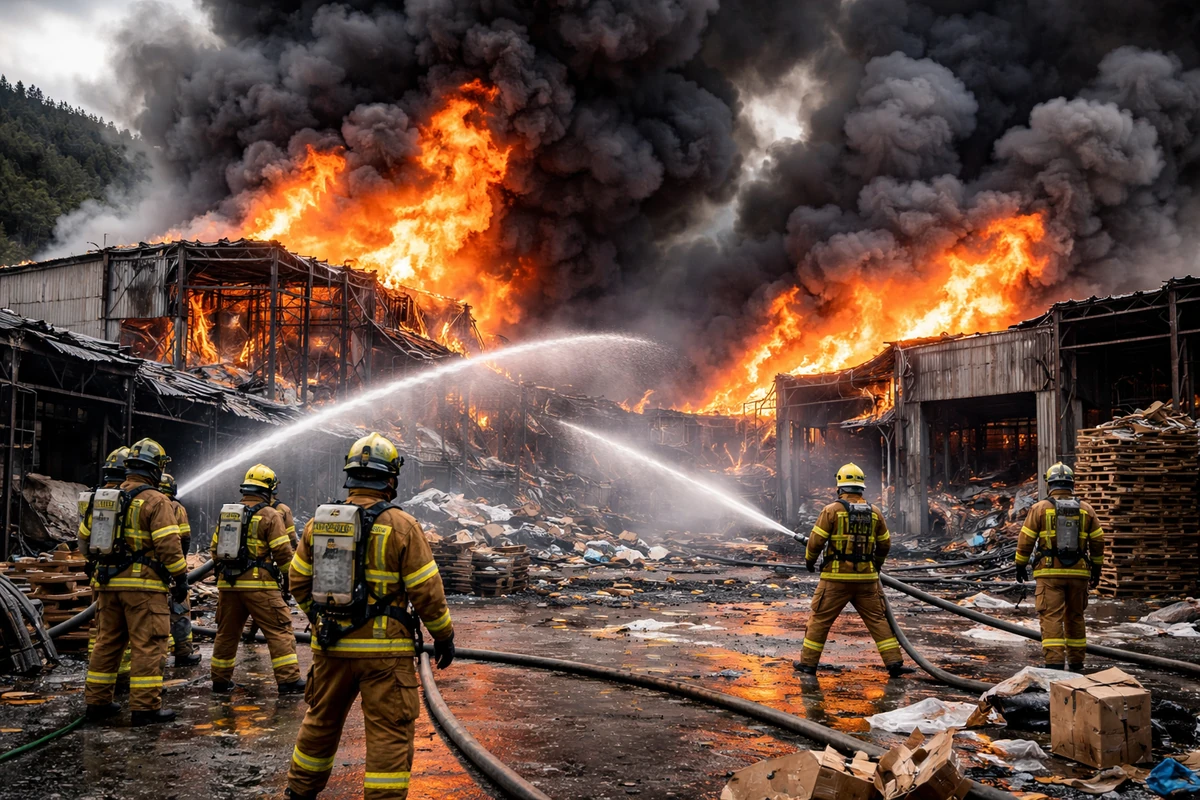
A fire that tore through a distribution factory complex in Gwangju, a city in Gyeonggi Province southeast of Seoul, destroyed five buildings and briefly spread to nearby wooded hillsides, according to South Korean authorities and local media reports. Fire officials said they issued what is known in South Korea as a "Stage 1" response shortly after the blaze broke out on March 31, deploying additional personnel and equipment beyond a routine single-station response. Roughly two and a half hours later, firefighters had achieved what officials call an initial suppression, meaning the main flames were brought under control even if hot spots and hidden embers may have remained.
On paper, that may sound like a familiar industrial fire story: a blaze starts at a warehouse-like facility, first responders arrive, the fire is contained, and investigators begin sorting through the damage. But the Gwangju fire has drawn attention in South Korea for reasons that go well beyond one company’s property loss. The incident is being viewed as a stress test for the country’s industrial safety systems, especially at the sprawling logistics and distribution sites that have become essential to how modern consumers shop, how retailers replenish inventory and how goods move across one of the world’s most densely populated economies.
For American readers, the closest analogy might be a major warehouse fire in the exurban ring outside Atlanta, Chicago or Dallas, where fulfillment centers sit near highways, residential developments and patches of undeveloped land. These are facilities that look simple from the outside — big-box structures designed for storage and truck access — but can become extraordinarily dangerous once a fire starts inside. Pallets, cardboard, plastic wrapping, consumer products and mixed goods can turn an ordinary-looking building into a high-heat, low-visibility maze in minutes.
That appears to be part of what happened in Gwangju. Officials said flames were intense enough not only to consume multiple factory-related buildings but also to spread into surrounding brush and low forested terrain. In spring, when Korea often experiences dry air, gusty winds and highly variable rainfall, the line between an industrial fire and a brush fire can disappear quickly. That is one reason this case has resonated beyond the local area. It is not simply about one industrial site. It is also about delivery networks, community safety, wildfire risk and the ability of local governments to respond when several types of emergencies collide at once.
South Korea is often praised abroad for high-tech infrastructure, advanced manufacturing and efficient urban systems. But, like the United States, it has repeatedly been reminded that modern logistics can outrun modern safety culture. The Gwangju fire is the latest example of how a sector built around speed, throughput and tight margins can become vulnerable when routine safety practices fail to keep pace with operational demands.
Why distribution centers can burn so fiercely
Distribution factories and logistics warehouses pose a different kind of fire risk than a traditional manufacturing plant. In a factory where goods are made, hazards may center on machinery, chemicals or production lines. In a distribution center, the danger often comes from volume: huge quantities of combustible materials packed into large, open interiors with high ceilings and densely arranged storage systems. Even when a building appears to be a simple warehouse, the fire environment inside can become extremely complex.
Think about the ordinary materials found in a typical fulfillment operation. There are cardboard boxes, shrink wrap, vinyl storage materials, wood pallets, plastic bins, foam cushioning, paper labels and consumer goods with their own mixed burn characteristics. Food products may be stored near household items; electronics packaging may sit not far from chemical-based consumer products; promotional inventory may be stacked temporarily in aisles during peak periods. When all of that is concentrated in one space, the result can be a fire that spreads both horizontally and vertically with alarming speed.
Fire experts have long warned that high-bay storage buildings can be especially difficult to manage because hot gases and smoke rise quickly into the upper reaches of the structure, then accumulate and spread across a broad ceiling area before dropping heat and toxic smoke back into the working zone below. Shelving systems and tightly packed storage lanes can also create channels that allow flames to travel rapidly through multiple product categories at once. That makes it harder for firefighters to predict how the fire will behave and harder for workers to escape or mount any meaningful first response.
Another challenge is that mixed inventory does not burn in a uniform way. Some goods char slowly. Others melt, drip, flare or release thick black smoke. Certain packaging materials can ignite quickly and generate temperatures high enough to compromise structural elements or suppress sprinkler effectiveness. Goods that are not directly touched by flame may still deform, rupture or contribute to secondary combustion under prolonged heat. The more varied the inventory, the more unpredictable the fire pattern becomes.
Americans have seen versions of this problem in fires at self-storage businesses, e-commerce fulfillment centers and distribution hubs linked to retail supply chains. The building may not look dramatic from the road, but inside it is a carefully optimized machine for moving goods — and that same optimization can work against emergency response. The better the building is at maximizing storage density and traffic flow for trucks and workers, the more difficult it may be to create the open, accessible conditions firefighters need when something goes wrong.
The meaning of a South Korean "Stage 1" fire response
One detail highlighted in Korean reporting was the decision to activate a "Stage 1" response. For readers outside South Korea, that is not just bureaucratic jargon. It signals that fire officials judged the incident serious enough from the outset to require a broader mobilization of personnel and equipment than a smaller fire would. Response tiers vary by jurisdiction, but the core idea is similar to mutual-aid escalation systems used in the United States: local commanders assess the size of the fire, the risk of spread, nearby exposures and the likely duration of operations, then call for more help early if they believe the first wave will not be enough.
That early judgment matters because in warehouse fires the first 10 to 30 minutes can shape everything that follows. If an automatic suppression system works, if employees report the blaze immediately, if aisles and access routes are clear and if firefighters can attack the seat of the fire quickly, losses can sometimes be limited. But when alarms fail, workers hesitate, combustible inventory is stacked too high or smoke conditions prevent entry, the window for containment can close almost instantly.
Officials later said they had achieved "initial suppression" after about two and a half hours. That phrase can be misunderstood by the public. In many fire services, including South Korea’s, initial suppression does not necessarily mean the fire is fully extinguished. It means the main body of fire has been knocked down and its spread is largely controlled. In a logistics facility full of stored goods, however, hidden embers can persist inside pallets, packaging clusters, ceiling voids and partially collapsed storage areas. Reignition is a real risk, and crews may need hours more to secure the scene, search for remaining hot spots and monitor structural stability.
Smoke is often what makes these incidents so punishing. Distribution center fires can produce dense, dark smoke loaded with toxic gases, sharply reducing visibility and limiting the routes firefighters can safely use. If there is any concern about roof collapse, falling wall panels or destabilized storage racks, incident commanders may have to scale back interior operations and fight the fire from outside instead. That can protect firefighters, but it also reduces the chances of saving the structure.
In that sense, a Stage 1 mobilization is both a sign of urgency and, sometimes, a sign of how little room for error exists once a large commercial fire has taken hold. It reflects a basic reality familiar to fire departments from California to New Jersey: if a warehouse is already fully involved, resources matter, but design, maintenance and prevention mattered more.
Spring weather turned a building fire into a wider hazard
The Gwangju fire also underscored a seasonal danger that may be less familiar to readers who know South Korea mainly through its cities, technology exports or pop culture. Spring in Korea is often dry and windy, particularly before the summer monsoon season settles in. Even when rain is forecast nationally, actual conditions can vary widely by region and by hour. That means a fire that starts in a built environment can jump into nearby vegetation surprisingly fast.
In this case, flames reportedly spread to adjacent hillsides. That detail is significant because many industrial sites in South Korea sit at the edges of urbanized areas, where warehouses, light factories and logistics yards back up against low mountains, wooded slopes or agricultural land. It is a pattern created by land prices, transportation access and zoning pressures. Facilities need large footprints and truck-friendly access roads, so they are often built outside dense city centers. But those same peripheral locations can be harder to defend during a fast-moving fire.
There are at least two ways that proximity to forest or brush magnifies risk. First, an industrial blaze can ignite surrounding vegetation, effectively creating a second emergency. Second, wind and radiant heat from outdoor fire can feed back into the industrial site, igniting exterior walls, roofs, loading areas or stored materials outside the main structure. That feedback loop can slow suppression efforts and force commanders to split attention between building protection and wildfire-style containment.
American audiences have become more accustomed to this kind of overlap in places such as California, Colorado and parts of Texas, where the boundary between development and wildfire-prone land has become a major planning issue. South Korea faces a different geography and climate, but the principle is similar: once industrial growth extends into marginal or transitional land, emergency planning has to account for both structural fires and landscape fires, not treat them as separate worlds.
Access can become a crucial problem. Roads in peripheral industrial districts may be limited. Turning radiuses for large apparatus may be tight. Water sources may not be as robust as those in dense urban cores. If crews also need to establish a fire line to protect nearby woods or brush, manpower and equipment are stretched further. A blaze that might have remained a contained industrial incident in a better-served location can become a regional emergency when terrain and land use work against responders.
A supply-chain issue, not just a local fire
What makes fires like this politically and economically important is that they do not stay confined to the property line. Modern logistics facilities are nodes in a larger chain. When one goes down, consequences ripple outward: road closures snarl traffic, deliveries are delayed, nearby businesses lose access, local residents worry about smoke and toxic runoff, and fire departments may have fewer resources available for other emergencies while crews remain committed at the scene.
That is one reason the Gwangju fire has become a broader story in South Korea’s domestic news. It touches on the resilience of distribution networks that now play an outsized role in daily life. South Korea’s consumers, like Americans, have grown used to rapid delivery, discount events and just-in-time inventory systems that keep goods moving with little slack. Those efficiencies are good for convenience and competitiveness, but they can create pressure to maximize floor space, accelerate inventory turnover and temporarily overload storage capacity during promotional seasons or product surges.
That operational reality matters for safety. Experts in Korea have pointed out that the core problem is not only whether a warehouse has sprinklers, alarms and fire partitions on paper. It is whether those systems still work as intended when stock levels spike, aisles narrow, temporary storage encroaches on clearance zones and managers prioritize throughput over disciplined housekeeping. In many countries, including the United States, that gap between code compliance and day-to-day practice is where serious industrial accidents take root.
There is also the public health dimension. Fires involving mixed commercial goods can release hazardous smoke, ash and runoff, especially when plastics and packaging materials burn in large quantities. Residents living near distribution districts may not know exactly what is stored inside a given building, and emergency notifications can lag the speed of the event itself. For local governments, that means a warehouse fire can quickly become a public communication challenge as well as a firefighting challenge.
Even when no mass casualty occurs, the social impact can be real. Workers may lose shifts or jobs. Small businesses can face inventory disruption. Trucking schedules may be thrown off. Nearby communities may spend hours under smoke advisories or traffic restrictions. In a country as tightly networked as South Korea, where industrial, residential and natural spaces often sit close together, those secondary effects can be felt quickly.
The recurring question: Are inspections enough?
Every time a major industrial fire breaks out in South Korea, a familiar question follows: were required safety systems present, and if so, did they actually work? That is also a familiar question in the United States. It is possible for a facility to satisfy regulatory requirements on paper while still operating in ways that undermine real-world fire safety. A fire door blocked by stored goods, a sprinkler pattern interrupted by overstacked inventory, an emergency route narrowed by temporary pallets or a contractor who is unclear about reporting authority can all erode protection without showing up clearly in a compliance checklist.
Korean commentators and safety experts have zeroed in on that distinction after the Gwangju blaze. Distribution centers are dynamic workplaces. Inventory levels rise and fall. Seasonal promotions change storage patterns. Temporary overflow becomes permanent. Contractors, subcontractors, tenants and building owners may each control part of the operation but not the whole of it. In that environment, responsibility can become blurred. Everyone assumes someone else is watching the hazards, and meanwhile the hazards accumulate.
This issue is especially acute in logistics, where outsourcing is common. A building owner may lease space to an operator; the operator may use third-party staffing; equipment maintenance may be handled by another vendor; safety training may be inconsistent across shifts. After a fire, those lines of responsibility become the subject of scrutiny and sometimes legal dispute. Before a fire, they can create the very gaps that make prevention harder.
Experts in South Korea have argued that the answer lies not simply in increasing the number of inspections but in making risk assessments more tailored to actual site conditions. That means understanding what kinds of goods are currently on-site, how much of them are present, whether dry spring conditions increase external spread risk, what staffing looks like during night shifts versus daytime operations, and whether emergency plans reflect the building as it is really being used rather than as it was originally designed.
For American readers, it may be helpful to think of this as the difference between passing a restaurant inspection and actually maintaining safe food practices during a holiday rush. Compliance matters. But safety culture lives in the mundane decisions made every day: where materials are stacked, whether employees speak up, whether supervisors stop unsafe shortcuts, whether maintenance is preventive rather than reactive. In large logistics facilities, those decisions can determine whether a small ignition source becomes a building loss.
What the Gwangju fire says about South Korea now
South Korea’s global image is often dominated by semiconductors, K-pop, blockbuster streaming dramas and sleek urban infrastructure. All of that is real. But beneath that polished surface is an economy that also relies on ordinary, combustible, labor-intensive spaces: warehouses, trucking depots, cold storage sites, fulfillment hubs and industrial yards. Those places rarely attract international attention unless something goes badly wrong.
The Gwangju fire is a reminder that the Korean Wave, the export economy and the convenience of modern consumption all rest on a physical logistics system that can be surprisingly fragile. A blaze at one distribution site may look local, but it reveals national vulnerabilities: how industrial growth meets land-use planning, how emergency services handle compound risks, how safety is enforced across subcontracted operations and how communities absorb the fallout when commerce and hazard overlap.
It also highlights a broader challenge many advanced economies share. As supply chains become faster and more complex, the pressure to move and store goods efficiently often outpaces public understanding of the risks hidden inside the buildings that make convenience possible. Consumers see next-day delivery. Firefighters see combustible load, limited access, mixed inventory and difficult smoke conditions. Policymakers see an economic engine that needs oversight without becoming politically inconvenient. Those views can coexist — until a major fire forces them together.
In the coming days, investigators in South Korea will likely focus on the cause of the fire, whether suppression systems functioned properly, whether building and storage practices met safety standards and whether any procedural failures contributed to the scale of the loss. Those findings will matter. But the broader lesson is already visible. Industrial fires in the spring are not just about what ignites. They are about where a building sits, how it is operated, what it stores, how much warning workers have, whether emergency routes are protected and how quickly an initial blaze can intersect with weather and landscape.
That is why this incident has drawn attention far beyond the immediate site. Five buildings were destroyed. A hillside reportedly caught fire. Firefighters needed an escalated response and hours to gain control. Even without a full accounting of the cause, the event illustrates how a single warehouse fire can challenge supply-chain resilience, local disaster readiness and the thin line separating industrial accidents from environmental emergencies.
For South Korea, that makes the Gwangju blaze more than a one-day headline. It is a warning about the spaces behind the consumer economy — the spaces most people never see until smoke rises above the roofline.
Comments
Post a Comment