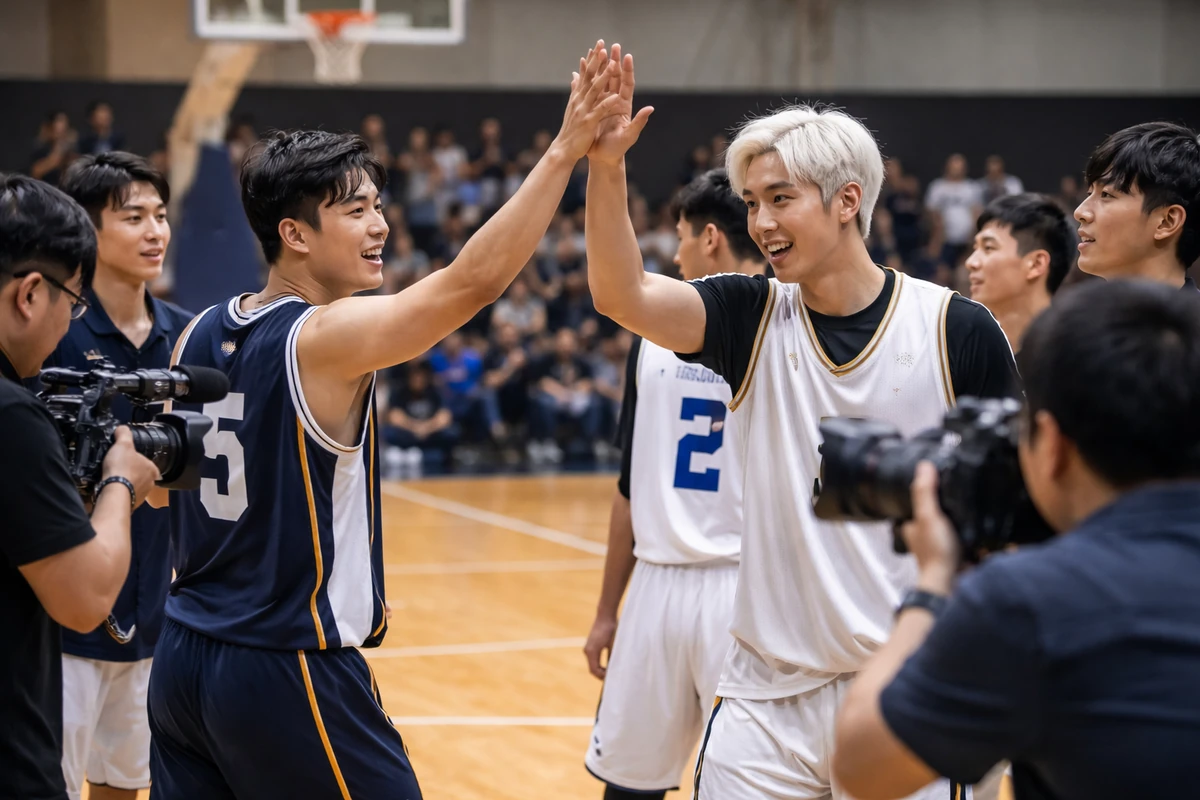
A Korean sports-variety show is making a calculated bet on fandom, humor and a broader audience
South Korean television has long treated sports and entertainment as overlapping businesses, but the latest casting move for the second season of the basketball variety show “Hot-Blooded Basketball Team” suggests the industry is pushing that formula into a new phase. Reports in South Korea say EXO member Chanyeol and entertainer Jo Jin-se are joining the show for Season 2, a move that may sound like a routine casting update on paper but, in practice, reveals a great deal about where Korean unscripted television is headed.
For American audiences unfamiliar with the genre, Korean variety shows are not simple equivalents of ESPN studio programs, nor are they exactly like U.S. reality competition series. They often blend game play, personality-driven comedy, character arcs and highly edited emotional storytelling. In that sense, a sports-variety show is less about pure athletic performance than about turning competition into a weekly narrative: Who improves, who bonds, who cracks under pressure and who unexpectedly becomes indispensable.
That is why Chanyeol’s addition matters. He is not just another celebrity guest. He is a member of EXO, one of K-pop’s biggest global boy bands, a group whose influence extends far beyond album sales into fashion, fan communities, digital media and brand partnerships. When a performer with that kind of international fan base joins a basketball-centered series, the show is no longer competing only for domestic TV viewers. It begins competing for online attention, social media clips, overseas fandom engagement and the kind of cultural chatter that can outlast a single episode.
At the same time, Jo Jin-se’s casting points to a different but equally important priority. Korean entertainment producers know that star power can attract first-time viewers, but it does not always keep them watching. To make a season work, the show also needs someone who can create chemistry, ground the format in humor and make the team’s successes and failures feel relatable rather than polished. Put together, the casting of a top idol and an entertainer known for comedic instincts looks less accidental than strategic.
Season 2, in other words, is not simply adding faces. It is testing whether a sports-variety program can expand beyond a traditional male-leaning sports audience and become a broader pop-culture product.
What sports-variety means in South Korea, and why basketball fits the format so well
To understand why this casting news is drawing attention, it helps to understand the particular role sports-variety shows play in South Korea. In the United States, sports content often divides neatly into categories: live games, documentary series, panel debate shows or reality competitions. In South Korea, those lines are more porous. A show built around basketball can also be a comedy, a team-building experiment, a fan-service vehicle and a redemption story for inexperienced players all at once.
That structure favors season-based storytelling. Rather than producing one-off sports specials, Korean broadcasters have increasingly leaned toward multi-episode seasons that allow viewers to track incremental growth. Producers do not have to spend every episode explaining the basic rules. Instead, they can focus on the drama of improvement: a player learning positioning, a team discovering rhythm, a celebrity confronting the gap between image and ability.
Basketball is especially useful for that kind of television. It is visually compact compared with soccer or baseball. The court is contained, the pace is fast and a player’s mistakes or progress are easy to see in real time. Viewers do not need a deep understanding of the Korean Basketball League to grasp a blown defensive rotation, a rushed shot or the emotional swing of a close game. That clarity makes basketball ideal for reality-style editing, where every look, reaction and turning point can be turned into story material.
It also helps that basketball already carries strong cultural associations in both Korea and the United States. In Korea, it remains familiar through school sports and recreational play, even for viewers who are not avid followers of the professional game. In the U.S., audiences may think of basketball as one of the most personality-driven sports, where individual flair and team chemistry coexist. Korean producers seem to understand that dynamic well. A basketball variety show lets them assign recognizable roles: the hard worker, the natural athlete, the comic relief, the struggling rookie and the unexpected leader.
From a production standpoint, basketball is efficient. The game is quick enough to deliver momentum, structured enough to create suspense and stylish enough to connect to youth culture. Sneakers, uniforms, team colors and streetwear aesthetics all intersect naturally with pop music and celebrity branding. That is part of why idol-basketball pairings keep appearing in Korean entertainment. The sport does not just offer competition; it offers image.
Why Chanyeol changes the equation from a TV show to a transnational fan event
Chanyeol’s presence raises the stakes because K-pop fandom does not consume media the way a traditional television audience does. Fans do not simply tune in for a full episode and wait a week. They clip, share, subtitle, repost, analyze and replay individual moments. A smile on the bench, a reaction after a missed shot or a conversation with teammates can circulate online as aggressively as a highlight play.
That matters in today’s media environment, where a program’s overall ratings tell only part of the story. A show can gain significant traction because one cast member drives online discovery. Someone who would never seek out a Korean sports-variety series might watch because they follow Chanyeol. Once inside, they may stay for the basketball, the team arc or the interpersonal dynamics. In business terms, a star like Chanyeol lowers the entry barrier for nontraditional viewers.
For American readers, a loose parallel might be what happens when an established music star crosses into another entertainment space and brings a highly organized fan community with them. The product changes because the audience changes. Coverage expands, clips circulate faster and advertisers begin to see new possibilities. In Korea’s platform economy, where linear broadcast, cable, streaming and social media all feed one another, that can be more valuable than a small boost in overnight ratings.
Chanyeol’s casting also underscores how globalized K-pop fandom has become. EXO is not merely a domestic brand. The group has spent years building a following across Asia, North America, Latin America and Europe. That means this show’s digital footprint could extend well beyond South Korea, especially if subtitled clips spread through fan communities. Producers are likely aware that international audiences often discover Korean programs not through official marketing campaigns but through fandom ecosystems.
There is also a commercial dimension. Sports programming has traditionally been seen as a natural fit for advertisers in categories like food, beverages, cars or men’s apparel. But once an idol with a strong fan base enters the picture, the potential partner list widens. Beauty, fashion, mobile tech and lifestyle brands may all see an opening. That does not guarantee success, but it does make the show more legible as a multi-platform property rather than a niche sports program.
None of this means Chanyeol alone can carry the season. In fact, that is precisely the risk Korean producers are trying to avoid. If a sports-variety show becomes too dependent on one celebrity, it can feel flimsy, with the game reduced to a backdrop. The real challenge is whether Chanyeol can function not just as a celebrity magnet but as part of a believable team story.
Jo Jin-se’s role may be less flashy, but it could be just as important
If Chanyeol opens the door to fan communities, Jo Jin-se appears positioned to make sure regular viewers want to stay inside. Korean entertainment executives have learned over and over that star casting alone is not enough. Audiences may come for fame, but they continue watching for friction, humor, vulnerability and growth. That is where a variety-savvy figure becomes invaluable.
Jo Jin-se’s addition suggests the show understands an essential truth about sports entertainment: viewers connect most deeply not to perfect athletes, but to the human process of trying, failing, adjusting and trying again. In basketball, that process is especially exposed. A bad pass, blown defensive assignment or lapse in stamina cannot be hidden for long. The game reveals weakness quickly, which is exactly what makes it useful for storytelling.
An entertainer with comic timing can transform those moments into something watchable rather than merely awkward. He can react, narrate, diffuse tension and help the audience process the embarrassment or pressure that comes with competition. In that sense, Jo Jin-se is not just there to be funny. He is there to maintain emotional temperature. He helps make the show feel less like a celebrity showcase and more like a team people can recognize themselves in.
That relatability is crucial if the producers want to avoid skewing too far toward idol fandom. One of the most difficult balancing acts in Korean unscripted television is retaining a core audience while attracting new viewers. If a program becomes too obviously tailored to one fandom, casual audiences can feel excluded. If it ignores the fandom logic entirely, it leaves potential digital momentum on the table. The apparent thinking behind this casting combination is that Chanyeol offers scale while Jo Jin-se offers accessibility.
From a narrative standpoint, that makes sense. In early episodes, viewers can be drawn to the novelty of new personalities entering an existing team. In the middle stretch, the focus can shift to improvement and chemistry. By the end of the season, the emotional payoff is usually not just whether the team wins, but how the group has changed. A comedian or variety personality often becomes central to that arc because he reflects the audience’s own learning curve.
Season 2 shows how Korean TV now builds stories for clips, communities and repeat viewing
The timing of this move is important because the Korean entertainment business is operating under pressure familiar to media companies everywhere: keep loyal viewers from drifting away while still bringing in new ones. That challenge is especially difficult for season-based unscripted shows. Returning audiences want continuity. New audiences want an easy way in. Adding fresh cast members is one of the simplest ways to solve both problems at once.
But this is not only about refreshing the cast. It is about engineering storylines that travel well across platforms. Modern variety programs are built with the understanding that many consumers will not watch every episode from beginning to end. They may encounter the show as a short clip, a meme, a fan edit or a subtitled moment on social media. Producers increasingly have to think not only about the full broadcast, but also about what can be cut into shareable segments.
A basketball variety show offers a large supply of such moments: a dramatic score, a training failure, a quick exchange between teammates, a visibly emotional reaction after a win or loss. Add a major idol, and the circulation speed of those fragments rises. Add a strong variety performer, and those fragments become funnier and easier to understand out of context. It is a formula that reflects the realities of contemporary viewing habits.
For Americans, the closest comparison may be the way sports-documentary storytelling has increasingly merged with social media culture. A show no longer exists only in its full-length form. It exists as a stream of moments that can be consumed independently. The difference in South Korea is that the variety tradition is already highly fluent in creating those moments. Producers have spent decades refining ensemble chemistry, reaction shots, on-screen captions and emotional beats. Sports has simply become one more arena in which those tools can be deployed.
That helps explain why Korean broadcasters and streaming platforms would be paying attention to “Hot-Blooded Basketball Team” Season 2. A successful season could generate more than one revenue stream or viewer metric. It could feed behind-the-scenes content, cast interviews, brand tie-ins, online extras and live fan events. If the team chemistry clicks, the show becomes not just a series but a content engine.
Still, the strategy comes with risks. Too much emphasis on individual star moments can dilute the sports narrative. Too much focus on performance can alienate viewers who came for personality. The editing has to thread a narrow needle: competitive enough to feel meaningful, but accessible enough to welcome people who know little about basketball or Korean variety conventions.
What American audiences should watch for as the season unfolds
For viewers outside South Korea, especially those who know Chanyeol from music rather than television, the most revealing question may be whether he can transcend celebrity status inside a team setting. Sports-variety shows often expose something that polished idol promotions do not: uncertainty. Can he adapt to collective play? Can he handle visible mistakes? Can he become part of a narrative larger than his fame? If he can, the show gains credibility. If he cannot, it risks feeling like a star vehicle in uniform.
The second major point to watch is chemistry. Korean unscripted programs live or die on the relationships among cast members. In American sports media, chemistry is often discussed as an abstract locker-room quality. In Korean variety television, it is the product. It is built through teasing, encouragement, conflict, awkward adjustment and eventually trust. The entry of new members is therefore not just a personnel change. It is a narrative event.
Third, there is the question of whether the show can genuinely broaden its audience. South Korean media companies have spent years trying to escape rigid demographic boxes. The idea that sports television belongs mainly to men, or that idol-centered content belongs mainly to younger women, is increasingly outdated. Programs like this seem designed to challenge those assumptions by merging athletic competition with fandom culture and emotionally legible storytelling.
That convergence mirrors larger shifts in global entertainment. American viewers have seen plenty of evidence that audiences no longer consume culture in neatly separated categories. Sports, music, fashion and internet fandom overlap constantly. South Korea, with its highly networked entertainment ecosystem, may simply be moving more quickly and more deliberately in that direction.
There is also a subtler cultural point here. Korean television often places heavy emphasis on group identity, hierarchy and earned belonging. Team-based sports-variety shows are especially effective at dramatizing those values. New members do not simply show up and perform; they have to fold into the group, find their place and prove themselves through effort and interaction. For international viewers, that can provide a useful window into how Korean entertainment frames teamwork, resilience and social dynamics.
In the end, that may be why this casting announcement matters. It is not just about whether one K-pop star and one entertainer can help a show in its second season. It is about whether Korean sports-variety television can evolve into a more expansive format, one that speaks simultaneously to dedicated sports viewers, casual entertainment fans and global K-pop communities. If Season 2 succeeds, it will not be because Chanyeol alone boosts attention or because Jo Jin-se alone supplies laughs. It will be because the producers correctly diagnosed the modern entertainment marketplace: audiences want competition, but they also want characters; they want skill, but they also want story; and increasingly, they want a show that lives as vividly online as it does on television.
That is the real test ahead for “Hot-Blooded Basketball Team” Season 2. The casting news offers a clear thesis. Now the program has to prove it on the court, in the edit and across the digital afterlife every new episode will inevitably face.
Comments
Post a Comment