A Deadly Truckers Union Rally in South Korea Has Become a Broader Test of Labor Rights, Safety and State Power
A workplace death becomes a national political argument
What began as a fatal incident at a truckers union protest in the South Korean city of Jinju is rapidly becoming something much bigger: a national debate over labor rights, industrial safety, police responsibility and the role of government in managing social conflict.
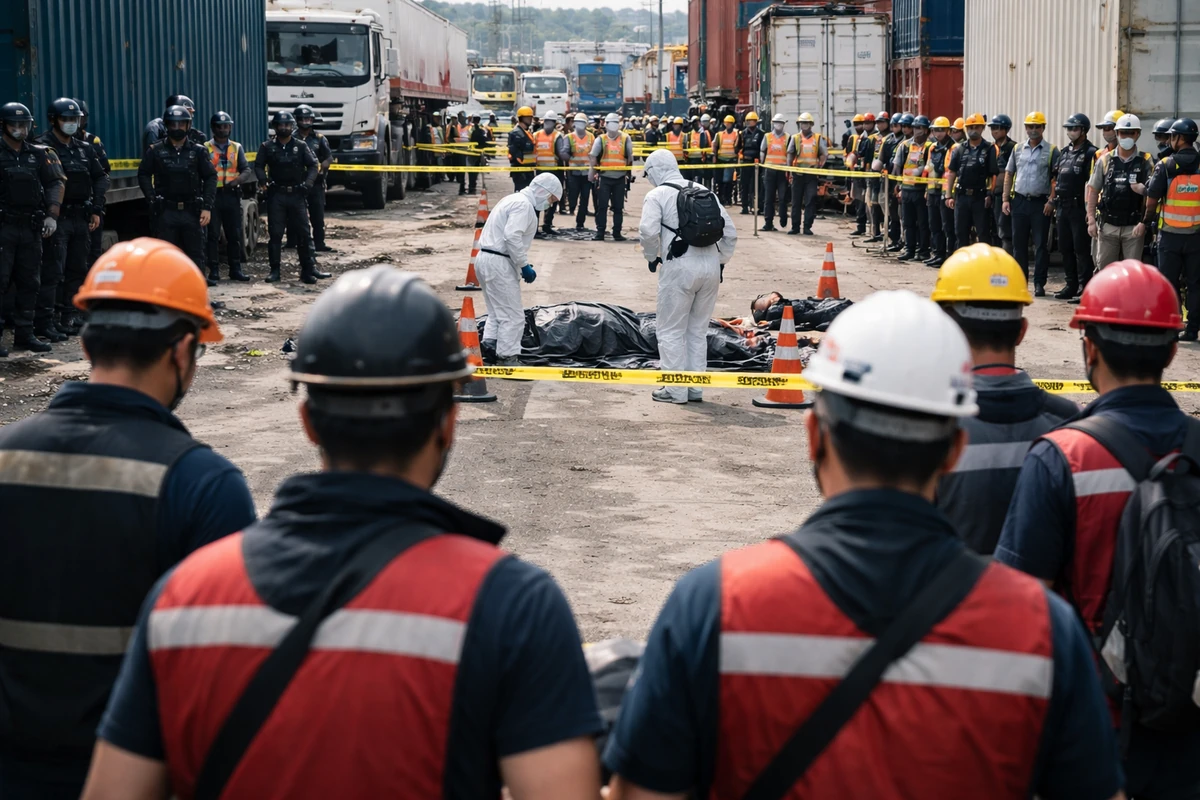
According to the Korean summary of official statements and political reaction, the accident occurred April 20, 2026, at a rally organized by the Cargo Truckers Solidarity union outside a logistics center in South Gyeongsang Province. Three people were reported killed or injured in the incident. South Korean authorities initially responded with the expected language of condolence, promising a thorough investigation and accountability for any illegal conduct. But the government also did something more politically significant. It suggested early on that the tragedy was not simply the result of one driver’s actions or one chaotic moment on a protest line, but of deeper institutional failures.
That distinction matters. In the United States, readers may be familiar with how a mine collapse, warehouse death or police confrontation can move quickly from being treated as an isolated event to being framed as evidence of a broken system. South Korea is now confronting a similar dynamic. Once the government itself describes truck drivers as a vital part of the national economy and points to weak protections for their rights and inadequate systems for dialogue and mediation, the question changes. It is no longer only, “What exactly happened?” It becomes, “Why was the situation allowed to become so dangerous in the first place?”
That shift is what has turned the Jinju case into a political issue, not just a criminal or administrative one. In South Korea, where labor conflict, state authority and economic pressure often intersect in highly visible ways, tragedies like this rarely remain confined to the scene of the accident. They quickly become arguments about who holds power, who bears risk and whose lives are treated as negotiable when supply chains are under strain.
Why truckers unions matter so much in South Korea
For American readers, it helps to understand why a truckers union protest can carry such political weight in South Korea. Cargo transportation workers occupy a strategic position in the country’s economy. South Korea is one of the world’s most export-dependent industrial nations, with major manufacturing sectors tied to ports, industrial complexes and tightly coordinated logistics networks. When truckers stop moving, the effects can spread quickly through the supply chain.
The union at the center of the Jinju incident, commonly referred to in Korea as the Cargo Truckers Solidarity, has in recent years become one of the country’s most visible labor organizations. Its disputes often touch not just wages, but freight rates, subcontracting, cost burdens and safety conditions. Many truckers in South Korea function in a gray zone familiar to Americans who follow fights over gig work or misclassification. They may technically be treated as independent operators or contractors, yet remain economically dependent on large corporate networks and vulnerable to pricing decisions made far above them.
That structure creates a recurring tension: The workers who physically move goods are indispensable, but the lines of legal responsibility for bargaining and safety can be diffuse. That is especially true in logistics, where major brands, warehouse operators, contractors and drivers may all be linked in layered commercial relationships. When conflict breaks out, each side may argue that someone else is responsible.
In the Jinju case, that is already emerging as one of the central political questions. Opposition politicians in South Gyeongsang Province, according to the Korean account, have called for scrutiny not just of the immediate circumstances of the crash but of the bargaining role of the principal company involved, identified in the summary as CU, the convenience store chain whose logistics system appears connected to the protest site. That means the dispute is expanding from an accident investigation into a debate over what South Koreans call the “woncheong,” or principal contractor — the lead firm at the top of a subcontracting chain. For Americans, a rough comparison would be asking whether Amazon, Walmart or a major shipping company can claim distance from labor conflict happening inside a contracted logistics operation that ultimately serves its business.
The government’s message carries both sympathy and risk
One striking feature of the official response is its two-track structure. The government expressed condolences and promised a rigorous investigation, which is standard in the aftermath of a deadly incident. But it also pointed to structural shortcomings, saying that protections for freight workers and systems for dialogue and mediation had not been sufficiently established.
That language may sound technocratic, but politically it is loaded. Governments often prefer in the first days after a tragedy to stick to narrow promises: establish the facts, punish any lawbreaking, comfort the victims’ families. By speaking early about systemic problems, South Korea’s government has effectively acknowledged that the current framework for preventing labor conflict may be inadequate.
That can be read in two ways at once. On the one hand, it may signal a refusal to reduce the event to a freak accident. On the other, it raises expectations the government may later struggle to meet. Once leaders describe a death as connected to institutional weaknesses, they invite an obvious follow-up question: What, specifically, will you change?
If the investigation drags on, if agencies issue conflicting conclusions or if proposals for reform stall in partisan deadlock, the government’s early language could come back to haunt it. In politics, naming a structural problem is not neutral. It creates an obligation to act. And in South Korea, where public trust can shift quickly after industrial disasters or high-profile state failures, a gap between rhetoric and action tends to become its own scandal.
This is part of why the Jinju case matters beyond the immediate facts. It is testing whether South Korea’s leadership sees labor unrest mainly as a law-and-order issue, an economic management problem, or a democratic governance challenge requiring stronger institutions for negotiation and safety oversight. Those are not the same thing, and the answer will shape how the public understands both the government’s labor policy and its broader governing philosophy.
The political fight is now about framing, not just facts
In the hours after major tragedies, politicians do more than react; they compete to define what the event means. That appears to be happening already in South Korea. Regional branches of political parties quickly called for mourning and fact-finding, but the more important battle is over framing. Was this an unfortunate accident in a tense protest environment, or was it what some opposition voices are already calling a “structural disaster” created by failures in bargaining, safety management and public authority?
That distinction may sound semantic, but it has real consequences. If the dominant frame is accidental tragedy, the likely policy outcome is limited: criminal accountability, tighter event control and perhaps technical safety recommendations. If the dominant frame is structural failure, then the range of responsibility broadens dramatically. The focus turns to the company at the top of the supply chain, to police decision-making, to contingency planning during strikes and to the state’s long-term treatment of freight labor.
South Gyeongsang’s Democratic Party officials, as summarized in the Korean account, are pushing strongly toward that second frame. They argue the incident should be understood as the product of overlapping failures: a vacuum in labor-management negotiations, questionable intervention by public authorities and overly aggressive logistics operations during a strike. Whether that becomes the nationally accepted interpretation will depend on what the investigation uncovers, but in political terms the opening move is clear. Opponents of the government are trying to prevent the story from being narrowed to the behavior of one driver or one moment of confusion.
For U.S. readers, this resembles a familiar pattern after workplace or protest-related deaths: competing narratives emerge immediately. One side emphasizes disorder, individual error and the need for control. The other emphasizes power imbalance, corporate pressure and foreseeable risk. South Korea’s debate now appears headed down that same path, with unusually high stakes because trucking disputes can affect the national economy and because South Korean politics has a long history of treating labor conflict as a proxy for wider ideological battles.
Three major questions are driving the controversy
Even with facts still under review, the Korean summary points to three major areas where political and legal scrutiny is likely to converge.
The first is the responsibility of the principal contractor or lead company. In logistics systems built on multiple layers of contracts and subcontracting, it is often difficult to determine who has the duty to negotiate, who has the duty to ensure safe conditions and who can be held accountable when frontline workers are exposed to danger. If the top company benefited from continued logistics operations during a strike, critics will argue it cannot disclaim responsibility for the conditions under which those operations took place.
The second is the role of public authority, especially the police. Protest sites that overlap with active freight movement are inherently risky. Authorities must balance competing obligations: maintaining public order, protecting freedom of assembly, allowing traffic or goods movement and preventing injury. That balance is notoriously difficult in any democracy. The question in Jinju is whether police recognized and responded appropriately to warning signs, and whether their management of the scene favored the continuation of logistics operations over the safety of demonstrators.
The third is the adequacy of site safety planning and alternative logistics operations during a strike. If a company chooses to keep goods moving during labor action, then separation of routes, crowd control, emergency response planning and risk assessment become central. These are not secondary details; they are the difference between a tense protest and a deadly one. A finding that safety precautions were inadequate would intensify pressure on both corporate operators and government regulators. A finding that authorities failed to impose or enforce proper controls could widen the circle of blame even further.
Importantly, these questions are linked. It may be impossible to isolate one culprit neatly because bargaining structure, operational decisions and police management all shape the environment in which a fatal event occurs. That is why this case is proving so politically combustible. It resists a simple conclusion.
A long-running Korean debate over labor law is back in focus
The Jinju tragedy is also reviving a broader debate in South Korea over labor law and the real-world meaning of workers’ rights. The Korean summary notes that political attention may turn to revisions in union law and, in particular, to how far responsibility extends up the contracting chain. That is one of the country’s most contentious labor issues.
To an American audience, this may sound like a technical legal fight, but it goes to the heart of modern work. In many advanced economies, companies increasingly rely on layers of contractors, franchise structures, dispatch labor or nominally independent workers. The business advantages are obvious: flexibility, lower direct employment costs and some distance from legal liability. The downside is also clear: workers may face serious risks without a straightforward path to bargaining power or accountability.
South Korea has struggled with this problem for years. Labor advocates argue that if major corporations effectively control the economic conditions under which subcontracted or dependent workers operate, then those corporations should bear corresponding obligations to bargain and to ensure safety. Business groups, by contrast, warn that expanding such responsibility too far could create uncertainty, increase costs and undermine operational flexibility.
The Jinju case gives that abstract dispute a human face. When a death occurs at the intersection of a union protest, a logistics center and a complex contracting structure, legal arguments about who counts as a responsible party no longer feel remote. They become questions about whether the law tracks reality closely enough to protect people whose work keeps the economy functioning.
That is why this incident may resonate well beyond South Gyeongsang Province. It could become a reference point in the national argument over whether South Korea’s labor system adequately reflects the way modern supply chains are actually organized. In the same way that warehouse fatalities or app-based labor disputes in the United States have forced a reconsideration of old legal categories, this death may intensify calls in South Korea to rethink the distance between formal contracts and practical power.
Why safety and public sympathy could reshape the politics
Labor disputes do not always generate broad public sympathy. Arguments over wages, union tactics or strike disruption can divide voters, especially if daily life or supply chains are affected. But when labor conflict becomes associated with death and physical danger, the political calculus changes. Safety is a much more powerful and cross-cutting issue than compensation alone.
That is especially true in South Korea, where a series of industrial and public disasters over the past decade have deepened public sensitivity to the idea that preventable deaths often reflect institutional weakness rather than bad luck. In that environment, a fatality at a truckers rally is likely to be judged not only on the facts of the moment but on whether authorities, businesses and political leaders had already been warned about the risks embedded in the system.
For centrist or less ideologically committed voters, that distinction matters. A labor dispute can seem distant. A death that appears preventable is much harder to dismiss. If the public comes to view the Jinju tragedy as the result of avoidable failures in safety management, bargaining channels or official oversight, then the story could reach well beyond organized labor and into the mainstream political agenda.
That is one reason the government’s own language is so consequential. By linking freight workers to the health of the national economy and referring to inadequate structures for rights protection and mediation, officials have made it harder to treat the victims as peripheral actors in a niche conflict. They have acknowledged, in effect, that these workers are central to the country’s economic life while also suggesting they may not have been institutionally protected in proportion to their importance.
That is a politically potent combination. In the United States, politicians often celebrate “essential workers” while policy lags behind the rhetoric. South Korea now faces a similar reckoning: If truckers are indispensable enough to be described as the economy’s lifeblood, what does the state owe them when conflict emerges at the point where economic necessity meets personal risk?
What to watch next in the aftermath of Jinju
The next phase of this story will likely turn on evidence, but the broader political trajectory is already visible. Investigators will have to establish the immediate chain of events: vehicle movement, crowd conditions, traffic control, police actions and safety measures on site. That factual record will shape the legal response. But the political response will likely depend just as much on whether the findings support a wider conclusion that this was a foreseeable failure of system design.
Several indicators will be worth watching. One is whether the investigation remains tightly focused on the immediate collision or expands to examine negotiations, command decisions and logistics planning. Another is whether lawmakers push hearings or demand testimony from corporate executives, police officials and labor authorities. A third is whether the government moves beyond general language about reform and proposes concrete changes to mediation structures, work stoppage protocols or principal contractor obligations.
Also important is whether the ruling side and opposition settle into familiar ideological camps or whether the issue cuts across partisan lines. Fatal labor incidents sometimes create brief windows for consensus before politics hardens again. But that tends to happen only when leaders believe the public sees institutional reform as urgent rather than optional.
For now, the most significant point is this: In South Korea, the Jinju truckers union death is no longer being discussed as merely a tragic episode at a volatile protest. It is being debated as a case study in how labor conflict is governed, how safety is managed and how responsibility is assigned in an economy built on layered logistics networks and precarious workers.
That makes it more than a local tragedy. It is becoming a test of whether a modern democracy can respond to an industrial death with more than condolences and blame. The country now faces a harder challenge: deciding whether this was a singular misfortune or a warning about a system that asks essential workers to bear too much risk with too little protection.
Comments
Post a Comment