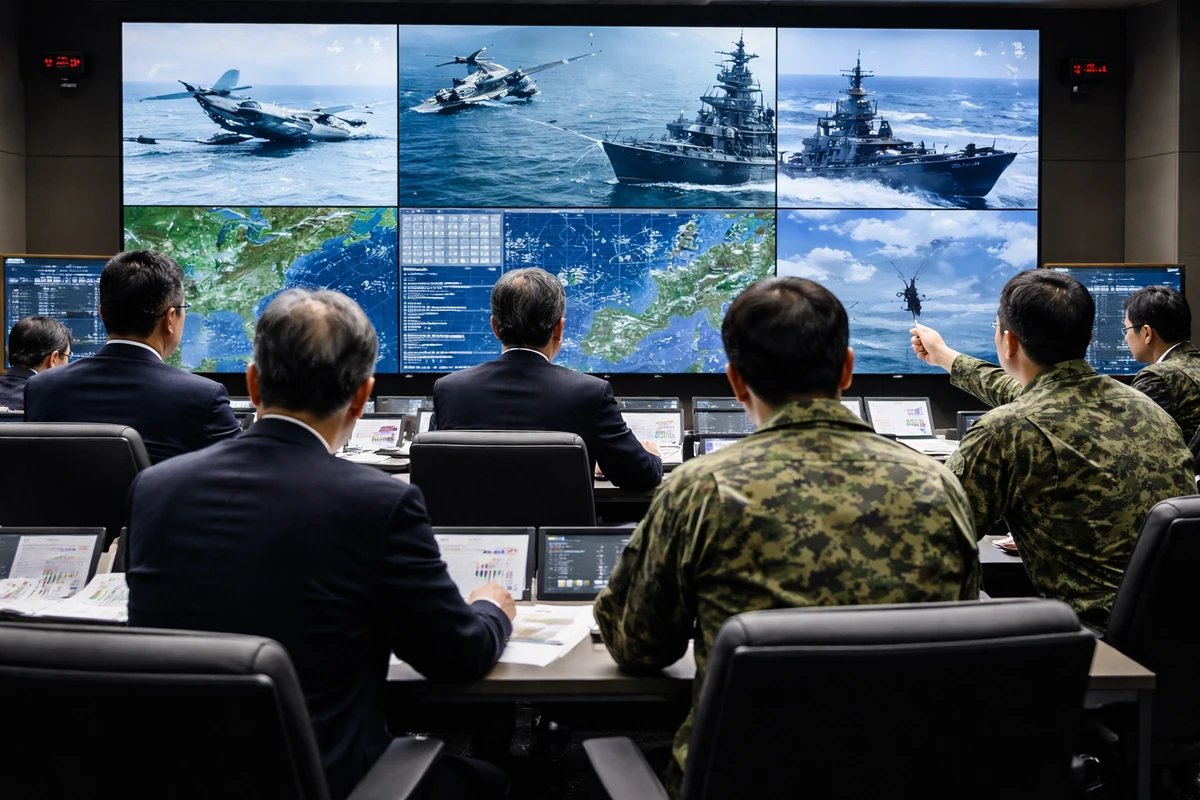
Japan moves closer to a new military spending benchmark
Japan has proposed 10.6 trillion yen, or roughly $70 billion at current exchange rates, in defense-related spending for fiscal 2026, marking another major step in a military buildup that would have been politically difficult to imagine in the country just a few years ago. According to Japanese media reports, the figure includes a core Defense Ministry budget of 9 trillion yen and an additional 1.6 trillion yen for security-related items such as public infrastructure upgrades and maritime security. The headline number matters on its own, but the deeper significance is that Japan is steadily turning a once-controversial strategic pledge into budget reality.
For American readers, the easiest comparison may be NATO’s familiar benchmark of spending 2% of gross domestic product on defense. Japan is not a NATO member, but its government has adopted a similar target: lifting defense-related spending to 2% of GDP by fiscal 2027. That goal, announced as part of a major national security overhaul in late 2022, was widely seen at the time as ambitious given Japan’s long postwar tradition of military restraint. Now, with yearly budgets climbing and the categories of what counts as security spending expanding, that target is no longer theoretical.
The timing is no accident. Japan, like much of East Asia, is responding to an increasingly tense regional security environment shaped by China’s military rise, North Korea’s missile and nuclear programs, and Russia’s war in Ukraine, which jolted policymakers far beyond Europe. For Tokyo, the message of recent years has been clear: a country that depends on open sea lanes, U.S. alliance guarantees and regional stability believes it can no longer afford to treat defense as a secondary budget item.
The numbers are big, but the accounting debate matters, too
One reason the new proposal is drawing so much attention is that its meaning changes depending on how the math is done. Using Japan’s fiscal 2022 GDP of about 560 trillion yen, the new 10.6 trillion-yen total comes to roughly 1.9% of GDP, a figure that makes Tokyo appear to be on the doorstep of its 2% goal. But using the government’s larger projected GDP for fiscal 2026, around 690 trillion yen, the same budget works out to closer to 1.5%. In other words, the exact same spending plan can be framed either as nearly there or still well short of the target.
That kind of dispute may sound technical, but it carries political weight. In Washington, arguments over baseline years, inflation adjustments and what should count toward defense spending are familiar features of budget politics. Japan is now having a similar debate. A fixed 2022 baseline helps the government show continuity and measurable progress from the moment it announced its new security doctrine. A current-year GDP forecast, by contrast, makes the increase look more modest and may soften public concern about how quickly defense costs are rising.
The ambiguity gives Japanese leaders rhetorical flexibility. When they want to demonstrate resolve to allies and deter rivals, they can emphasize that spending is already nearing 2% on the older baseline. When they need to reassure domestic audiences worried about debt, taxes or social spending, they can note that the ratio remains lower using present-day economic projections. That dual messaging reflects a political reality in Japan: support for stronger defense has grown, but public opinion still expects careful justification for large and sustained military outlays.
Why this is about more than the Defense Ministry
The most consequential part of the announcement may not be the raw size of the budget, but the widening definition of what counts as defense-related spending. Japan has traditionally described its military effort mainly through the Defense Ministry’s own budget. This time, Tokyo is also folding in surrounding categories such as public infrastructure and maritime security. That broader approach reflects a modern view of national security that extends beyond fighter jets, missiles and warships.
To Americans, this logic may sound familiar after years of debate over port resilience, semiconductor supply chains, cyber defense and the vulnerabilities exposed by the pandemic. Infrastructure that appears civilian in peacetime can become strategically vital in a crisis. Ports, airports, fuel depots, transport corridors and communications systems determine how quickly troops and supplies can move. Coast guard-style maritime security, meanwhile, can be central in the so-called gray zone — the space between peace and outright war where states use patrols, law enforcement vessels, pressure tactics and signaling to advance strategic aims without triggering full-scale conflict.
For Japan, an island nation whose economy depends heavily on trade and secure sea lanes, that broader security lens carries obvious practical importance. Maritime security is not a side issue in East Asia; it sits at the center of disputes involving territorial claims, fishing rights, military presence and freedom of navigation. By counting infrastructure and maritime capabilities as part of a wider security architecture, Tokyo is effectively telling domestic and foreign audiences alike that defense can no longer be understood as the exclusive domain of the military. It is a whole-of-government project.
A postwar shift that has been building for years
This budget proposal did not emerge from nowhere. It is part of a larger strategic turn set in motion by Japan’s 2022 revision of three key security documents, including its National Security Strategy. Those revisions laid out a plan to raise defense-related spending to 2% of GDP by fiscal 2027 and secure about 43 trillion yen over five years. At the time, the changes were treated as a watershed because they signaled that Japan was moving away from the habits that defined much of its post-World War II security identity.
That identity was shaped by both domestic law and political culture. Japan’s postwar constitution, especially its famous Article 9, renounces war and has long been interpreted as placing strict limits on military activity. While Japan has maintained the Self-Defense Forces for decades and possesses sophisticated capabilities, public discourse often treated any major expansion in military roles with caution. Even when Japan gradually loosened some constraints — for instance by reinterpreting collective self-defense in the 2010s — the political language remained careful, incremental and often defensive in tone.
What is changing now is not simply procurement, but the degree of openness. Tokyo is increasingly speaking about deterrence, resilience, long-range capabilities and sustained budget growth in direct terms. In plain English, Japan is normalizing a conversation that used to be handled with greater sensitivity. That does not mean the country is abandoning all restraint, nor does it erase the deep historical memory of militarism in Asia. But it does show a government more willing than before to say publicly that the old assumptions about regional security no longer hold.
What Washington wants — and what neighbors fear
From the perspective of the United States, Japan’s trajectory is likely to be welcomed. For years, American administrations of both parties have encouraged allies to shoulder more of the regional security burden. That pressure has taken different tones depending on who was in the White House, but the underlying expectation has been consistent: as China grows more powerful and the strategic competition in the Indo-Pacific sharpens, Washington wants capable partners that can invest more, coordinate more and deter more. Japan’s rising budget fits that vision.
The U.S.-Japan alliance remains the cornerstone of Japan’s security policy, and recent summit meetings have highlighted a push for greater integration in command structures, missile defense, intelligence sharing and contingency planning. In that context, Japan’s higher spending is not just a national decision; it is part of a broader effort to make the alliance more operationally effective. American officials often describe this as burden-sharing, though in practice it is also about making the alliance more credible in a crisis involving Taiwan, the East China Sea or the Korean Peninsula.
But what reassures Washington does not necessarily reassure everyone else. In East Asia, military signals rarely stay confined to domestic politics. China is likely to read Japan’s buildup as further evidence of strategic alignment with the U.S. effort to counter Beijing. North Korea will almost certainly use it in propaganda to justify its own weapons development. South Korea, despite improving ties with Japan under current leadership, still views Japanese military normalization through the filter of colonial history and unresolved memory disputes. In the region, defense budgets are never just accounting documents; they are political messages.
The political balancing act inside Japan
Even as the security logic grows stronger, Japan’s leaders still face a basic governing challenge: how to pay for all this. Japan has one of the heaviest public debt burdens among advanced economies, and its aging population continues to put pressure on pensions, health care and social services. That means every long-term increase in defense spending competes, at least indirectly, with other national priorities. The government must persuade voters not only that stronger defense is necessary, but that it can be funded responsibly.
That is one reason the framing of the numbers matters so much. If the increases are presented as part of a planned, step-by-step buildup under an existing five-year roadmap, they may feel less like a dramatic break and more like managed policy. The government can argue that it is not improvising in panic, but executing a strategy adopted in response to changing threats. In a country where sudden shifts in security policy can still prompt unease, predictability is politically valuable.
There is also a messaging advantage in broadening the definition of security spending. Investments in ports, airfields, transportation networks and maritime surveillance can be defended not only as military necessities but as public goods that strengthen disaster response, supply chain resilience and overall national preparedness. In Japan, where earthquakes, tsunamis and typhoons are part of national life, resilience carries real political appeal. Spending that supports both defense and civilian readiness may be easier to justify than spending that looks purely martial.
The extra 1.6 trillion yen tells its own story
The additional 1.6 trillion yen outside the core Defense Ministry budget may seem like a supporting detail, but it reveals a great deal about how Japan now thinks about security. Public infrastructure improvements and maritime security do not fit the old image of defense as a matter of barracks, tanks and traditional military hardware alone. Instead, they reflect a world in which coercion can take many forms: pressure on shipping lanes, harassment by state-backed vessels, sabotage of logistics networks, cyberattacks on critical systems or disruptions that stop just short of open war.
This is especially relevant in the waters around Japan, where coast guard activities, naval deployments and territorial friction often overlap. In East Asia, confrontations do not always arrive in the form of a declared conflict. They can emerge through sustained patrols, airspace incursions, maritime standoffs and efforts to test political will. A government preparing for that environment needs more than conventional military capacity. It needs ports that can handle rapid deployment, transport networks that remain functional in emergencies, and maritime agencies equipped to manage persistent pressure at sea.
Seen that way, the 1.6 trillion yen is not peripheral to Japan’s defense story; it is central to it. It underscores the collapse of the once-neat line between civilian and military preparedness. For U.S. readers, a useful analogy may be the growing American discussion around “homeland resilience” and critical infrastructure protection in an era of great-power competition. Japan is making a similar move, but with the added urgency of living in one of the world’s most heavily contested strategic neighborhoods.
What this means for East Asia going forward
Japan’s proposed fiscal 2026 defense-related budget does not, by itself, transform the balance of power in Asia. Military change is cumulative, and budgets are only one part of a larger picture that includes doctrine, industrial capacity, alliance coordination and political will. But budgets do matter because they show what governments are willing to sustain over time. In that sense, this proposal is less important as a single-year spike than as evidence that Japan’s strategic shift is becoming institutionalized.
If the current path holds, fiscal 2027 will be the real milestone. That is the year Tokyo has promised to bring defense-related spending to 2% of GDP, and by then the question will be less whether Japan intends to change and more how far the change has already gone. That includes practical issues such as missile stockpiles, counterstrike capabilities, base hardening, logistics, industrial production and the readiness of both military and civilian agencies to operate under stress. It also includes whether the Japanese public continues to accept a larger defense role as the new normal.
For the broader region, the implications are mixed. Supporters will argue that a stronger Japan improves deterrence and helps stabilize the Indo-Pacific by making aggression costlier. Critics will warn that military expansions tend to provoke countermoves and deepen mistrust in a region with painful historical memories. Both arguments contain truth. What is clear now is that Japan has moved beyond symbolic debate. The country is writing its new security posture into the budget, line by line, and in doing so is redrawing the strategic map of East Asia in ways Washington and the region will be watching closely.
Comments
Post a Comment