
A Korean director turns from spectacle to memory
South Korean filmmaker Chung Ji-young has spent decades making movies willing to press on political nerves, but his new film appears to be taking a quieter route into one of the country’s most painful historical wounds. His latest feature, My Name Is, which opened April 15, 2026, does not begin with gunfire, mass arrests or a history lesson. Instead, it starts with a teenager who hates his own name.
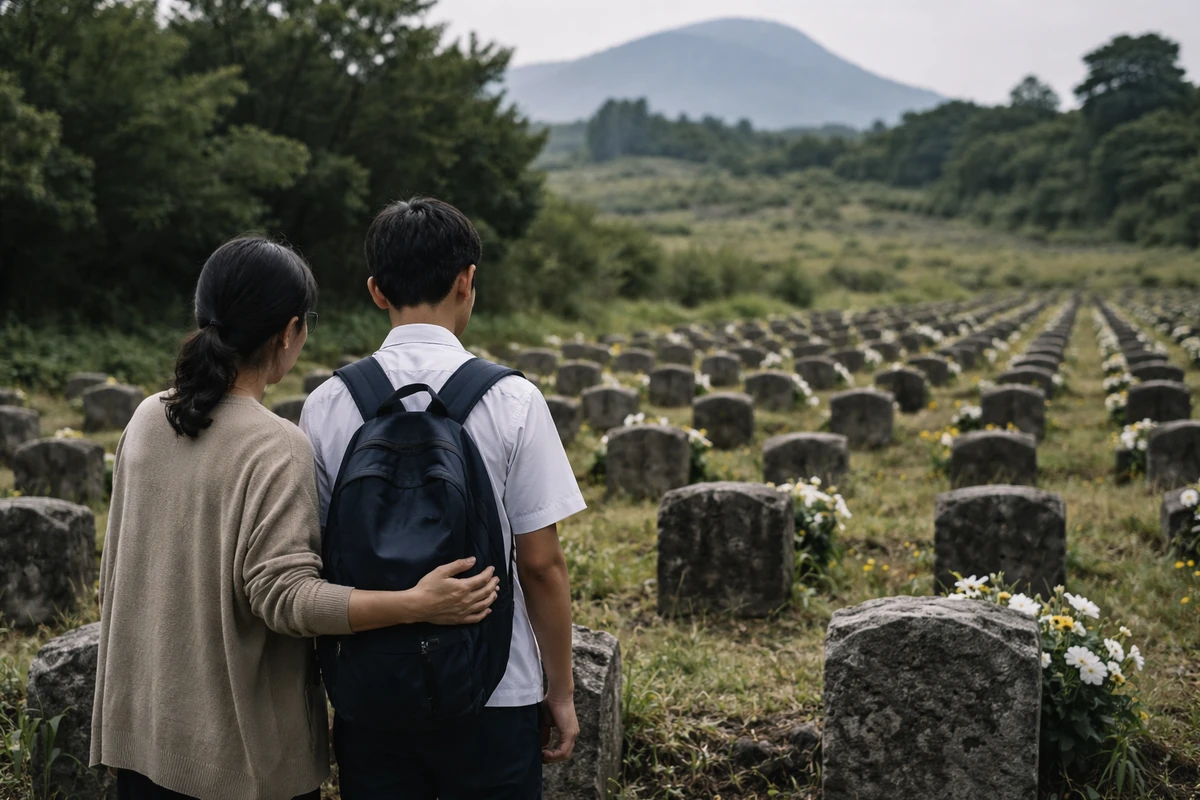
That choice is the point. According to comments released in an interview this week, Chung’s film approaches the Jeju 4.3 tragedy — one of modern Korea’s defining and long-suppressed episodes of state violence — not as a conventional historical epic but as a family drama set in 1998 on Jeju Island. At the center are 18-year-old Young-ok, a high school student who wants to discard his name, and his mother, Jung-soon, a dance teacher raising her son while carrying memories she has tried for years to bury.
For American audiences, the creative strategy may feel familiar in one sense and surprising in another. Hollywood has often returned to national traumas through intimate stories rather than battlefield re-creations: think of films that explore the afterlives of war, segregation or political violence through what lingers inside a household long after headlines fade. But in South Korea, where historical dramas often face pressure to educate, persuade or openly condemn, My Name Is appears to be making a different wager. Rather than staging tragedy head-on, it asks what history sounds like after the shouting stops — in silences at the dinner table, in the inheritance of shame and in a child’s uneasy relationship to his own identity.
That makes the film notable not just for its subject matter, but for how it is framing it. The emphasis is less on reenacting atrocity than on tracing its residue. In doing so, Chung seems to be arguing that some histories are not merely remembered; they are lived on, passed across generations in fragments, omissions and emotional reflexes that can outlast the political systems that produced them.
What Jeju 4.3 means in Korea
For readers outside Korea, the Jeju 4.3 tragedy may not be immediately recognizable in the way the Gwangju uprising or the Korean War might be. Yet in South Korea, it stands as one of the clearest examples of how anti-communist repression and state violence scarred civilians in the years around the country’s founding.
The shorthand “4.3” refers to events that began on April 3, 1948, on Jeju, a volcanic island off the southern coast of the Korean Peninsula that today is better known internationally as a tourist destination, honeymoon spot and UNESCO-listed natural wonder. In the late 1940s, however, it became the site of a brutal crackdown after an armed uprising and escalating conflict tied to ideological tensions, police violence and the division of Korea in the aftermath of Japanese colonial rule and World War II. Over the course of the suppression, large numbers of civilians were killed. Estimates vary, but scholars and official inquiries have placed the death toll in the tens of thousands.
For decades, open discussion of Jeju 4.3 was constrained in South Korea, especially under authoritarian governments that treated the episode largely through the lens of anti-communist orthodoxy. Families associated, fairly or not, with the uprising could carry stigma for years. That matters in understanding the emotional architecture of Chung’s film. In Korea, a name is not just a label; it often carries family history, generational meaning and social memory. A teenager who wants to reject his own name is not simply being rebellious. He may be trying to sever himself from a burden he only partly understands.
That dynamic has resonance beyond Korea. Americans may think of families marked by McCarthy-era suspicion, by the racial terror of Jim Crow or by the inherited silence surrounding wartime trauma. The specifics are different, but the emotional logic is not. A society can move on publicly while private households remain stuck in unfinished history. Children often grow up sensing that something happened long before they were born, even if no one will fully explain it.
My Name Is appears to build its drama around exactly that kind of atmosphere. The tragedy is not remote or sealed in the past; it is present in the strain between a mother and son, in the things not said and in the uneasy realization that personal confusion may be rooted in national history.
Why the family-drama frame matters
On paper, the film could almost be mistaken for a coming-of-age story. Young-ok is a high school senior. Jung-soon teaches dance and tries to hold together an ordinary life. Those details are not decorative. They are the entry point. Rather than opening with a lesson about Jeju 4.3, the film reportedly leads viewers through the everyday rhythms of adolescence and parenthood before revealing how deeply the past has shaped them.
That is a meaningful artistic decision. Historical films often face a difficult balancing act: explain too much, and they become lectures; explain too little, and they risk seeming evasive or inaccessible. Chung’s answer seems to be to let emotional recognition come first. Viewers follow the son’s resentment, confusion and desire for reinvention. They watch the mother’s discipline, reserve and avoidance. Only gradually does the broader weight of history press into the frame.
For audiences unfamiliar with Korean cinema, it may help to think of this as a movie less interested in showing “the event” than in showing how an event settles into family life like sediment. Trauma here is not just flashback material. It is structure. It organizes what people say, what they cannot say, what they pass down and what they try to protect their children from learning.
That approach also sidesteps a trap that can haunt films about atrocity: the temptation to turn suffering into spectacle. There is always an ethical question in depicting mass violence. How directly should it be shown? When does reconstruction become necessary witness, and when does it become display? Chung appears to be answering by shifting attention from the scale of horror to the durability of its echo.
Some viewers in Korea may wish for a more frontal treatment of Jeju 4.3, especially given how long public reckoning took. But the indirect route may be exactly what gives the film wider reach. A viewer who might resist a history lesson may still be drawn into a story about a parent and child drifting apart. Once there, the political stakes arrive not as argument but as lived reality. That can be a powerful form of storytelling, especially when dealing with histories that were once denied or compartmentalized.
A difficult film to finance says something about the industry
If the movie’s subject is about buried memory, its production story says something equally telling about the present state of Korean cinema. Chung has said that films about Jeju 4.3 have struggled for years to clear the investment barrier. My Name Is reportedly began with a script selected through a contest organized by the Jeju 4.3 Peace Foundation, but like other projects on the same subject, it had trouble attracting backers and ultimately moved forward through means that included crowdfunding.
That is more than a behind-the-scenes anecdote. It is a window into what kinds of stories the market is willing to support. South Korea has one of the world’s most dynamic film industries, a system capable of producing global sensations, muscular thrillers and prestige awards contenders. But commercial sophistication does not erase commercial caution. A film rooted in historical trauma, especially one linked to regional memory and state violence rather than easy genre hooks, can still be treated as a risky proposition.
American readers will recognize the pattern. Studios in the United States routinely speak the language of courage and artistic vision while favoring projects with proven intellectual property, franchise logic or neatly targetable audiences. Korean cinema, for all its creative strengths, is not immune to the same pressures. Heavy subject matter, uncertain box-office ceilings and political sensitivity can leave serious historical stories stranded between cultural importance and financial reluctance.
The irony is especially sharp in Chung’s case. He is not an untested newcomer. He is a veteran director who has been making films for more than 40 years, since the early 1980s. If a filmmaker of his stature struggles to secure financing for a project like this, the implications for younger or less established directors are obvious. The threshold for telling difficult history is likely even higher for them.
That makes My Name Is significant beyond its artistic merits. Its very existence says something about what the Korean industry still considers a gamble. It also underscores the role that public institutions, foundations and ordinary viewers can play in bringing politically and historically charged stories to the screen when mainstream capital hesitates.
Actor Yum Hye-ran and the idea of “universal love”
Part of the film’s strategy comes into clearer focus through comments from actor Yum Hye-ran, who plays Jung-soon. Yum, one of South Korea’s most respected character actors and increasingly familiar to international streaming audiences, said she was drawn to the project because, despite its grounding in Jeju 4.3, it spoke to what she called “universal love.”
That phrase can sound soft around a hard subject, but it appears to get at the film’s central ambition. The story is not asking viewers to care only because the history is important. It is asking them to care because the characters are legible at the most intimate level: a mother trying to endure, a son trying to define himself, a relationship warped by loss and silence.
Yum also reportedly said that if a film is not engaging, it risks becoming propagandistic, and that she chose this one because it was literarily compelling rather than didactic. That is an unusually candid way to describe a problem many socially conscious films encounter. A noble message does not automatically produce persuasive cinema. If a movie announces its lesson too loudly, audiences may admire its intentions while remaining emotionally outside it.
This is where My Name Is could matter. In the best version of this approach, the film does not dilute history; it deepens access to it. A viewer does not need prior knowledge of Jeju 4.3 to understand a child’s yearning to escape inherited pain or a parent’s instinct to hide what feels unbearable. The historical education comes through attachment to people, not through slogans.
That distinction is important in South Korea, where public debates over historical memory can be intensely politicized. It also matters for international audiences, who may encounter Korean historical cinema without the background needed to decode every reference. By rooting itself in emotional continuity rather than ideological declaration, the film may be positioning itself for a broader conversation across borders.
Why 1998 is an especially telling setting
The decision to set the film in 1998, rather than during the original 1948 violence or its immediate aftermath, gives the project another layer of meaning. Fifty years had passed, but that did not mean the story was over. If anything, the late 1990s in South Korea were a moment when older silences were beginning to loosen, even as the country was dealing with new pressures, including the Asian financial crisis and the unfinished work of democratic transition.
For Korea, 1998 sits in a recognizable in-between period: after authoritarian rule, but before historical wounds had been fully acknowledged or integrated into public life. Formal democracy existed, yet memory remained uneven. That makes it an apt setting for a story about what happens when the private cost of history catches up to the present.
Americans might compare it loosely to stories set in the years after the civil rights era or after the Vietnam War, when the legal and political landscape had shifted but the emotional and familial consequences remained unresolved. The calendar says one thing; the household says another. Time passes unevenly in societies recovering from violence.
By choosing 1998, Chung seems to be emphasizing the afterlife of trauma rather than the original wound alone. History, in this framework, is not preserved in a museum case. It continues to shape speech, relationships and self-understanding decades later. Jung-soon’s effort to bury painful memory and Young-ok’s desire to abandon his name suggest that forgetting is never clean. The past survives in altered form, often hardest to detect precisely where it has been most thoroughly suppressed.
That temporal distance may also help the film avoid the stiffness that sometimes affects period reconstructions of nationally sacred or contested events. Instead of asking actors to embody symbols from a history textbook, it asks them to inhabit people who are still trying to live with consequences. That is a subtler challenge and potentially a more affecting one.
What Chung Ji-young’s anxiety reveals
Chung has said he is not usually the kind of director who loses sleep before a release, but that this film feels different. After more than four decades in the industry, that admission carries weight. The anxiety, by his own account, is tied to how hard the movie was to get made. A film that has had to fight this long for financing, attention and screen space naturally arrives in theaters carrying more than the usual burden.
That unease is personal, but it is also industrial. South Korean film has been rapidly reshaped by large-scale commercial production, franchise logic and competition from serialized streaming content. In that environment, where exactly does a mid-to-late-career auteur place a film about regional trauma, historical memory and family rupture? The answer is far from secure.
So the release of My Name Is matters even before ticket sales are counted. It represents a kind of resistance to the narrowing of what gets deemed screen-worthy. This is not resistance in the slogan-heavy sense that Yum warned against. It is resistance in the older artistic sense: insisting that some stories must be made even when the market does not instantly recognize their profitability.
For American audiences watching Korea’s culture industries from afar, that may be one of the most interesting aspects of the film. The global success of K-pop, Korean television and Korean cinema can create the illusion of a frictionless cultural machine, as if Korean creators now move effortlessly from local stories to worldwide acclaim. In reality, difficult stories still face structural obstacles. National success does not erase internal hierarchies of value. Some narratives remain harder to finance, harder to market and harder to fit inside the entertainment economy’s preferred formulas.
A film about the present tense of history
Ultimately, what makes My Name Is compelling is not simply that it addresses Jeju 4.3, but that it appears to understand historical trauma as a present-tense force. That is a vital distinction. Too often, films about national tragedy are framed as acts of respectful backward-looking remembrance. Chung’s project seems to suggest something more unsettling: that the past is not past if it continues to govern how people love, raise children, hide themselves and speak — or refuse to speak — inside the family.
That insight gives the movie relevance beyond Korea. Every nation has its own catalog of events that are formally acknowledged yet unevenly digested. The United States has many such histories: slavery and segregation, the internment of Japanese Americans, anti-communist persecutions, the long shadow of Vietnam, post-9/11 wars and the quieter generational injuries they leave behind. The details differ, but the mechanism is recognizable. Official narratives close faster than private pain does.
If My Name Is succeeds, it may do so because it trusts viewers to feel history before they are asked to analyze it. It treats a monumental Korean tragedy not as a distant civics lesson but as something that can still shape a teenager’s sense of self and a mother’s capacity for openness half a century later. In that respect, the film’s title feels especially apt. A name is where identity becomes public. It is also where family history first touches the individual.
By building its story around a boy who wants to reject his name and a mother forced to revisit what she has hidden, Chung is not looking away from Jeju 4.3. He is looking at what happened after the event was over, after the victims were gone, after the country moved forward and after ordinary life resumed on the surface. He is asking what remained.
That may be the most honest way to tell this kind of story. Not every historical reckoning needs to arrive with a battle scene. Sometimes the deeper confrontation happens in a room between two people who love each other, bound by a past one of them remembers and the other has only inherited. In that space, history stops being abstract. It becomes family.



0 Comments