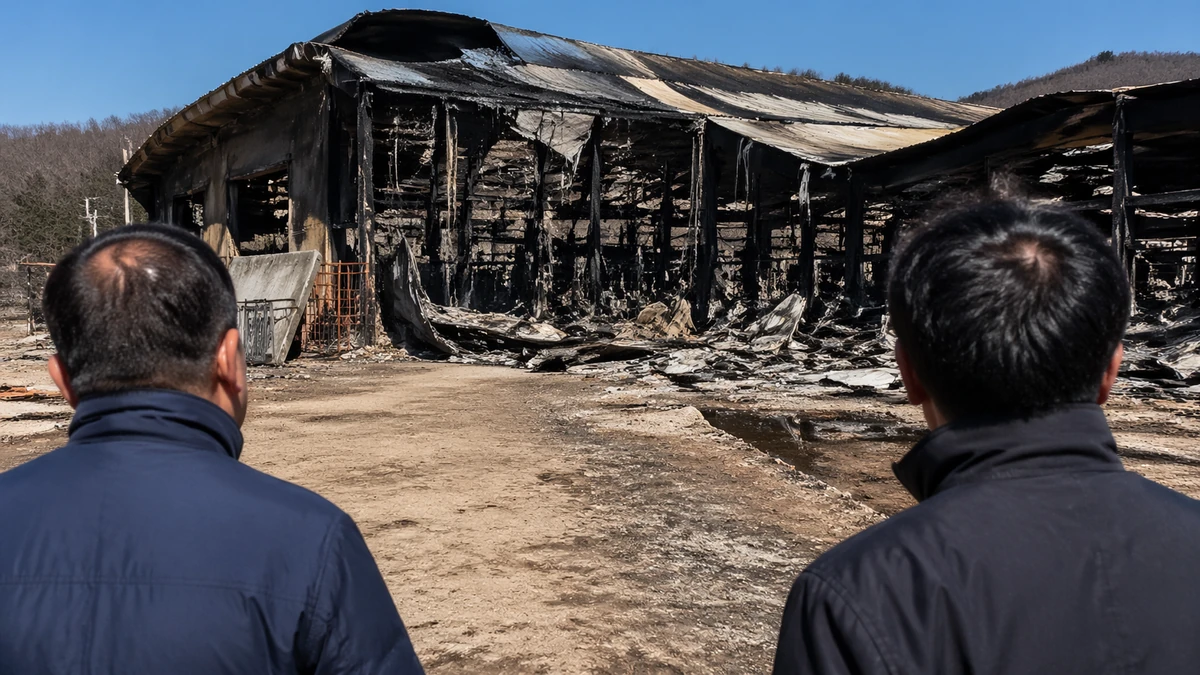
A fire before dawn, and a livelihood gone in minutes
A predawn fire at a chicken farm in South Korea’s North Gyeongsang Province killed about 10,000 chicks this week, a loss that officials say caused no human injuries but one that underscores a deeper problem in the country’s countryside: the fragility of rural livelihoods during South Korea’s dry and windy spring fire season.
The blaze broke out at about 3:08 a.m. on April 24 at a poultry facility in Anpyeong-myeon, a rural township in Uiseong County, according to local reports and fire authorities. Firefighters brought it under control in a little more than an hour. No people were hurt, and authorities are investigating the cause and total scale of the damage.
On paper, the first official takeaway sounds reassuring. No one died. No workers were reported injured. In the language of breaking news, that can make an incident appear contained. But in farming communities, especially in a sector as tightly timed and cost-sensitive as poultry production, “no casualties” does not mean no disaster. For a family farm or small livestock operator, the loss of 10,000 chicks is not just a matter of property damage. It can erase months of planning, disrupt the next production cycle and wipe out a major share of expected income in a single morning.
That is one reason this fire has resonated beyond one farm in one county. It arrived on the same day weather forecasters warned that Daegu and the surrounding Gyeongbuk region — shorthand in Korea for North Gyeongsang Province — would face especially dry air and elevated fire risk. The overlap matters. It suggests the blaze was not simply an isolated piece of bad luck, but part of a broader seasonal vulnerability that affects barns, greenhouses, storage sheds and other agricultural facilities across the Korean countryside every spring.
For American readers, the closest parallel may be the way wildfire warnings in California or the Great Plains can signal not just danger in forests and grasslands, but also danger to barns, ranch equipment, feed stores and outbuildings far from urban fire infrastructure. In South Korea, the geography is different and the farms are often smaller, but the underlying issue is familiar: when dry conditions, electrical demand and lightly staffed rural facilities collide, the margin for error shrinks quickly.
Why spring can be so dangerous in rural Korea
To many people, spring weather sounds benign. The forecast around the fire was, in ordinary terms, pleasant: clear skies, cool morning temperatures and milder afternoon highs. But that kind of weather can be deceptive from a disaster-prevention standpoint.
In the Daegu-Gyeongbuk area on April 24, morning temperatures were low enough to keep heating needs in play. Early readings in inland parts of the region hovered in the 30s and 40s Fahrenheit, while daytime highs were expected to climb into the 60s and 70s. In some inland and mountainous areas of eastern and northern South Korea, overnight and early morning conditions were cold enough for frost or ice. That wide day-night swing is common in the Korean spring. It is also a recipe for strain inside livestock buildings.
Poultry farms, especially facilities raising newly hatched chicks, depend heavily on controlled temperature and ventilation. Young birds are extremely vulnerable to cold, so operators often rely on heaters, warming lamps, insulated enclosures and tightly managed airflow. As the day warms up, ventilation needs increase. That means electrical systems and climate-control equipment may be working hard at precisely the time when the surrounding air is dry and combustible materials are close at hand.
The list of risks inside a poultry house is long and ordinary: feed, bedding, dust, wiring, heating units, fans and plastic or lightweight building materials. None of those things is unusual. Together, they form an environment where a spark, short circuit or overheating device can escalate quickly. If the fire starts before sunrise, when staffing is thin and most workers are asleep or away from the barn, response time becomes the deciding factor.
That is why spring in South Korea is not just cherry blossom season. It is also wildfire season, dust season and, increasingly, a season of warnings about dry air, strong winds and preventable fires. In recent years, South Koreans have become accustomed to emergency text alerts about forest fire conditions in the eastern and southeastern parts of the country. But the risk does not stop at the tree line. Agricultural facilities often sit in exactly the sort of exposed, rural settings where weather conditions and infrastructure limitations reinforce each other.
Seen that way, the Uiseong fire is less a one-off tragedy than a case study in what can happen when mild-looking spring weather hides dangerous operating conditions.
The hidden meaning of “no human casualties”
In South Korean breaking news coverage, as in U.S. coverage, officials often move quickly to answer the most urgent question first: Were there casualties? When the answer is no, stories may be framed as a close call. That is understandable. Human life comes first. But in agricultural communities, that phrase can also flatten the true scale of the loss.
The 10,000 chicks that died in the fire were not simply inventory. They were the beginning of a production cycle. In poultry farming, timing is everything. Birds are brought in, fed, heated, monitored and grown according to a schedule tied to feed costs, labor, transport arrangements and future sales. If a fire destroys chicks at an early stage, the blow can extend far beyond the immediate loss of the animals. Farmers may still face ongoing utility bills, debt payments, cleanup expenses, insurance paperwork, repairs, biosecurity measures and delays before they can restock.
For smaller or family-run operations, the result can be a cash-flow crisis. Rural South Korea, like rural America, has been grappling with an aging population and labor shortages for years. Many farms are run by older owners with limited staffing and little cushion against a major disruption. Rebuilding a damaged poultry house is not like reopening a storefront the next day. It involves electrical inspections, structural repairs, sanitation, coordination with suppliers and a decision about whether the operator can afford to resume production at all.
There is also a broader community effect. Farms are not isolated economic units. They support feed suppliers, transport companies, veterinarians, equipment repair businesses and local labor. When one facility goes down, the impact can ripple outward. A fire that kills livestock may not register nationally the way a fatal apartment blaze would, but in a county economy, it can still be severe.
American readers may recognize a similar dynamic in reports from dairy barn fires, hog facility accidents or feed mill explosions in rural states. The headline may say no one was hurt, but the actual consequence is often the partial destruction of a family business. In South Korea’s poultry sector, where margins can be tight and recovery time matters, that distinction is especially important.
Why livestock barns remain structurally vulnerable
There is a reason fires at barns and livestock facilities recur often enough to be recognized as a policy issue in South Korea. The problem is not only individual carelessness or bad luck. It is structural.
First, these buildings are equipment-heavy by design. Modern livestock operations rely on heaters, ventilation fans, automated feeders, lighting systems and environmental controls that may run for long stretches without interruption. In periods of large temperature swings, the demand on those systems rises. Any weakness in wiring, overloaded circuits, dust accumulation or aging equipment becomes more consequential.
Second, evacuation works very differently for animals than for people. Human workers can often escape a fire if they detect it in time. Chicks packed into a heated enclosure cannot. Even a relatively small blaze can generate smoke and heat fast enough to kill large numbers of birds before firefighters arrive. That asymmetry explains why a livestock fire can produce enormous losses even when no one is physically injured.
Third, safety systems are uneven. Large corporate farms may have more advanced monitoring and suppression tools, but many agricultural facilities are smaller, older or operated with limited labor. Some are effectively semi-automated overnight, with little on-site presence during the hours when fires may smolder undetected. South Korea has sophisticated urban infrastructure in and around Seoul and other major cities, but its countryside still faces the same challenges seen in rural regions around the world: longer response times, older buildings and fewer layers of oversight.
Fourth, barns occupy a gray zone in the public imagination. They are industrial sites in terms of their electrical and operational demands, but they are not always treated with the same level of preventive scrutiny as factories or large commercial buildings. That can leave a gap between formal safety guidance and the realities of day-to-day management on the farm.
In the Uiseong case, the cause of the fire has not yet been confirmed, and it would be premature to assign blame. But the underlying pattern is already clear enough to matter. When a facility depends on constant heat and airflow, contains abundant combustible material and operates with little staffing before dawn, the conditions for a serious fire can exist even without extraordinary circumstances.
A region already on edge over fire risk
The timing of the poultry farm blaze is significant for another reason: it came amid wider concern over dry weather in several parts of South Korea. On the same day, forecasts warned of very dry air in sections of the inland central region, Gangwon Province and northern parts of North Gyeongsang. In Korean public messaging, such warnings often focus on mountain and forest fires, which are a recurring spring threat.
That emphasis makes sense. South Korea is mountainous, densely settled and highly sensitive to fast-moving wildfires. In recent years, major fires on the country’s east coast and in other regions have burned homes, forests and cultural sites, prompting evacuations and national debate about disaster readiness. When authorities warn residents to be careful with outdoor flames, cigarettes or brush burning, they are responding to a real and familiar risk.
But the Uiseong fire is a reminder that dry-season vigilance cannot stop with forests. A barn fire, a warehouse fire, a greenhouse fire and a brush fire may belong to different administrative categories, but on the ground they share common ingredients: low humidity, combustible material, vulnerable electrical systems and, sometimes, wind that helps a small ignition source become a major incident.
That distinction matters because public awareness often lags behind technical risk. A resident may hear “dry weather advisory” and think about hiking trails or burning leaves. A farmer or livestock operator has to think about heaters, ventilation motors, dust and wiring inside a building that may be operating with minimal supervision in the middle of the night. The gap between those two perceptions can be costly.
In the United States, similar blind spots appear when wildfire messaging fails to account for how dry conditions affect agricultural or industrial sites, not just public lands. South Korea’s challenge is compressed by geography and density, but it is not unique. Weather alerts are most useful when they are translated into concrete, site-specific action: inspect circuits, reduce ignition hazards, verify alarms, check extinguishers and pay special attention to facilities housing animals that cannot be quickly moved.
What this says about rural South Korea
Behind the immediate damage is a larger story about the Korean countryside. South Korea is often discussed abroad through the lens of its cities, technology giants and global pop culture. That image is real, but it can obscure a parallel reality in rural areas, where aging populations, labor shortages and thin economic margins shape daily life.
Uiseong County is a farming region, not a glittering urban center. Like many rural areas in South Korea, it faces population decline and a shrinking base of younger workers willing to remain in agriculture. That means safety and recovery burdens often fall on older farm owners, families and small crews. When something goes wrong, the question is not only whether the fire department can contain the flames. It is whether the operator has the manpower, capital and administrative support to recover.
That is one reason a barn fire can be read as more than an isolated accident. It exposes the difference between formal resilience and practical resilience. South Korea has a strong state, advanced telecommunications and an increasingly sophisticated disaster-response culture. Yet in many rural settings, prevention still depends on ordinary upkeep, routine inspections and the ability of overstretched farm households to manage complex systems with limited help.
There is also a cultural dimension worth explaining for readers outside Korea. In Korean news reports, stories about local disasters often carry an implicit community lens. The concern is not only the immediate event, but what it says about the social fabric around it: whether the village, township or county has enough support to absorb the shock. That is especially true in rural reporting, where one farm’s losses can be seen as part of a broader pattern of strain on agricultural communities.
In that context, the phrase “no human casualties” can unintentionally miss the social reality. The point is not to diminish the value of human safety. It is to acknowledge that in a farming region, the destruction of a productive facility can be a blow to household stability, local supply chains and already fragile communities.
What prevention could look like
The official investigation into the cause of the Uiseong fire will matter. If authorities determine that faulty wiring, heating equipment or another specific issue was involved, that finding could shape future inspections and insurance decisions. But waiting for post-fire explanations is not enough if the same basic pattern keeps repeating.
The most effective response may be unglamorous: targeted seasonal inspections of electrical systems in livestock barns, more robust heat and smoke detection in overnight facilities, practical guidance tailored to dry-weather periods and faster recovery aid for farmers whose businesses are interrupted by fire. None of that is especially dramatic. That is precisely the point. Preventive policy often looks mundane until it fails.
South Korea already has the technical capacity to build better warning and monitoring systems. The harder question is whether those systems are reaching the places where they are most needed and whether smaller operators can afford to act on the warnings they receive. An older farmer may know the season is dangerous and still postpone upgrades because of cost. A family-run operation may understand the risks of overnight equipment loads and still lack the labor to keep someone on-site at 3 a.m.
In the United States, policymakers confronting rural fire safety often run into the same reality. Prevention is not just a matter of advice. It depends on money, staffing and sustained attention to buildings that are essential to the food system but easy for the public to overlook. Barns do not capture national attention the way apartment towers or forest infernos do. Yet they remain critical infrastructure in the most literal sense: they house the animals and equipment that feed people and sustain farm incomes.
The Uiseong fire did not become a mass-casualty event. That is fortunate. But if the lesson drawn from it is simply that no one was hurt, the opportunity to address a deeper weakness will be lost. The more useful reading is this: on a dry spring morning, in a region already under warning for fire risk, a single blaze wiped out 10,000 chicks and likely dealt a heavy blow to one farm’s economic future. That is not a minor local mishap. It is a reminder that disaster vulnerability often lives in ordinary places, behind the walls of facilities most people never see.
Spring in South Korea is often marketed through postcard imagery — cherry blossoms, clear skies, mountain trails and cool evenings. But for rural communities, it is also a season of exposure. Cold dawns keep heaters running. Warm afternoons dry the air. Staff is limited. Buildings are packed with combustible material. And when something catches fire before sunrise, the damage can outrun the news shorthand used to describe it.
That is the real significance of what happened in Uiseong. It was not just a barn fire. It was a warning about how easily rural losses can be minimized, even when the economic and social damage is profound. If South Korea wants to make its spring fire strategy more effective, it may need to broaden the frame — from wildlands to working lands, from public warnings to farm-level prevention and from casualty counts to the full cost of rural disaster.
Comments
Post a Comment