
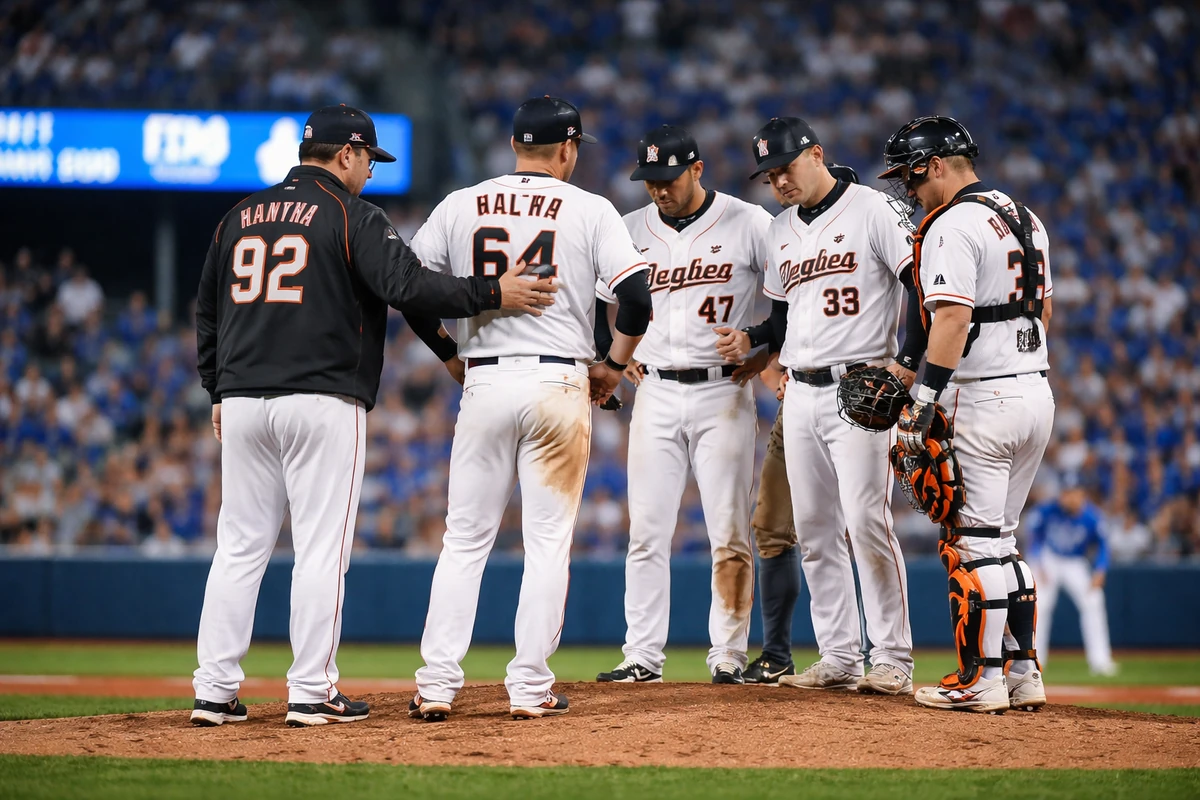
A Historic Loss That Says More Than the Score
Blowout losses happen in baseball. Even the best teams have nights when the bats go quiet, the defense unravels for an inning, or a starting pitcher simply does not have his usual command. Over a 144-game season in South Korea’s Korea Baseball Organization, or KBO, those games are usually treated as background noise. A team turns the page, resets the bullpen and tries again the next day.
What happened to the Hanwha Eagles in Daejeon against the Samsung Lions was something different. According to Korean media reports, Hanwha pitchers issued 16 walks and hit two batters, for a combined 18 free passes. That broke the KBO record for the most walks and hit-by-pitches allowed by one team in a single game. It also tied the league’s single-game team record for walks allowed.
Those numbers matter not just because they are ugly, but because they point to a particular kind of collapse. Giving up home runs can be explained by a bad pitch or a great swing. Even a barrage of singles can reflect an opponent’s strong approach at the plate. But a tidal wave of walks and hit batters tells a harsher story. It means the team on the mound lost control before the other team had to seize it.
That is why this game lands differently. In American sports terms, this was less like getting outslugged in a wild Coors Field-type game and more like watching a football team pile up false starts, personal fouls and delay-of-game penalties until the contest becomes unrecognizable. The numbers go in the box score, but the real damage is to rhythm, confidence and trust.
For Hanwha, one of the KBO’s most closely watched teams because of its young power arms and a passionate fan base, the record is more than a one-night embarrassment. It is a warning flare. When a pitching staff hands out 18 free bases in one game, the question is no longer whether one pitcher had an off night. The question becomes whether the team’s pitching plan, game management and mental reset mechanisms are sturdy enough for a long season.
Why Free Passes Are Baseball’s Clearest Sign of Trouble
To many casual fans, a walk can seem less dramatic than a line-drive double into the gap. But inside the game, pitchers, coaches and front offices know that repeated walks can be even more damaging. They raise pitch counts, force hasty trips to the bullpen, create constant traffic on the bases and keep defenders standing on the field inning after inning. Just as important, they shift the mental burden onto the pitcher.
That is especially true in Korea, where baseball culture places heavy emphasis on “control” and “game operation,” concepts that overlap with what American broadcasters might call command and pace. A pitcher who throws hard is admired. A pitcher who can get ahead in the count, challenge hitters in the zone and keep the defense engaged is trusted. The latter is what wins over a season.
When Hanwha handed out 16 walks, it gave Samsung an environment in which the Lions did not need to force the action. They did not have to chase marginal pitches or swing themselves into trouble. They could wait, take, foul off a few offerings and trust that another mistake, or another ball, would come. Once that pattern sets in, an offense barely has to manufacture pressure; the pitching staff manufactures it for them.
That is what makes a game like this so corrosive. Every long at-bat drags on the defense. Every missed strike-zone target increases the pitcher’s stress. Every mound visit and pitching change reminds everyone in the stadium that the game is being played on the offense’s terms. There is a compounding effect. A pitcher afraid of the middle of the plate nibbles at the corners. Missing the corners leads to hitter’s counts. Hitter’s counts force a more predictable pitch. And if the pitcher still cannot trust his release point, the next pitch misses too.
In that sense, Hanwha’s record night was not just a stat line. It was a structural breakdown. The team did not merely lose the game. It lost the ability to dictate how the game would be played.
The KBO Context: Why This Resonates in South Korean Baseball
For American readers who do not follow the KBO closely, it helps to understand why a game like this carries extra weight in South Korea. KBO baseball is deeply woven into urban identity and local pride. Teams are linked to major conglomerates, known in Korea as chaebol, and fans often build generational loyalty around those clubs. Hanwha, backed by the Hanwha business group, represents Daejeon and much of central Korea, while Samsung, one of the most globally recognized Korean companies, has one of the league’s most established baseball brands.
The Eagles’ home, Hanwha Life Eagles Park in Daejeon, is known for a loyal and emotionally invested crowd. Korean baseball fandom also tends to be more organized and communal than what many Americans are used to in Major League Baseball. Cheer songs, coordinated chants, drum sections and player-specific rooting routines create an atmosphere that can feel closer to a college football student section than a quiet night at a big-league park. In that setting, a pitching collapse is not just observed. It is collectively endured.
There is also the matter of expectation. Hanwha has spent years trying to climb out of the lower reaches of the standings, and every sign of progress is closely watched. The club’s young arms, including starter Moon Dong-ju, have been central to that hope. Moon is one of the Korean pitchers who has drawn attention for premium velocity, and in a baseball culture that still prizes the ace-like image of a power starter, he symbolizes possibility. When a game starts with his hit batter and spirals into a staff-wide command failure, it carries symbolic force beyond one outing.
The record itself also matters because of its longevity. Korean reports noted that Hanwha surpassed a team mark of 17 combined walks and hit batters set in 1990. In other words, this was not merely a rough night that happened to be bad. It was bad enough to erase a record that had lasted roughly three and a half decades. Those are the kinds of numbers that force a team to look inward, because ordinary slump language no longer covers it.
And while the KBO often projects a more offense-friendly image to overseas audiences than MLB does, pitchers still live by the same basic truth as everywhere else: if you cannot throw strikes consistently, everything else in your game becomes secondary. Velocity, movement and pitch design are only as useful as the pitcher’s willingness and ability to attack the zone.
From Moon Dong-ju to the Bullpen, This Was a System Failure
The easiest way to discuss a game like this is to assign blame to one pitcher. Baseball encourages that habit. Starting pitchers are identified as winners and losers. Relievers are tagged as the ones who “blew it.” Fans want a face to attach to the failure. But a team record of 18 free passes resists that kind of simplification.
Moon Dong-ju’s early hit batter may have marked the beginning of the record, but the larger issue was how the instability spread. When a starter cannot settle into the game early, the bullpen is forced into action sooner than planned. Relievers begin warming up before their normal routines. Matchups become reactive instead of deliberate. Roles blur. The middle innings, normally a bridge, become a traffic jam.
That chain reaction is familiar to any American baseball fan who has watched a staff burn through arms in April or May and then pay for it in July. A bullpen can survive a bad night. What it struggles to survive is repeated exposure to games in which nobody records efficient outs. Walk-heavy innings are exhausting because they are slow, stressful and resistant to clean endings. One reliever throws 28 pitches to get through four batters. Another enters with inherited runners and a tight strike zone in his head before he throws his first pitch. By the time the manager reaches for the back end of the bullpen, the game has already extracted too much from too many people.
That is why the Korean analysis around this game focuses not only on individual command but on “connection,” the linked nature of game management from the first inning to the last. In practical terms, the Eagles did not just fail to execute pitches. They failed to preserve sequence, role clarity and tempo across the entire staff.
The outing by Kim Seo-hyun, who reportedly accounted for seven of the free passes charged during the game, underscored the point. Kim is another pitcher whose talent has made him a high-interest figure. But talent without strike one is a dangerous bargain. A fastball that looks electric at 98 mph can become less a weapon than a threat to the pitcher’s own stability if the hitter knows he can simply wait it out.
That psychological shift is central. Once batters sense the pitcher is not commanding the zone, the confrontation changes. A hitter no longer needs to prove he can catch up to premium velocity. He only needs to prove he can remain patient. The pitcher, meanwhile, feels pressure not just to throw a strike but to throw a perfect strike. That is when control problems can deepen into something more serious: a crisis of conviction.
What This Says About Hanwha’s Season, Not Just One Game
Baseball is famously resistant to overreaction. One night in May or June can be followed by a winning streak. A pitcher with no command on Tuesday can look unhittable on Sunday. Teams that chase every ugly result tend to lose themselves. So it is worth saying clearly: one game does not define Hanwha’s season.
But one game can illuminate a fault line.
A record for walks and hit batters allowed is different from records that reflect dominance. If a team sets a franchise mark for strikeouts, fans celebrate. If a hitter breaks a home run record, it becomes a signature moment. But the most free passes ever allowed in a game is more like an emergency-room chart. It documents internal failure. It says the team’s own actions, more than the opponent’s excellence, drove the outcome.
That matters in a long season because pitching problems tend to compound. A lineup can break out of a slump quickly. A defense can tighten up with cleaner fundamentals. But a staff that begins to doubt its own command can drag that uncertainty from series to series. Opposing teams notice patterns. They adjust scouting reports. They tell hitters to make Hanwha pitchers prove they can land strike one. They stop expanding the zone. They lengthen at-bats. A single disastrous night can alter how opponents approach the Eagles for weeks.
American fans have seen versions of this before. Think of a young MLB staff whose stuff looks brilliant on paper but whose walk rate quietly sabotages every advantage. At some point, hitters around the league stop fearing the radar-gun reading and start trusting the count. That is when a team’s flashy upside starts to feel less like promise and more like untapped potential.
For Hanwha, the concern is not merely that it lost to Samsung. It is that the game exposed how fragile the staff can look when the count gets away from it. The club has arms. It may even have star-level arms. But the order of trust in baseball is unforgiving. First comes the ability to repeat your delivery. Then comes command within the strike zone. Only after that do raw velocity and sharp breaking pitches become sustainable advantages.
The Korean summary of the game points toward a similar conclusion: the issue now is not whether Hanwha possesses good stuff, but whether its pitchers can trust that stuff enough to challenge hitters. That is a subtle but crucial distinction. Pitchers often overthrow when they are trying not to get hit. The more they fear contact, the less likely they are to attack. The less they attack, the more hitters sit back. And the more hitters sit back, the more every pitch feels like a test of nerve rather than execution.
Samsung’s Role, and Why Patience Can Be a Winning Strategy
This was, of course, also a game won by Samsung, and the Lions deserve credit for understanding what the night gave them. Not every offense handles wildness well. Some lineups get impatient, chase a hittable pitch too early in the count and let pitchers off the hook. Samsung apparently did the opposite. It accepted the free baserunners, made Hanwha throw more pitches and allowed the game to come to it.
There is a lesson here that transcends one league or one country. In baseball, patience can be a form of pressure. A disciplined offense does not need to be passive. It can be aggressive in the sense that it forces the pitcher into the strike zone on its terms. When a staff is visibly struggling to locate, the smartest approach is often the least flashy one: do less, wait longer and trust the pitcher to blink first.
That dynamic also changes managerial decision-making. If the offense knows the other team cannot reliably throw strikes, there is less need for sacrifice bunts, hit-and-run plays or first-pitch ambushes. The game slows down and simplifies. The lineup just keeps passing the burden back to the mound. Over time, that simplicity can be devastating.
In many ways, that may be the hardest part of this loss for Hanwha to accept. Samsung did not necessarily need to overpower the Eagles. Hanwha ceded the game’s rhythm. It handed the Lions the opportunity to control tempo, leverage and emotional momentum without demanding extraordinary offensive heroics. That is why the damage feels larger than the final margin. The Eagles were not merely beaten. They were maneuvered into self-destruction.
The Next Day Matters More Than the Record Book
In sports, record-setting failures can become either turning points or previews. The difference is often visible immediately. The next game, the next series and the next set of bullpen decisions reveal whether the staff and coaching group truly understand what went wrong.
That is why the follow-up game against Samsung matters so much. The statistics from the record loss are already fixed in league history. What remains unsettled is the interpretation. Was this an isolated storm, a once-a-season nightmare that no longer reflects the club’s baseline? Or was it an early and dramatic expression of a deeper problem in how Hanwha sequences its pitchers, manages count pressure and restores composure when things begin to slide?
The answers will not come from speeches. They will come from small but revealing choices. Does the next starter get ahead early? Does the coaching staff act more quickly when a reliever cannot find the zone? Do pitchers challenge hitters in fastball counts rather than trying to paint perfect corners? Does the defense look more alert when innings move at a normal pace? Those are the signs of a club responding to a warning instead of merely surviving it.
For an American audience, there is a temptation to read a KBO story like this as a quirky statistical oddity from overseas baseball. That would miss the larger point. The same truth applies in the majors, in college ball and in youth baseball. A team can survive getting hit hard. It has a much harder time surviving a loss of trust in the strike zone. Once that trust disappears, every inning gets longer, every reliever gets busier and every game starts to feel like it is teetering on the edge.
Hanwha’s record-setting night against Samsung was humiliating on its face. But the true significance lies in what it revealed. The problem was not only wildness. It was the disappearance of structure. And in baseball, structure is what allows talent to matter.
The Eagles still have time to correct it. The KBO season is long, and young staffs do evolve. But if there is one lesson from this game, it is that teams do not steady themselves by throwing harder or hoping the next outing is cleaner. They steady themselves by rebuilding the sequence of trust: strike one, manageable counts, defined roles, calmer innings. Until that happens, a night like this will remain more than a bad memory. It will remain a warning.


0 Comments