A South Korean EV Charging Company Heads to Market, Signaling the Next Phase of the Electric-Car Race
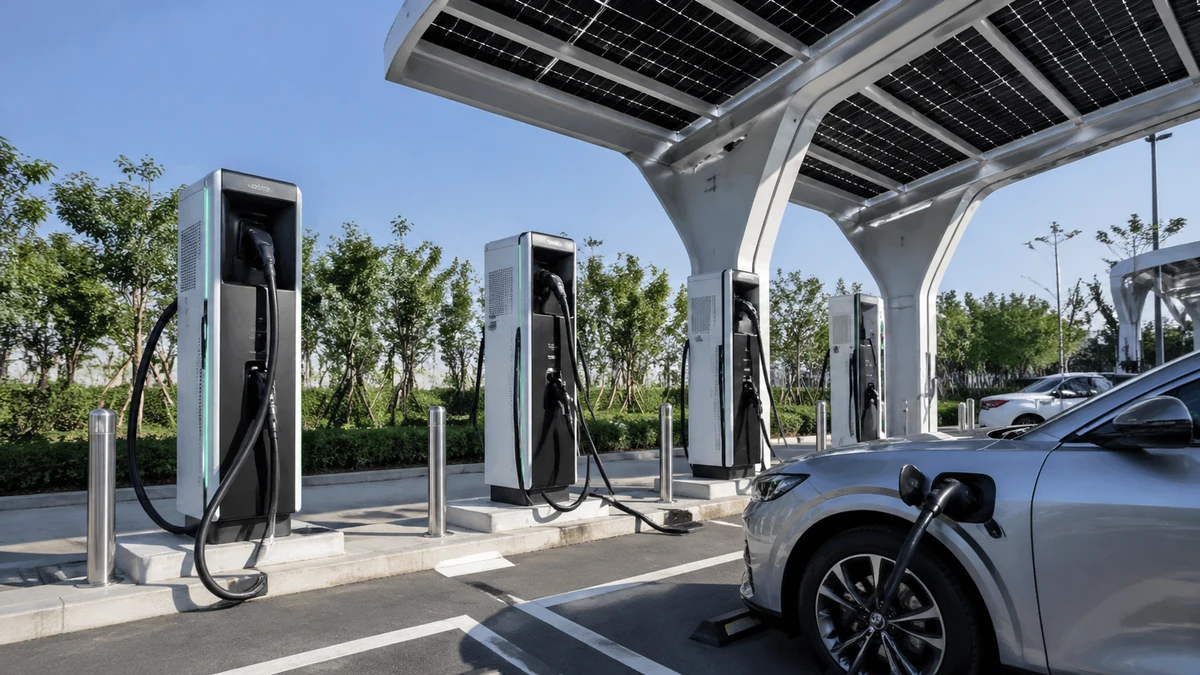
South Korea’s stock market is making a bet on charging, not just cars
South Korea has approved the stock market debut of Chaevi, an electric-vehicle charging services company, in a move that says as much about the future of transportation as it does about one company’s finances. The Korea Exchange, the operator of the country’s main securities markets, said Chaevi was approved for a new listing on the Kosdaq market, with trading set to begin July 29.
For American readers, the easiest comparison is this: Imagine if a company focused on the chargers, software and service network behind EVs — not the vehicles themselves — reached a public-market milestone that suggested investors were ready to treat charging infrastructure as a standalone industry. That is what makes Chaevi’s listing more than routine corporate paperwork. It reflects a broader shift in how South Korea’s capital markets are thinking about the electric-car era.
In the United States, much of the EV conversation still revolves around familiar names like Tesla, Ford, General Motors and Rivian, along with the charging networks that support them. South Korea has its own major automotive giants, including Hyundai Motor and Kia, both of which have become increasingly important global EV players. But the Chaevi listing highlights a related point: The race to electrify transportation is no longer only about who builds the best car. It is also about who builds, operates and scales the infrastructure that makes those cars practical in daily life.
That is especially important in a country like South Korea, where dense cities, apartment living and limited space can make home charging less straightforward than the suburban garage model familiar to many Americans. In that context, charging networks are not a side business. They are a critical layer of the transportation system itself.
Founded in 2016, Chaevi focuses on EV charging services and charging equipment. According to the figures cited in the Korean report, the company posted 101.739 billion won in consolidated revenue last year, roughly equivalent to tens of millions of U.S. dollars depending on exchange rates, while recording an operating loss of 29.634 billion won. Those numbers present a mixed picture: meaningful revenue scale, but continued pressure on profitability.
That tension is hardly unique to South Korea. Across global clean-tech sectors, investors have spent years weighing a familiar trade-off: high upfront costs and uncertain profitability versus the promise of long-term growth in a rapidly changing market. Chaevi’s public debut places that calculation out in the open.
What Kosdaq means in plain English
To understand why this matters, it helps to explain Kosdaq, a term that may be unfamiliar to many outside Korea. Kosdaq is often described as South Korea’s tech-heavy, growth-oriented stock market, somewhat analogous to America’s Nasdaq, though the comparison is not exact. It has become a home for companies in emerging industries and sectors where investors are often buying into future potential as much as present earnings.
So when South Korean regulators approve a company like Chaevi for listing there, the decision sends a signal. It suggests that the market is willing to consider EV charging as a distinct business category worthy of public investment and public scrutiny. In practical terms, that means Chaevi will no longer be evaluated only by private investors or industry insiders. Its business model, balance sheet and growth prospects will now be judged in the open, through daily stock trading and the expectations that come with being a listed company.
That matters because stock exchanges do more than provide a place to buy and sell shares. They also help define what kinds of industries a country views as strategic, scalable or investable. In the same way that a successful public listing in the U.S. can validate an industry segment — whether cloud software, ride-hailing or renewable energy — a Kosdaq listing can shape how Korean investors and policymakers think about a new sector.
In Chaevi’s case, the message is not simply that one company got approval. It is that EV charging, as a business in its own right, is moving closer to the center of Korea’s industrial and financial landscape.
There is another layer here as well. In many markets, electric vehicles have captured public imagination because the products are easy to see: sleek cars, new dashboards, long-range battery claims. Charging infrastructure is less glamorous. It is the plumbing of the EV era — essential, expensive and often overlooked until something goes wrong. A public-market debut for a charging company suggests that investors are beginning to treat that plumbing as a core growth story rather than a secondary support function.
Why charging infrastructure has become the real test of the EV transition
For years, the global EV conversation focused on vehicle adoption: how many cars were sold, which brands were gaining ground, and how quickly internal combustion engines might lose market share. But in market after market, a tougher reality has become clear. Selling electric cars is one challenge; building a reliable, accessible and profitable charging ecosystem is another.
Americans have seen versions of this problem firsthand. Public charging stations can be unevenly distributed, wait times can frustrate drivers on busy travel weekends, and reliability concerns remain a recurring issue. Even as Washington has poured money into EV infrastructure through federal programs, the real-world experience of charging is still one of the biggest bottlenecks to wider adoption.
South Korea faces its own version of that challenge. The country has a strong manufacturing base, advanced technology companies and a government that has backed future-mobility initiatives. But the transition from gasoline to electric mobility still depends on something very concrete: whether drivers can conveniently charge where they live, work and travel.
That is why companies like Chaevi matter. The Korean summary describes Chaevi as operating in both charging services and charging equipment. Those are two linked but distinct parts of the business. Charging equipment is the hardware — the stations, connectors and physical installations. Charging services involve the software, operations, maintenance, payment systems and customer experience that determine whether a charger is actually useful in practice.
In the U.S., that distinction is familiar to anyone who has tried comparing different charging networks. The station itself is only part of the story. Drivers also care whether the app works, whether the charger is functioning, whether speeds match expectations, whether pricing is clear, and whether the location is convenient and safe. Charging is as much a service business as it is an equipment business.
That hybrid model appears to be part of what South Korean investors are now being asked to evaluate. Chaevi is not just selling machines. It is participating in a broader ecosystem that blends hardware deployment with ongoing network operations. That may make the business more scalable over time, but it also means higher complexity and potentially heavy capital demands.
The larger takeaway is one that readers far beyond Korea can understand. The EV industry is maturing. The center of gravity is moving beyond car manufacturing alone and into the ecosystem that keeps electric transportation running day to day. Chaevi’s listing is a marker of that transition.
The numbers show both promise and pressure
The figures attached to Chaevi’s listing tell a story that is both encouraging and cautionary. On one hand, annual revenue of 101.739 billion won indicates the company is not operating at a purely experimental scale. This is not a concept-stage startup with little commercial traction. It is already generating sizable sales in a market tied to EV infrastructure.
On the other hand, the operating loss of 29.634 billion won underscores a central problem facing charging companies around the world: Growth does not automatically translate into profitability.
That should not surprise investors who follow infrastructure-heavy sectors. Charging networks require substantial early spending, including equipment installation, site acquisition or partnerships, grid connections, maintenance systems and customer-facing technology. Profit can lag far behind deployment. Utilization rates matter. So do electricity costs, competition, regulation and the pace of EV adoption in specific regions.
It would be irresponsible to assume the precise reasons for Chaevi’s losses beyond what was reported. The Korean summary does not provide a detailed breakdown of the company’s cost structure or strategic spending. But the broad pattern fits a familiar clean-energy playbook: Build early, grow quickly, absorb losses and try to achieve scale before competitors do.
That is exactly why a public listing becomes so consequential. Once a company begins trading publicly, the narrative gets harder. Private markets can often reward vision and patience. Public markets tend to ask sharper questions: How fast can revenue grow? When will margins improve? How defensible is the business? Can the company survive pricing pressure or a slowdown in EV adoption?
In that sense, Chaevi’s market debut is not simply a vote of confidence. It is the beginning of a more demanding phase. Investors are not only being invited to believe in the EV charging story. They are being asked to price the risks that come with it.
American readers may hear echoes of U.S. clean-tech cycles, where companies in promising industries often entered public markets before their economics fully matured. Some became category leaders. Others struggled under the weight of capital costs, competition and investor impatience. Chaevi now enters that same kind of proving ground, but in a specifically Korean market context.
What this says about South Korea’s economy
South Korea is often understood abroad through a few highly visible exports: semiconductors, cars, ships, smartphones and pop culture, from K-pop to Oscar-winning films and streaming hits. Those images are real, but they can flatten a more complicated economic picture. The Chaevi listing offers a glimpse into how the country is changing beneath those headline industries.
South Korea has long been associated with manufacturing might. It built global brands through industrial scale, export discipline and aggressive technological upgrading. What is notable now is how that manufacturing strength is beginning to extend deeper into service-oriented and infrastructure-oriented parts of the next economy.
EV charging sits at that intersection. It is connected to manufacturing because chargers are physical products. It is connected to services because operating a charging network requires software, logistics and customer management. And it is connected to public policy because transportation electrification depends heavily on planning, incentives and energy systems.
That makes Chaevi’s listing symbolically important. It suggests South Korea’s industrial transition is no longer limited to producing the vehicles or batteries that dominate global headlines. It is also moving into the less visible but increasingly decisive layers of the value chain.
The Korean report also noted that, on the same day, the Korea Exchange received preliminary listing review applications from other companies, including one in apparel manufacturing. That detail may sound secondary, but it helps show the broader picture. Korea’s capital market is not simply chasing one trend. It is accommodating both traditional manufacturers and newer, transition-era businesses at the same time.
For global observers, that is a useful reminder that South Korea’s economy is not monolithic. It is a mix of old and new industries evolving in parallel. A clothing manufacturer pursuing listing procedures and an EV charging company beginning public trading are very different stories, yet both reflect a market trying to finance multiple versions of growth at once.
That layered structure may be one reason Korea remains so closely watched by investors. It is advanced enough to serve as a test market for future industries, but still rooted in the industrial backbone that made it one of Asia’s most successful export economies. When a company like Chaevi reaches the public market, it can therefore signal more than firm-specific momentum. It can hint at how the country sees its own next chapter.
Why American readers should pay attention
At first glance, a Korean exchange approving a Korean charging company for a Korean market debut may seem like niche financial news. But it carries broader significance for anyone following the global shift to electric transportation.
The reason is simple: The EV race is becoming more international, more infrastructure-dependent and more economically complex. Every major auto market is confronting some version of the same question. It is not enough to build electric cars. Can countries also build the charging backbone, business models and investor confidence needed to make mass adoption work?
In the U.S., that question remains unsettled. The Biden administration made EV infrastructure a centerpiece of its climate and industrial agenda, but deployment has often been slower and more complicated than promised. Private charging networks continue to compete for scale and reliability, while automakers have increasingly stepped into the charging conversation themselves. The result is a fragmented but rapidly evolving market.
South Korea’s Chaevi story sits inside that global debate. Its listing shows that financial markets are starting to treat charging companies not merely as utility-like support businesses, but as strategic players in the mobility economy. That does not mean every such company will thrive. It does mean the sector is becoming visible enough, and potentially important enough, to stand on its own in front of public investors.
There is also a geopolitical angle. South Korea is not just another national market. It is home to world-class battery makers, major automakers and sophisticated electronics companies. When an EV charging company from that ecosystem goes public, international investors and competitors may read it as a sign of where industrial competition is heading next.
In other words, this is not only about one stock ticker starting to trade on July 29. It is about whether the infrastructure side of electrification is becoming a central arena of competition in its own right. The Korean market is now offering an early public test of that idea.
For American audiences used to viewing the EV story through Detroit, Silicon Valley or Washington, Chaevi is a reminder that some of the most important developments may come from elsewhere — and may center not on the cars people drive, but on the networks they depend on.
The questions investors will be asking next
Once Chaevi begins trading, several questions are likely to shape how the market responds. The first is scale: How large can a charging-services-and-equipment business become in South Korea as EV adoption expands? The second is execution: Can the company build a network and service model that customers trust and return to? The third is profitability: At what point, if any, do growth and utilization begin to offset the heavy costs associated with infrastructure rollout?
Those are not uniquely Korean questions. They are the same questions facing charging companies around the world. That is precisely why this listing deserves wider attention. Public markets often force industries to reveal their real economics faster than private hype cycles do. Chaevi’s debut will therefore be watched not only as a Korean IPO story, but as a small referendum on the business logic of EV charging itself.
There is no guarantee that investors will see the company as a pure growth play or as a stable infrastructure bet. It may be seen as something more ambiguous: a necessary business in a promising sector, but one whose path to durable profits remains uncertain. That ambiguity is, in some ways, the defining feature of the EV transition today.
Still, the symbolism is clear. South Korea’s market is opening its doors to a company built around charging infrastructure at a moment when the world is discovering that electrification is only as strong as the systems behind it. If the first phase of the EV era was about proving consumers would buy electric cars, the next phase may be about proving societies can support them at scale.
Chaevi’s listing is a modest but telling sign that this second phase is already underway. In South Korea, the public market is beginning to price that future in real time.
Comments
Post a Comment