
A single voyage, and a much bigger test
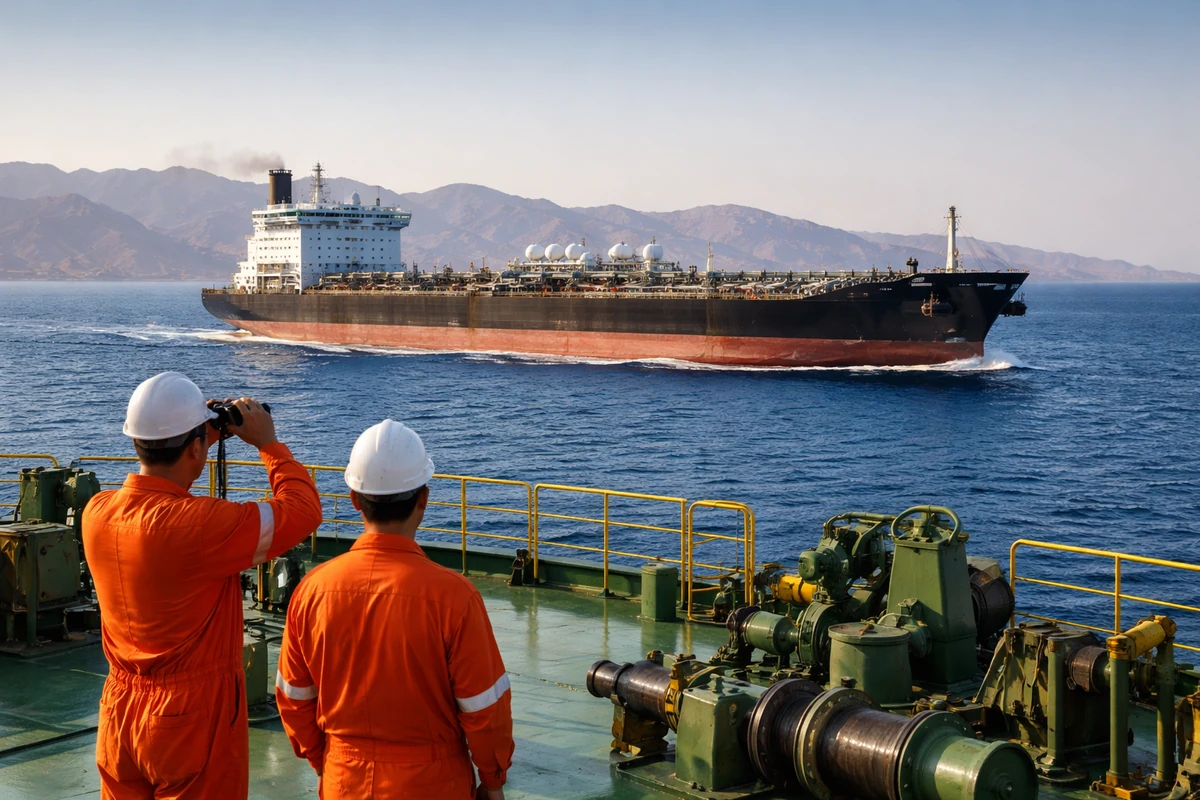
South Korea says one of its crude oil tankers has safely completed a passage through the Red Sea after loading oil at Saudi Arabia’s western port of Yanbu, marking the country’s first such case since the Strait of Hormuz was shut down. On paper, that may sound like a narrow shipping update. In practice, it is a revealing stress test for one of the world’s most trade-dependent economies and a reminder for American readers of how quickly a distant maritime crisis can ripple into daily economic life.
The voyage matters not because it proves the crisis is over, but because it suggests South Korea’s energy supply chain is not frozen. For a country that imports nearly all of its crude oil and relies heavily on Middle Eastern supplies, the question is not simply whether oil can move. It is whether it can move predictably, safely and at a cost that does not upend refining schedules, electricity generation, industrial production and consumer prices.
That distinction is crucial. The shutdown of the Strait of Hormuz, one of the world’s most important energy chokepoints, immediately raised fears that countries like South Korea and Japan would be left scrambling for alternatives. The Korean government’s announcement that a tanker loaded at Yanbu and safely exited through the Red Sea suggests an alternate route can work, at least for some cargoes. But it also underscores a broader reality: when one strategic waterway closes, the result is not a clean rerouting of global commerce. It is a messy and expensive recalculation involving insurance premiums, vessel scheduling, port congestion, delivery timing and political risk.
For Americans, a useful comparison may be the way a hurricane in the Gulf of Mexico can send tremors through gasoline markets far beyond the storm zone. The damage is not just physical. It is logistical and psychological. Traders, refiners, shipping firms and policymakers all start pricing in uncertainty. That is what South Korea is managing now, except on a global scale and in a far more dangerous geopolitical environment.
The safe passage of one Korean-linked tanker is therefore not a return to normal. It is an early indicator that workarounds exist. Whether those workarounds can be turned into a durable system is the real story.
Why Yanbu matters far beyond Saudi Arabia
Much of the significance of this development comes down to geography. Yanbu sits on Saudi Arabia’s western coast along the Red Sea, not on the Persian Gulf side where so much of the world’s oil export infrastructure is concentrated. In normal times, that may seem like a technical detail. In a crisis centered on Hormuz, it becomes strategic.
If Saudi oil exports were entirely dependent on ports east of the Arabian Peninsula, a closure of Hormuz would be even more paralyzing. But western ports such as Yanbu offer at least some ability to redirect flows. That does not eliminate the danger, and it certainly does not replace all lost capacity. It does, however, create options, and in supply chain crises, options can be almost as valuable as inventory.
For import-dependent economies, flexibility in ports and shipping lanes can function like a backup generator during a blackout. You do not run the whole system on it indefinitely, but it can keep essential operations alive. South Korea appears to be testing that kind of contingency now. A shipment loaded on Saudi Arabia’s Red Sea coast shows that the region’s energy infrastructure is not entirely locked into a single eastbound export logic. It suggests that producer nations and consumer nations can still improvise together under pressure.
Still, there is a big difference between proving something can be done once and showing it can be repeated at scale. Crude oil is not just another commodity stacked in containers and moved on a flexible schedule. Refineries are calibrated for specific grades of crude, and those facilities run on tightly coordinated delivery timelines. A delay of days or even hours can complicate procurement decisions, output planning and downstream contracts.
That is why South Korean officials and industry executives are unlikely to interpret this tanker’s transit as a sign to relax. If anything, the successful voyage raises tougher questions: How many shipments can realistically be rerouted this way? How much extra cost will buyers absorb? Will insurers remain willing to cover these voyages at a sustainable rate? And how much disruption can refiners tolerate before higher costs begin reaching households and manufacturers?
These questions would matter in any advanced economy. They matter especially in South Korea, where export manufacturing, petrochemicals and energy-intensive industries are central to national growth. In that sense, Yanbu is not just a Saudi port in this story. It has become a symbol of whether modern economies can remain nimble when global chokepoints fail.
For South Korea, predictability matters as much as supply
South Korea’s vulnerability in moments like this is not hard to understand. The country is one of the world’s largest energy importers, with limited domestic fossil fuel resources and a long-standing dependence on seaborne supplies. Its success as an industrial power has always rested in part on the assumption that ships will keep moving and raw materials will arrive on time.
That is why the most important variable is often not volume alone, but predictability. Refiners need to know when crude will arrive, what quality it will be and what it will cost by the time it reaches port. Power producers and petrochemical companies make linked decisions based on those assumptions. When shipping routes suddenly change, the first casualty is not necessarily supply itself. It is confidence in the timetable.
The Korean tanker’s successful Red Sea passage offers reassurance on that front, but only in a limited way. It shows the equation has not collapsed entirely. It does not show the equation is stable. A route can be open and still be commercially punishing. If insurers sharply raise premiums, if ships must slow down for security reasons, if ports become clogged or if naval risks intensify, then the system may continue functioning while becoming steadily more expensive and less reliable.
That kind of instability is especially challenging for South Korea because geopolitical shocks hit the country indirectly but quickly. Seoul may not be a military party to the Middle East conflict driving the current disruption, yet the country still absorbs the fallout in near real time through freight rates, oil prices, exchange rate volatility and business sentiment. That is a familiar pattern for globally integrated economies. Distance provides no insulation when markets are tightly connected.
For American readers, there is a lesson here that extends beyond Korea. The Biden and Trump eras alike have seen growing discussion in Washington about supply chain resilience, strategic decoupling and domestic production. South Korea’s current predicament shows why those debates matter, but also why no advanced economy can fully disentangle itself from maritime geography. Even highly sophisticated industrial nations remain exposed to narrow sea lanes, fragile shipping calendars and risk perceptions set by events thousands of miles away.
That is why the bigger Korean policy challenge starts after this successful transit. Officials and companies now have to figure out whether a one-off rerouting success can become a repeatable operating model. That means prearranged use of alternate ports, more robust tanker deployment plans, clearer refinery stockpile strategies, better coordination with insurers and shipping companies, and financial backstops for market turbulence. The real measure of resilience is not whether a country can improvise once. It is whether it can institutionalize the improvisation.
The Red Sea is open, but not normal
The Red Sea has long been one of the world’s essential maritime corridors, linking the Suez Canal to global shipping routes between Asia and Europe. For container lines, bulk cargo operators and energy shippers alike, it is part of the circulatory system of global trade. In the context of a Hormuz shutdown, its importance has expanded again, not merely as a background waterway, but as an active alternative route carrying strategic weight.
But “open” does not mean “normal.” Maritime trade is not governed by a simple yes-or-no standard in which routes are either blocked or freely available. Shipping exists on a spectrum of risk, and risk gets converted into price. A vessel may be physically able to transit a route while the cost of doing so rises dramatically because of higher war-risk premiums, security protocols, longer turnaround times and tightened availability of ships.
That is what makes the South Korean transit significant and sobering at the same time. It demonstrates that the sea lane remains viable. It also highlights how cautious, expensive and fragile that viability may be. In other words, the route is functioning, but under stress.
For countries like South Korea, whose economic model depends heavily on both imports and exports, instability in the Red Sea carries consequences beyond crude oil. Delays or security concerns affecting one category of shipping can spill over into others, including industrial inputs, parts and intermediate goods. American consumers saw a version of this dynamic during the pandemic, when disruptions in ports and freight networks translated into shortages, delays and higher prices in sectors far removed from the original bottleneck. The current Middle East shipping crisis raises a similar concern, except the catalyst is not public health but conflict and strategic geography.
There is also a psychological effect on markets. Once traders and logistics planners see a crucial corridor as vulnerable, they begin to build that vulnerability into contracts and decisions. Companies may hold more inventory, reroute cargo preemptively or demand higher compensation for uncertainty. Those defensive moves can help firms manage risk individually, but across the system they often increase costs and reduce efficiency.
So while the Korean tanker’s passage through the Red Sea is plainly good news, it should not be confused with proof that the shipping environment has stabilized. The better reading is narrower and more realistic: a pressured system has found some room to breathe.
What the G20 discussion reveals about the wider crisis
The same day that South Korea highlighted the tanker’s successful transit, finance officials gathered in Washington for a Group of 20 meeting where the Middle East crisis surfaced as a broader economic concern. That overlap matters. It shows that what begins as a maritime and energy story rarely stays confined to ships and oil markets.
According to the Korean summary of the meeting, participants discussed the need for an early easing of tensions and for support to low-income countries. That reflects a growing recognition across capitals that the cost of conflict does not stop at the front lines. When vital shipping routes are threatened, oil may be the first headline, but the damage can spread into food systems, fertilizer prices, freight bills, fiscal stress and humanitarian budgets.
That is especially true for poorer countries, which often have less room to absorb sudden increases in energy import costs or shipping charges. A wealthy economy can cushion some of the blow through subsidies, reserves or emergency financing. Lower-income states frequently cannot. For them, a surge in transport costs can quickly widen budget deficits, intensify inflation and raise the risk of social unrest.
Japanese Finance Minister Satsuki Katayama said after the meeting that there was shared understanding among participants about the need to address the Middle East crisis and help low-income nations, though no joint communique was adopted. That detail may seem procedural, but it speaks to a larger problem. The international system can often agree that a crisis is dangerous long before it agrees on what to do about it. Consensus on diagnosis does not automatically produce consensus on treatment.
For South Korea, that uncertainty matters because the country sits at the intersection of global trade, energy dependence and financial openness. If prolonged shipping disruptions keep oil prices elevated, Korean households and businesses could feel pressure through fuel, transport and manufacturing costs. If financial stress spreads across emerging markets, Seoul could also face turbulence through currency moves and shifts in investor risk appetite. In that sense, the tanker’s Red Sea passage and the G20’s debate are not separate developments. They are different windows into the same crisis architecture.
For Americans, there is an important parallel. U.S. policymakers often talk about national security, economic security and humanitarian stability as if they sit in separate policy boxes. Events like this show how tightly linked those boxes really are. A blocked strait can become an inflation story, a debt story and a food security story all at once. South Korea’s shipping challenge is one piece of that larger puzzle.
A fragile truce does not erase structural risk
The Korean summary also notes a reported 10-day ceasefire agreement between Israel and Lebanon, a sign that regional tensions can ease in bursts even as the broader landscape remains unstable. That kind of partial de-escalation may help calm markets temporarily, but it does not remove the structural risk hanging over shipping and energy systems.
That is because maritime logistics respond not only to current fighting, but to the expectation that fighting could resume or widen. A shipowner, insurer or refinery planner does not need to believe disaster is certain to change behavior. It is enough to believe the odds of disruption are uncomfortably high. In that environment, even positive political developments may only modestly reduce the premium placed on safety, flexibility and delay tolerance.
This is one of the central economic lessons of the past several years, from the pandemic to the war in Ukraine to repeated Red Sea and Black Sea disruptions: efficiency is no longer the only benchmark. For decades, the dominant logic of globalization rewarded the fastest and cheapest route. Today, companies and governments increasingly value the route that can survive shocks, even if it costs more in ordinary times.
South Korea’s experience fits squarely into that shift. The successful tanker transit is encouraging because it shows redundancy exists. But redundancy is expensive. Maintaining alternate shipping options, diversifying procurement channels, building inventories and preparing financial buffers all carry costs that may be politically unpopular in calm periods. Crises are what reveal whether those costs were worth paying.
There is a cultural dimension here that American audiences may appreciate with a bit of context. In South Korea, the phrase often used in discussions of national industrial policy and crisis response can evoke the idea of systems working in disciplined coordination, not just individual firms acting alone. That mindset has roots in the country’s rapid postwar development, when state planning, strategic industries and export competitiveness were closely linked. In modern form, it translates into an expectation that government ministries, refiners, shipping lines and financial authorities will move in concert when external shocks hit. The tanker story is not being read in Seoul simply as a shipping company success. It is being read as a test of whether the national system can adapt under pressure.
That system has now cleared an initial hurdle. But the deeper question remains unresolved. Can South Korea turn an exceptional passage into a sustainable template for operating in a world where chokepoints are increasingly politicized and conflict can redraw trade routes overnight?
What this voyage means now
The safest conclusion is a measured one. South Korea’s first known post-Hormuz Red Sea crude transit is a meaningful sign of resilience, not a declaration of security. It shows that alternative pathways for Middle Eastern oil remain available. It also shows that those pathways are becoming strategic battlegrounds of cost, timing and risk.
For Seoul, the policy challenge is now broader than escorting a few ships or monitoring prices. It is about redesigning resilience across the whole chain: port access, tanker allocation, emergency reserves, insurance arrangements, refinery planning and financial safeguards. For the international community, the message is similarly clear. Maritime chokepoints are no longer niche concerns for shipping specialists. They are fault lines running through energy markets, inflation, development finance and geopolitical stability.
For American readers, the South Korean tanker’s journey is a reminder that globalization still moves through very physical bottlenecks. We tend to talk about the world economy in abstract terms, but it still depends on real ships passing through narrow stretches of water under conditions that can change in a day. When those passages become contested, the consequences travel much farther than the map suggests.
In that sense, this was more than a successful voyage out of Yanbu. It was a small but revealing case study in how modern economies cope when the world’s trade arteries come under strain. South Korea has shown that rerouting is possible. The next test will be whether possible can become dependable.



0 Comments