South Korea’s Rising Homeholding Taxes Are Reshaping the Housing Market — and Testing Owners’ Nerves
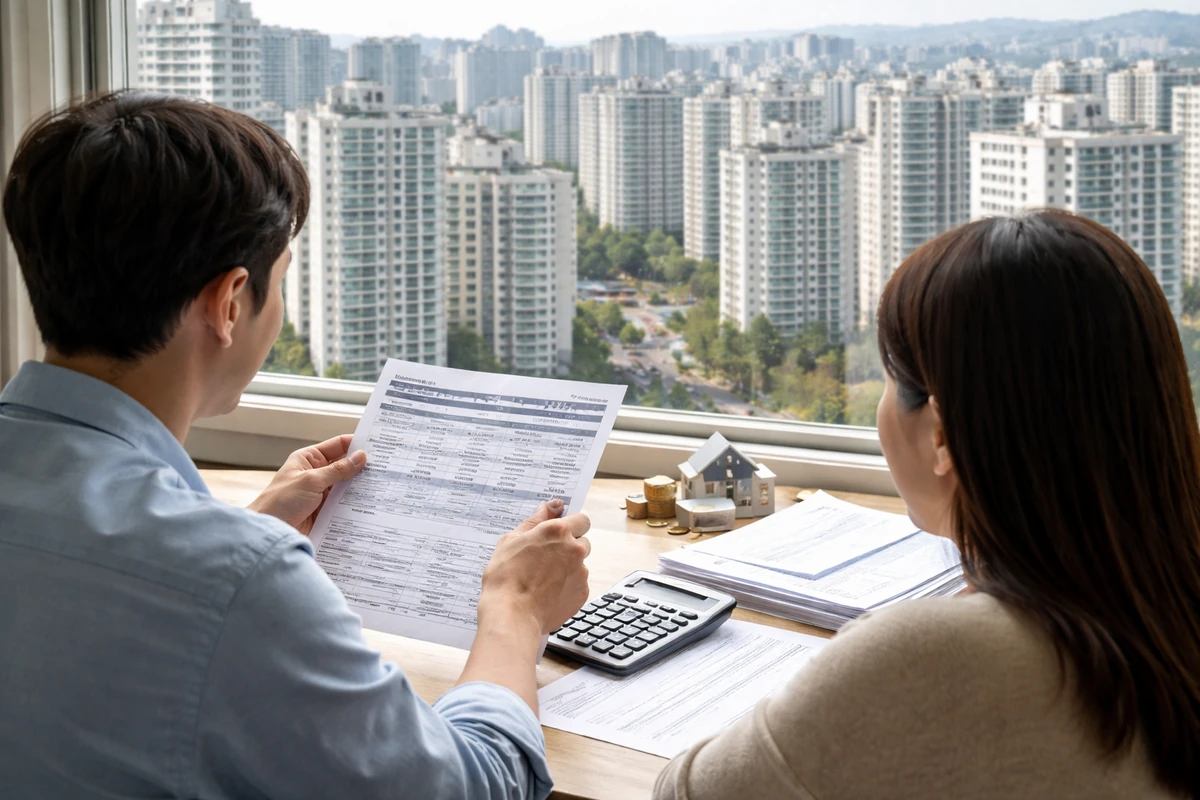
A tax bill, not a sale price, is becoming the first warning sign
In South Korea’s housing market, one of the clearest signals of stress in 2026 is not showing up first in home sales or auction listings. It is arriving in mailboxes.
New estimates reported by Seoul Economic Daily suggest that this year’s taxes on owning residential property — broadly known in Korea as “holding taxes” — will rise about 15% from a year earlier. On top of that, the country’s comprehensive real estate tax, a national levy aimed at higher-value property owners, is expected to increase by an average of roughly 670,000 won per taxpayer, or about $480 to $500 depending on exchange rates.
For American readers, the comparison is closest to a sharp increase in annual property-tax obligations layered together with an additional surtax on more expensive or multiple properties. The exact Korean tax structure is different from the U.S. system, where local governments dominate property taxation, but the household effect is easy to recognize: owning a home is getting more expensive even before an owner thinks about mortgage costs, maintenance, insurance or whether the market is rising or falling.
That matters because South Korea’s housing market is entering a complicated phase. Borrowing is more expensive than it was during the era of ultralow rates. Lending rules remain tightly managed by the government. The rental market is changing as the country continues its long shift away from Korea’s distinctive “jeonse” system — a lease arrangement in which tenants put down a huge refundable deposit instead of paying traditional monthly rent — toward more conventional monthly rental structures. And price performance is increasingly uneven, with high-demand neighborhoods in and around Seoul behaving very differently from weaker regional markets.
In that environment, a rise in holding taxes is no longer just a budget issue. It affects strategy. It influences whether owners keep a home longer, sell sooner, turn to rental income more aggressively or decide an inherited or second property is no longer worth the ongoing cash drain. In a market where sentiment is fragile, the annual cost of simply holding an asset can shape behavior as powerfully as headlines about home prices.
That is especially true because holding taxes are not based on whether a household’s income rises in step with property values. The bill comes due whether the owner’s cash flow improved or not. In boom years, rising home values can make owners more tolerant of annual taxes. When prices flatten, or when gains become less certain, the same tax can feel much heavier.
Why the burden feels larger now
Taxes rarely dominate housing conversations in good times. When prices are climbing quickly, owners often treat annual levies as the cost of participating in a profitable market. That calculus changes in a slower, more selective market, and that is where South Korea appears to be now.
Interest rates remain well above the floor that defined the easy-money years. Korean regulators, trying to limit household debt and speculative buying, have used lending rules to distinguish between what policymakers call “end-user demand” — families buying a primary residence — and investment demand. In practice, that means not every buyer can borrow freely, and not every owner has easy refinancing options. Add a double-digit increase in holding taxes, and the full cost of owning housing rises in a way that is hard to ignore.
Economists and real estate brokers often talk about “total carrying cost.” That means buyers and owners do not judge a home only by its sticker price. They look at loan interest, taxes, maintenance fees for apartment complexes, possible repair costs and the opportunity cost of tying up capital. In South Korea, where apartment ownership has long been one of the most important household wealth-building tools, that total-cost calculation is becoming more conservative.
That shift in mindset could be one of the most important developments in the market this year. Instead of assuming that appreciation will eventually outrun carrying costs, households are more likely to ask whether the expected return is strong enough to justify the cash leaving their bank account each year. In practical terms, that can change the ranking of which homes are worth keeping. A prime apartment in a coveted Seoul district may still seem like a long-term hold. A weaker asset in a thinly traded regional market may start to look like dead weight.
The result is that tax policy is acting less like a background condition and more like a sorting mechanism. It is separating homes owners feel compelled to defend from those they may quietly consider selling. In the United States, that logic would be familiar in expensive metro areas where rising property taxes can force retirees, landlords or owners of second homes to rethink whether they can afford to stay put. South Korea is now confronting a version of that same pressure, but within a more tightly managed and politically sensitive housing system.
The psychology of ownership is changing before transaction volumes do
One of the more revealing aspects of the current moment is that taxes may matter most when actual sales are weak. In hot markets, buyers and sellers tend to focus on price momentum. In slower markets, the pressure shifts to carrying costs.
That is because many homeowners are caught in an awkward middle ground. They may want to sell, but not at the price the market is currently offering. They may be willing to hold, but not indefinitely if annual taxes keep climbing. They may own a property they do not live in — perhaps an inherited home, perhaps a unit kept after moving to another residence — and feel uncertain about the right time to exit. In all of those cases, the tax bill becomes a source of psychological pressure long before a transaction occurs.
What makes this moment especially important is that the burden can no longer be dismissed as only a problem for the ultrawealthy. South Korea’s comprehensive real estate tax, known locally as “jongbu tax,” has often been politically framed around owners of expensive homes or multiple properties. But a 15% rise in overall holding taxes sends a broader message that goes beyond one tax bracket or one class of owner. The market hears something simple and powerful: keeping a home is getting more expensive.
That message can pull buyers and sellers in opposite directions. Owners who feel squeezed may become more willing to cut prices, particularly if they need liquidity or are managing more than one property. Buyers, meanwhile, may interpret higher holding costs as a reason to wait, betting that more owners will come under pressure later. In that scenario, the market does not necessarily become more liquid. Instead, it can become more fragmented. Some sellers rush. Some buyers hesitate. And the gap between strong neighborhoods and weak ones becomes more visible.
That fragmentation is already a defining feature of South Korea’s housing market. Even within Seoul, where global investors and casual observers often assume prices move in a single direction, neighborhood differences can be stark. Premium districts with strong school reputations, good transit access and limited supply often hold up better. Less favored locations, aging apartment stock or outer-ring suburban areas can behave very differently. The same is true across the broader Seoul metropolitan area, known as the capital region, compared with provincial cities.
In other words, higher holding taxes are not likely to create one national housing story. They are more likely to amplify several stories at once.
More listings may come, but a flood is far from guaranteed
Conventional wisdom says that if owning becomes more expensive, more people will sell. There is truth in that. Repeated annual costs do create a rational incentive to unload property, especially for owners sensitive to cash flow.
That group is larger than just speculative investors. It can include people who inherited homes and kept them longer than expected, owners who delayed selling after moving elsewhere, retirees with valuable property but limited disposable income and families juggling debt in a higher-rate environment. For them, rising holding taxes can be the push that turns passive dissatisfaction into action.
Still, it would be a mistake to assume a tax increase automatically unleashes a wave of listings. Real estate is not a stock portfolio. Homes are illiquid, emotionally charged and costly to sell. If owners believe prices will eventually recover, especially in sought-after parts of Seoul, they may tolerate higher taxes for longer than outsiders expect.
That is why the effect of higher taxes depends less on the tax alone than on how it interacts with everything else: loan maturities, refinancing conditions, household income, age, access to rental income and local market depth. In some neighborhoods, owners may quietly hold the line, treating taxes as painful but manageable. In others, the same increase could push more units onto the market, particularly where expected appreciation is weak and buyer demand is thin.
For U.S. readers, the closest analogy might be the uneven effect of rising carrying costs in America after mortgage rates surged. Higher rates did not produce the same outcome everywhere. In supply-starved, high-income neighborhoods, owners often stayed put and inventory remained tight. In more marginal markets or among owners facing financial strain, pressure was more immediate. South Korea’s tax increase appears poised to create a similar pattern of uneven stress rather than a single nationwide correction.
That unevenness matters for policymakers. If the goal is to improve market functioning, a blunt increase in holding costs can work in contradictory ways. It may coax some owners to sell, but it may also cause others to sit tighter, waiting for better conditions. The result may be more segmentation rather than a smooth increase in transactions.
Can landlords pass the cost on to tenants? Only sometimes
Whenever property taxes go up, the same question follows: Will landlords simply charge tenants more? The short answer in South Korea, as in the United States, is that some will try, but markets do not allow automatic pass-through.
The logic behind rent increases is straightforward. If the cost of owning rises, landlords have an incentive to recover part of that burden through higher rents. But whether they can do so depends on demand, competition and the availability of alternatives. If tenants have other options, or if a local market is already soft, landlords may have little room to raise prices.
That is particularly important in South Korea because its rental market is structurally more complex than many Americans might expect. Jeonse, the large deposit lease that became a hallmark of Korean housing over decades, has been gradually giving way to monthly rent arrangements as interest rates, financing conditions and risk appetites changed. In a jeonse contract, the landlord can invest the tenant’s large lump-sum deposit and historically did not rely on monthly rent income. In a monthly-rent system, recurring cash flow matters much more.
That means rising holding taxes can land differently depending on the lease structure and the region. In high-demand districts where tenants strongly want to live near good schools, major business centers or dense subway networks, landlords may have somewhat more pricing power. In areas with weaker demand or more competitive supply, they may not.
Some owners may actually respond in the opposite direction. Rather than raising rent aggressively and risking vacancy, they may choose to prioritize stable occupancy. A reliable tenant paying on time can be more valuable than a higher asking rent that leaves a unit empty. That calculation becomes more important when owners are already facing larger tax bills and do not want the added uncertainty of vacancy.
Over time, though, higher holding costs could still reshape the rental market indirectly. Owners with low yields and high tax burdens may decide to sell rather than continue renting. Others may change lease formats, shorten their time horizon or become more selective about where they operate as landlords. So while taxes do not move one-for-one into rent, they can alter the structure of rental supply.
A policy contradiction at the heart of the market
The politics of housing taxes in South Korea have long been contentious because they carry two competing messages at once.
On one hand, higher taxes on property ownership can be framed as a fairness measure. They place a larger burden on those benefiting from real estate wealth, discourage speculative accumulation and signal that housing should not be treated only as a vehicle for asset concentration. In a country where housing inequality and apartment prices have shaped elections, social mobility and family planning, that argument has real force.
On the other hand, increasing annual ownership costs in a fragile market can reduce flexibility, strain older owners on fixed incomes and complicate efforts to revive transactions. If the government wants smoother trading activity but also sends a signal that holding property will become more expensive, buyers and sellers may both become more cautious.
That tension is one reason the market pays such close attention to tax policy as a signal, not just a math problem. Investors, homeowners and brokers do not read a 15% increase merely as a revenue change. They read it as a clue about what level of carrying cost the government considers acceptable, and about how future policy may evolve.
In softer markets, those signals can have outsized effects. Housing prices are influenced by income, supply, interest rates, demographics and location. But when confidence is thin, a relatively small change in annual cost can be the factor that changes a household’s decision. It can make one owner a bit more willing to sell, one buyer a bit more willing to wait and one landlord a bit more cautious about expansion.
That is why this year’s increase matters beyond the size of the bill itself. It arrives at a time when the Korean housing market is already highly sensitive to marginal shifts in cost and sentiment. In such moments, taxes can become the final nudge.
Seoul versus the rest: the same tax can feel very different
Perhaps the biggest mistake outsiders make when looking at South Korea’s housing market is treating it as a single national machine centered only on Seoul. Seoul matters enormously, of course. It is the country’s political, economic and cultural core, and the broader capital region houses roughly half the nation’s population. But the lived experience of the market differs sharply between the capital area and many provincial cities.
That divide is crucial when thinking about higher holding taxes. In expensive, highly desirable neighborhoods, owners may complain loudly about rising tax bills while still feeling confident enough to hold. They may have stronger balance sheets, better rental prospects and greater faith in future appreciation. In markets where price recovery looks less certain and transactions are sparse, the same increase can feel much more punishing.
In practical terms, that means the tax burden is not just about rate tables. It is about local resilience. A homeowner in a premium Seoul district may view higher taxes as painful but survivable. An owner of an apartment in a slower regional market may see the same policy as a direct threat to cash flow with no obvious upside.
This is also where the debate intersects with broader political frustration in South Korea over what many see as a capital-region-centered policy lens. When the government designs housing rules with Seoul in mind, the effects elsewhere can look very different. A tax system intended to address concentration of wealth in expensive metro housing may land awkwardly in areas where prices are weaker and liquidity is low.
For American audiences, the parallel might be policies that make intuitive sense in Manhattan, San Francisco or greater Washington but feel mismatched in smaller, slower-growth metros. National housing policy is often experienced locally. South Korea is no exception.
What it means for 2026
The immediate takeaway is not that South Korea is on the verge of a dramatic nationwide housing sell-off. The more plausible outcome is subtler: a market in which owners become choosier, buyers become more demanding and regional splits become more pronounced.
Some owners will absorb the higher tax and keep holding, especially if they own well-located assets or believe future gains justify the expense. Others will reassess inherited homes, secondary properties or lower-yield rentals. Some may try to pass costs to tenants where demand is strong. Others may decide stable occupancy matters more than pushing rent higher. And many potential buyers, seeing ownership costs rise alongside still-restrictive lending conditions, may conclude they can afford to wait.
That is why the rise in holding taxes is better understood as a force that sharpens existing divisions rather than one that single-handedly changes the market’s direction. It widens the contrast between owners with staying power and owners under pressure. It reinforces the difference between neighborhoods that can command patience and those that cannot. And it reminds households that in a mature, high-cost market, the decision to own property is not only about future value but about the recurring cost of keeping that bet alive.
For years, South Korea’s housing conversation has often revolved around price charts, government crackdowns and the political symbolism of apartment ownership. In 2026, the more revealing question may be simpler and more personal: not what a home is worth on paper, but how much it costs to keep one more year.
Comments
Post a Comment