At a U.N. climate week in South Korea, the biggest question about AI isn’t innovation — it’s inequality
A global climate conversation arrives in a city many Americans may remember from another era of optimism
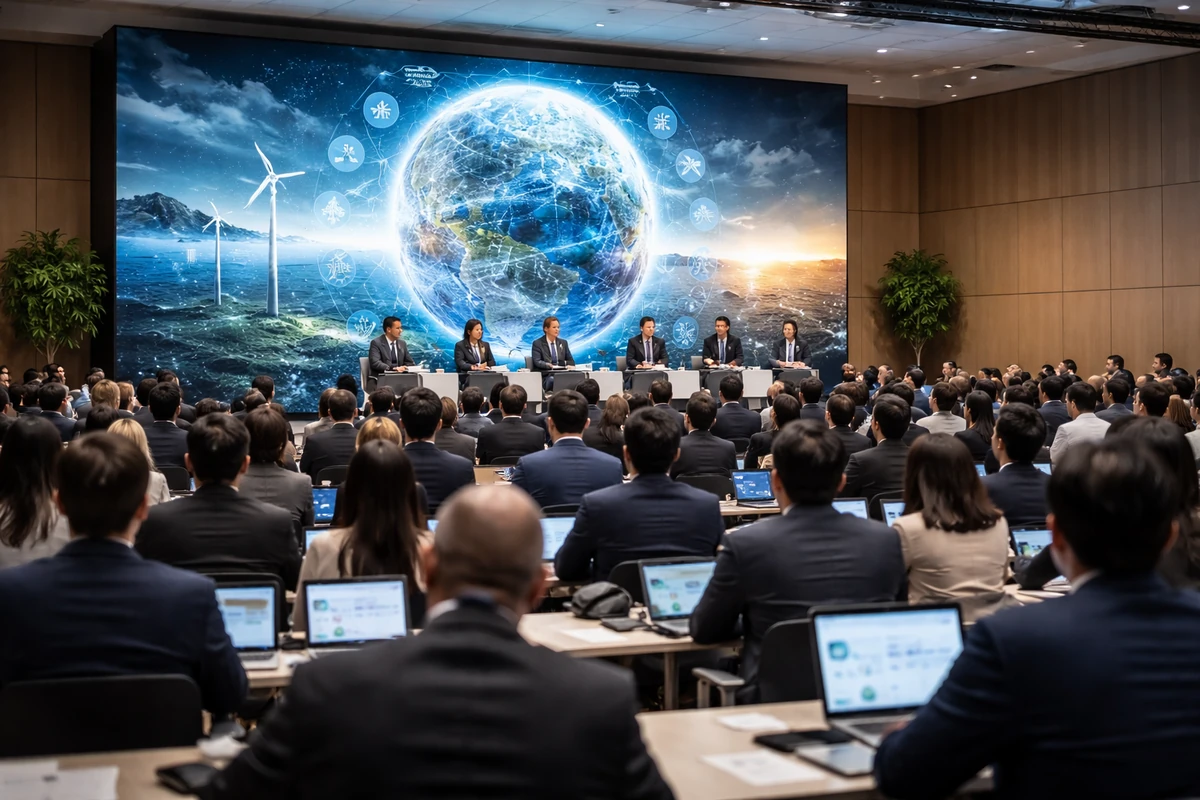
In April 2026, officials, aid agencies, startups and international organizations will gather in Yeosu, a coastal city in South Korea, for a conversation that sounds, at first glance, like a familiar 21st-century conference topic: how artificial intelligence can help the world respond to climate change. The event, scheduled for April 23 at the Yeosu Expo Convention Center, is part of the U.N. Framework Convention on Climate Change’s third Climate Week, running from April 21 to 25. It is being organized jointly by the Korea International Cooperation Agency, or KOICA, and the U.N. climate secretariat.
But beneath the language of innovation and digital solutions lies a more uncomfortable and more consequential issue. The central question is not simply what AI can do. It is who gets to use it, under what conditions, and whether a new generation of climate technology will reduce global inequality or deepen it.
That distinction matters. In Washington, Brussels and Silicon Valley, AI is often discussed as a force multiplier — a tool that can make forecasting more accurate, resource allocation more efficient and public services more responsive. In the climate world, that can mean faster flood warnings, smarter drought monitoring, better crop planning and more precise disaster response. Yet in many lower-income countries, the barriers to using those tools remain basic and stubborn: unreliable electricity, limited broadband, weak data systems, shortages of trained personnel and underfunded public institutions.
So while the Yeosu forum may look like a technical seminar, the real story is about development, power and fairness. It is about whether climate action in the world’s most vulnerable countries will be shaped by their own needs or by technologies designed elsewhere for very different conditions. And it is about how South Korea, a country that transformed itself from aid recipient to donor within a few decades, is trying to position itself in that debate.
For American readers, one way to think about it is this: imagine if the future of hurricane prediction in a vulnerable coastal country depended not only on good science, but on access to cloud computing, consistent weather records, public trust in government alerts and a functioning emergency management system. AI can improve the first part. It cannot substitute for the rest. That is the gap Yeosu is trying to address.
The climate divide is not only about who suffers most, but who can respond
When policymakers talk about “climate inequality,” they often mean that poorer countries and communities are hit harder by a problem they did less to create. That is true, and it remains one of the defining moral facts of the climate crisis. Low-income countries have contributed far less to global greenhouse gas emissions than industrialized economies, yet they often face harsher consequences, from crop failures and extreme heat to floods, coastal erosion and disease outbreaks.
But in development policy, climate inequality means something even more specific: the gap in response capacity. Two places can experience the same storm, heat wave or drought and see very different outcomes depending on the strength of their institutions. One government may have reliable forecasting systems, early warning alerts, emergency shelters and insurance mechanisms. Another may not know the scale of the damage until days later, when roads are washed out and communication networks are down.
That difference in administrative and technical capacity is where AI increasingly enters the conversation. Properly deployed, AI can process large volumes of satellite images, sensor data and weather observations much faster than conventional systems. It can help identify patterns that suggest crop stress, flash-flood risks or infrastructure vulnerabilities. In theory, it can help governments prioritize where to send scarce resources before a disaster hits rather than after the fact.
Yet theory is not the same as implementation. AI systems are only as useful as the ecosystem around them. A predictive model is of little value if there are no reliable local data to feed it. A flood alert is of limited use if it never reaches residents in time, or if local authorities lack the means to evacuate people. A sophisticated climate dashboard means little if a ministry does not have staff trained to interpret the results and translate them into policy.
That is why the Yeosu agenda appears to place unusual emphasis not just on technology adoption but on demand-driven cooperation — in other words, designing solutions based on what developing countries actually need and can sustain. That may sound obvious, but international technology discussions often lean in the opposite direction. They celebrate cutting-edge tools first and ask practical questions later. If Yeosu succeeds in reordering those priorities, it will have done something more significant than staging another AI showcase.
Why South Korea’s role matters in the development debate
South Korea occupies a distinctive place in global development politics. For much of the post-Korean War era, it was a country associated with poverty, reconstruction and foreign aid. Today, it is one of the world’s most advanced economies, a major technology exporter and an increasingly visible donor in international development. That transformation gives Seoul a narrative many Western countries cannot claim with the same immediacy: it has lived both sides of the aid relationship.
KOICA, South Korea’s lead development agency, has traditionally been known for projects related to infrastructure, governance, health care and education. Those remain important pillars of the country’s aid strategy. But the global development agenda has shifted. Climate change is no longer a specialized environmental issue, and digital technology is no longer a niche sector. Both now cut across nearly every major development challenge, from agriculture and migration to disaster preparedness and urban planning.
The decision to co-host a forum focused on “AI for climate action in developing countries” suggests that South Korea wants to play a more visible role at that intersection. The symbolism is notable. This is not merely a domestic event or a bilateral workshop. It is part of an official U.N. climate week program, organized with the UNFCCC secretariat. That gives the gathering a multilateral frame and raises the stakes beyond branding or public diplomacy.
For Seoul, there is also a strategic dimension. South Korea has long sought to expand its influence as a middle power — a country that is not a superpower but can still shape agendas through diplomacy, technology and institution-building. Hosting a conversation on climate AI allows South Korea to link two areas central to its international identity: advanced digital capability and development cooperation. It also offers a way to distinguish itself from larger powers by emphasizing practical partnerships rather than ideological rivalry.
American readers may recognize a parallel in how middle-size allies often carve out influence in global forums. They do not dominate by scale, as the United States or China might, but by becoming trusted conveners in specific issue areas. In this case, South Korea appears to be betting that climate adaptation and responsible technology transfer are two such areas.
Still, a conference is not the same thing as a policy breakthrough. The development world is full of declarations that generate headlines without changing conditions on the ground. Yeosu’s significance will depend less on who appears onstage than on what follows: financing, pilot programs, data partnerships, technical training and long-term support for institutions in countries that face the greatest climate risks.
The structure of the forum reveals what organizers think the real problem is
The event’s two-session structure offers a revealing map of the current debate. The first session, focused on “AI for climate action: solutions across sectors,” brings together AI innovators, global companies, international organizations and startups. That lineup reflects the supply side of the equation: the people building tools, refining models and pitching applications. This is the part of the conversation most familiar to audiences accustomed to tech conferences — what the technology can do, where it has worked and how it might scale.
There is nothing inherently wrong with that. The private sector, international institutions and smaller companies all have roles to play. Companies can contribute engineering expertise and platforms. International organizations can help define standards and public-interest goals. Startups often excel at solving narrow, concrete problems more quickly than larger bureaucracies can. In the climate space, that might include everything from crop-yield modeling to localized flood prediction to energy management for fragile grids.
But the second session is arguably more important. Titled around “bridging gaps” through demand-responsive support and wider use of AI, it is expected to include international organizations, representatives from developing countries, donor agencies and multilateral development banks. That moves the discussion from invention to governance. Not just what can be built, but who can access it, who pays for it, who maintains it, and whether it answers a problem defined by the people most affected.
That distinction gets to the heart of a recurring failure in global development: the tendency to treat technology as a product to be delivered rather than a system to be embedded. A country may receive software, equipment or a pilot platform, only to find that it lacks the trained workforce, legal framework, data architecture or maintenance budget to keep the project alive. The result is a familiar pattern — the donor-funded demonstration that performs well in presentations and disappears in practice.
By placing a solution-oriented session alongside one centered on inequality, demand and expansion of use, the Yeosu forum appears to acknowledge that problem directly. In effect, it is asking two questions that need to be asked together: What tools are available, and under what conditions do they become genuinely usable?
That may sound procedural, but it is politically significant. It challenges a provider-centered model in which wealthy countries and corporations define the terms of innovation and expect vulnerable countries to adapt. If this forum is serious about narrowing gaps, developing countries cannot simply be end users in the discussion. They have to be agenda-setters.
AI could help with climate adaptation, but it is not a magic solution
Public discussion of AI often swings between hype and fear. In one version, it is a near-magical technology capable of fixing long-standing social problems. In another, it is a destabilizing force that threatens jobs, privacy and democratic accountability. In climate adaptation, the truth is more grounded. AI may be genuinely useful, but only in specific ways and only when matched to local realities.
Consider early warning systems. If machine-learning models can improve forecasting for floods, landslides or heat waves, that can save lives. If AI helps agricultural agencies anticipate drought stress, farmers may get better guidance on planting and irrigation. If governments can map informal settlements or erosion zones more accurately, they may be able to target support before a disaster turns catastrophic. Those are meaningful gains.
But AI cannot resolve the underlying structural weaknesses that make some countries more vulnerable in the first place. It cannot replace roads, drainage systems, resilient housing, emergency communications or trusted local governance. It cannot solve debt burdens that leave governments with little fiscal room to invest in adaptation. And it cannot, by itself, settle difficult questions about data ownership, privacy, accountability and public oversight.
There is also the issue of fit. In development work, the most important technology is often not the most advanced one, but the most appropriate one. A simpler model that local officials can understand and maintain may be more valuable than a sophisticated tool that depends on foreign contractors and expensive infrastructure. A forecasting system that integrates local knowledge and low-cost communications may outperform an elegant platform that assumes stable connectivity and dense data coverage.
This is especially important for low- and middle-income countries, where imported technology can create new forms of dependence if it is not carefully adapted. If the goal is resilience, then ownership matters. So do training, institutional memory and the ability to operate systems after donor attention shifts elsewhere. Otherwise, AI becomes another example of what critics of development aid have long warned about: solutions designed from the outside, presented as transformative, but disconnected from the realities of implementation.
That is why the language around “appropriate technology” — technology suited to a country’s actual conditions and capacities — may matter more than the phrase “cutting edge.” The world does not need more examples of climate tech that looks impressive in a brochure and fails under field conditions. It needs tools that public agencies in vulnerable countries can actually use, trust and sustain.
What Yeosu says about the next phase of climate diplomacy
For years, global climate diplomacy has focused heavily on emissions targets, climate finance, adaptation funding, and the contentious issue known as “loss and damage” — the costs borne by countries suffering climate harms they did little to cause. Those debates remain central, and none of them are going away. But the rise of AI is adding a new layer to the politics of climate cooperation: technological access itself is becoming a fault line.
That shift mirrors a broader pattern in the global economy. Advanced digital tools promise efficiency and insight, but they also tend to reward places that already have strong institutions, rich datasets and robust infrastructure. In other words, the countries best positioned to use AI effectively are often those least vulnerable to the worst immediate climate impacts. Without deliberate intervention, that mismatch can widen inequality.
Seen in that light, the Yeosu forum is not only about climate adaptation. It is about the rules of the next development era. Will AI be treated as a public good in areas where lives and livelihoods are at stake, or as a premium resource available mainly to countries and institutions that can afford it? Will partnerships be built around mutual problem-solving, or around a familiar model in which expertise flows one way and dependency the other?
Those questions will resonate well beyond South Korea. They are relevant to debates in the United States about how foreign assistance should evolve, how public-interest technology should be funded, and what responsible global leadership looks like in an age of climate disruption. For U.S. policymakers, foundations and technology companies, the lesson is not that AI should be discounted. It is that innovation without equity will not produce resilience at the global scale the climate crisis demands.
If the conference in Yeosu has a chance to matter, it is because it appears to recognize that the real divide is not between countries that care about climate and countries that do not, nor between those that embrace AI and those that fear it. The sharper divide is between countries that can turn information into action and countries that are still struggling to build the systems that make action possible.
That is a harder problem than designing a better algorithm. It requires money, institutions, long-term partnerships and political humility. It requires listening to vulnerable countries not as passive recipients of innovation but as experts in their own risks. And it requires acknowledging an uncomfortable truth: in the climate era, the most important technological question is often not what the newest tool can do, but who is still being left behind.
A turning point, if organizers are willing to confront the inequality at the center
There is a temptation, at international gatherings like this one, to frame every new tool as a turning point. Sometimes that language is justified; often it is not. AI may indeed become an important part of climate adaptation in the developing world. But the more meaningful turning point would be political, not technological: a shift from seeing innovation as an export to seeing it as a shared capacity that must be built with, not just for, vulnerable countries.
That would mean measuring success differently. Not by how many demos are shown, how many companies attend or how often the phrase “digital transformation” appears in official remarks. Instead, success would mean whether countries with limited resources leave with clearer access to financing, stronger institutional partnerships, realistic implementation pathways and a greater say in shaping the tools meant for them.
Yeosu is, in some ways, an apt place for this debate. The city is best known internationally for Expo 2012, a world’s fair built around the theme of the living ocean and coast — a reminder that South Korea has long used this port city to stage conversations about the future. Fourteen years later, the future on display is no longer only about green growth or technological possibility. It is about whether the benefits of those possibilities can be distributed more fairly.
For American audiences, that makes this a story not simply about South Korea or even about AI. It is a story about the global architecture of climate response at a moment when the gap between what technology can promise and what many governments can actually deliver is becoming impossible to ignore. If the Yeosu forum keeps that gap at the center of the conversation, it could offer a more honest model for climate cooperation than the usual parade of shiny solutions.
And that may be the clearest takeaway: the most urgent agenda item in Yeosu is not the technology itself. It is the inequality that determines whether technology becomes a lifeline or just another advantage for those who already have one.
Comments
Post a Comment