
A chart drop that still reads like a win
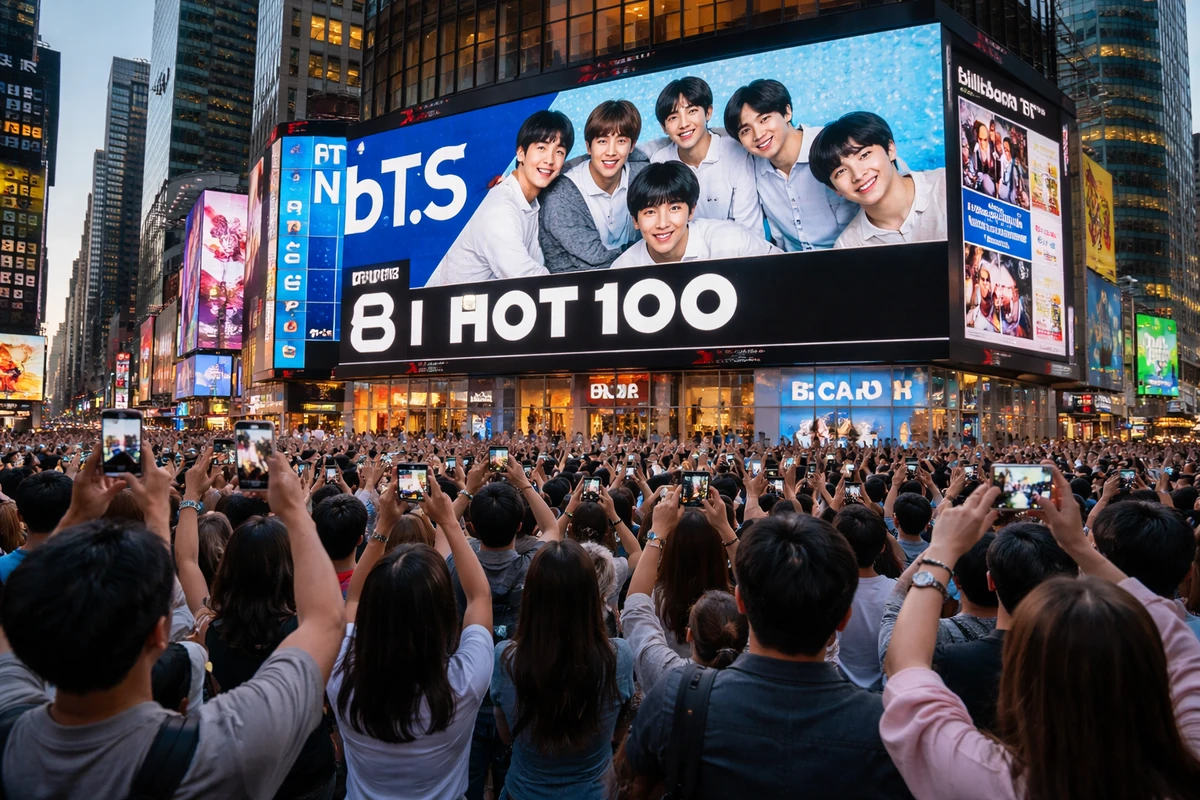
BTS’ new single “Swim” fell from No. 2 to No. 5 on this week’s Billboard Hot 100, a move that might look like a step back if you only glance at the numbers. In the weekly horse race of American pop charts, any decline can be framed as cooling momentum. But in this case, the more revealing story is not that the song moved down three spots. It is that it is still there — firmly inside the Top 10 — three weeks after debuting at No. 1.
That distinction matters, especially in an era when chart headlines tend to obsess over first-week splash. A No. 1 debut is the flashy moment. Staying near the top after the initial burst is the harder part. According to Billboard’s chart preview for the second week of April 2026, “Swim,” the title track from BTS’ fifth album “Arirang,” has now spent three straight weeks in the Hot 100’s Top 10. For any act, that signals more than a one-week event. For BTS, returning as a full group after years shaped by military service and solo activity, it suggests the comeback is holding beyond the opening surge.
For American readers less familiar with how K-pop is often discussed, it is worth pausing here. Coverage of Korean pop in the United States has often reduced success to a simple question: Did the song hit No. 1 or not? But that lens can flatten the real story. Pop hits are no longer built by one kind of listener or one kind of consumption. They rise and fall through a mix of streaming, radio, digital sales and fan behavior. A song that remains near the top after the comeback fireworks fade is often showing something more durable than hype.
That is the case being made by “Swim.” The song’s current standing suggests it is not merely living off the symbolic power of BTS’ reunion. It is benefiting from that, certainly. But three weeks into a release cycle, endurance starts to tell a different story — about repeat listening, ongoing fan investment and the group’s ability to keep competing in an American market crowded with new releases every Friday.
In other words, No. 5 is not just a lower number than No. 2. In this context, it is evidence that the floor remains unusually high.
Why three weeks in the Top 10 matters more than many headlines suggest
In U.S. music coverage, the first week of a major release often gets treated like opening weekend at the box office. There is a built-in temptation to chase the biggest debut, the loudest fan mobilization and the most dramatic headline. But just as Hollywood learned that a blockbuster’s staying power can matter as much as its opening, the music industry increasingly watches what happens after week one.
For BTS, a No. 1 debut for “Swim” was always going to be interpreted through the lens of scale. The group has one of the most organized and globally connected fan communities in modern pop. Their supporters, known as ARMY, have spent years demonstrating an ability to turn excitement into measurable outcomes, from album sales to chart performance to sold-out stadium tours. That makes the initial burst impressive, but not entirely surprising.
The more revealing number may be where the song lands in week three. A big fandom can help launch a single. Remaining in the upper tier of the Hot 100 requires more. It usually means the song is continuing to attract streams, continue to sell, and retain enough energy to withstand new competition. It also means listeners are not treating it like a ceremonial purchase tied only to the event of release.
This is especially true in the current U.S. market, where chart traffic is fast and fragmented. Consumers discover music through TikTok clips, Spotify playlists, YouTube shorts, radio programming, gaming tie-ins, streaming soundtracks and old-fashioned fan recommendation. Songs can rocket upward on virality and disappear just as quickly. A third week in the Top 10 is not immortality, but it is a sign that a track has found multiple lanes of support.
That is why the word “drop” can be misleading. Yes, BTS moved from No. 2 to No. 5. But charts are relative by nature. A song’s weekly position depends not only on its own performance but also on what else is crowding the field. Measured against the broader market, “Swim” is still functioning as one of the biggest songs in America. For a comeback single tied to a group returning after a prolonged interruption, that is a significant achievement.
The comeback carries extra weight because of South Korea’s military system
To understand why this release has drawn such intense attention, American readers need some cultural context. South Korea requires most able-bodied men to complete military service, a national obligation that has long shaped the careers of male celebrities, athletes and entertainers. For K-pop groups, that requirement can interrupt momentum at exactly the moment a group is trying to sustain a global audience.
BTS’ relationship to that reality has been followed for years in Korea and abroad. The group became the most globally recognized act in K-pop history, but its members were never fully outside the demands of the system. As each member entered military service, BTS shifted into a period defined less by collective activity and more by solo projects, pre-recorded content and the management of absence. For fans, that created a strange form of waiting: the group never disappeared from public consciousness, but its full-group identity was paused.
That is what makes “Arirang,” and “Swim” in particular, more than just another release. It is being received as the sound of restoration. The comeback carries symbolic weight because it marks the group’s return after roughly four years shaped by enlistment-related interruptions. In K-pop, “comeback” does not mean what it often means in the United States. Here, an artist can “come back” after a few months between promotional cycles. In Korea, the term is standard industry language for a new release, but in BTS’ case this comeback also has the emotional force that English speakers would normally associate with a true return after an absence.
That emotional force helps explain the explosive opening. Fans were not just consuming a song; they were participating in a moment that had been building for years. But symbolism alone does not keep a track high on the Hot 100 into its third week. Plenty of reunion records generate a spike of nostalgia and then fade. What “Swim” appears to be showing instead is that BTS’ return has translated from narrative into sustained market response.
There is another cultural layer in the album title “Arirang,” which invokes one of Korea’s most famous and emotionally resonant traditional folk songs. For Korean audiences, “Arirang” can suggest longing, resilience, separation and national identity. It occupies a place in Korean culture somewhat akin to the emotional recognition Americans might attach to an old standard like “America the Beautiful” or “This Land Is Your Land,” though the comparison is imperfect. By using that title, BTS seems to be signaling a return that is not just commercial, but also reflective — a reintroduction of self, history and identity after a long interval.
That does not mean every listener in the United States is parsing the same symbolism. But it does mean the comeback enters the market with meaning that goes beyond ordinary release-week excitement.
The digital sales story says something important about BTS’ fandom
If there is one data point from this chart week that deserves special attention, it is not the Hot 100 position alone. It is the fact that “Swim” remained No. 1 in digital song sales for a third straight week, with 24,000 downloads, according to Billboard’s reporting.
In a streaming-dominated music economy, digital purchases no longer function as the all-powerful indicator they once were in the iTunes era. Americans today mostly rent access to music through subscription platforms rather than buying tracks outright. So a strong download number can look old-fashioned on paper. But that is exactly why it is meaningful. Purchasing a song in 2026 is a more deliberate act than streaming it. It says something about intensity of support.
For BTS, this speaks to the character of the fan base. ARMY has long been noted not only for size, but also for organization and intentionality. Fans do not simply listen passively; many engage with releases as participants in a collective effort to support the group in measurable ways. That can include buying tracks, purchasing multiple versions of albums, coordinating streaming goals and amplifying releases across social platforms. Critics sometimes dismiss that as pure fan mobilization, as though it somehow counts less than other forms of success. But in the modern entertainment industry, committed paying customers are not a weakness. They are a competitive advantage.
That is especially true in a chart environment where volatility is the norm. Viral songs can explode and evaporate. Radio can be slow to respond. Streaming culture rewards ubiquity, but also forgetfulness. A loyal base willing to spend money repeatedly gives an artist insulation against the turbulence of the market. “Swim” topping the download chart for three consecutive weeks suggests not just initial enthusiasm, but a staying pattern of active support.
At the same time, it would be too simplistic to argue that the song’s success is only a fandom artifact. Sustained sales over several weeks require continued attention, and high placement on the Hot 100 still demands a broader package of performance. Fans can create a launchpad. They cannot entirely manufacture a song’s ongoing relevance in the face of strong competition from other major releases.
What the numbers suggest, then, is a hybrid reality that increasingly defines K-pop in America: fan-driven purchasing power and mainstream discovery can operate side by side. BTS remains unusually strong at the former, while still credible in the latter. That combination is one reason the group has repeatedly outlasted predictions that K-pop’s American breakthrough would be brief.
A crowded field makes No. 5 look stronger, not weaker
Charts do not exist in a vacuum, and this week’s ranking should be understood in relation to the songs around it. Billboard reported that Ella Langley’s “Pushin’ Texas” held at No. 1, while another Langley track, “Be Her,” reached No. 8. Also in the mix is “Golden,” a song from the animated feature “K-Pop Demon Hunters,” which remained at No. 7.
That landscape matters because it illustrates how competitive the upper reaches of the Hot 100 have become. Pop, country, soundtrack music and global crossover releases are colliding in the same small stretch of chart real estate. The modern American listener is moving fluidly across genres, and hits now emerge from a wide range of cultural pipelines — Nashville, TikTok, Hollywood franchise tie-ins and global fan networks alike.
In that context, “Swim” staying at No. 5 looks less like retreat and more like stabilization under pressure. If the song had plunged out of the Top 10 after the comeback week, that would have suggested the peak was mostly symbolic. If it were being propped up by only one metric while collapsing elsewhere, that would tell a different story as well. But what this week shows is a song still standing in the center of a crowded, highly competitive market.
That point is especially important for K-pop, which has often been judged in the U.S. through a narrower lens than domestic pop. When an American act falls from No. 2 to No. 5, the conversation often centers on momentum, competition and release cycles. When a K-pop act does the same, the discussion can too quickly shift to whether the act is “fading” or whether the fan base “failed to hold it.” That double standard misses how charts actually work.
The healthier interpretation is to ask not simply whether the song fell, but how it is holding. “Swim” appears to be holding through continued paid support, ongoing attention and enough broad consumption to remain among the week’s biggest songs. That does not guarantee a long run ahead. It does mean the song has not yet entered the kind of free fall that often follows a fandom-fueled debut.
What this says about K-pop’s changing place in the American market
There is also a bigger industry story here, one that extends beyond BTS. For years, K-pop’s performance in the United States was framed as novelty, then as disruption, and eventually as a recurring but still somewhat separate track within the broader pop economy. That framing no longer fully captures the landscape.
K-pop now exists in the U.S. market in multiple forms at once. There are traditional idol group releases, solo projects, soundtrack placements, collaborations with Western artists and songs boosted by film and television ecosystems. The presence of “Golden” from “K-Pop Demon Hunters” in the same upper chart tier as “Swim” is revealing. It suggests that “K-pop” is no longer only a matter of group promotion from Seoul. It has become a broader cultural category circulating through animation, streaming platforms, fandom communities and English-language media.
That expansion creates both opportunity and tougher competition. On one hand, K-pop has more entry points into American culture than ever before. On the other, standing out inside that widened field is harder. A Top 10 placement in 2026 may in some ways be more difficult to maintain than it was when K-pop was newer to many U.S. listeners, because the market is more saturated, the novelty factor is lower and the internal competition is sharper.
BTS’ current chart performance therefore works on two levels. It is a specific story about one group’s comeback single. But it is also a case study in how top-tier K-pop acts now compete: not as exotic exceptions, but as durable players in the same churn of metrics, narratives and genre rivalries that shape the rest of the American music business.
That shift may be the clearest sign of all that K-pop’s place in the United States has matured. The conversation is no longer just about whether Korean acts can break through. It is about what kinds of staying power they can build once they are already inside the system.
The next question is no longer whether BTS returned, but how long this run lasts
The next few weeks will matter because the story is now changing shape. The first question — can BTS come back as a full group and immediately command attention? — has already been answered. Yes. The second question is the more interesting one: Can “Swim” continue to hold the upper tier of the Hot 100 as the comeback glow fades and newer songs arrive?
That is where the standard becomes sharper. Global superstars are judged not merely by whether they succeed, but by how long they can sustain success. “Swim” already has a strong résumé: a No. 1 debut, three straight weeks in the Top 10 and three consecutive weeks atop the digital sales chart. For most artists, that would be enough to settle the matter. For BTS, whose scale has reset expectations repeatedly, those numbers may simply move the conversation into its next phase.
If the song remains in the Top 10 next week, the case for durability strengthens further. If digital sales continue to lead while other metrics soften, that will tell one story — a fan-powered backbone with selective mainstream breadth. If streaming or radio grows, it will tell another — a comeback track broadening beyond the core audience. Either way, the key issue now is not whether the song has already peaked, but what kind of support structure it retains after the peak.
That is a more useful way to read chart performance in 2026, not just for BTS but for pop music generally. The weekly rise-and-fall framing is seductive because it is simple. But music consumption is no longer simple. A song’s life can be extended by fandom, rediscovered through algorithms, revived by performance clips or folded into a broader cultural moment weeks after release. The smartest reading of the chart is not always the most dramatic one.
For now, the clearest takeaway is this: “Swim” may have slipped from No. 2 to No. 5, but the decline does not look like collapse. It looks like evidence that the song is still in the fight, and that BTS’ return is being measured not just in headlines, but in staying power. In a market that burns through attention quickly, that may be the most meaningful number of all.


0 Comments