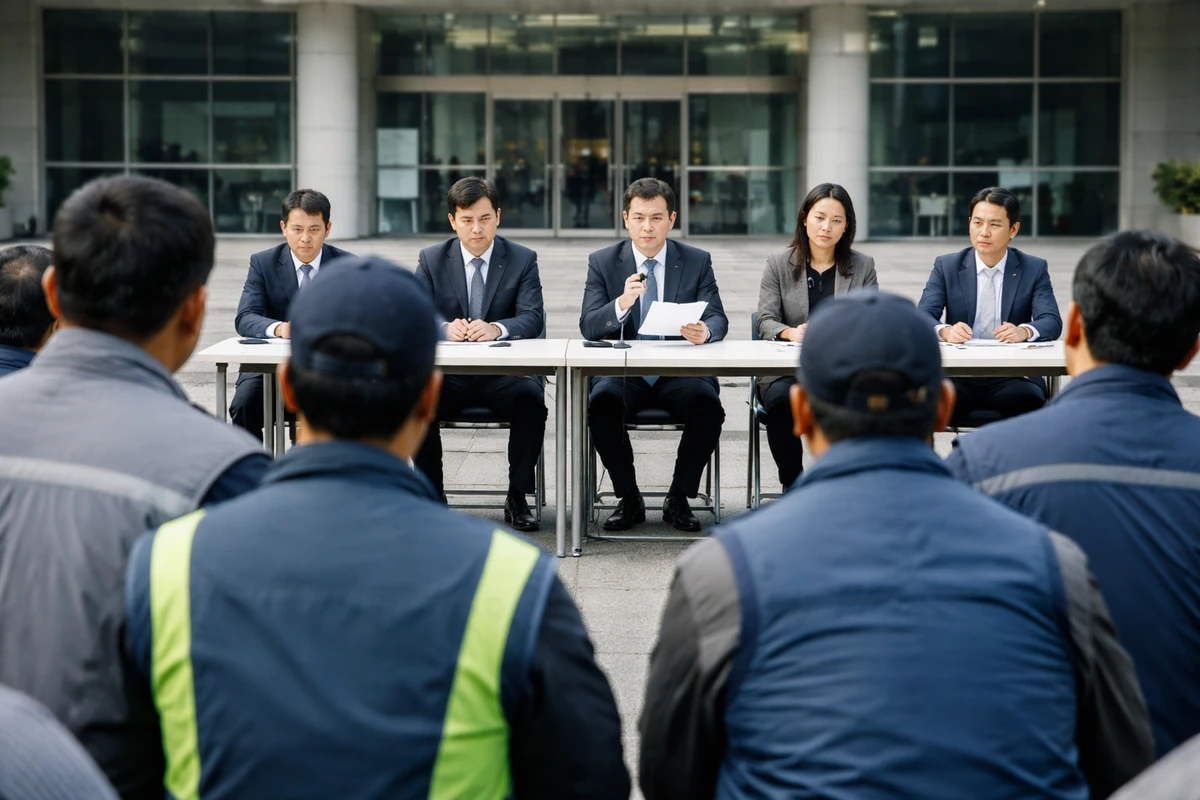
A local ruling in South Korea opens a much larger debate
A labor ruling in South Korea that, on its face, appears narrowly technical has reopened a much broader question about who really counts as the boss in modern public work. The case centers on Hwaseong, a fast-growing city south of Seoul, and a group of community sports instructors employed by the city’s sports council rather than directly by city hall. The instructors and their union argued that the city should be treated as a real bargaining party because it exercises meaningful control over hiring and pay. A regional labor commission disagreed, ruling that the city could not be considered the employer if it was mainly carrying out budgets and administrative duties set by law and local ordinance rather than directly determining working conditions.
To American readers, the dispute may sound like a Korean version of a familiar fight: When a public service is funded, designed and publicly branded by government, but delivered through a separate agency, contractor, nonprofit or quasi-public body, who is actually responsible for the workers doing the job? In the United States, similar arguments surface around school support staff, transit contractors, home care workers, charter school employees and workers employed through private firms that carry out public functions. The legal categories may differ, but the underlying tension is recognizable. Public officials often control the money and the policy, while the workers’ formal employer is another entity with limited power to improve wages or staffing.
That is why this South Korean case matters beyond one city and one occupation. It touches on a core feature of how government works in many democracies today: public services are increasingly delivered through layered institutions. One body holds the purse strings. Another signs the contracts. Another supervises the workplace. Another claims legal independence. Workers, meanwhile, are often left trying to negotiate with the organization that is closest on paper but not necessarily the one with the most real power.
In South Korea, the April decision by the Gyeonggi Regional Labor Relations Commission has become a fresh marker in an old labor debate. The ruling involved a petition brought by the Korean Confederation of Trade Unions-affiliated Public Solidarity Union, which argued that Hwaseong had enough practical authority over sports instructors’ allowances and hiring to be recognized as an employer for bargaining purposes. The commission rejected that claim, drawing a line between influence and direct control. That distinction may sound dry, but it has major consequences for thousands of workers in Korea’s public-facing sectors.
The legal dispute may have started in a sports program, but its implications reach into schools, cultural institutions, care services, maintenance work and other corners of public life where the government’s role is obvious to residents but harder to pin down in labor law.
Who are South Korea’s “sports for all” instructors?
The workers at the center of the case are known in Korea as “living sports instructors,” a term that does not translate neatly into American English. They are not elite coaches preparing Olympic athletes. They are closer to community recreation professionals, youth fitness coordinators and public wellness instructors rolled into one. They run exercise and sports programs for residents, often at neighborhood facilities, public gyms, community centers and schools. Their work supports a broader Korean policy goal: improving public health and encouraging everyday participation in sports.
For Americans, the closest analog might be city recreation staff who organize senior fitness classes, after-school sports, neighborhood wellness programs or local youth leagues. But unlike a straightforward municipal parks department job in the United States, these Korean positions often exist in a more complicated institutional setup. The workers may perform services that the public sees as clearly belonging to the city, yet their official employer is not the municipal government itself. Instead, they may be attached to a sports council, association, foundation or other arm’s-length organization tied to the local government.
That structure is common in South Korea’s public sector. Local governments frequently rely on affiliated bodies, delegated agencies or entrusted organizations to carry out work. In Korean administrative practice, this can create a gap between public function and formal employment. Residents may reasonably assume the workers are city employees because they represent a city-sponsored program. But when disputes arise over pay, scheduling, discipline, job security or collective bargaining, the workers are told that their direct employer is the separate organization, not city hall.
This arrangement matters because sports instructors are not peripheral workers in a luxury service. They are often the frontline labor behind public recreation and wellness efforts, especially in a country grappling with aging, youth health concerns and demand for accessible community programming. Their work is public-facing, visible and often essential to how local governments present themselves as responsive providers of services. Yet the more public the mission appears, the more jarring it can be for workers to find that the government funding and promoting the work is not legally on the other side of the bargaining table.
That disconnect is exactly what gave this case its force. The union’s argument was not simply that the city had some influence. Almost every government funder has some influence. The deeper claim was that the city’s involvement in setting the terms of the program was concrete enough that it should share labor responsibility. The labor commission’s ruling said, in effect, that such a conclusion requires more than budgetary oversight or general policy authority.
The legal fault line: influence versus control
The central question in the Hwaseong dispute was whether the city had what Korean labor discussions often describe as “substantial control” over working conditions. That idea has become increasingly important in labor fights involving subcontracting, outsourcing and indirect employment. Put simply: Is the entity that signs the paycheck the only employer that matters, or can another institution also be treated as an employer if it effectively decides how people are hired, paid and managed?
The union argued that the city’s role in shaping hiring and allowances for the sports instructors was significant enough that it should be recognized as more than a distant funder. That position aligns with a wider labor push in South Korea to expand responsibility beyond the traditional direct employer, especially in workplaces where layers of contracts and delegated authority can shield the main decision-maker from accountability.
The labor commission took a narrower view. According to the summary of the decision, the commission reasoned that a local government is hard to classify as an employer if it is primarily executing budgets established under statute and local ordinances rather than directly determining individual workers’ conditions of employment. In practical terms, that means legal employer status still turns heavily on who makes specific decisions about wages, hiring systems, personnel authority and day-to-day command, not simply who designs the broader program or controls the public money behind it.
This is a crucial distinction. In public administration, influence is everywhere. Governments approve budgets, set policy goals, define program standards and evaluate outcomes. But labor law typically asks more pointed questions: Who makes the final hiring call? Who sets the wage structure? Who has disciplinary power? Who gives orders on the job? Who can renew or terminate the contract? The commission appears to have concluded that even if Hwaseong shaped the environment around the instructors’ work, that was not enough to establish employer status without stronger proof of direct control over these concrete employment decisions.
For readers in the United States, the reasoning may evoke disputes around the “joint employer” standard, a phrase used in American labor law to describe situations in which more than one entity may be responsible for workers. The Korean legal framework is different, and local governments operate under different administrative rules, but the practical problem is similar. Workers and unions are trying to follow the chain of power. Employers and governments often answer by pointing to the chain of contracts.
That is why the case is not simply about one city winning or one union losing. It is about where the law draws the line between structural power and legal responsibility in a fragmented labor system.
Why this matters far beyond one sports council
The importance of the ruling lies in the kind of workers it affects. South Korea’s public sector includes many people whose jobs are public in purpose but indirect in form. They work in schools, social welfare, facilities management, child care, elder care, arts programming, cultural institutions and recreation. Their labor is woven into daily life. Yet many are not formally employed by the ministry, municipality or public office that funds or designs the service.
This is not unique to Korea. Across the United States, public institutions have increasingly turned to outside operators, nonprofit partners and quasi-independent bodies. School districts rely on vendors and staffing companies. Cities contract out maintenance or social services. State-funded care work may be delivered through agencies that themselves operate under tight reimbursement rules. In many of those systems, workers discover that the entity they negotiate with lacks the financial autonomy to satisfy their demands, while the entity with real fiscal leverage insists it is not the employer.
That is the structural frustration behind the Korean debate. If the sports council is the only recognized employer, then the union may be forced to negotiate with an organization whose budgetary room is limited because city hall controls the broader financial framework. If the city is not legally responsible, then the bargaining process risks becoming formalistic: workers can press their case, but the party across the table may not have the power to fully respond.
South Korean labor advocates have long argued that this gap weakens labor rights in the public sphere. A worker can be central to a public service but still be kept at arm’s length from the institution that actually determines the resource envelope. In effect, the worker carries public responsibilities without enjoying direct access to public accountability. The burden of the job is public; the channel for improving the job is private, semi-private or institutionally fragmented.
Employers and local governments see it differently. From their perspective, legal boundaries matter for a reason. Municipal governments are creatures of law, operating under budgets approved through formal processes and constrained by local councils, ordinances and administrative rules. If every public-facing worker employed by an affiliated entity could treat city hall as the employer, local officials argue, the structure of delegated administration would become unstable. The distinction between an autonomous organization and the government that funds it would erode, and local governments could be drawn into labor relationships they do not directly manage.
Those competing views help explain why this seemingly specialized ruling has drawn broader attention. It touches the architecture of public labor, not just one grievance about one set of allowances.
The politics behind the phrase “Yellow Envelope Law”
The union in this case argued that Hwaseong should be treated as a kind of employer recognized under the framework often associated in Korean politics with the so-called “Yellow Envelope Law.” That phrase may be unfamiliar to international readers and is worth explaining. It refers to a broader political and legislative debate in South Korea over expanding labor protections in complex employment structures, especially by widening who can be held responsible when workers’ conditions are controlled by entities other than their formal direct employer.
The nickname comes from an earlier labor solidarity campaign and has since become shorthand for politically charged efforts to revise labor rules in favor of workers facing subcontracting and indirect employment. Supporters say such reforms are necessary because the old model of a single, clearly identifiable employer no longer matches the reality of many workplaces. Critics say the concept risks creating legal uncertainty and imposing bargaining duties or liability on parties whose connection to the workers is too indirect.
In American terms, one way to think about it is as part of a broader argument over whether labor law should follow the formal corporate structure or the actual chain of command and financial control. It is not a perfect comparison, but it resembles debates over fissured workplaces, staffing agencies, franchise systems and subcontracted labor, where the question is whether the law should look past the paperwork to the practical distribution of power.
The Hwaseong ruling does not resolve that national argument. But it does signal caution. At least in this case, the labor commission was unwilling to stretch employer status merely because the city exercised policy and budgetary influence in a public service system. For unions, that means future cases may require far more detailed evidence: documents showing city approval over hiring, explicit control of personnel standards, intervention in evaluations or renewals, or specific authority over compensation structures.
That evidentiary burden matters. It suggests that future labor disputes in the public sector may become increasingly document-driven, less about broad claims of public responsibility and more about proving, line by line, who signs off on what. In other words, workers may need to map the administrative machinery itself to show that a government body is not just influential in theory but decisive in practice.
What the ruling says about local government and responsibility
The commission’s decision also reveals something deeper about local governance in South Korea. It reaffirms that holding the budget is not, by itself, the same as being the employer. In many systems, money is power. But in labor law, power is often parsed into finer categories: who commands, who hires, who disciplines, who sets the wage grid. The ruling suggests that even substantial fiscal influence may fall short if it is filtered through legal and administrative frameworks rather than exercised as direct workplace authority.
That has institutional consequences. It allows local governments some distance from labor disputes involving affiliated entities, even when the public sees the service as unmistakably municipal. It also places heavy responsibility on intermediary organizations such as sports councils, foundations or associations. Those bodies may have to answer as employers even when they operate with constrained discretion and depend heavily on city budgets.
The result can be a familiar public-sector paradox: the organization with legal responsibility may lack real financial freedom, while the organization with financial leverage may disclaim legal responsibility. For workers, that can make labor rights feel thinner in practice than they appear on paper. They may have bargaining rights, but not necessarily against the actor capable of making meaningful changes.
Local governments have their own counterargument. If a city is required to assume employer status every time it funds and supervises a delegated public service, the legal distinction between direct administration and delegated administration could collapse. That would not only create labor implications; it could reshape how local governments structure entire categories of public work. Officials can plausibly argue that public administration depends on preserving these boundaries, especially when separate organizations were created precisely to manage programs with some institutional independence.
Still, a legal line that appears tidy from the administrative side can look artificial from the worker’s side. Workers experience their jobs through control over schedules, standards, evaluation and pay. If those conditions are heavily conditioned by municipal rules or funding decisions, then being told the city is not really the employer may feel less like a principled legal distinction and more like an evasion.
The view from the ground: public work, private distance
The sharpest tension in the case may be the distance between institutional logic and lived experience. For city officials, the matter can be framed in terms of jurisdiction, delegated authority and statutory limits. For workers, the matter is more immediate: Who ultimately shapes the conditions under which I do a public job? If the answer, in practice, feels like the city, then a ruling denying city employer status can seem disconnected from reality.
That disconnect is especially visible in occupations like community sports instruction because the work is so closely tied to everyday civic life. Residents see the service as part of the city’s promise to the public. The classes are part of neighborhood infrastructure, much like park programming or senior recreation offerings in American towns. Yet the worker delivering that service may find that the most powerful institution in the chain is legally out of reach when it comes time to negotiate.
This is the enduring dilemma of indirect public employment. Governments can preserve flexibility, distribute risk and maintain administrative distance by placing work in affiliated organizations. But workers in those systems can experience fragmentation instead of accountability. The public mission is unified; the employment relationship is not.
South Korea’s labor movement has spent years pressing on that contradiction. The debate is not only about legal doctrine. It is also about a broader social question: If society depends on these workers to perform public services, should the law make it easier to hold public institutions responsible for the labor conditions behind those services? Or should legal responsibility remain tightly confined to the formal employer, even if that leaves workers negotiating with entities that lack the means to address the root issue?
The Hwaseong ruling does not settle those questions. What it does is clarify the hurdle. Influence, even meaningful influence, may not be enough. Unions seeking to bring local governments to the bargaining table will likely need stronger proof of direct, operational control. That means the next phase of these fights may hinge less on moral arguments about public responsibility and more on the fine-grained paper trail of administrative power.
What comes next
In practical terms, the ruling is likely to shape strategy on all sides. Unions will probably look for more specific evidence in future cases: approval procedures for staffing, internal directives on pay standards, oversight of evaluations, conditions attached to subsidies or evidence that local officials intervene in renewals and personnel matters. Local governments, meanwhile, may seek to preserve even clearer formal separations between policy support and employer functions so they are less vulnerable to claims of being a de facto employer.
For the sports instructors in Hwaseong and similarly situated workers elsewhere, the immediate effect may be sobering. A reaffirmed legal boundary means the path to meaningful bargaining remains complicated. Even when workers perform an unmistakably public service, the law may still tell them that the state is nearby but not across the table.
And yet these disputes rarely disappear after one ruling. They return because the underlying structure keeps producing the same conflict. As governments rely on hybrid institutions to deliver public goods, labor law is repeatedly asked to answer a deceptively simple question: Who is the real employer? The answer matters not only for legal doctrine but for how democratic accountability works in everyday life.
When a resident joins a city-sponsored fitness class, the arrangement looks simple. The city offers a service, a trained instructor delivers it, and the public benefits. But behind that ordinary scene is a much more complex map of power, money and responsibility. South Korea’s latest labor ruling shows how contested that map remains. It also serves as a reminder, familiar on both sides of the Pacific, that in modern public work the hardest question is often not what the job is, but who really owns it.
Comments
Post a Comment