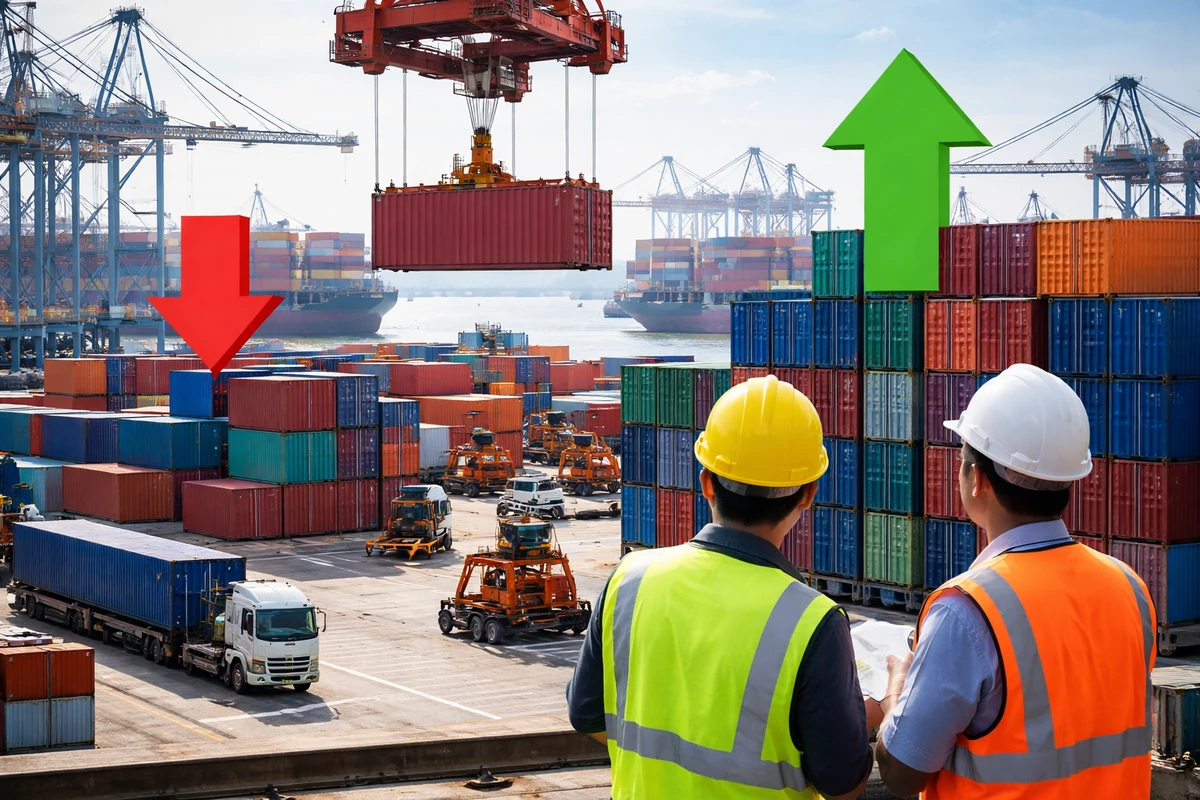
A sudden shift in the world’s factory
For years, one of the simplest ways to take the temperature of the global economy has been to watch China’s trade data. When Chinese exports are booming, it usually means consumers and businesses around the world are still buying, factories are still humming and supply chains are still moving. When those numbers weaken, it can be an early warning that something deeper is changing.
That is why China’s March trade report deserves attention far beyond Beijing. On the surface, the numbers look positive enough: exports rose 2.5% from a year earlier, reaching about $321 billion, while imports jumped 27.8%. But the headline increase in exports masks a dramatic cooldown. Just one month earlier, exports had surged nearly 40%. March’s export growth was not only far weaker than February’s pace; it also missed market expectations by a wide margin.
In other words, the picture is not one of a Chinese trade machine roaring ahead in a straight line. It is one of an economy adjusting under pressure, with exports losing momentum even as imports rise sharply. That combination suggests China is entering a more complicated phase — one shaped by geopolitical friction, supply chain stress, policy recalibration and an evolving effort to move up the manufacturing value chain.
For American readers, the easiest comparison might be the way Wall Street looks past a company’s top-line revenue and focuses on what is happening underneath. A business can still post growth while showing signs of weaker demand, rising costs or a major strategic shift. China’s March trade report reads much the same way. The topline says growth. The internals say transition — and potentially trouble.
That matters because China is not just another exporting nation. It remains central to the way goods move across Asia and into American homes, from electronics and machinery to industrial parts and consumer products. Changes in China’s trade flows can affect everything from shipping costs and factory orders to inflation and inventory planning in the United States.
Why export growth slowed so abruptly
The big question is why exports cooled so fast. Some month-to-month volatility is normal, and trade data often swing because of seasonal factors, shipping schedules or a weak comparison base from the prior year. But the gap between February’s 39.6% surge and March’s 2.5% increase is so large that it is hard to dismiss as statistical noise alone.
Several forces appear to be converging at once. One is the deteriorating external environment. Ongoing tensions involving Iran and the broader instability tied to the Middle East have added uncertainty to energy markets and maritime shipping routes. When war risk rises, companies involved in global trade tend to become more cautious. They delay purchase orders, change delivery schedules, diversify shipping lanes or build in wider buffers. For an economy like China’s — deeply tied to manufacturing and heavily reliant on moving both intermediate and finished goods across borders — that uncertainty can quickly show up in export figures.
Another factor is policy. Chinese authorities have increasingly emphasized balancing imports and exports rather than simply maximizing export growth at all costs. That may sound technical, but it reflects a real strategic concern. Large and politically visible trade surpluses can intensify friction with major trading partners, especially the United States. At a time when Washington remains focused on supply chain security, industrial policy and strategic competition with Beijing, Chinese policymakers have an incentive to avoid the appearance of an ever-widening export-led imbalance.
That does not mean Beijing is deliberately engineering a collapse in exports. It does mean China may be more willing than before to tolerate slower export growth if it reduces diplomatic pressure, stabilizes domestic supply and supports a broader economic transition. In practical terms, that could translate into policies that encourage more imports of key materials and industrial inputs while placing less emphasis on headline export gains.
There is also a structural dimension. China has spent years trying to move beyond its image as the world’s low-cost assembly line. It wants to export more advanced industrial and technology-intensive products and rely less on labor-heavy, lower-margin goods. That kind of shift rarely happens smoothly. As the export mix changes, strong growth in high-end sectors can coexist with weakness in more traditional categories, producing an uneven overall result.
Seen in that light, March’s numbers may be less about a sudden collapse in demand and more about a trade model under revision. China is still exporting vast amounts of goods. But the question increasingly is not just how much it sells abroad. It is what it sells, where it sells it and under what geopolitical constraints.
The import surge may matter even more
If the export slowdown raised eyebrows, the import jump was the true surprise. Imports rose 27.8% in March from a year earlier — an unusually strong increase that points to a very different side of the Chinese economy.
At first glance, the optimistic interpretation is that domestic demand is recovering. Stronger imports can suggest that factories are ramping up production, consumers are spending more and businesses are replenishing stock. For a country wrestling with uneven growth and concerns about confidence, that would be welcome news.
But there is another possibility: China may be importing more not because everything is booming at home, but because it is trying to get ahead of potential disruption. When global tensions rise, large manufacturing economies often rush to secure energy, raw materials and industrial inputs before costs climb further or supplies tighten. In that sense, surging imports can reflect caution as much as confidence.
This is especially relevant in the current environment. Instability connected to the Middle East has already raised concerns about energy prices, petrochemical supply and shipping reliability. Reports elsewhere in Asia about tightening supplies of plastic-related feedstocks underscore how quickly raw-material stress can spread through regional manufacturing networks. China’s import increase may therefore reflect a defensive move: building inventories, locking in supply and reducing vulnerability to future shocks.
For American readers, a useful analogy might be the way U.S. retailers behaved during the supply chain disruptions of the pandemic era. Companies that once relied on just-in-time logistics began ordering earlier, ordering more and holding larger inventories because they no longer trusted the old system to deliver on schedule. China’s import surge may be part of a similar adjustment, but on a much larger industrial scale.
The combination of weaker export growth and stronger imports also has a political and macroeconomic significance. It suggests China’s trade surplus could narrow, at least temporarily. Internationally, that may soften criticism that China depends too heavily on an export-led model. Domestically, it may help support production and investment by ensuring that manufacturers have access to the materials they need. Trade data often function as a leading indicator, showing changes in business behavior before they appear clearly in headline growth numbers. If so, March may be signaling that Chinese firms are preparing for a more volatile and contested commercial environment.
The sharp drop in exports to the United States
Among the country-by-country details, one figure stands out: China’s exports to the United States fell 26.5% from a year earlier in March. That is more than a routine fluctuation. It is a sign that the economic relationship between the world’s two largest economies remains under strain, even when headlines are not dominated by tariffs or summit diplomacy.
For years, the United States was one of the most important end markets for Chinese-made goods, from furniture and toys to electronics and home appliances. American consumers became accustomed to the low prices and broad selection that came with China-centered manufacturing. Big-box retailers, e-commerce platforms and multinational supply chains all helped reinforce that system.
But over the past several years, the U.S.-China trade relationship has changed fundamentally. Tariffs imposed during the Trump administration did not fully unwind under President Joe Biden. Washington has layered on export controls, industrial subsidies and a broader national security framework aimed at reducing strategic dependence on China in key sectors. American companies, meanwhile, have increasingly explored what supply chain experts call “China plus one” strategies — keeping some production in China while shifting other operations to countries such as Vietnam, India or Mexico.
That phrase, common in business circles but less familiar outside them, essentially means companies no longer want all of their manufacturing eggs in one basket. The pandemic exposed the risk of overconcentration. Geopolitical tensions made that risk feel even more urgent. The result is not a sudden divorce from China but a gradual rebalancing, with some production and sourcing moving elsewhere.
The 26.5% decline in Chinese exports to the United States suggests that rebalancing is still underway. It may also indicate softer American demand in certain categories, but the broader meaning is political as much as economic. Trade between the two countries is no longer being shaped only by price and efficiency. It is increasingly shaped by strategy, regulation and mutual suspicion.
That has real consequences. A drop in Chinese exports to the U.S. can ripple through global logistics networks, affect sourcing decisions for American importers and alter pricing dynamics for everything from household goods to industrial inputs. It also increases pressure on China to find alternative markets or to sell a different mix of products abroad. In that sense, the decline in U.S.-bound exports is not just a bilateral datapoint. It is evidence of a larger reordering in the global economy.
Technology exports are rising, but not enough to offset the broader slowdown
There was one bright spot in China’s March data: exports of high-tech products rose sharply, climbing 31.36% from a year earlier to roughly $102 billion. That performance fits with Beijing’s long-running effort to move toward higher-value manufacturing, including advanced electronics, industrial equipment and other technology-intensive goods.
For China, this is more than an economic upgrade. It is a strategic project. The country’s leadership has made clear that future competitiveness will depend less on low wages and mass production alone and more on mastering the industries that define modern power: semiconductors, next-generation communications, electric vehicles, batteries, artificial intelligence-related hardware and advanced machinery.
American readers may recognize the parallel with Washington’s own industrial push. The CHIPS and Science Act, incentives for clean energy manufacturing and bipartisan concern about critical supply chains all reflect the same broad reality: technology and manufacturing are no longer viewed merely as business sectors. They are increasingly treated as pillars of national security and geopolitical influence.
China’s strong technology-export growth suggests that, despite external pressure, it is still finding room to expand in more sophisticated segments of global trade. But those gains did not offset the broader export slowdown. That matters because it shows both the promise and the limits of China’s transition.
High-tech growth can improve margins, strengthen industrial capacity and reduce dependence on commodity-style exports. But if major markets become harder to access, global demand softens or logistics become less reliable, even advanced products cannot fully insulate the broader export sector. In addition, many high-tech supply chains themselves are globally interdependent, meaning they remain vulnerable to sanctions, export controls and disputes over standards or intellectual property.
So while the rise in technology exports is important, it should not be read as proof that China has solved its trade challenges. Instead, it suggests the country is in the middle of a difficult shift: trying to replace old growth drivers with new ones while the global system around it becomes less open and more politicized.
What this means for Asia and the rest of the world
China’s trade data are never just about China. As the central hub in many Asian supply chains, the country’s changing export and import patterns affect manufacturers across the region, including South Korea, Japan, Taiwan and Southeast Asia.
When China imports more raw materials and intermediate goods, suppliers elsewhere in Asia may benefit. But if that import surge reflects stockpiling or anxiety over future shortages, it can also intensify competition for key inputs. That is especially true in sectors linked to petrochemicals, electronics components and industrial materials. Reports of shortages in certain plastic feedstocks in Southeast Asia show how quickly supply strain in one part of the region can spill into others.
The same logic applies to exports. If China’s U.S.-bound shipments keep weakening, some neighboring countries may capture more orders as companies diversify sourcing. Vietnam and Mexico, for example, have already benefited in certain manufacturing categories as firms seek alternatives to direct China exposure. But that shift is not a simple win for everyone else. Many exporters in Asia remain tied to China through component supply, machinery sales or assembly networks. A slowdown in Chinese manufacturing can therefore hurt countries that also compete with China.
South Korea offers a particularly useful example. Korean companies compete with Chinese firms in high-value sectors such as semiconductors, batteries, displays and advanced manufacturing. At the same time, China remains a major market and production hub linked to Korean industry. If China’s trade structure shifts toward more advanced exports while reducing dependence on certain foreign inputs, that could intensify competition for Korea even as it reshapes regional demand.
For the United States, the implications are broad. A more volatile Chinese trade profile could affect inflation trends, especially if shipping disruptions or raw-material competition raise costs. It could also influence the strategic debate in Washington over tariffs, industrial policy and the resilience of U.S. supply chains. If China is importing more defensively and exporting more selectively, American officials and businesses alike may face a world in which trade flows are less predictable and less governed by purely economic logic.
More than a data point
The most important takeaway from China’s March trade report is that it points to a changing global system, not just a changing month. Exports are still growing, but barely. Imports are booming, but for reasons that may be as defensive as they are optimistic. Sales to the United States are down sharply. Technology exports are rising but not enough to carry the whole economy.
Taken together, those figures suggest China is no longer operating within the old, familiar trade script in which rising exports automatically meant a bigger surplus, greater factory activity and deeper integration into the global economy. Instead, Beijing appears to be navigating a more fragmented landscape — one in which war risk, shipping insecurity, trade friction and industrial policy all shape the numbers at the same time.
For American audiences, that distinction matters. It is tempting to read a trade report as a narrow economic update, relevant mainly to investors or trade ministries. But China’s trade data increasingly act as a scoreboard for larger forces: the future of globalization, the durability of U.S.-China economic ties, the health of Asian supply chains and the contest over who controls the technologies that will define the next era of industry.
March’s numbers do not tell us that China’s export model has broken down. Nor do they prove that domestic demand is fully recovering. What they do show is a notable change in temperature. The world’s largest manufacturing power is still moving a huge volume of goods, but the balance is shifting. And when the balance shifts in China, the effects rarely stay there.
In the months ahead, economists and policymakers will be watching whether March was the beginning of a durable trend or a sharp but temporary adjustment. Either way, the report is a reminder that global trade is no longer just about who can make products most cheaply or ship them most efficiently. It is also about who can adapt fastest to a world in which economics, politics and security are increasingly impossible to separate.
Comments
Post a Comment