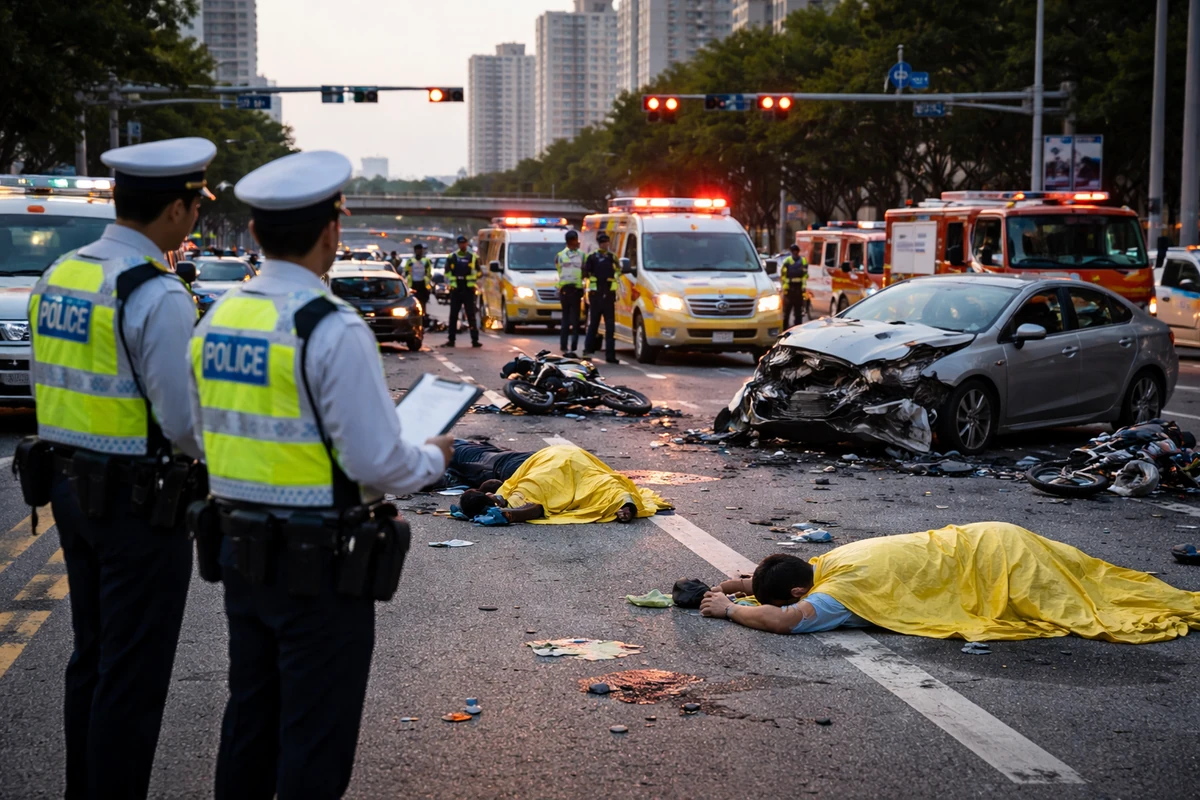
A troubling paradox on South Korea’s roads
South Korea recorded fewer traffic accidents last year, but more people died in them — a jarring combination that is forcing officials and the public to rethink what road safety really means in one of Asia’s fastest-aging countries.
The country reported 2,549 traffic deaths for the year, according to an April 17, 2026, social affairs report, even as the overall number of crashes declined. At the same time, deaths linked to older drivers rose 10.8% from a year earlier. On paper, those numbers seem to point in opposite directions. In reality, they tell a more complicated story: South Korea may be getting better at reducing the number of collisions, while becoming more vulnerable to the deadliest consequences when crashes do happen.
That distinction matters. For years, traffic policy in South Korea, as in the United States and many other countries, has focused heavily on frequency — how to reduce the number of crashes through tougher enforcement, anti-drunk-driving campaigns, lower speeding rates, better signals and safer cars. Those efforts appear to have helped bring down accident counts. But a rise in fatalities suggests the country has entered a different phase of road risk, one in which the severity of crashes matters as much as, or more than, the raw number of incidents.
For American readers, there is a useful comparison here. The United States has long wrestled with a similar disconnect: safer vehicles and falling fatality rates over some periods did not eliminate the danger created by larger SUVs, distracted driving, speeding and road designs that leave pedestrians exposed. South Korea’s current debate has its own local dimensions, but the central question will sound familiar on either side of the Pacific: What good is a decline in crashes if the crashes that remain are more likely to kill?
In South Korea, that question lands with particular force because the country is aging at extraordinary speed. The issue is not simply whether more older adults are behind the wheel. It is that more of the people using the transportation system — drivers, walkers, cyclists and bus riders alike — are older, physically more fragile and more likely to suffer severe injury from the same impact that a younger person might survive.
That changes how a society has to think about danger. A low-speed collision in a parking lot, a turning error at an intersection or a nighttime strike involving a pedestrian may not sound like a mass-casualty event. But in an aging society, these ordinary crashes can carry life-or-death consequences. South Korea’s statistics suggest the country is no longer dealing primarily with the problem of many accidents. It is increasingly dealing with the problem of fewer, but more lethal, ones.
Why aging matters beyond the driver’s seat
Public discussion of road safety often gravitates toward older drivers, and South Korea is no exception. When deaths involving elderly drivers rise, the immediate political temptation is to frame the issue in simple terms: older people are driving longer, therefore they are the problem. But that interpretation is too narrow to explain what is happening.
South Korea’s roads are aging, not just its motorists. The country has one of the world’s lowest birth rates and one of its fastest-growing senior populations. That demographic shift affects every part of daily mobility. Older pedestrians take longer to cross wide streets. Older bicyclists may be less stable and more vulnerable to falls or collisions. Older transit users may rely more heavily on buses and subways but face difficulty getting to stops, navigating poorly lit streets or judging fast-moving traffic at complex intersections.
In other words, the transportation system is serving a population whose physical resilience is changing. A crash that once resulted in a broken bone may now lead to a fatal head injury or complications from trauma in a body less able to recover. That is not a moral failing or proof of recklessness. It is a structural fact of an aging society.
This is a crucial distinction because it shifts the policy lens from blame to design. If officials look only at whether older adults make driving mistakes, they may miss the broader reason fatalities are climbing. Age can affect vision, reaction time and judgment, but it also affects survivability. The same impact, at the same speed, may produce radically different outcomes depending on who is involved. A road system calibrated around younger bodies and faster decisions can become much more dangerous once the average road user is older.
Americans have seen versions of this debate before. In many U.S. suburbs and rural communities, giving up a driver’s license can mean losing access to doctors, grocery stores, family and social life. South Korea faces a comparable dilemma, especially outside Seoul and other major metropolitan areas. When a car is not a luxury but a lifeline, it becomes much harder to treat driving cessation as a simple fix.
That is why the phrase “older driver problem” can be misleading. It turns a broad social transformation into a story about one group’s shortcomings. South Korea’s numbers point instead to a transportation system under strain from demographic reality. The question is not merely who is making mistakes. It is whether roads, vehicles, signals and transit options have adapted to the people who now depend on them.
What the numbers may really be saying
The figure of 2,549 traffic deaths is more than a line in a government spreadsheet. Coupled with falling accident totals, it suggests a change in the nature of risk itself. South Korea may be moving away from an era of frequent, widespread crashes and toward one marked by fewer incidents that carry higher stakes.
That kind of shift can happen for several reasons. Cars may be safer than before in routine collisions, but certain types of crashes — especially those involving pedestrians, intersections or vulnerable older road users — remain highly unforgiving. Urban design may reduce some forms of reckless driving while doing less to protect people crossing streets at night. Better enforcement may cut down on the number of minor collisions without addressing the conditions that turn a serious crash into a fatal one.
The reported 10.8% increase in deaths involving older drivers offers one clue, but not the whole answer. It may reflect reduced ability to respond to sudden road conditions. It may also reflect the fact that older drivers themselves are less likely to survive when a crash happens. And it may reveal something deeper about where these drivers live and why they keep driving.
In smaller cities, rural areas and regional communities across South Korea, daily life is often built around the assumption of car use. Hospitals, traditional markets, government offices and workplaces may be spread out. Bus routes can be limited, and service intervals long. In those places, driving is not merely a matter of convenience or independence in the American cultural sense. It is basic infrastructure for participating in society.
That geographic reality matters because it means risk is not distributed evenly. A blanket national policy may sound fair in Seoul, where subways and buses are dense and taxis are plentiful, but feel punitive in a county where the nearest clinic is miles away and public transportation is scarce. This urban-rural divide is familiar in the United States, where policymakers often discover that the transportation choices available in New York or Washington do not resemble those in Iowa, Mississippi or rural California.
So when South Korea’s statistics show rising deaths amid fewer accidents, the most important takeaway may not be driver incompetence. It may be structural vulnerability: a society in which the people on the road are older, the consequences of injury are more severe, and alternatives to driving are often inadequate. That does not absolve individual drivers of responsibility. It does, however, suggest that moralizing about careless seniors will not solve a problem rooted in demography, geography and design.
Why taking away licenses is not a complete solution
Whenever concern rises over older drivers, one proposal quickly returns: encourage seniors to surrender their licenses. South Korea has experimented with programs that offer incentives for voluntary license return among older adults. From an administrative standpoint, the idea has obvious appeal. It is relatively easy to explain, easy to measure and politically visible.
But easy is not the same as effective.
A license surrender policy can reduce risk for some drivers, particularly those with clear cognitive or physical impairments. Yet as a broad solution, it runs into a basic conflict between safety and mobility. If a person stops driving in a place without dependable alternatives, the result may be isolation, missed medical appointments, lost access to groceries and weaker social ties. In a rapidly aging country, that trade-off is not abstract. It shapes everyday survival.
American readers may recognize this from debates over aging in place. In much of the U.S., older adults remain in car-dependent communities because that is where their homes, families and routines are. Losing the ability to drive can become a precursor to loneliness, dependency or a move into assisted living. South Korea’s rural and suburban areas pose similar problems, even though the country is geographically smaller and more densely populated overall.
There is another reason the license-surrender approach is limited: older adults are not a uniform category. Someone in their late 70s who drives only in daylight, avoids highways and has an excellent safety record is not the same as someone with declining vision, slower cognition and a history of risky maneuvers. Lumping everyone together by age may satisfy political demands for action, but it is a blunt instrument.
A more precise approach would focus on fitness to drive rather than age alone. That could include periodic screening, graduated restrictions, refresher education, in-vehicle assistance technologies and road redesigns that reduce the kinds of situations most likely to produce catastrophic outcomes. In the United States, states have taken different approaches to older driver renewal, from vision tests to shorter renewal periods, though the effectiveness of those policies varies. South Korea now faces the same question many aging societies do: how to protect public safety without turning old age itself into a disqualifying offense.
Framed that way, the issue becomes less about punishment and more about accommodation. A system designed for older adults — clearer signage, longer crossing times, better lighting, simpler intersections, safer turns and alternative transportation — is usually safer for everyone else too, including children, people with disabilities, novice drivers and night-shift workers heading home after dark.
That is a principle urban planners increasingly emphasize worldwide: designing for the most vulnerable road user often improves safety across the board. South Korea’s fatality data suggest it may need to embrace that logic more fully.
The police response, and its limits
Police have said they will strengthen safety measures for older adults in response to the latest figures. That acknowledgment is important. It signals that officials are not dismissing the rise in deaths as statistical noise. But the value of the response will depend on what “stronger measures” actually means.
If it means more enforcement alone, South Korea may address only part of the problem. Ticketing dangerous behavior has a role, of course. Speeding, drunk driving and signal violations remain major contributors to road deaths in any country. But enforcement cannot lengthen a short pedestrian signal, brighten a dark crosswalk or make a confusing intersection easier for an older driver to navigate.
And that is where the debate becomes less about policing and more about public works. In an aging society, road safety policy has to extend beyond the traditional law-enforcement toolkit. Pedestrian crossing times may need to be recalibrated to match older walking speeds. Street lighting may need to improve in areas where nighttime visibility is poor. Left-turn designs, lane markings and signal timing may need to be simplified. Areas around bus stops, markets, clinics and senior centers may require extra protection because that is where older adults actually move through the city.
There is also the matter of priority. For decades, many transportation systems have been organized around vehicle throughput — how to keep cars moving efficiently. But what works for traffic flow does not always work for human survival. A wider turning radius may make driving easier for some vehicles while encouraging faster turns that endanger pedestrians. A shorter signal cycle may reduce congestion but leave slower walkers stranded in the crosswalk. A dimly lit road may save money while making it harder to spot an older person in dark clothing at night.
South Korea is hardly alone in confronting this trade-off. U.S. cities from Hoboken, New Jersey, to Seattle have embraced versions of “Vision Zero,” a strategy aimed at eliminating traffic deaths through safer design, lower speeds and data-driven interventions. Those efforts have had mixed results, but they offer one lesson relevant to South Korea: reducing fatalities requires more than asking people to behave better. It requires building roads that are more forgiving when people inevitably make mistakes.
Regional variation will complicate any national strategy. Seoul’s extensive subway network gives older residents options that people in many provincial areas do not have. A policy that works in the capital may fail in outlying counties where buses run infrequently and destinations are widely dispersed. For that reason, a one-size-fits-all response is unlikely to succeed. Safety policy will need to account for local transportation demand, access to health care, the proportion of older residents and the real availability of alternatives to driving.
A broader question for South Korea’s future
The most important question raised by South Korea’s traffic data may not be, “Who is the dangerous driver?” It may be, “What kind of society makes ordinary movement more likely to become fatal?” That is a harder question because it pushes beyond individual behavior and into the design of everyday life.
The country can rightly claim progress if accident numbers are falling. But if fatalities rise anyway, then success on paper is not enough. Policymakers may need to stop treating crash counts as the primary scorecard and pay greater attention to lethality: which crashes kill, where they happen, who dies and what features of the road environment make survival less likely.
That change in perspective would reflect a broader shift already underway in many developed countries. As populations age, road safety can no longer be defined simply by keeping cars from colliding. It must include protecting bodies that are more fragile, supporting mobility without requiring constant driving and redesigning public space around the needs of people rather than the speed of vehicles.
In practical terms, that may mean slower roads, brighter roads, simpler roads and more patient roads. It may also mean more investment in demand-responsive transit, community shuttles, hospital transportation services and walkable neighborhood planning, especially outside major cities. For a country known for technological sophistication, South Korea may also look to driver-assistance systems, better emergency response and data tools that identify high-risk corridors before they produce more deaths.
None of those steps will eliminate the political sensitivity of the issue. In South Korea, as in the United States, questions of senior driving can quickly become emotionally charged because they touch on dignity, family obligations and fear of decline. Many families know the awkward conversation of wondering whether an aging parent should still drive. Governments know the backlash that can follow if they appear to target older citizens without giving them realistic alternatives.
That is precisely why the current moment matters. If the public debate is reduced to whether older adults should hand over their licenses, South Korea risks mistaking a symptom for the disease. But if the country uses this data as a prompt to redesign transportation around an older population, it could produce benefits that reach far beyond one age group.
Children crossing the street, delivery workers on scooters, pedestrians walking home after a late shift and drivers navigating an unfamiliar intersection all gain from safer design. The lesson at the heart of South Korea’s latest road toll is not simply that aging creates danger. It is that aging exposes weaknesses that were already there.
Fewer crashes but more deaths is not just a statistical oddity. It is a warning that the old measures of success may no longer be enough. For South Korea, one of the world’s most rapidly aging societies, the future of road safety may depend on accepting a simple but profound truth: the safest transportation system is not the one that moves the fastest. It is the one most capable of keeping its most vulnerable people alive.
Comments
Post a Comment