
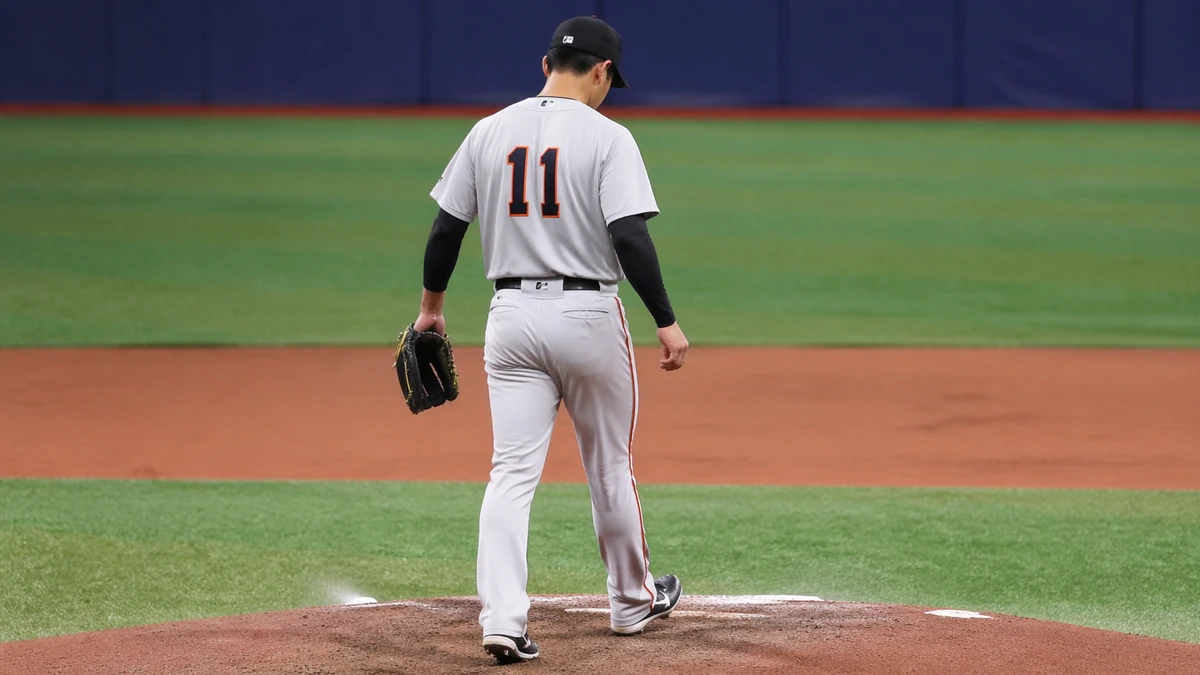
A costly injury lands at a pivotal moment
The Hanwha Eagles, one of South Korea’s most closely watched professional baseball clubs, have been dealt the kind of injury that can alter not just a week or two of scheduling, but the shape of an entire season. The team announced April 23 that right-hander Um Sang-baek underwent reconstructive surgery on the ulnar collateral ligament in his right elbow, along with a procedure to remove bone fragments from the joint. In practical terms, that means he is almost certainly done for the 2026 season.
For American baseball fans, the shorthand is familiar: this is the Korean baseball equivalent of losing a rotation arm to Tommy John surgery. South Korean teams do not always use the American nickname, but the implications are much the same. The recovery timeline for ligament reconstruction in the elbow is typically about a year, and often longer before a pitcher returns to full competitive form. Even when the surgery is considered successful, the process is less a pause than a reset.
The timing makes the news especially damaging. Early in the season is when clubs are still trying to stabilize their starting five, define bullpen roles and figure out whether the roster they built in the offseason can actually carry them through the long grind of summer. Losing a starting pitcher then is not just about replacing innings in the next series. It forces coaches and front offices to revisit every assumption they made about workload, depth and durability.
That is exactly what Hanwha now faces. According to the club, Um experienced pain in his right elbow on March 31 and was moved to the rehab group. Further testing revealed a torn ulnar collateral ligament and bone fragments in the elbow, leading to the decision to operate. The organization said the finer points of his rehab schedule will be determined after monitoring his post-surgery recovery, but the broad conclusion is already clear: one of the team’s intended rotation pieces is gone, and the plan that existed before opening month is no longer viable.
In a sport where continuity matters and where one weak link in a rotation can put strain on every relief arm behind him, that kind of disruption can linger for months. Hanwha is not simply losing a pitcher. It is losing structure.
Why Um’s absence matters beyond one roster spot
Every starting pitcher matters, but not every starting pitcher carries the same weight inside a season plan. Um was not viewed merely as a spot starter or temporary depth. Hanwha brought him in to serve as one of the stabilizing pieces of its rotation, the kind of arm expected to take regular turns, absorb innings and prevent the bullpen from being overworked in the first half.
That role is especially important in the Korea Baseball Organization, or KBO, the top professional baseball league in South Korea. For readers more familiar with Major League Baseball, the KBO is highly competitive but operates under somewhat different roster and usage patterns. Foreign players, for example, often occupy a prominent place in rotations, and domestic starters who can give a team steady innings are highly valued because they help bridge the gap between imported top-end talent and a bullpen that can be stretched thin over the course of the season.
Hanwha’s problem, then, is not simply that it needs another pitcher to take the ball every fifth day. It is that replacing a body is easier than replacing a function. A team can call up someone to make starts. It is much harder to find another arm who can deliver the same expected mix of experience, predictability and workload management that a club believed it had purchased when it signed Um.
That distinction matters because rotations create ripple effects. If one starter exits early on a regular basis, the bullpen absorbs those innings. If the bullpen absorbs those innings, relievers become unavailable the next day. If relievers become unavailable, managers have fewer tactical options late in games. Soon an injury that initially looked like one man’s absence becomes a systemwide stress test.
That is why the loss feels structural. Hanwha’s coaches now have to think about more than who gets Um’s turns. They have to rethink how aggressively to push other starters, how often to use bullpen games, how to protect relief arms from overuse, and how much roster churn the pitching staff can withstand before it affects the standings.
The contract raised expectations, and now the pressure changes
The injury also lands against the backdrop of a significant financial commitment. Hanwha signed Um as a free agent in November 2024 to a four-year deal worth up to 7.8 billion won, roughly the sort of contract in Korean baseball that signals more than a routine roster addition. In KBO terms, this was a statement investment, the kind of move designed to reinforce a rotation over multiple seasons rather than patch a short-term hole.
That context helps explain why the announcement carries extra weight. In both MLB and the KBO, free-agent signings are not judged only by raw statistics. They are judged by what they are supposed to solve. A club spends on a veteran pitcher because it wants fewer unknowns. It wants someone who can help define the floor of the staff, keep losing streaks from snowballing and turn a shaky middle of the rotation into something more reliable.
Um entered 2026 needing to show exactly that. His 2025 season had fallen well short of expectations. Over 28 appearances, he posted a 2-7 record with one hold and a 6.58 earned-run average. Wins and losses can be misleading, especially for pitchers, but a 6.58 ERA is a more direct indicator of struggle. By any standard, that is not the line a team expects from a pitcher signed to help anchor its planning.
That made this season a critical one. The storyline around Um was supposed to be whether he could rebound, reestablish his value and justify the confidence Hanwha showed in him. Instead, the story has shifted from performance to rehab. The question is no longer whether he can reverse a disappointing first year under the contract, but when he can pitch again and what version of him returns after surgery.
For the club, this complicates not just the present but the economics of the deal. Teams do not sign pitchers to long-term contracts expecting immediate full value every season, but they do expect some predictability. Elbow ligament reconstruction interrupts that completely. The issue is no longer underperformance versus expectations; it is the uncertainty that follows a major arm surgery, where velocity, command and durability may all take time to return.
What elbow ligament reconstruction means in baseball terms
To many American readers, elbow ligament reconstruction is synonymous with Tommy John surgery, named after the former Los Angeles Dodgers pitcher who became the first prominent player to return from the procedure in the 1970s. Today it is so common in baseball that some fans almost speak of it casually. But for a pitcher and his team, there is nothing casual about it.
The surgery typically involves replacing the damaged ulnar collateral ligament with a tendon taken from elsewhere in the body or from a donor. Recovery unfolds in stages: rest, gradual range-of-motion work, strengthening, flat-ground throwing, bullpen sessions, batting practice and, eventually, competitive games. Even after a player is officially back, performance often lags behind availability. Being cleared to pitch is not the same as being fully restored.
That is part of why the KBO club’s reference to monitoring his rehab details after surgery matters. Recovery from this operation is not linear. Some pitchers progress smoothly; others hit setbacks in the form of soreness, mechanical adjustments or difficulty regaining command. Bone fragment removal adds another layer, because it suggests the elbow issue was not limited to the ligament alone. That does not necessarily change the prognosis dramatically, but it underlines that this was not a minor cleanup.
For Um personally, the next year is likely to be defined by patience more than anything he can show on a field. Athletes often describe this kind of rehab as mentally draining because it strips the game down to repetitive, invisible work. There are no crowds for mobility exercises, no headlines for pain-free catch play and no standings boost from a successful bullpen session in an empty stadium. Yet those steps are the foundation for everything that follows.
In American sports terms, this is similar to what fans see when an NFL quarterback returns from ligament surgery or an NBA star spends months relearning how to trust a repaired knee. The physical healing matters, but so does the athlete’s confidence in the repaired body. For a pitcher, whose livelihood depends on repeating a violent overhead motion hundreds of times with precision, that trust is central to any comeback.
How the injury reshapes Hanwha’s season
The most immediate consequence is obvious: Hanwha needs to find starts that Um was supposed to make. But that is the simplest version of the problem. The more difficult challenge is preserving the health and effectiveness of everyone else while filling the gap. If the team leans too hard on short-term fixes, it risks turning one injury into a chain reaction.
Baseball people often talk about “innings” as if they are interchangeable units. They are not. Five innings from a settled starter on a normal pitch count is different from five innings stitched together by three relievers and a call-up making his first start of the season. The latter arrangement may get a team through a single game, but over weeks it can tax relievers, disrupt routines and force managers into less-than-ideal decisions.
This is particularly true during the stretch of a season when a team is trying to determine whether it can contend. Early and midseason games may not carry the same dramatic feel as September pennant races, but they shape the runway for everything that follows. Fall too far behind because the rotation becomes unstable, and the standings can harden before the roster has time to recover.
The Korean summary of Hanwha’s situation makes an important point: what the team loses is not just a name on the roster, but the role he was meant to perform. That is a subtle but important distinction in professional sports. Organizations can often identify a replacement player. They cannot always reproduce the same strategic value. A veteran starter expected to lighten the bullpen’s workload, break a losing streak and offer dependable innings across six months performs a team-building function that is hard to replicate on short notice.
That means Hanwha’s response cannot be limited to plugging in another arm and hoping the problem disappears. This calls for redesign. The club must reconsider inning limits for remaining starters, the cadence of relief usage, how often to shuffle arms between the active roster and the minors, and whether to prioritize immediate patchwork or more durable long-range solutions. Those are not glamorous questions, but they often define whether a team survives a major pitching injury or spirals because of it.
The player’s setback is also a career crossroads
For Um, the injury represents more than a lost season. It may mark the dividing line between one chapter of his career and the next. Before the surgery, the pressing issue was performance. After it, the first objective becomes something more basic: getting back to a point where he can pitch without pain and rebuild the mechanics needed to compete at a high level.
That shift matters because it changes the entire framework through which a player is judged. In a normal season, a pitcher can work on sequencing, command, pitch mix or confidence. During recovery from elbow ligament reconstruction, none of those refinements matter until the body is capable of handling the workload again. The task becomes foundational.
There is also the mental element. Athletes recovering from major injuries often speak about the frustration of being physically present with the team but professionally absent from the action that defines their identity. For a pitcher already coming off a disappointing year, the psychological challenge can be even sharper. The comeback clock starts while the memory of underperformance is still fresh. The player is not simply trying to return; he is trying to return in a way that rewrites the conversation around him.
At the same time, long rehab periods can offer a kind of enforced reset that normal seasons rarely allow. Without the pressure of immediate results, some pitchers use the process to refine mechanics, improve strength and rethink how they maintain their arm over the long term. American baseball is full of comeback examples in which a pitcher returned from ligament surgery with altered habits, cleaner delivery and a more sustainable routine. That does not guarantee success, but it shows why a rehabilitation year can be more than lost time.
For Um, the eventual evaluation is unlikely to center on how quickly he gets back onto a mound. The more meaningful questions will be whether his stuff returns, whether his command stabilizes and whether his arm can hold up across a real starter’s workload. In that sense, the calendar matters less than the quality of the comeback.
What this says about baseball’s fragile long-term planning
There is a broader lesson here that extends beyond one pitcher and one KBO team. Baseball organizations spend enormous amounts of time and money trying to reduce uncertainty. They sign free agents, study medical records, build depth charts and project workloads months in advance. And yet the sport remains uniquely vulnerable to the sudden fragility of the pitching arm.
That is as true in Seoul as it is in New York or Los Angeles. A single elbow can reorder competitive ambitions. The economics may differ between the KBO and MLB, but the logic of roster construction is strikingly similar. Teams build rotations because starters do more than start games. They organize the entire pitching ecosystem. When one of those pieces disappears, even a club with decent depth can find itself improvising.
For American readers who do not closely follow Korean baseball, Hanwha’s situation offers a useful reminder that the KBO is not a niche sideshow but a mature, deeply followed professional league where baseball carries real emotional and commercial weight. Injuries of this kind are covered intensely because they affect not just tactics and payroll, but fan expectation and team identity. In South Korea, as in the United States, baseball supporters understand that a season can pivot on news from a training room as quickly as it can on a game-winning hit.
Hanwha now enters that uncertain stretch where the most important work may happen away from the spotlight. The front office and coaching staff need to redesign the path forward. The bullpen must absorb new pressure. Replacement options have to be evaluated with care. And Um begins the slow, often lonely process of rehabilitation that defines the next phase of his career.
The headlines will understandably focus on the surgery and the phrase “season-ending.” But the more revealing story may be what comes next: whether Hanwha can adapt without letting one injury multiply into several more problems, and whether Um can turn a year of recovery into the foundation of a healthier return. That is the challenge now facing both player and team, and it is far more complicated than filling one empty turn in the rotation.




0 Comments