IMF’s New Korea Outlook Carries a Familiar Warning for Americans: Prices May Stay Hot Even as Growth Stalls
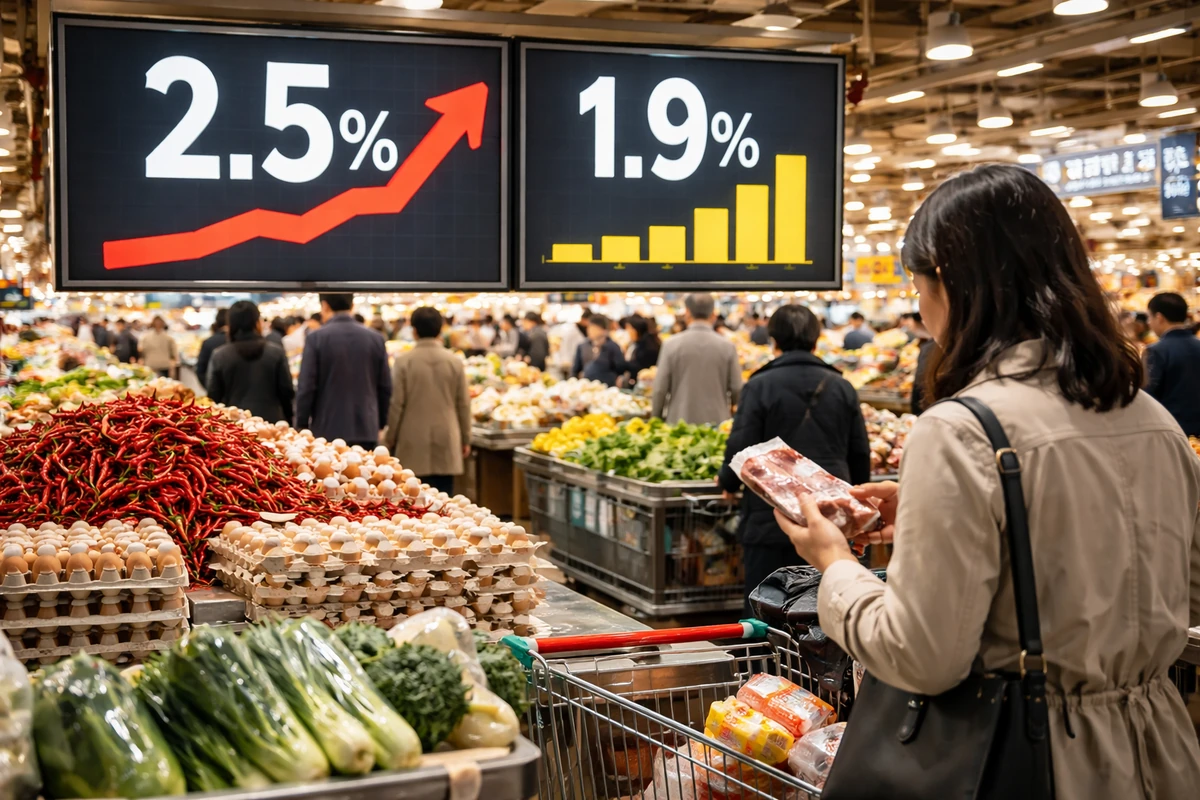
South Korea gets an economic warning that is about more than one forecast
South Korea received an uncomfortable economic message this week from the International Monetary Fund: The bigger problem may no longer be how fast the country grows, but how expensive everyday life becomes while growth remains weak. In its April 2026 World Economic Outlook, the IMF left its forecast for South Korea’s real gross domestic product growth unchanged at 1.9% for this year, but sharply raised its consumer inflation forecast to 2.5% from 1.8%.
That combination matters. On paper, a 1.9% growth rate that does not deteriorate further might look like relative stability, especially at a time of global uncertainty. But the more revealing shift is the jump in expected inflation. Economists, investors and policymakers had largely hoped for a year defined by cooling prices and only modest slowing in the economy. The IMF’s revision suggests a different reality: Growth is not collapsing, but the cost of living may start biting harder again.
For American readers, the broad outline is familiar. The United States spent years wrestling with the same unsettling mix of stubborn prices and uneven growth, with households feeling squeezed long before official statistics looked alarming. South Korea is not facing a 1970s-style stagflation spiral, and the IMF is not predicting an outright crisis. But the latest outlook hints at a version of the problem that modern economies dread: not booming demand that pushes wages and spending higher, but external shocks that lift prices while the broader economy remains fragile.
That distinction is important. Inflation driven by strong consumer demand can, at least in theory, come with rising incomes and healthy business activity. Inflation driven by energy costs, shipping disruptions and geopolitical stress tends to feel worse. Consumers pay more, companies face higher costs, and policymakers have fewer clean options. That is the trap South Korea increasingly appears to be trying to avoid.
The IMF’s numbers also rest on a major assumption: that the economic effects of conflict in the Middle East begin to fade around the middle of the year. In other words, even this more worrisome inflation forecast assumes the geopolitical shock does not continue intensifying. If oil prices stay elevated longer, shipping routes remain disrupted, or regional tensions worsen, both inflation and growth forecasts could shift again — and not in a favorable direction.
Why 1.9% growth is less reassuring than it looks
At first glance, holding a growth forecast steady can sound like good news. Markets often react positively when an international organization refrains from downgrading a country’s outlook during a volatile period. South Korea, the world’s 13th-largest economy and a major exporter of semiconductors, automobiles, batteries and consumer electronics, has long been seen as a country unusually sensitive to swings in global trade, energy prices and investor sentiment. A stable growth projection could therefore be read as a sign that the economy is absorbing external shocks better than feared.
But 1.9% is not an especially strong number for a country that depends heavily on trade and has spent years trying to revive domestic demand. It is not the kind of pace that guarantees households will feel better off, or that businesses will have enough confidence to invest aggressively. In South Korea, as in the United States, headline economic performance and day-to-day public mood often diverge. Growth can remain positive while consumers still feel anxious about groceries, utility bills, housing costs and job security.
That gap between official resilience and lived experience has become a recurring theme in many advanced economies. In Korea, the disconnect can be especially sharp because so much of the economy’s strength comes from large export-oriented conglomerates, known locally as chaebol — family-controlled industrial giants such as Samsung, Hyundai and SK Group. When exports hold up, macroeconomic data can look decent even if smaller businesses, service-sector firms and urban households feel pressure.
So the IMF’s unchanged growth figure should not be mistaken for a sign of broad-based economic comfort. If anything, it suggests a kind of balance point: The economy may avoid a sharper slowdown if global conditions do not worsen, but it is not growing with enough force to cushion households or smaller firms from renewed price pressure. That is a narrow margin of safety.
There is also a qualitative issue behind the number. Growth that is sustained by specific sectors, temporary inventory cycles or external demand is not the same as growth driven by healthier domestic consumption and rising private investment. The IMF forecast does not say Korean households have suddenly become more confident or that the country’s recovery is getting stronger at the grassroots level. It says, more narrowly, that the broader economy may keep moving forward — but under conditions that remain vulnerable to another external shock.
The bigger story is inflation, and what 2.5% means for households
The increase in the IMF’s inflation forecast from 1.8% to 2.5% may not sound dramatic to Americans who lived through price spikes far above that level in recent years. But in the Korean context, the move is significant. Inflation around 2% is often viewed by central banks and markets as manageable. Move materially above that, and expectations can start shifting. Businesses become quicker to raise prices, consumers become more sensitive to future increases, and wage demands can adjust in ways that make inflation harder to bring down.
Even more important is how inflation is felt. A national consumer price index is an average. Household pain is not. Lower-income households, retirees, younger workers and families with fixed monthly obligations tend to feel price increases more intensely, especially when those increases are concentrated in essentials such as energy, transportation and food. South Korea has its own version of the same kitchen-table economics that drove so much political frustration in the United States: It does not matter much to families if headline growth holds steady when monthly expenses keep rising faster than their sense of financial security.
In Korea, food prices and utility costs carry outsized emotional and political weight. Consumers closely track the prices of staples, and rising costs for fuel, electricity and transport can ripple quickly through household budgets. The country imports nearly all of its energy, which makes it especially exposed to oil shocks. If crude prices rise because of Middle East instability, the effect does not stop at the gas pump. It touches shipping, manufacturing, logistics, air travel and eventually grocery shelves.
That is one reason the IMF revision is so consequential. This is not an inflation story necessarily powered by an overheating labor market or excessive consumer spending. It is a cost-push story, the kind economists worry about because it erodes purchasing power without bringing many of the usual benefits associated with strong demand. If wages do not rise at the same pace, real incomes fall. If companies cannot pass higher costs on to consumers, profit margins shrink. If they do pass them on, consumption can weaken further.
For Korea’s aging population, highly urbanized workforce and debt-conscious middle class, that squeeze can become politically sensitive quickly. South Korea also has a distinctive housing system, with large upfront deposits common in some rental arrangements, along with already elevated household debt. That means many families have little room for new monthly stress. A few percentage points of inflation may look modest on a chart, but in an economy where many households are already watching every major expense, it can alter behavior fast.
A policy dilemma with no easy answer
The IMF forecast also sharpens a problem for Korean policymakers that will sound familiar to anyone who followed the Federal Reserve and White House debates in Washington over the past several years. When growth weakens, governments and central banks are normally pressured to support the economy. When inflation rises, they are pressured to avoid doing too much. When both happen at once, or appear to be moving in opposite directions, the playbook becomes far less straightforward.
For the Bank of Korea, the country’s central bank, the central question is what kind of inflation it is confronting. If prices were rising because the economy was too hot, higher interest rates might cool demand. But when inflation is being pushed by external supply factors — higher oil prices, geopolitical stress, shipping bottlenecks or a weaker currency — traditional rate tools can only do so much. Raising rates may help anchor inflation expectations and defend credibility, but it does not pump more oil or reopen disrupted trade lanes. It can, however, put additional strain on already weak consumers and businesses.
Fiscal policy is no easier. The government can try to cushion vulnerable households and affected industries, but broad stimulus carries risks if it also boosts demand at the wrong moment. That means the most likely policy path is not sweeping spending, but narrower and more targeted relief: help for lower-income households, subsidies or temporary support for energy-intensive sectors, and measures aimed at transportation, logistics or other cost-sensitive parts of the economy.
That kind of targeted response sounds technocratic, but it can be politically difficult. Governments prefer simple messages: the economy is recovering, inflation is easing, relief is on the way. The current moment does not lend itself to clean narratives. Korean officials are likely to stress flexibility, vigilance and conditional responses — language that often reflects real uncertainty more than confidence.
There is another challenge here, too. Markets are not just reading the numbers; they are reading the assumptions behind them. The IMF kept growth steady and raised inflation under the premise that Middle East tensions moderate later this year. If that assumption proves wrong, the policy environment gets even tougher. Officials would then be forced to decide whether to prioritize cushioning growth, containing prices or preserving financial stability. Those goals do not always align.
What this means for Korean businesses and investors
For companies, the IMF’s revised outlook changes the calculation in ways that go beyond a single year-end forecast. Executives now have to ask three harder questions. How long will higher input costs last? Which industries can pass those costs on to consumers? And how defensive should they become in hiring, investment and borrowing decisions?
Those questions matter across the Korean economy, but not evenly. Export giants with pricing power, strong cash flow or favorable currency effects may be able to weather cost increases more comfortably. Companies in sectors where consumers are already price-sensitive — transportation, retail, food service, distribution and some parts of manufacturing — may have fewer options. They can raise prices and risk losing customers, or absorb costs and accept weaker margins. Neither is ideal.
Investors are likely to sort Korean firms more sharply on exactly those grounds. In recent years, global markets have become quick to reward businesses that can defend margins in volatile environments. That often means companies with dominant brands, mission-critical products, stable demand or flexible supply chains. In Korea, it may also mean a clearer divide between global champions and domestically exposed firms.
There is an important nuance, however. Inflation is not uniformly bad for every company. Some businesses benefit from pricing leverage. Others benefit from exchange-rate moves that offset imported-cost pressure. Still others can shift product mix, renegotiate contracts or improve efficiency. The real issue is not whether inflation rises, but who can absorb it and who cannot. In that sense, the Korean market may increasingly reward resilience over pure growth.
That same logic applies more broadly to financial markets. A steady growth forecast is not automatically a reason for optimism if it comes paired with a higher inflation outlook. Taken together, the numbers suggest an economy moving from a recovery story to a defense story. The focus shifts from expansion to protection: protecting household purchasing power, protecting corporate profitability and protecting policy credibility.
Why Americans should pay attention to Korea’s outlook
For U.S. readers, it may be tempting to view Korea’s new forecast as a distant regional story. But South Korea is deeply tied to the global economy and to American consumers in ways that are easy to overlook. It is a top producer of memory chips and advanced batteries, a critical player in auto manufacturing and a major link in supply chains that touch everything from smartphones to electric vehicles. If Korea is facing a prolonged period of higher imported costs and constrained growth, that has implications beyond Seoul.
It also serves as a reminder that the post-pandemic inflation story never fully became a simple demand story or a simple supply story. It has been both, at different moments, and often filtered through geopolitical events. A flare-up in the Middle East can ripple into Asian manufacturing costs. Those costs can affect corporate planning in Korea. And those shifts can ultimately influence prices, investment and trade flows involving the United States.
There is a cultural dimension worth understanding as well. South Korea is often known abroad through the lens of K-pop, Korean dramas, beauty products and high-tech consumer brands. Those industries remain powerful symbols of Korean soft power, and they help explain why the country commands so much global attention. But beneath that glossy image is an economy with very real vulnerabilities: heavy dependence on trade, imported energy, demographic headwinds and a domestic mood that can turn quickly when living costs rise.
That broader context matters because economic discomfort in Korea often shows up not only in financial statistics but in public sentiment, consumer caution and political pressure. Americans saw their own version of that disconnect when voters remained sour on the economy even as job growth stayed solid. Korea is now confronting a similar possibility: an economy that is not technically failing, but is still making people feel poorer.
The IMF forecast does not say South Korea is headed for an economic breakdown. It says something subtler and, in some ways, more unnerving. Growth may hold up just enough to avoid panic, but inflation may rise enough to keep households, businesses and policymakers under steady strain. That is the kind of economic environment that produces caution, not confidence.
The real warning is in the combination, not the headline number
The most important takeaway from the IMF’s new outlook is that the danger lies in the mix of conditions rather than in any single statistic. A 1.9% growth forecast alone might have been tolerable. A 2.5% inflation forecast alone might have been manageable. Together, they point to a more uncomfortable reality: South Korea may be entering a phase where the economy keeps moving, but with too little momentum to offset a renewed cost-of-living squeeze.
That is why the inflation revision matters more than the stable growth figure. It changes the underlying story from one of gradual normalization to one of renewed vulnerability. If prices are rising not because Korea is booming but because external shocks are making energy and inputs more expensive, then the burden falls disproportionately on households and on businesses with limited pricing power. It also narrows the room for policymakers to act decisively in either direction.
And because the IMF outlook is built on an assumption of easing geopolitical stress later in the year, even this warning may not represent the worst-case scenario. If those conditions do not improve, the apparent balance in the forecast could give way to more difficult trade-offs. Growth could weaken. Inflation could stay elevated. Policy could become more constrained.
For now, the IMF has not downgraded Korea into crisis territory. But it has drawn attention to a risk that governments everywhere, including in Washington, understand all too well: citizens can tolerate slow growth for a while, and they can tolerate moderate inflation for a while, but tolerating both at once is much harder. In that sense, South Korea’s latest forecast is not just a Korean story. It is a global one, shaped by war, energy, trade and the stubborn reality that for most families, the economy is measured less by GDP than by what life costs from month to month.
Comments
Post a Comment