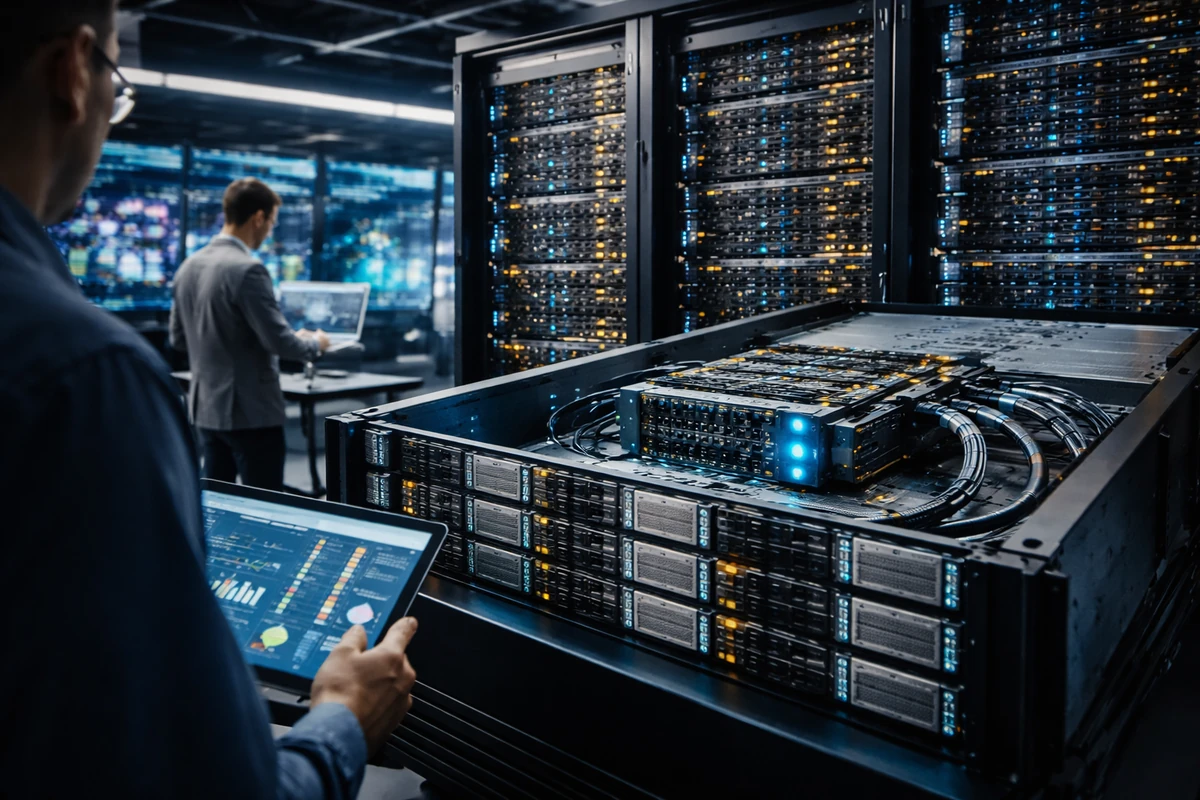
AI’s hidden traffic jam is moving into plain sight
For the last two years, much of the global conversation around artificial intelligence has sounded like an arms race over computing power. Who has the most advanced GPUs? Which company can train the biggest large language model? How quickly can firms cut the cost of inference, the process of generating answers after a model is trained? In South Korea, as in the United States, those questions have dominated tech conferences, corporate presentations and investor briefings.
But a recent product debut at AI EXPO KOREA 2026 suggests the conversation is beginning to change. Graid Technology used the Seoul event to showcase its AI and high-performance computing storage product, SupremeRAID, while putting an unusually blunt message front and center: In modern AI infrastructure, storage bottlenecks are becoming just as important as raw compute.
That may sound like a niche engineering concern, the sort of thing only data center managers lose sleep over. It is not. The shift matters because the AI industry is moving from a phase defined by flashy demonstrations to one shaped by day-to-day operations. Once companies actually run AI services at scale, the glamorous part of the system — the expensive chips doing the math — can end up waiting idly if data is not fed in quickly enough or saved efficiently enough. In other words, a company can spend millions on top-tier processors and still fail to deliver the speed or reliability users expect.
For American readers, there is a useful analogy here. Think of an AI system as a fleet of high-performance race cars. The GPUs are the engines, and they matter enormously. But if the pit crew is slow, if the fuel lines are clogged, or if the track entrance is jammed, those cars do not win races. They sit still. Storage is part of that overlooked support system: the place where training data is read, checkpoints are saved, logs accumulate, backups are maintained and model outputs are written back into the broader digital ecosystem.
South Korea’s tech industry is now highlighting a problem that U.S. companies, hyperscale cloud providers and research institutions know well: AI performance is no longer just about the chip. It is about the movement of data through the entire machine.
Why storage suddenly matters so much
Storage has long played a supporting role in conversations about computing infrastructure. The stars were always the CPU, then the GPU, then specialized AI chips, plus memory and networking gear. Storage tended to be treated as necessary but unglamorous — more warehouse than engine room.
That made sense when workloads were lighter and software demands were less punishing. It makes less sense in the era of generative AI and multimodal models, which handle not just text but images, audio and video. These systems consume enormous data sets during training and continue to generate heavy traffic once they are deployed in products. They need to pull information quickly, write new information continuously and preserve huge volumes of metadata for compliance, debugging and optimization.
During training, for example, models rely on vast streams of data moving steadily from storage into compute clusters. If that stream slows, the GPUs wait. During live service, companies need fast response times for user queries while also saving logs, maintaining audit trails, updating vector databases and managing backups. A single customer-facing chatbot may look simple from the outside, but behind the scenes it sits atop a far more complicated data pipeline.
That helps explain why storage bottlenecks are receiving more attention now. The problem is not theoretical. It shows up in long checkpoint save times, sluggish distributed file access, backup delays, lower-than-expected GPU utilization and disappointing returns from server expansion. If the system cannot move data efficiently, adding more chips does not necessarily produce proportional gains.
American businesses have already seen versions of this problem in the cloud era. Buying more capacity is not the same as fixing architecture. A retailer can spin up more compute for recommendation systems; a bank can add servers for fraud detection; a hospital can expand AI tools for image analysis. But if the underlying data path is clogged, the new capacity behaves like extra lanes on a highway that still merges into a single traffic bottleneck. The congestion just moves downstream.
South Korea’s IT sector is now confronting that reality in public. The significance of Graid Technology’s message is not merely that a new product appeared at a trade show. It is that the market has matured enough to admit an uncomfortable truth: the hard part of AI is increasingly operational, not just computational.
What this means in South Korea’s tech market
South Korea offers a particularly interesting case study because it has many of the ingredients countries say they want for an AI future. It has world-class semiconductor manufacturing, some of the fastest broadband and mobile networks in the world, sophisticated electronics and manufacturing sectors, and major companies with long experience in operating large-scale digital services. In the United States, South Korea is often referenced for its leadership in memory chips, displays, consumer electronics and telecom infrastructure.
Yet those strengths do not automatically solve the problem of AI deployment. Korean companies, like their U.S. counterparts, are moving beyond the question of whether to adopt AI and into the harder question of how to run it efficiently in production. That distinction matters. In the experimental phase, executives often care most about whether a model can produce convincing demos. In the commercialization phase, what matters is uptime, cost control, response speed, compliance and the ability to scale without wasting capital.
That is where storage becomes less of a backend detail and more of a business issue. Many Korean companies are operating in hybrid environments, with some workloads in public cloud platforms and others in on-premises or private cloud systems. This is common in the United States as well, especially in industries that handle sensitive information. Finance firms, hospitals, manufacturers and gaming companies often do not want every critical workload fully dependent on outside cloud infrastructure, whether because of data governance, latency, long-term cost or regulatory requirements.
Hybrid setups can bring flexibility, but they also make data movement more complicated. Information has to travel across different storage tiers, across networks, sometimes across physical sites, and often under strict security and access-control rules. The more complex that path becomes, the more likely it is that storage and input-output performance will define the real-world quality of the service.
That is especially relevant in South Korea, where companies often face pressure to move quickly from pilot project to commercial rollout. Fast adoption is a hallmark of the local market. New technologies can spread rapidly, but so can executive expectations. Once a proof of concept works, there is often immediate pressure to expand it into a revenue-producing service. Under those conditions, the ability to squeeze more performance out of existing infrastructure can matter as much as buying another round of hardware.
In practical terms, a storage bottleneck can mean longer wait times for customers, slower internal analytics, higher power costs, more idle compute and unnecessary expansion spending. For firms trying to justify AI investments to boards and shareholders, that is not a technical footnote. It goes directly to profitability.
The AI economy is becoming an operations story
One of the biggest shifts in the global AI boom is that investment criteria are changing. During the earliest wave of generative AI excitement, a company’s narrative often centered on visible benchmarks: the newest GPU cluster, the largest parameter count, the most impressive benchmark scores, the fastest chatbot demo. Those headlines still matter. But increasingly, enterprises are asking a different set of questions.
How many workloads can the same infrastructure handle? How much of the system is sitting idle? How quickly can the company recover from failures? How expensive is backup and replication? How much latency is introduced by storage and networking rather than model design? What is the total cost of ownership once hardware, energy, cooling, staffing and downtime are factored in?
Those questions are less glamorous, but they are central to the next phase of the AI business. Once AI systems are embedded into products and workflows, even small inefficiencies compound into large costs. A model that is cheap to run in a lab may become expensive in production if logs pile up, checkpoints take too long, data cannot be loaded fast enough or multi-tenant access controls create operational drag.
That is why the storage discussion is not just about hardware performance. It is about what might be called the economics of AI operations. If a company can reduce storage bottlenecks, it may be able to process more work with the same chips, delay costly expansions and improve reliability at the same time. If it cannot, it may end up treating infrastructure spending as the default answer to problems that are really architectural.
This dynamic is familiar in other parts of American industry. Airlines do not improve profitability simply by buying more planes if they cannot turn them around efficiently at the gate. Hospitals do not solve patient flow issues just by adding equipment if records, staffing and scheduling remain inefficient. Warehouses do not become productive just because robots are installed if inventory systems and loading docks remain disorganized. AI is heading in that same direction. The limiting factor is often not the most visible piece of machinery, but the operational system surrounding it.
South Korea’s industry is now broadcasting that lesson at a moment when many companies around the world are still fixated on headline-grabbing chip counts. That makes the message worth paying attention to well beyond Seoul.
Why AI and high-performance computing are converging
Another reason this story matters is that it highlights how AI and high-performance computing, or HPC, are increasingly overlapping. To the general public, these may sound like different domains. AI evokes chatbots, image generators and digital assistants. HPC may bring to mind research labs, weather forecasting or advanced scientific simulation.
Inside real-world infrastructure, however, the distinction is often less dramatic. Both AI and HPC rely on large-scale parallel processing. Both require data to move quickly and consistently across complex systems. Both suffer when storage throughput cannot keep pace with computation. And both are increasingly used in overlapping industries.
Manufacturing offers a good example. A factory deploying machine vision, predictive maintenance and digital twin simulation may use AI tools to analyze images and equipment logs while also using HPC-style resources for modeling and optimization. In health care and biotech, researchers may pair genomic analysis and medical imaging with machine learning pipelines. In media, video analysis and content recommendation can generate both AI-style inference workloads and HPC-like data demands. In finance, low-latency processing, risk modeling and compliance logging all converge around the same infrastructure headaches.
That is why storage has become a shared pain point. It is no longer confined to a narrow class of enterprise data centers. The challenge now spans cloud providers, software companies, manufacturers, research institutions and public-sector technology teams. The more that organizations rely on AI for mission-critical services, the less tolerance they have for backend inefficiencies that slow the whole system.
For American readers, this is part of a broader pattern in the tech economy: the frontier of competition shifts over time. Early in a cycle, companies win by getting access to scarce components or by building eye-catching products. Later, winners are often the ones that industrialize operations most effectively. The history of cloud computing, smartphones, e-commerce logistics and streaming media all followed some version of that pattern. AI appears to be doing the same.
In that sense, the unveiling of a storage-focused AI product at a Korean expo is less a standalone event than a marker of where the market is headed. It signals that infrastructure conversations are becoming more sophisticated, and more honest, about where the real constraints lie.
Cloud vs. on-premises is being reconsidered
The storage debate also forces companies to revisit a broader strategic question: what belongs in the cloud, and what belongs on infrastructure they control themselves?
Over the past several years, many businesses embraced cloud-based AI services because they offered speed, convenience and reduced upfront capital costs. That remains true, especially for smaller organizations and fast-moving product teams. But as AI workloads grow, so do concerns over data sovereignty, long-term operating costs, security and latency. For some organizations, that means moving certain critical workloads back on premises or strengthening a hybrid model rather than relying on the cloud alone.
When companies operate their own infrastructure, the storage problem becomes harder to ignore. In a public cloud service, bottlenecks can be obscured behind a managed platform. Customers may see performance tiers and monthly bills, but not always the engineering trade-offs underneath. In an on-premises environment, every design choice is more visible. Disk, cache, controller, file system and network architecture all become part of the company’s own problem set.
That is one reason solutions aimed at reducing storage bottlenecks may find a receptive audience in South Korea and elsewhere. As more organizations seek tighter control over sensitive or large-scale AI workloads, storage efficiency becomes not just a feature but part of the architecture decision itself.
This is especially true in heavily regulated or data-intensive sectors. Financial institutions must balance real-time processing with strict compliance requirements. Hospitals and biotech firms handle large medical images and research data under tight privacy rules. Manufacturers generate oceans of sensor readings, machine logs and visual inspection data. Game companies produce enormous streams of personalization data, player behavior logs and live service telemetry. In all of those cases, AI is no longer an isolated experiment. It is becoming part of the operating system of the business.
That means storage concerns rise from the server room into the executive suite. They affect customer experience, resilience, regulatory readiness and margins. They are no longer merely for infrastructure specialists to debate.
What the Korean industry is really signaling
The deeper takeaway from this moment in South Korea’s technology sector is that AI is entering a more mature phase. The public conversation is starting to catch up with what engineers and operators have been seeing behind the scenes. The issue is not just what model a company has adopted, but how well it can run that model over time, at scale and under cost pressure.
That makes storage optimization one of the most important “invisible” battlegrounds in the AI era. It lacks the sizzle of a breakthrough chip or a celebrity chatbot launch. It does not make for dramatic keynote moments in the same way that a benchmark record does. But it is precisely the kind of foundational issue that separates experiments from enduring businesses.
The Korean article’s central insight is one American readers should take seriously: in AI, there comes a point when adding more horsepower does not solve the problem if the rest of the vehicle is not built to keep up. South Korea, with its advanced digital infrastructure and fast-moving corporate culture, is now confronting that reality in a visible way. The same reckoning is underway in the United States, from Silicon Valley labs to enterprise IT departments trying to make AI practical and profitable.
If anything, the story should be read as a warning against simplistic narratives about the AI race. It is tempting to reduce the competition to chip shortages, national industrial policy or the next big model release. Those factors matter. But the companies and countries that thrive in AI will also need to master the less glamorous layers of infrastructure: data movement, storage efficiency, system reliability and recovery.
That may be the real significance of a storage-focused launch at a Korean tech expo. It suggests the industry is beginning to recognize that AI’s future will not be decided by compute alone. It will be decided by whether the entire pipeline — from storage to network to processor and back again — can operate without costly friction.
In the first act of the AI boom, the biggest question was who could build or buy the most powerful brains. In the next act, the question may be who can keep those brains from sitting around waiting for data. That is a far less flashy story. It is also, increasingly, the one that will determine who actually wins.
Comments
Post a Comment