K-pop’s Global Business Has Moved Beyond Breakthroughs. Now It’s About Running a Worldwide Touring Machine.
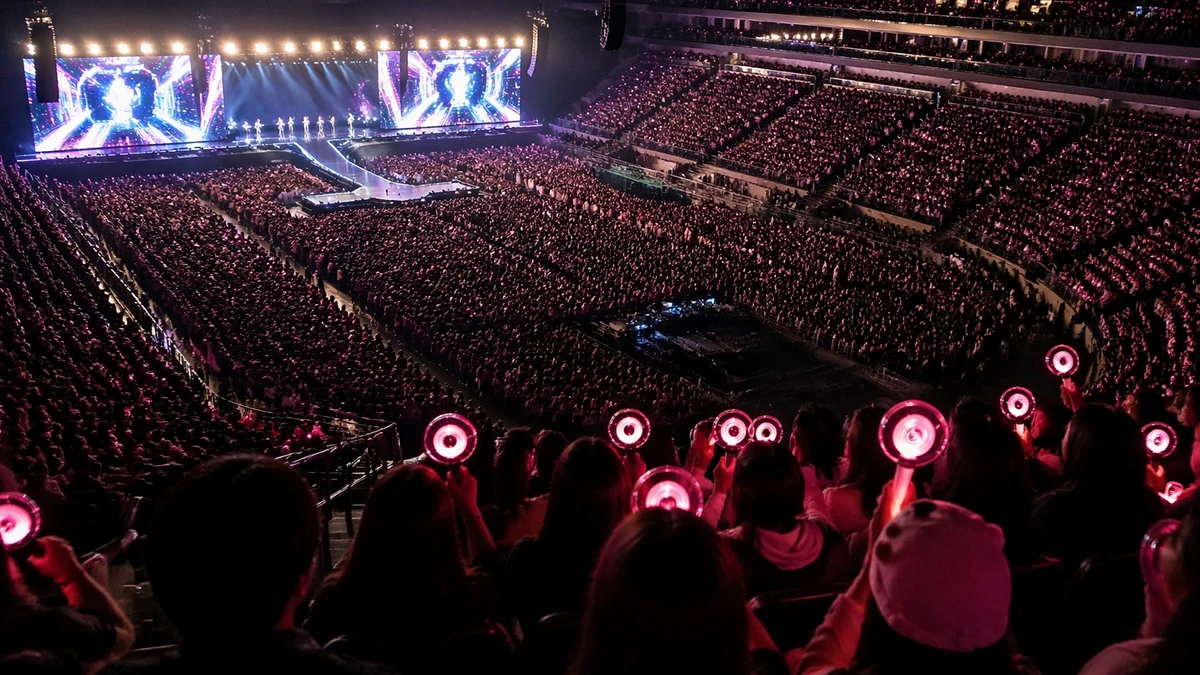
K-pop is no longer proving it can travel. It is proving it can scale.
For years, much of the conversation around K-pop outside South Korea revolved around a single question: Could it break into the American market and other major music economies? That question now feels outdated. The more revealing story in 2026 is not whether K-pop can land a hit, generate buzz on TikTok or place an album on the Billboard charts. It is whether Korean entertainment companies can repeatedly fill arenas, domes and stadiums across multiple countries, manage complex live-event logistics and turn fandom into a stable, recurring business.
Two announcements made public on April 24 offered a particularly clear snapshot of that shift. TWICE, one of K-pop’s most durable girl groups, said it had drawn about 550,000 fans across 35 shows in 20 North American cities from January through April 18, the largest North American tour in the group’s history. On the same day, ENHYPEN announced plans for an eight-show run in Japan’s four major domes from December through February.
On the surface, those are headline-friendly concert numbers. But together they point to something bigger than star power. They suggest K-pop is no longer in a phase of overseas “entry,” where success is measured by novelty, firsts or symbolic milestones. It has entered an operational phase, one in which the crucial questions are about routing, repeat demand, venue scale, audience retention and whether Korean companies can run live entertainment businesses in foreign markets with the consistency of major global touring acts.
For American readers, the comparison is less about a foreign genre making occasional splashy appearances and more about what happens when a once-emerging music ecosystem starts functioning like an established touring industry. Think less “viral crossover” and more “can this act reliably sell out a multi-city U.S. swing the way top pop, country or Latin artists do?” By that measure, the latest numbers from TWICE and ENHYPEN matter because they show K-pop’s international model becoming less episodic and more institutional.
That change may sound technical, but it helps explain why K-pop remains one of the most closely watched sectors in global entertainment. In the streaming era, almost every song is available everywhere. What is scarce, and therefore increasingly valuable, is the in-person experience: the ticket, the merchandise, the travel, the hours a fan chooses to spend inside an arena and around a live event. That is where loyalty becomes measurable in dollars and operational know-how becomes just as important as artistic appeal.
Why TWICE’s North American numbers matter beyond the headline
TWICE’s reported 550,000 attendees across 35 concerts in 20 North American cities stand out not simply because the total is large, but because of what kind of demand it represents. A one-night spectacle in Los Angeles or New York can function as a cultural event. A 35-show run spread across the continent is something else entirely. It suggests a group is not merely drawing curiosity from a niche audience or attracting fans willing to travel long distances for a once-in-a-lifetime experience. It suggests there is enough local or regional demand to support repeated performances within the same market.
That distinction matters in the concert business. A splashy overseas appearance can be a sign of momentum. A dense multi-city itinerary is a sign of infrastructure. It requires confidence not only in the size of the fan base but also in forecasting which cities can sustain demand, how quickly tickets will move, where multiple nights make sense and how to manage fatigue for both performers and audiences.
In American terms, this is the difference between a buzzy international act stopping by a festival and a proven touring artist building a route through the same system used by mainstream arena headliners. Venue availability, trucking, staffing, local promotion, security, travel schedules and merchandising all become part of the equation. Success is no longer about whether the artist is known; it is about whether the artist can operate at scale without the whole enterprise feeling fragile.
TWICE’s numbers are also notable because they speak to longevity, especially for a girl group in an industry often criticized for its speed of turnover. K-pop has long been associated with rapid cycles: trainees debut young, trends shift quickly and each new generation of groups is pushed aggressively into the spotlight. Under that model, attention often clusters around the newest act. What makes TWICE’s current performance noteworthy is that the group is not relying on the novelty of a debut-era breakthrough. Instead, it is posting what its company describes as its biggest North American tour yet well into an established career.
That is an important signal for how K-pop is maturing. It suggests fan communities can deepen over time rather than simply burn hot and fade. Catalog matters. Brand identity matters. Experience matters. In other words, K-pop acts may increasingly resemble legacy pop brands, where years of music, performance history and audience trust can support bigger tours even after the most explosive early-career moment has passed.
For an American audience accustomed to seeing artists like Taylor Swift, Beyonce or Bruce Springsteen build live-empires that span decades, that may sound familiar. But for K-pop, where the business has often been framed around youth, speed and constant reinvention, it represents a meaningful shift in how value is created and sustained.
Japan’s National Stadium is about more than prestige
TWICE’s next move underscores the same point from a different angle. The group is scheduled to perform solo concerts at Tokyo’s National Stadium on April 25, 26 and 28, becoming the first overseas female act to hold solo shows there over three dates. The symbolic value is obvious. But the practical significance may be even more important.
For readers in the United States, Japan’s live entertainment market can be difficult to fully appreciate from afar. It is one of the most mature and lucrative music markets in the world, with deeply rooted ticket-buying habits, strong merchandise culture and a highly organized fan ecosystem. In K-pop industry terms, Japan is not just a nearby overseas market for Korean acts. It is one of the toughest and most consequential proving grounds for sustained performance demand.
A major stadium booking in Japan is not merely a trophy venue. It is a high-risk business decision. Stadium-scale concerts can generate substantial revenue, but empty seats or weak repeat demand are visible immediately and can undercut the symbolic value of the achievement. Booking three dates at National Stadium implies confidence that a group’s fan base is not only sizable but stable enough to justify repeated use of a venue at the top end of the market.
That kind of bet is rarely based on a single comeback song or a short-term spike in online chatter. It rests on accumulated loyalty: fans who know the catalog, trust the live experience and are willing to make the trip, buy the merchandise and invest time as well as money. The broader point is that K-pop’s biggest assets are no longer limited to catchy singles or polished music videos. They increasingly include brand durability and operational certainty.
There is also a broader strategic lesson in the fact that TWICE is posting strong numbers in North America while also commanding major venues in Japan. These are not interchangeable markets. Their audiences, consumption habits and concert traditions differ. Success in both suggests K-pop’s globalization cannot be explained simply by saying “Korean culture is spreading.” That phrase, often used to summarize the Korean Wave, or “Hallyu,” captures momentum but not mechanics. What the latest touring data show is something more concrete: Korean companies are learning to read distinct local markets and design separate live strategies for each.
In practical terms, that means K-pop is becoming less a cultural export in the old sense and more a transnational events business, one that plugs into existing venue systems across regions and does so repeatedly.
ENHYPEN and the speed of the next generation
If TWICE represents durability, ENHYPEN illustrates another trend reshaping K-pop’s live business: the compression of the growth curve. The group’s planned run through Japan’s four major domes — Tokyo Dome, Vantelin Dome Nagoya, Mizuho PayPay Dome Fukuoka and Kyocera Dome Osaka, for a total of eight shows — signals a level of scale that once might have been treated as the reward for many more years of activity.
That timing is significant. K-pop’s industry model has evolved in a way that allows newer groups to accumulate global fandom faster than their predecessors did. Social media, streaming platforms, subtitled content, international fan communities and increasingly sophisticated global marketing have shortened the time between debut and large-scale overseas demand. A group no longer has to spend years gradually building awareness territory by territory in the way pop acts once did.
For the industry, that is both an opportunity and a challenge. On one hand, faster fan aggregation makes large venues viable earlier in an act’s life cycle. On the other, it means companies must be ready to support that scale operationally much sooner. Selling a dome tour is not just a matter of popularity. It requires production capacity, scheduling discipline, ticketing strategy and confidence that the audience is strong enough to absorb multiple dates without the project becoming overextended.
ENHYPEN’s tour plan suggests that in today’s K-pop, large-venue ambitions are moving from exceptional to increasingly repeatable. That matters because it hints at a model no longer dependent on a handful of generational superstars. Instead, the industry appears to be building systems that can produce different kinds of large-scale live acts across generations.
Viewed together, TWICE and ENHYPEN are less rivals than examples of two complementary pillars of the current K-pop business. One shows how an established act can continue expanding through catalog, reputation and durable fan commitment. The other shows how quickly a newer act can be scaled into the upper tier of live performance. One proves the staying power of a long-built brand; the other proves the market’s ability to absorb the next wave at unusual speed.
That combination is what makes the April 24 announcements particularly revealing. They suggest K-pop’s live sector is not relying on one-off phenomena. It is constructing repeatable models across age groups, fan demographics and market types.
Why concerts now matter more than streams alone
The rise of live performance as K-pop’s central battleground reflects a broader reality in the music business. Streaming can create ubiquity, but ubiquity does not automatically translate into economic stability. A song can trend globally without guaranteeing that listeners will spend money on a ticket, travel to a venue or line up for merchandise. That gap between attention and action is one of the defining challenges of the digital entertainment era.
Live events help close it. In the K-pop ecosystem, concerts are where abstract fandom becomes concrete. Seats sold, average ticket prices, merchandise purchases, fan travel patterns and on-site dwell time all become measurable indicators of economic value. A fan who streams a song repeatedly is important. A fan who buys a ticket, books a hotel, purchases a light stick and spends several hours inside a venue is participating in a much broader commercial ecosystem.
That is why TWICE’s 35-show North American run is more significant than a raw chart placement. It demonstrates the ability to mobilize people offline, in real time, at scale. In a world where algorithm-driven visibility can be fleeting, that is a powerful marker of stability. A large tour suggests the act is not merely present in the culture; it is capable of generating real consumer behavior beyond the screen.
The same logic applies to Japan’s domes and stadiums. These venues are both glamorous and brutally practical. Behind every attendance record is an army of workers handling staging, transport, safety, staffing, timing and crowd control. Fans often encounter only the polished result. But from an industry perspective, those invisible systems are central. They are what transform celebrity into enterprise.
That is especially relevant for K-pop because the genre has sometimes been discussed in Western media primarily through aesthetics: synchronized choreography, intense fan culture, high-concept visuals and digital savvy. Those elements remain important, but they can obscure a more consequential development. The real maturation of K-pop overseas may be less about style and more about operations — the ability to run large-scale touring businesses with consistency across continents.
Put simply, K-pop is becoming less a story about discovering an exciting foreign genre and more a story about how that genre has built a formidable live-commercial machine.
What TWICE says about women in K-pop — and the old assumptions the data are challenging
TWICE’s latest numbers also speak to a long-running bias inside and around the K-pop industry: the assumption that girl groups may dominate in visibility and viral relevance but face limits when it comes to long-term touring power and drawing audiences at the biggest venues. That narrative has circulated for years, often tied to the idea that female acts are more vulnerable to trend cycles and less likely to sustain fan spending over long periods.
The evidence coming out of TWICE’s current run complicates that assumption. A North American tour with about 550,000 attendees, followed by three solo dates at Japan’s National Stadium, is not a story of fleeting relevance. It is a story of endurance, purchasing power and cross-market loyalty. It suggests that, under the right conditions, a girl group can function not just as a cultural phenomenon but as a durable live brand.
That matters because discussions of female K-pop acts have often focused heavily on digital performance: chart peaks, social media virality, fashion influence and short-cycle comeback impact. Those are real forms of power, but they can flatten the broader business picture. Touring exposes a different set of strengths, including repertoire depth, brand trust and the willingness of fans to keep showing up over time.
For American readers, there is an understandable parallel to debates in the U.S. music industry, where women performers have repeatedly had to disprove assumptions about ticket-selling stamina, stadium viability or longevity in genres long dominated by male acts. K-pop’s version of that debate has its own industry-specific context, but the underlying theme is recognizable: when fans keep buying tickets year after year, older assumptions start looking less like wisdom and more like inertia.
TWICE’s continued expansion does not erase the structural challenges female acts may face. But it does indicate that the market can reward durability and trust just as much as novelty. That is an important development in a business often criticized for burning through talent too quickly.
From cultural export to embedded global industry
The phrase “Korean Wave” remains useful shorthand for the international rise of Korean pop culture, from music and television to film and beauty. But as K-pop’s overseas business matures, that term can also feel too broad, even too soft, to describe what is now happening on the ground. Waves crest. They spread. They suggest movement. What TWICE and ENHYPEN show is something more settled and more structural.
K-pop is embedding itself into the hard infrastructure of global entertainment: arena calendars, dome schedules, stadium economics, logistics chains and regional touring circuits. That is a different stage of development from simply gaining fans abroad. It means Korean companies are no longer just shipping songs and content overseas. They are learning how to occupy the same operational terrain as established live-industry players.
For North America, that has several implications. It means K-pop’s presence is less dependent on moments of novelty than it once was. It means local promoters, venues and sponsors are increasingly dealing with Korean acts not as special exceptions but as recurring business partners. And it means the metrics that matter most may continue to shift away from online buzz toward more grounded indicators such as repeat attendance, city coverage and venue scale.
None of this guarantees permanent success. Touring remains expensive, labor-intensive and vulnerable to market saturation, scheduling conflicts and changing fan habits. A robust live business has to be maintained, not assumed. But the current data indicate K-pop has moved into a phase where such questions are now central. The challenge is no longer whether it can arrive. The challenge is how well it can keep running.
That may be the clearest lesson from the latest announcements. TWICE’s North American attendance and Japan stadium dates, along with ENHYPEN’s planned four-dome run, are not just proof that K-pop remains popular abroad. They are evidence that K-pop’s most important international contest is increasingly one of management, repetition and execution. In business terms, the story has evolved from export to operations.
And in the global music economy of 2026, that may be the strongest sign yet that K-pop is not merely visiting the world stage. It is helping administer it.
Comments
Post a Comment