
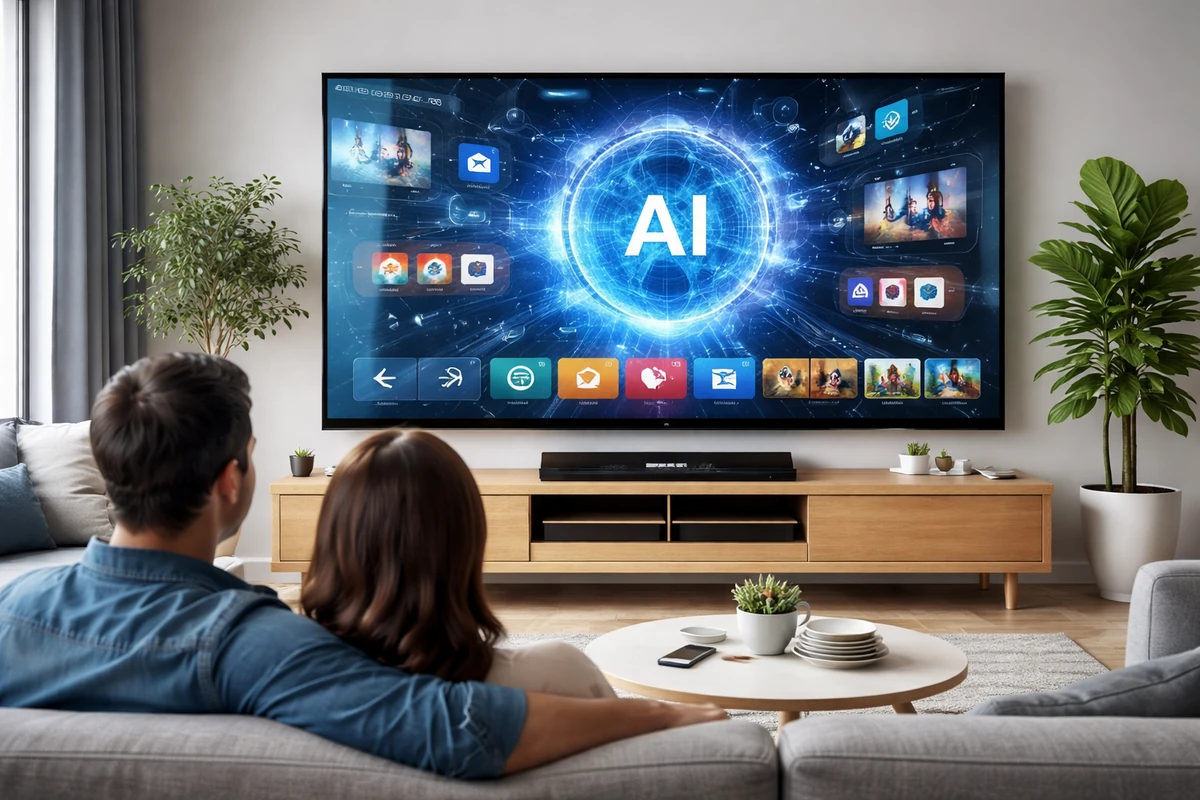
Samsung’s message is bigger than a product launch
Samsung Electronics has signaled a major shift in the way it wants consumers to think about television: not as a screen on the wall, but as an artificial intelligence device at the center of the home. In South Korea, where Samsung’s moves are watched as closely as Apple product events are in the United States, the company’s declaration that it plans to put AI into all of its TVs has been read as something much larger than a marketing slogan. It is, in effect, a statement that the television is being redefined from a finished appliance into a living-room computer, concierge and control hub.
That matters well beyond South Korea’s tech industry. Americans have spent years hearing that the future of consumer electronics belongs to smartphones, smart speakers and, more recently, AI assistants embedded in chatbots. But Samsung is betting that the most important screen in the house may still be the one in the living room. The company’s logic is straightforward: the TV is already where families gather, where streaming subscriptions live, where live sports and major cultural events still draw shared attention, and where an increasing amount of advertising and shopping is migrating. If AI becomes a default feature across Samsung’s full TV lineup, including lower-priced models, that could shift the competition away from traditional measures like picture quality, size and price and toward a broader contest over software, services and household influence.
For U.S. consumers, the easiest comparison may be the way smartphones evolved. At one time, the selling points were hardware basics: battery life, camera quality, storage capacity. Over time, the operating system, app ecosystem and services layered on top became just as important, if not more so. Samsung appears to be making a similar argument about TVs. The panel still matters. The hardware still matters. But the real differentiator may become what the television understands, what it suggests, what it can control and how naturally it fits into daily life.
The company’s use of the word “all” is especially important. In consumer electronics, AI has often been treated as a premium add-on, the sort of buzzword used to justify more expensive models. Expanding AI across an entire lineup suggests Samsung sees it less as a flashy feature and more as a foundational layer of the product, akin to the operating system itself. That is a notable change in posture. It implies that in the near future, consumers may not shop for an “AI TV” so much as assume that any modern TV is expected to understand speech, interpret context, personalize what appears on screen and serve as a command center for other connected devices.
That, in turn, opens a new phase in the battle for the home. The contest is no longer only about who sells the most televisions. It is about who owns the interface through which families watch, search, shop, manage subscriptions and increasingly run parts of their households.
The television is becoming less of a display and more of an interface
When many consumers hear the phrase “AI TV,” they tend to think first of familiar conveniences: sharper upscaling, better voice recognition, more accurate recommendations or automatic adjustment of sound and brightness. Those are real features, and manufacturers will continue to advertise them. But the larger industry significance lies elsewhere. The more consequential change is in how people interact with the device.
For decades, television has largely been a menu-driven experience. Users pick up a remote, move through rows of apps, scroll through categories and choose something to watch. Smart TV interfaces made that process more app-centric, but not necessarily more intuitive. In fact, the explosion of streaming options has often made modern TV feel more cluttered, not less. A typical American household may juggle Netflix, Disney+, Hulu, Max, YouTube, Prime Video, sports packages and free ad-supported channels, all while trying to remember which show is on which service. Decision fatigue has become part of the entertainment experience.
Samsung’s vision points toward a more conversational model. Instead of asking the user to navigate a maze of menus, an AI-equipped TV could infer intent, understand context and reduce friction. A person could turn on the television and ask for “something light for 30 minutes before bed,” “a movie the whole family can watch,” or “the game highlights and then a comedy.” The TV, in theory, would combine past viewing habits, time of day, household preferences and available services to provide something closer to a guided experience than a manual search.
That sounds simple, but it represents a major redesign of the user interface. The television stops being a passive playback machine and starts acting more like an active assistant. The distinction is crucial. A recommendation engine is useful. A system that interprets needs before the user fully articulates them is more powerful. It can keep people engaged longer, lower the mental effort required to choose content and create new opportunities for companies to shape behavior on the screen.
In the U.S., consumers have already seen hints of this direction in streaming platforms that auto-play content, voice assistants that pull up shows by actor or mood, and algorithmic homepages that rearrange themselves based on watch history. Samsung is suggesting the next stage goes further. The TV would not simply host apps from Netflix or YouTube; it could become the layer that mediates between all of them, while also tying in smart-home functions, household alerts and other services that turn the biggest screen in the house into a daily dashboard.
That is why this shift should not be dismissed as another round of gadget branding. Whoever controls the TV interface may gain significant leverage over how users spend time, what services they choose, what they buy and which ecosystem they remain loyal to over the long replacement cycle of a television.
Why the living room matters in a way phones do not
Unlike smartphones, televisions are communal devices. That difference may sound obvious, but it has broad business consequences. A phone is highly personal: one screen, one owner, one stream of data. A television is often shared by couples, roommates and families with children. It is the place where interests collide and compromise happens. In American terms, it is still the screen for NFL Sundays, election nights, Oscars broadcasts, kids’ cartoons on weekend mornings and binge-watching after work. It is not carried around all day, but it occupies a central spot in domestic life.
That makes the TV valuable in a different way from the smartphone. Even if a television generates fewer interactions per hour than a phone, the interactions tend to happen in longer sessions and in socially meaningful settings. People may spend hours in front of it in a single sitting. They may make decisions together there. They may respond to ads or suggestions in a group. For a company trying to build an ecosystem, that shared attention is powerful.
Samsung’s strategy appears to recognize this. The goal is not simply to sell a piece of hardware once every several years. It is to maintain an ongoing relationship after the sale through software updates, content discovery, device control, advertising and possibly commerce. In other words, the company is looking at “time spent” and connectedness, not just shipment volume.
That logic echoes how Silicon Valley talks about engagement, but applied to consumer appliances. In the old model, a television maker’s job was largely done once the product left the store. In the new model, the TV remains a service platform. It can collect signals about usage, receive updates, promote subscriptions, steer consumers toward certain content and serve as a touchpoint for a broader smart-home network. The more time users spend inside that environment, the more value the manufacturer can extract long after the original purchase.
In the U.S., where smart-home adoption has been uneven and often fragmented among Amazon Alexa, Google Home, Apple HomeKit and device-specific apps, that could be an appealing pitch. Many consumers already own smart lights, robot vacuums, connected thermostats, video doorbells and smart kitchen appliances. What they often lack is a simple, unified way to see and manage them. A large television screen in the living room is well suited to that job. It can show camera feeds, energy use, appliance status, delivery notifications or bedtime routines in a format that is easier to grasp than a phone app.
This is one reason TV makers are reluctant to surrender the living room to streaming platforms alone. If the television becomes merely a neutral monitor for external apps, the manufacturer risks losing its direct relationship with the user. But if it becomes the household’s main interface, the manufacturer gains a strategic foothold in the home that extends far beyond entertainment.
AI in every TV could reshape advertising, subscriptions and shopping
The economic implications are just as significant as the technical ones. Television has long been central to advertising, but the nature of TV advertising is changing quickly. Traditional linear television ads have been losing ground to streaming, where ads can be targeted more precisely and linked more directly to consumer behavior. A smarter television, equipped with AI and deep knowledge of viewing patterns, could push that evolution further.
Imagine a TV that knows a household tends to watch cooking shows on weeknights, streams children’s content on Saturday mornings and shops for home goods during holiday weekends. In theory, that device could deliver not just more targeted ads, but more context-aware prompts. It might suggest a meal-kit offer after a cooking program, surface a sale on soundbars after a sports broadcast or make it easier to subscribe to a new service after detecting interest in a specific genre.
For media and retail companies, that is attractive because it moves beyond impression-based advertising toward more measurable conversion. For consumers, however, it raises an immediate question: when does personalization become surveillance? A television that feels helpful may increase convenience. A television that feels like it is always watching, listening or steering behavior may provoke backlash.
This tension is especially acute in the living room, where expectations of privacy are often stronger than they are on smartphones or laptops. Families may be willing to tolerate aggressive personalization in shopping apps they open intentionally. They may be far less comfortable with it on a shared household screen that occupies a central place in domestic life. Trust matters more when the device sits in the room where people relax, talk and spend time together.
That means Samsung and its competitors will need to sell not only intelligence, but restraint. The companies that succeed may be the ones that make AI useful without making it intrusive. In practical terms, that means transparent privacy controls, clear explanations of what data is processed on the device versus in the cloud, sensible defaults for shared households and easy ways to manage profiles for adults and children. It also means delivering tangible value: consumers will not accept more data collection unless the benefits are obvious and reliable.
There is precedent for this in the American market. Smart speakers became mainstream only after consumers decided the convenience of timers, music playback and basic home control outweighed discomfort about microphones in the house. Even then, privacy controversies never fully disappeared. AI TVs could face a similar trajectory, but with even higher stakes because the device is more visually central, used by multiple people and involved in more commercial activity.
What companies want is not just more exposure. They want longer sessions, more transactions and tighter ecosystem lock-in. But to get there, the TV must be perceived as a genuinely useful household assistant, not simply a smarter billboard.
For South Korea’s tech industry, this is an opportunity and a test
In South Korea, Samsung’s declaration carries importance beyond one company’s product roadmap. The country’s technology sector has long excelled in hardware manufacturing, from memory chips and displays to smartphones and home appliances. The challenge in the AI era is whether that manufacturing strength can be fused with software, model optimization, voice interfaces, advertising technology and smart-home platforms in a way that creates durable advantage.
That context may not always be obvious to American readers. South Korea is home to some of the world’s most sophisticated electronics supply chains, and Samsung is not simply a TV brand there. It is a national industrial heavyweight whose decisions ripple across semiconductors, components, software vendors and content ecosystems. When Samsung says AI will be built into all TVs, domestic suppliers and software developers hear more than a branding update. They hear a potential reordering of priorities across the consumer tech stack.
That could create openings for companies working on on-device AI processing, latency reduction, multimodal interfaces, household identity management and content metadata. It could also accelerate the pressure on Korean firms to move beyond headline-grabbing large language models and into the messier work of embedding AI into everyday devices in ways ordinary people actually use. Consumer adoption often depends less on flashy demos than on whether the technology disappears smoothly into routine life.
Television is a particularly revealing test case. It is used frequently, but not continuously. It is shared, not personal. It serves multiple purposes at once: entertainment, information, ambient presence and increasingly home control. If AI works well here, it suggests a company understands not just language models, but domestic behavior. If it fails, the failure will be highly visible. Americans know this dynamic from products that looked futuristic on stage and then turned frustrating in real households. The same risk applies here.
The technical challenge is also more complex than the label “AI TV” suggests. Good performance is not only about raw model size or clever generative outputs. It is about response speed, accuracy in noisy rooms, differentiation among family members, reliability of voice recognition, smooth fallback when the system misunderstands a request and sensible permission structures on a shared device. A solution that works on a personal smartphone may not translate neatly to a living-room television where a child, parent and guest all use the same screen.
That is why Samsung’s announcement should be seen as both an opportunity and a demanding test. If South Korean firms can make AI feel natural in home devices, they will have demonstrated a real consumer pathway for AI adoption beyond office software and chatbots. If they cannot, “AI built in” risks becoming just another phrase stamped on packaging.
The biggest question is not what AI TVs can do, but who controls them
Beneath the product strategy lies a more consequential issue: control. In the AI TV era, the most important question may not be what features appear on a spec sheet, but who owns the relationship with the user. Does the TV maker build and control the assistant? Does it rely on outside AI providers? Or does it adopt a hybrid approach in which multiple services sit on top of the hardware?
Each model comes with trade-offs. If Samsung keeps tight control over the AI layer, it can tie hardware, operating system and services together more cohesively. That can strengthen brand identity and preserve control over data and monetization. But it may slow innovation if outside AI companies move faster or offer more capable assistants. If Samsung leans too heavily on external AI partners, it may deliver better functionality more quickly, but risk turning its own products into vessels for someone else’s ecosystem.
This dilemma is familiar in American tech. Apple’s strength has long come from tight integration, while other companies have thrived by building broad partnerships and open platforms. The TV market may be moving toward a similar split. Manufacturers want to avoid becoming interchangeable hardware vendors while giant AI companies are eager to insert their assistants into as many screens and devices as possible.
The issue becomes even more sensitive because televisions have longer replacement cycles than phones. Consumers may keep a TV for seven years or more. That means buyers are not just choosing a screen; they are choosing an evolving software environment that will shape their home experience over time. If the AI strategy changes midstream, if support fades or if data practices become controversial, consumers may feel trapped in an ecosystem they did not fully understand when they made the purchase.
Trust, then, becomes a competitive differentiator. In a shared family device, mistakes carry weight. A faulty recommendation is minor. A privacy misstep, an inappropriate profile mix-up, a child accessing restricted material or an assistant mishearing private conversation can be much more damaging. Consumers are likely to demand a higher standard of reliability and discretion from a television than from a phone app they can simply delete.
That may ultimately shape the winners in this market. The best AI TV may not be the one with the most dramatic demo, the longest list of features or the boldest claims. It may be the one that is least obtrusive, most stable and easiest to trust. In other words, success may come when consumers stop noticing the AI as a separate technology and simply experience the television as easier, calmer and more useful.
The American takeaway: the TV business is turning into a platform business
For American consumers, Samsung’s strategy is a sign of where the broader electronics market is heading. The television business is no longer only about hardware margins and showroom comparisons. It is increasingly a platform business, where the real competition concerns software layers, ecosystem integration, advertising inventory, data governance and control of household attention.
That shift has been building for years, but AI could accelerate it. As televisions become more capable of interpreting language, understanding patterns and coordinating other devices, they become more strategically important to everyone from streaming services and advertisers to smart-home companies and AI developers. The living room, once treated as mature territory in consumer electronics, is becoming contested space again.
Samsung’s move also reflects a reality that many U.S. companies understand well: when hardware categories mature, the battle moves to experience and recurring revenue. That is true for smartphones, cars, smart speakers and now televisions. The companies that thrive are the ones that can keep the consumer relationship alive after the initial sale.
Whether Samsung can execute on that vision remains an open question. Consumers have heard grand promises before about connected homes and intelligent assistants, only to encounter fragmented apps, awkward voice commands and ecosystems that do not work well together. But the company’s message is still significant because it frames television as a central front in the next phase of AI adoption. Not a side screen. Not a luxury niche. A core household device.
For now, the declaration should be read less as a final answer than as the beginning of a new competition. The next generation of TVs may still boast brighter panels and thinner designs, but the deeper contest will be over who orchestrates life around the screen. If Samsung is right, the future of television will not be defined mainly by what viewers watch. It will be defined by what the television knows, what it suggests and how much control families are willing to hand over to the device in the middle of the room.
That is a far bigger story than another TV launch. It is a story about how AI enters everyday life: not only through phones in our pockets, but through the shared screens that shape family routines, media habits and domestic power in the modern home.




0 Comments