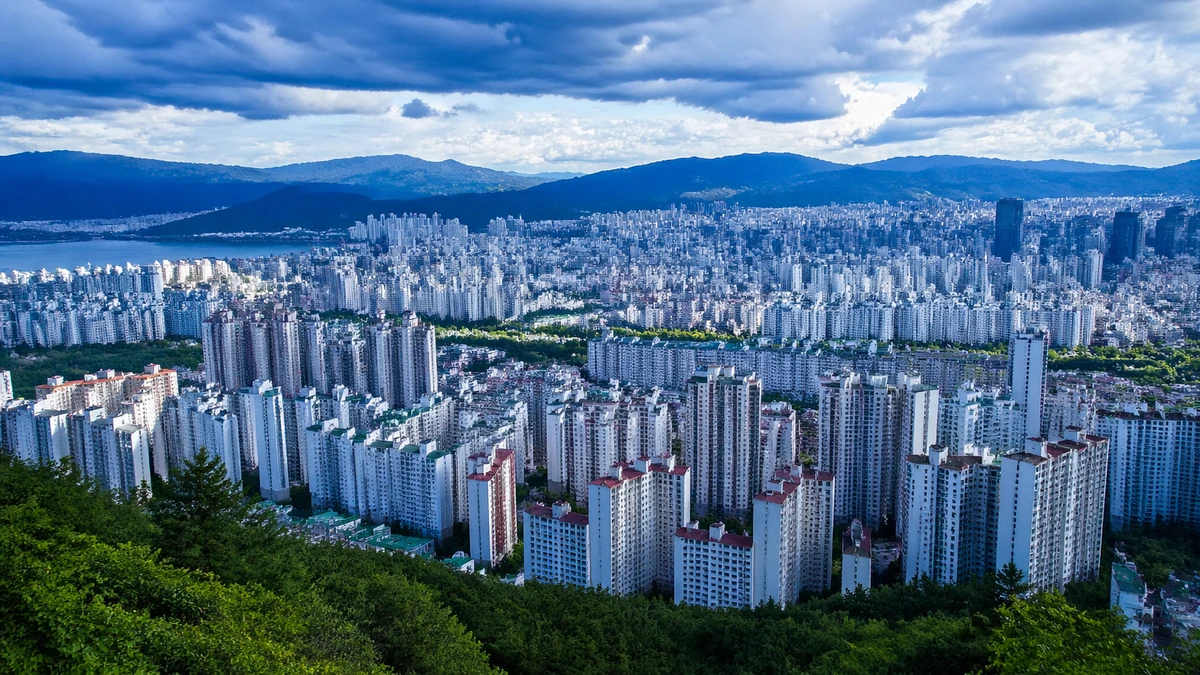
A Capital Region Splits Into Different Housing Realities
South Korea’s housing market has long been discussed in broad, almost shorthand terms: Seoul is expensive, the surrounding metro area follows its lead, and government policy can cool or ignite demand with a few changes to lending rules. But the latest data out of the Seoul metropolitan region, home to roughly half the country’s population, suggests that old framework is no longer enough. The most important story in Korea’s real estate market this spring is not that prices are simply rising or falling. It is that neighboring places are reacting in sharply different ways.
In March, apartment transactions in Seoul fell 17.7% from the previous month. On its face, that might sound like a familiar sign of a slowing market. But that reading gets complicated fast. Seoul apartment prices had still posted a 1.9% increase in February, and 85% of Seoul apartment transactions in March were for homes priced below 1.5 billion won, or roughly the equivalent of high-end urban housing in many major U.S. metro areas, though direct comparisons are imperfect. Put differently, fewer deals are getting done, but the market is not freezing evenly. Activity is narrowing into specific price bands and specific neighborhoods.
That matters because housing in South Korea, especially in and around Seoul, is not just about shelter or even personal wealth. It is deeply tied to family finances, marriage timing, school districts, commuting patterns and the kind of class mobility Americans might associate with a home in a coveted suburb with top-ranked public schools. In Korea, apartments are the dominant housing type in urban areas, and their values are scrutinized with a level of public attention that can resemble the way Americans track mortgage rates, stock indexes or gas prices.
The current shift suggests a market that is fragmenting under pressure from lending restrictions, reduced listings, high prices and uneven buyer confidence. Affluent districts once seen as almost immune to weakness are showing signs of cooling. More affordable districts inside Seoul are proving more resilient. And in outer-ring markets like Incheon, a city west of Seoul with its own economic base and large commuter population, home sales prices are flattening while rents continue to rise.
For American readers, the closest parallel may be a moment when Manhattan luxury condos soften, outer suburban starter homes still attract buyers, and nearby rental markets heat up because would-be buyers stay on the sidelines. But even that analogy only goes so far. Korea’s housing system has its own structures, including a strong government role in credit policy and a rental culture shaped partly by jeonse, the distinctive Korean system of large lump-sum security deposits instead of monthly rent. The result is a market that looks less like one tide lifting or lowering all boats and more like a series of connected but increasingly separate lanes.
That is the big takeaway from the spring 2026 data: the Seoul metro area is still one region on a map, but it is no longer behaving like one market.
Why Falling Transaction Volume Does Not Automatically Mean the Market Is Crashing
In most housing markets, a drop in sales volume is treated as an early warning sign. Fewer transactions can mean buyers are nervous, financing is harder to secure, or sellers are refusing to cut prices. All of those dynamics can be present in Seoul right now. But analysts looking only at volume risk missing something more important: demand has not disappeared so much as it has been squeezed into a narrower range of homes that buyers can still realistically afford and finance.
That distinction is crucial. South Korean regulators have repeatedly used lending rules to control housing speculation and household debt. When those rules tighten, the first deals to feel the strain are often the most expensive ones or purchases that require a heavy reliance on borrowed money. A buyer considering a top-tier apartment in Gangnam, Seoul’s best-known wealthy district, is much more exposed to financing limits and market timing concerns than a buyer targeting a comparatively lower-priced home in a farther-out district.
So when Seoul’s transaction count declines but the vast majority of completed deals are still happening below 1.5 billion won, it suggests the market is not uniformly weak. It suggests a kind of bottleneck. There are still buyers, but they are concentrated in the part of the market where loans are easier to secure, monthly payments are less punishing, and sticker shock is not quite so overwhelming.
Another factor is supply, or more precisely, the number of homes owners are actually willing to list. If buyers want to purchase but the inventory on the market is limited, transactions fall even without a broad collapse in demand. In that kind of environment, scarcity can still support prices, at least for homes that are seen as desirable and attainable. That helps explain why declining sales do not necessarily translate immediately into falling prices.
American homeowners may recognize part of this dynamic from the post-pandemic U.S. market, when elevated mortgage rates reduced transactions because both buyers and sellers hesitated, yet prices in many areas remained surprisingly firm due to low inventory. Seoul’s version is not identical, but the basic tension is similar: low activity does not always mean low demand. Sometimes it means the set of feasible deals has shrunk.
That is why some Korean analysts are increasingly describing the moment not as a broad downturn but as an “asymmetric contraction.” The pressure is real, but it is hitting different segments at different speeds. In practical terms, the market is becoming more selective. Homes that line up with tightened credit conditions and middle-tier budgets still move. Homes above that threshold face a much more fragile mood.
Gangnam and Gwacheon Cool While Nowon Holds Up
Some of the clearest evidence of that selectivity can be seen in the diverging trajectories of three well-known places in greater Seoul: Gangnam, Gwacheon and Nowon.
Gangnam needs little introduction. Even outside Korea, the district is globally recognizable thanks in part to pop culture, but within Korea it is shorthand for prestige, money and educational competition. It is the Korean equivalent of a place name that signals both wealth and aspiration, something like combining the cachet of Manhattan’s Upper East Side with the school-district obsession of affluent Silicon Valley suburbs. Prices there are extraordinarily high by national standards, and because of that, the district is especially sensitive to policy changes, financing limits and small shifts in elite buyer sentiment.
Gwacheon, a city just south of Seoul, occupies a somewhat different but similarly expensive niche. It has long been attractive for its proximity to Seoul, high-quality housing stock and reputation as a desirable residential area for professionals and upper-middle-class households. In recent reports, both Gangnam and Gwacheon have shown signs of shifting toward price declines.
That does not necessarily mean a dramatic crash is underway. In expensive markets, even a few lower-priced transactions can change the tone quickly because the total number of deals is relatively small. If some owners decide to sell, if buyers wait for better terms, or if investors with multiple properties begin to offload units, the mood can change fast. In high-end neighborhoods, the market often turns first in sentiment before it turns decisively in statistics.
Now compare that with Nowon, a northeastern district of Seoul that is generally considered more accessible by city standards. It does not command Gangnam-level prices, but it remains part of Seoul proper, with transit links and residential demand that appeal to households still determined to buy within the capital. Recent reporting indicates Nowon has continued to post gains even as pricier areas show weakness.
The lesson is not simply that some neighborhoods are better than others. It is that the same policy environment can produce opposite outcomes depending on the local price level and the buyer pool. In more expensive areas, tighter lending and affordability concerns can lead potential buyers to step back, even if they are not financially distressed. In more moderate-price areas, demand can persist because buyers recalibrate their goals and search for a place that still feels within reach.
For Americans, a familiar comparison might be this: if higher rates knock the top end of San Francisco or Westchester County off balance, some buyers may not leave the market entirely. They may instead pivot to more attainable neighborhoods where the monthly numbers still work. That appears to be happening inside Seoul itself. Rather than rising and falling in lockstep, the city is becoming more stratified, with resilience concentrated in places still seen as buyable.
That shift is important politically as well as economically. For years, housing discussions in Korea often treated Seoul as a single barometer. If Seoul was rising, the market was hot. If Seoul was softening, pressure was easing. The latest pattern makes that broad-brush approach less useful. Averages increasingly conceal the real story.
Incheon’s Flat Sales and Rising Rents Show Pressure Is Moving, Not Vanishing
If Seoul’s story is about a narrowing range of viable purchases, Incheon’s story is about what happens when would-be buyers hesitate. Located west of Seoul and connected to the capital by extensive transportation networks, Incheon is often discussed as part of the wider Seoul commuter belt. It is also a major city in its own right, home to South Korea’s main international airport and a mix of old urban neighborhoods, new development areas and industrial zones.
In March, Incheon’s housing sale prices turned flat, according to local reports, while both jeonse and monthly rents continued to rise. That combination is especially revealing. It suggests the burden on households has not gone away. It has merely shifted from would-be ownership costs into ongoing housing expenses.
For readers unfamiliar with Korean housing practices, jeonse is worth pausing on. Under the traditional system, a tenant provides a very large lump-sum deposit to the landlord, often financed partly through loans, and then pays little or no monthly rent during the lease term. The landlord, in turn, uses that deposit as capital. Monthly rent also exists, of course, and in recent years Korea’s rental market has become more mixed. But jeonse remains an important part of the housing ecosystem and can be heavily affected by interest rates, credit conditions and expectations about home values.
So when sale prices stop climbing in a place like Incheon but rental costs keep rising, it does not necessarily mean the market is stabilizing in a healthy way. It can mean households who might once have stretched to buy are instead staying in the rental market longer, bidding up rents as they wait. In American terms, it resembles a market where potential first-time buyers get priced out or deterred by high financing costs, then remain renters, increasing competition for apartments.
That also complicates a common assumption about the Seoul region: when central Seoul becomes too expensive, demand will simply spill outward into nearby cities and lift those sales markets. There is some truth to that. But not all displaced demand becomes purchase demand. Some of it becomes deferred demand. Households move outward geographically without moving into ownership. That appears to be part of what Incheon is showing now.
The result is a dual squeeze in outer-ring markets. Buying feels risky or unaffordable, but renting is not getting meaningfully cheaper either. For middle-income families, especially younger households trying to establish themselves, that can be an exhausting middle ground. It also means that policymakers cannot assume flat sale prices automatically signal relief. The pressure may just be manifesting somewhere else.
The Significance of the 1.5 Billion Won Threshold
One of the most telling figures in the recent data is that 85% of Seoul apartment transactions in March took place below 1.5 billion won. That number is more than a pricing footnote. It is evidence that the market is reorganizing itself around what households can still fund, not around where headline prestige lies.
When a large share of transactions concentrates in one price range, it usually points to several forces working at once. First, lending rules or financial conditions are squeezing the top end of the market. Second, buyers are prioritizing financing feasibility over ambition. Third, the public conversation shifts from “Which neighborhoods are rising?” to “What can I still buy?” Seoul appears to be in exactly that phase.
It would be a mistake, however, to interpret that as a straightforward boom in lower- or mid-priced housing. A concentration of deals below a certain threshold does not necessarily mean those homes are suddenly abundant or broadly affordable. It can also mean the upper tiers have become difficult to transact, forcing activity into the lower part of the market simply because that is where deals remain possible.
That nuance matters for anyone trying to understand Korean housing policy. Governments often look at total transaction volume or broad average price changes to judge whether a market is overheating or stabilizing. But if activity is increasingly compressed into particular price bands, those topline numbers become less informative. A market can look muted overall while still experiencing intense competition in the subset of homes that ordinary buyers can plausibly finance.
The United States has its own versions of this phenomenon. In many metro areas, a weak luxury market can coexist with fierce competition for starter homes. Builders, lenders and local officials then face a mismatch between what exists and what households can actually use. Seoul’s market is showing a similar mismatch, but under much tighter policy scrutiny and with much less room for geographic escape, given the centrality of Seoul to jobs, education and status.
That is why the 1.5 billion won statistic matters beyond the immediate month-to-month data. It signals a structural narrowing. The center of gravity in Seoul transactions is moving toward the band where households still have a fighting chance to close a deal. That is a very different market from one in which demand is spreading naturally across all tiers.
Why the Supply Debate Has Returned to the Forefront
As these regional and price-tier divides grow sharper, it is no surprise that the old debate over housing supply has come roaring back. In Korea, arguments over housing policy often split between those who want the government to lead construction and those who want private developers to play the bigger role. But the latest market signals suggest the more important question may be less ideological and more practical: what kind of supply is being added, where, and for whom?
The current market cannot be summed up simply as “there are not enough homes.” Shortage is part of the story, especially in a city as constrained and desirable as Seoul. But the more immediate problem appears to be a shortage of homes in the price ranges and locations that match actual household budgets under today’s lending conditions. If supply is added in a way that does not line up with those realities, headline construction numbers may rise without producing much felt relief.
That is a challenge Americans may recognize. In many U.S. cities, leaders talk about increasing supply, but what gets built is often skewed toward luxury units or projects that do little for middle-income buyers. Korea faces its own version of that policy trap. Expanding supply in theory is easier than expanding accessible supply in practice.
The fragmentation now visible across Seoul, Gwacheon, Nowon and Incheon underscores that point. If demand is clustering in relatively more attainable areas while expensive districts soften and outer-ring rental costs rise, then blanket solutions may miss the mark. Policymakers need to know not just whether more housing is being built, but whether it reaches households facing the tightest financing and affordability constraints.
There is also a timing problem. Housing supply takes years to materialize, while credit restrictions and market sentiment can shift quickly. That means short-term distortions, like a sudden concentration of transactions in one price band or rising rents in markets where sales have stalled, can persist long before new housing comes online. By then, household behavior may have changed in lasting ways.
In that sense, the latest market divergence is not just a real estate story. It is a social one. It affects who can remain in Seoul, who is pushed outward, who buys, who rents and who delays major life decisions because housing has become too uncertain. For a country already grappling with low birthrates, high household debt and deep generational inequality, those are not side issues.
A More Fragmented Future for Korea’s Housing Market
The old habit of talking about “the Seoul market” or “the capital region market” as if each were a single organism is becoming harder to defend. The evidence from spring 2026 points instead to a more fragmented landscape, where price level, neighborhood profile, financing access and housing type all determine how a local market reacts.
That means a drop in transactions no longer tells the whole story. It means price resilience in one district does not guarantee strength elsewhere. It means outer-ring markets cannot be understood simply as overflow valves for central Seoul. And it means policymakers, investors and ordinary families alike have to pay closer attention to the details beneath the averages.
For American readers, the broader lesson may feel familiar even if the local context is distinctly Korean. Housing markets often look most confusing precisely when they are under the greatest strain. Broad national or metro-level indicators can suggest one narrative while lived experience points to another. Some buyers pull back, others rush into the remaining affordable pockets, and renters absorb pressure that no longer shows up in sales prices.
That is where South Korea appears to be now. The issue is not merely whether home prices are going up or down. It is how quickly different segments are reacting, and what that says about access to housing in one of the world’s most concentrated urban economies.
Seoul and its surrounding cities are still deeply connected. People commute across their borders, compare their prices and make decisions across the whole region. But the market itself is becoming less synchronized. In the months ahead, that divergence may prove more important than any single headline about price gains or losses. It is the map beneath the averages, not the averages themselves, that now explains where Korea’s housing market is heading.
Comments
Post a Comment