South Korea moves to widen benefits for independence patriots’ families, doubling veterans medical network in a bid to make history tangible
South Korea turns remembrance into policy
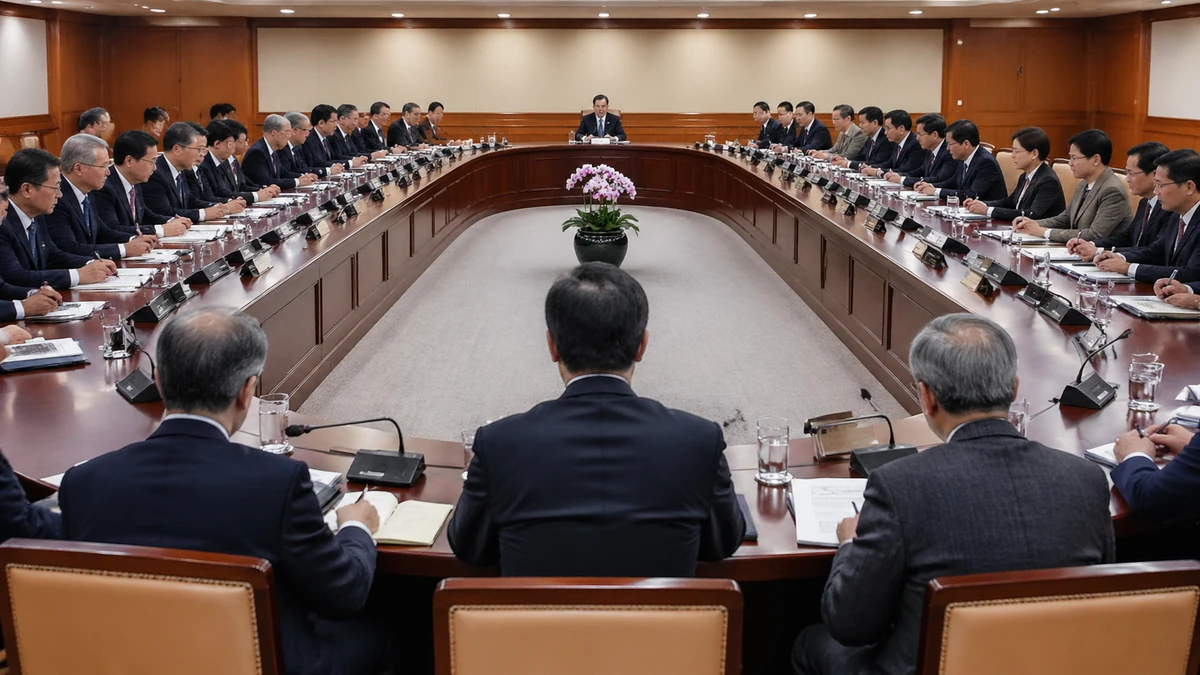
South Korea’s government has approved a new long-term plan that does more than adjust benefits around the margins. In a meeting chaired by Prime Minister Kim Min-seok at the Government Complex in Seoul, officials signed off on a national veterans and patriots development plan covering 2026 through 2030, anchoring two headline moves: expanding compensation for the surviving family members of independence patriots and doubling the number of contracted medical institutions available to people covered by the country’s veterans affairs system.
For American readers, the closest comparison may be a moment when a government decides that honoring military sacrifice or civil resistance cannot remain a matter of parades, speeches and museum exhibits alone. It has to show up in the monthly check, in access to a nearby hospital, in the rules that determine who is recognized and who is left out. That is the political meaning of Seoul’s announcement. This was not simply a bureaucratic update. It was a statement about how the state intends to remember those tied to Korea’s fight for sovereignty under Japanese colonial rule and how that memory should function in everyday life.
In South Korea, the term often translated as “patriots and veterans affairs,” or bohun, carries broader emotional and historical weight than the phrase can suggest in English. It includes support for military veterans, but it also reaches back to anti-colonial activists, democracy figures and others seen as having contributed to the nation through sacrifice. In this case, the focus on independence patriots is especially significant. These are people associated with the Korean independence movement during Japan’s colonial rule from 1910 to 1945, a period that remains central to Korean national identity and historical memory.
That is why the expansion of benefits for bereaved families matters politically. It signals that the state believes its existing recognition system has not gone far enough. And by pairing that with a major increase in medical access, the government is effectively saying that symbolic respect must be matched by practical care. For many recipients, the reality of state gratitude is not tested in a speech hall; it is tested at the hospital reception desk.
The plan also arrives at a time when democracies around the world are wrestling with how to translate national memory into public policy. The United States has its own debates over veterans’ health care, recognition for descendants of those who served and the public meaning of historical sacrifice. South Korea’s latest move belongs to that larger global conversation, but it is shaped by a distinctly Korean history: the unfinished work of remembering colonial resistance in a modern, highly developed democracy that is still defining how the past should live in the present.
Why independence patriots still occupy a special place in Korean public life
To understand why this announcement carries weight, it helps to understand who South Korea means when it refers to independence patriots. These are not simply war veterans in the conventional American sense. Many were activists, organizers, educators, guerrilla fighters, exiles and political leaders connected to efforts to resist Japanese imperial rule. Some operated in Korea, while others worked from China, Russia or elsewhere, often under severe hardship. Their legacy forms a foundational narrative of the modern South Korean state: that national freedom was won not only through post-World War II geopolitical change, but also through decades of Korean resistance.
In the United States, the emotional role such figures play may be loosely comparable to the place held by the Founding generation, civil rights icons or anti-authoritarian dissidents abroad whose lives later become part of a nation’s civic mythology. But the Korean case is also more immediate. Japanese colonial rule is not a distant chapter from the 18th or 19th century. It remains alive in family memory, education, diplomacy and regional politics. Questions about forced labor, wartime sexual slavery, collaboration and historical interpretation still shape relations between Seoul and Tokyo today.
That helps explain why policy toward the descendants of independence patriots is never just welfare policy. It is also a statement about the country’s moral hierarchy. Who gets recognized, who is compensated and how the government describes that obligation all send signals about what kind of nation South Korea believes itself to be. Expanding benefits to more surviving family members, even without every implementation detail yet public, suggests a belief that prior boundaries were too narrow for the historical debt involved.
There is also a generational dimension. The independence movement itself is moving farther from living memory. That creates a dilemma familiar to many countries: how do you preserve moral urgency after eyewitnesses are gone? One answer is commemoration through museums, textbooks and anniversaries. Another is institutionalization through benefits, health care and administrative recognition. South Korea’s latest plan leans heavily toward the second approach. It is an attempt to ensure that the memory of sacrifice is embedded in rules and budgets, not only in ceremonies.
That matters because public memory can harden into cliché if it is not tied to something concrete. A society may claim to honor its heroes, but citizens often judge sincerity through the design of public institutions. If recognition means difficult paperwork, limited eligibility and long travel for care, the honor can feel hollow. By contrast, when a government expands compensation and medical access, it turns remembrance into something citizens can measure.
From symbolism to hospital access
The most practical part of the announcement may be the decision to double the number of contracted medical institutions serving those eligible for veterans and patriots benefits. In a country with a fast-aging population and sharp regional disparities between Seoul and many rural areas, access matters almost as much as formal eligibility. A right on paper can mean little if it requires long travel, administrative confusion or waits that discourage use.
That is true in South Korea just as it is in the United States, where debates over veterans’ care often center not only on the scope of benefits but also on the ability to receive treatment close to home. South Korea’s expansion suggests officials understand that recognition must be experienced through convenience and availability. The policy is designed to reduce the distance between state promises and real medical treatment.
Even without full operational details, the political logic is clear. Compensation reflects a value judgment: these families deserve broader support because of a historical contribution tied to national independence. Medical expansion reflects delivery: the state intends to make that support visible in everyday life. Announcing both together is significant because it avoids separating honor from administration. One defines whom the nation values; the other defines whether those values are felt in practice.
For a government, that pairing can be powerful. Expanding financial recognition without improving access to services risks criticism that the change is mostly symbolic. Expanding health access without addressing the scope of family compensation risks suggesting that the underlying recognition remains too narrow. By linking the two, Seoul presented a more complete policy package, one aimed at both dignity and utility.
There is also an important psychological dimension. In many countries, veterans and bereaved families say their relationship with the state is shaped less by grand rhetoric than by daily encounters with institutions. A respectful clerk, a nearby clinic, a reimbursement that arrives on time, a transparent eligibility process — these interactions become the real face of government. South Korea’s decision appears to acknowledge that truth. If the state wants historical gratitude to feel credible, it must show up where people live, age and seek treatment.
That practical orientation also broadens the significance of the plan beyond memorial politics. It becomes part of a larger question facing advanced democracies: can public institutions treat historical sacrifice not as a static inheritance but as an ongoing civic obligation? South Korea’s answer, at least in this new framework, is yes — but only if memory is translated into systems people can actually use.
A five-year blueprint, not a one-day announcement
The government did not frame this as a one-off initiative. It approved a basic plan running from 2026 to 2030, which gives the announcement more institutional weight than a stand-alone policy promise. In Korean governance, a formal multiyear basic plan can shape budget priorities, interagency coordination and administrative sequencing. That means the significance of the meeting lies not only in what was announced but in the fact that the measures were folded into an official medium-term state agenda.
For American readers, think of the difference between unveiling an isolated agency program and embedding that program in a broader federal strategy document that guides spending and implementation over several years. The latter tends to survive beyond a single news cycle because it establishes a baseline for future action. South Korea’s move appears intended to do exactly that for patriots and veterans affairs.
This matters politically because state memory becomes more durable when it is bureaucratically routinized. A speech can inspire. A monument can symbolize. But a five-year plan creates obligations: someone must write the rules, allocate the money, negotiate with medical providers, review eligibility standards and monitor outcomes. It transforms remembrance from aspiration into administration.
That is one reason the plan deserves attention outside South Korea. Democracies often speak in lofty terms about sacrifice and civic debt, but implementation is where such claims are tested. By locking these priorities into a 2026-2030 roadmap, Seoul is signaling that veterans and historical recognition are not side issues to be addressed when politically convenient. They are being placed closer to the center of state management.
It is also worth noting what the summary of the Korean report did not include. The government has not, at least in the material provided, laid out every criterion, rollout date or enforcement mechanism. That leaves important questions unanswered, including which relatives will newly qualify, how quickly medical network expansion can occur and how regional equity will be measured. But the absence of those details does not diminish the political message of the plan. It simply means the next phase of scrutiny will shift from announcement to execution.
In that sense, the meeting marks a beginning rather than an endpoint. The plan sets the frame. The real test will be whether agencies can carry it out in a way that feels meaningful to families and patients rather than merely impressive on paper.
Kim Gu, UNESCO and the politics of international memory
The same meeting also set the direction for commemorative projects tied to the 150th anniversary of the birth of Kim Gu, one of the best-known figures in Korea’s independence movement. For many Americans, Kim may be unfamiliar, but in South Korea he occupies a place comparable to that of a revered national liberation leader — part statesman, part moral symbol, part historical touchstone. His life is deeply connected to the anti-colonial struggle and to Korean debates about nationalism, democracy and state legitimacy.
The government said the commemorative effort linked to a UNESCO memorial year would be guided by three themes: reexamining values, unity and solidarity, and memory and succession. Those phrases can sound abstract, but their intent is fairly clear. Officials want to present Kim Gu not simply as a figure for ceremonial reverence, but as a vehicle for discussing how the values of the independence movement should speak to the present.
That matters because history in South Korea is not only domestic. It is also diplomatic. Invoking UNESCO places the commemoration in an international register, suggesting that Korea’s independence story is something the government believes can be explained in universal terms beyond the peninsula. In effect, Seoul is trying to manage two audiences at once: a domestic public that sees independence memory as part of national identity, and an international public that may understand the story through a broader language of anti-colonialism, cultural heritage and democratic values.
There is a familiar pattern here for Americans. Countries often use anniversaries to tell the world who they are. The United States does it through milestone celebrations of independence, civil rights or major wars, packaging national memory into narratives legible to foreign audiences. South Korea appears to be doing something similar with Kim Gu: connecting local historical memory to global themes such as freedom, solidarity and civic inheritance.
The choice to discuss Kim Gu and the expansion of family compensation and medical access in the same meeting is revealing. It suggests that South Korea sees commemoration and welfare not as separate silos but as linked parts of a single state narrative. One speaks to values; the other demonstrates those values in practice. One addresses international symbolism; the other addresses domestic legitimacy. Together they form a fuller picture of how the country wants to remember its past and present that memory to the world.
Whether that strategy succeeds will depend on execution. Commemorative language can easily drift into sentimentality. International framing can flatten the complexity of historical debates. But the government’s effort to combine symbolic and material forms of recognition is notable precisely because it tries to avoid reducing history to spectacle alone.
More than routine politics
South Korean news, like political news anywhere, is often dominated by elections, party maneuvering, investigations and factional rivalry. Against that backdrop, this announcement stands out because it is not primarily about defeating an opponent or securing a short-term tactical advantage. It is about how the state defines its obligations to people connected to foundational moments in national history.
That is why the move resonates beyond ordinary administrative reform. It touches on a question that all modern democracies face: how should a government embody gratitude? Speeches are easy. Naming holidays is easier still. The harder work is designing institutions that preserve honor without turning it into empty bureaucracy. South Korea’s new plan is an attempt to answer that challenge by pairing narrative memory with usable benefits.
There is a nation-branding dimension here as well. South Korea is globally known for K-pop, film, technology and exports from Samsung smartphones to Hyundai cars. But states also project themselves through how they care for those associated with national sacrifice. Expanding benefits for the families of independence patriots sends a message about historical seriousness. Linking Kim Gu commemorations to UNESCO projects sends a message about international confidence. Improving medical access sends a message about administrative competence.
Together, those moves tell a story of a country that wants to be seen not only as economically successful and culturally influential, but as mature in the way it handles historical memory. That is especially important in East Asia, where disputes over history still shape diplomacy and identity. How a government remembers anti-colonial struggle is never purely retrospective. It has implications for regional politics, civic education and the legitimacy of public institutions.
Seen this way, the plan is not just about the beneficiaries, important as they are. It is also about the kind of political community South Korea wants to present to itself and others: one that treats the legacy of freedom and sovereignty as an obligation requiring both ceremony and care. The policy’s symbolic reach is therefore much broader than its administrative language might initially suggest.
The likely benefits, and the unanswered questions ahead
The immediate promise of the plan is straightforward. Broader compensation eligibility should ease burdens for more surviving relatives of recognized independence patriots. A much larger network of contracted medical providers should improve convenience, reduce travel strain and make state support feel more tangible. For elderly recipients in particular, proximity and ease of use can make the difference between nominal access and real access.
Still, the policy’s ultimate impact will depend on details that have yet to be fully spelled out. Which family members will be newly covered? Will the expansion address long-standing complaints about narrow definitions of bereaved relatives? How quickly can medical institutions be added, especially outside major metropolitan areas? Will reimbursement and administrative procedures be streamlined along with the network increase? Those questions matter because implementation often determines whether a reform is transformative or merely cosmetic.
There is also the budget question. Expanding recognition and medical access is rarely cost-free. If the government intends this plan to endure through 2030, it will need stable funding and effective coordination across ministries and providers. The political symbolism of the announcement is strong, but durable credibility will require evidence that the state can back its promises with resources and administrative follow-through.
Another challenge is public understanding. Because the language of bohun can encompass both veterans affairs and broader national merit, the government may need to explain the reform clearly to younger South Koreans who feel more distant from the independence era. That is where the Kim Gu anniversary projects may play a role, helping translate historical memory for a generation raised in a globally connected, culturally confident Korea that can sometimes take national sovereignty for granted.
For outside observers, the larger significance is this: South Korea is trying to build a bridge between the memory of liberation and the mechanics of modern governance. Rather than treating anti-colonial history as a sealed chapter, it is using benefits, medical infrastructure and public commemoration to keep that history active in civic life. In an age when democracies often struggle to connect lofty ideals with practical institutions, that is a revealing political choice.
Whether the effort succeeds will be measured less by the power of the announcement than by what happens next — in clinics, in government offices, in budget documents and in the lives of the families meant to benefit. But as a statement of direction, the message from Seoul is already clear: historical sacrifice should not live only in statues and ceremonies. It should be visible in the systems a nation builds for the people who carry that history forward.
Comments
Post a Comment