
South Korea turns to diplomacy as war risks spread beyond the battlefield
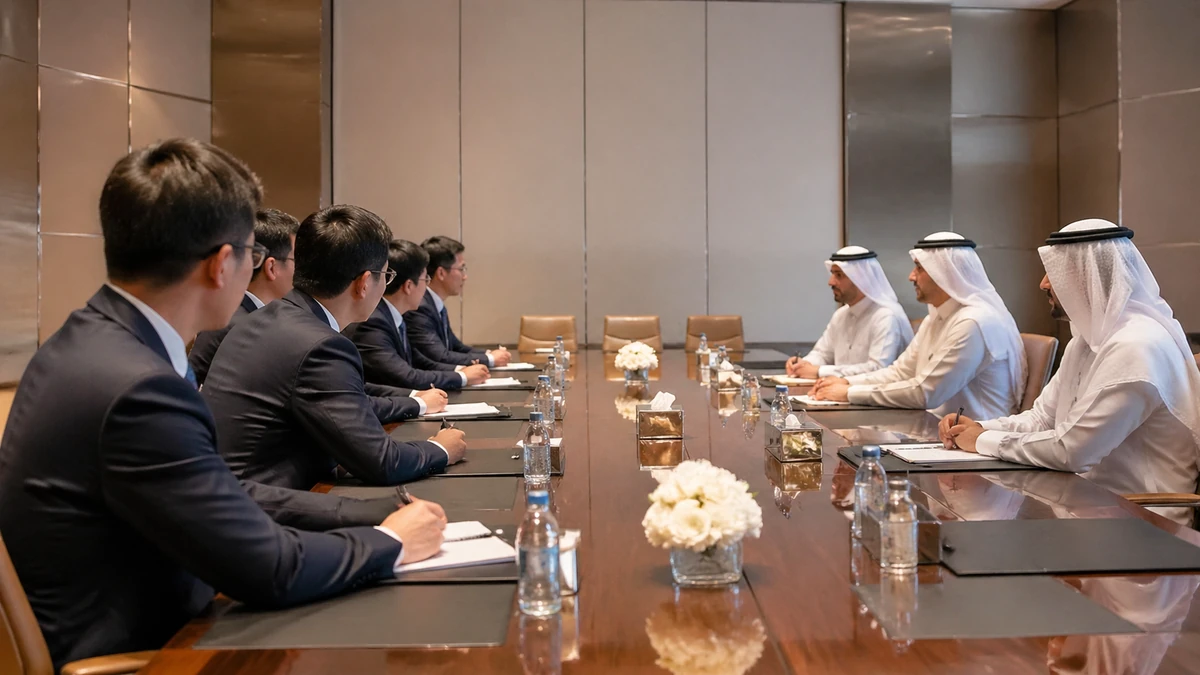
South Korea is dispatching a special envoy to Kuwait, Bahrain and Iraq in an effort to shore up high-level ties with key Middle Eastern partners at a moment when regional conflict is no longer just a security story. For Seoul, it is also an economic one.
The trip, scheduled for May 1 through May 9, comes as the South Korean government watches the prolonged fighting in the Middle East with growing concern over the knock-on effects on energy flows, shipping routes and broader supply-chain stability. According to the Foreign Ministry, the envoy, former acting ambassador to Saudi Arabia Moon Byung-joon, will meet senior officials in all three countries, exchange views on the regional situation and discuss “practical cooperation” across multiple sectors.
That language may sound diplomatic and broad by design, but the message behind it is easy to understand for an American audience: South Korea is trying to make sure geopolitical instability in one of the world’s most strategically vital regions does not cascade into deeper disruptions for its economy. In Washington, that logic would be familiar. Successive U.S. administrations have long treated the Middle East not only as a military and political theater, but also as a place where conflict can quickly affect oil prices, shipping costs, inflation and the availability of critical goods. Seoul is now navigating a similar reality in a very direct way.
South Korea is one of the world’s most trade-dependent advanced economies. It imports the vast majority of its energy, relies heavily on maritime shipping and sits at the center of global manufacturing networks for semiconductors, autos, batteries, petrochemicals and steel. When policymakers in Seoul talk about supply chains, they are not using a trendy buzzword. They are talking about the basic infrastructure that keeps factories running, export orders moving and household energy prices from spiking.
That helps explain why the government’s announcement matters beyond the diplomatic calendar. This is not merely a ceremonial trip or a photo-op tour of friendly capitals. It is a sign that South Korea sees Middle East diplomacy as part of the practical work of economic risk management. The government is responding to a world in which foreign policy, energy security and domestic economic stability are increasingly inseparable.
Just as American readers have become accustomed to hearing how conflict in the Red Sea, sanctions on oil producers or tension in the Strait of Hormuz can affect prices at the pump or delivery times for consumer goods, South Koreans are confronting the same interconnected world. In Seoul’s case, the urgency may be even sharper. The country’s export-led economy leaves it highly exposed to disruptions far from the Korean Peninsula.
Why Kuwait, Bahrain and Iraq matter to Seoul
At first glance, the choice of Kuwait, Bahrain and Iraq may seem unusual to readers more accustomed to headlines dominated by Saudi Arabia, the United Arab Emirates, Iran, Israel or Qatar. But that is precisely part of the story. By grouping these three countries into one envoy mission, South Korea appears to be signaling that it wants a more layered and diversified Middle East strategy rather than one limited to the region’s biggest headline-makers.
Kuwait has long been an important energy partner for Asian economies, including South Korea. Bahrain, though smaller, carries outsize diplomatic and financial roles in the Gulf and remains a key node in regional politics. Iraq, meanwhile, is not only a major oil-producing country but also a state whose stability or instability can reverberate across energy markets and regional alignments. Each country occupies a different place in the Middle East’s political and economic map. Taking them together suggests Seoul is not chasing a single transaction or a single issue, but building out multiple channels of communication across a wider region.
That matters in diplomatic terms. When uncertainty grows, governments often have two broad choices: concentrate narrowly on one or two indispensable partners, or widen the field of engagement so that risk is spread across relationships and communication lines. South Korea appears to be trying to do both — maintain core partnerships while broadening the circle of active diplomacy. In practical terms, that means more direct contact with more capitals, more listening as well as messaging, and more effort to understand how local officials see a fast-changing regional environment.
For American readers, there is a useful analogy in how U.S. officials often engage not just with one anchor power in a region, but with a network of states that each play distinct roles in security, energy, finance or logistics. The goal is not always to announce a breakthrough. Often, it is to prevent surprises, sustain trust and keep room for cooperation open when crises make every relationship more fragile.
In Seoul’s case, the symbolism of the itinerary is almost as important as the meetings themselves. Visiting three countries in one swing underscores that South Korea views the Middle East as a strategic space requiring active management, not simply a faraway region that enters Korean politics only when oil prices jump or violence flares. That is a notable shift in emphasis, especially for a country whose diplomacy is often discussed abroad mainly through the lens of North Korea, China, Japan and the United States.
South Korea’s foreign policy establishment has long had to prioritize Northeast Asian security concerns. But the envoy mission is a reminder that middle powers like South Korea do not have the luxury of focusing on only one neighborhood. If the Korean Peninsula remains Seoul’s immediate security concern, the Middle East is increasingly part of its economic security perimeter.
Supply chains are now foreign policy
The Korean government’s own framing of the trip is telling. It explicitly linked the envoy mission to the prolonged Middle East conflict and to supply-chain disruptions. That pairing reveals how governments now think about diplomacy in the post-pandemic, post-Ukraine-war era: conflict is no longer judged only by the territory at stake or the alliances involved, but by how quickly instability can travel through ports, shipping lanes, commodity markets and factory schedules.
In the United States, the phrase “supply chain” became common shorthand during the pandemic, when Americans encountered shortages, delayed deliveries and sticker shock on everything from cars to groceries. In South Korea, the term carries an even broader strategic weight because the nation’s economic model depends so heavily on importing raw materials, processing them efficiently and exporting finished goods around the world.
So when Seoul says it wants to discuss “practical cooperation in various fields,” the likely implication is not limited to abstract diplomatic goodwill. Without speculating beyond the announced facts, it is reasonable to read this as an effort to reinforce the real-world foundations of bilateral ties — energy supply, industrial coordination, business continuity, possibly construction and infrastructure cooperation, and broader economic resilience.
That approach also reflects a more hardheaded style of diplomacy. Rather than unveiling a grand new doctrine, South Korea is using one of the oldest tools in statecraft: send an experienced representative, meet people in person, compare assessments, reduce misunderstandings and search for areas where interests still overlap despite a volatile regional backdrop. In other words, this is diplomacy as maintenance work — unglamorous, often quiet, but essential.
For countries that sit at major chokepoints in trade and energy networks, that kind of maintenance can be invaluable. A war does not need to physically spread into every neighboring country to create wider economic consequences. Insurance costs can rise. Shipping routes can lengthen. Companies can grow more cautious. Investors can hesitate. Energy markets can tighten simply because traders fear what might happen next. In such an environment, a government that waits passively for disruption to arrive is already behind.
That is why the envoy trip deserves attention. It shows how a middle power tries to absorb global shocks not by making dramatic speeches, but by intensifying communication with partners whose decisions matter to market stability. It is a reminder that foreign ministries today often function as much like economic risk managers as traditional diplomatic institutions.
The choice of envoy sends its own message
The South Korean Foreign Ministry said the mission will be led by Moon Byung-joon, a former acting ambassador to Saudi Arabia. That personnel choice may look like a small detail, but in diplomacy those details often tell you how serious a government is about substance.
Appointing a figure with prior Middle East experience suggests Seoul wants more than symbolic engagement. It wants someone who understands the political rhythms of the region, knows how to read official language for nuance and can engage counterparts on the basis of existing familiarity with regional concerns. Experienced envoys are not simply messengers. At their best, they are translators of strategic intent — people who can explain their government’s priorities while also accurately gauging what their counterparts are really saying behind formal talking points.
That matters especially in a region where every conversation now carries multiple layers: public diplomacy, domestic political messaging, energy considerations, security anxieties and the calculations of outside powers all at once. Sending a seasoned hand indicates that Seoul wants to listen as well as speak.
That point is worth emphasizing because it gets to the heart of what this mission appears to be. A special envoy is not necessarily a one-way conveyor belt for policy. The role can be just as much about gathering impressions, testing the mood in various capitals and mapping where cooperation remains possible. The Foreign Ministry’s description of the trip — exchanging views on the regional situation while discussing practical cooperation — suggests a two-track purpose: understand the environment and preserve working relationships within it.
For American readers, there is an analogy in the way Washington sometimes dispatches former ambassadors, veteran military officers or senior diplomats on special assignments during periods of regional uncertainty. The value lies partly in expertise and partly in credibility. Counterparts are more likely to invest in a serious conversation when they believe the envoy can report back with authority and context.
In South Korea’s case, the envoy’s mission also reflects a broader truth about how the country practices diplomacy. Seoul often prefers calibrated, pragmatic moves over grandstanding. That can make its foreign policy seem understated from abroad. But understated does not mean passive. It often means the government is trying to get concrete outcomes without adding rhetorical heat to already tense situations.
A same-day Qatar meeting highlights the bigger pattern
The envoy announcement did not occur in isolation. On the same day, South Korean Prime Minister Kim Min-seok met in Seoul with Ahmed bin Mohammed Al Sayed, Qatar’s minister of state for foreign trade. During that meeting, Kim expressed appreciation for Qatar’s commitment to continue supplying liquefied natural gas to South Korea despite difficult regional conditions, according to the Korean government’s account.
That detail is significant because it illustrates the larger pattern behind Seoul’s recent Middle East outreach. South Korea is not treating the region only as a zone of crisis to be watched anxiously from afar. It is engaging country by country, issue by issue, in ways that connect diplomatic reassurance with practical economic needs.
Qatar occupies a particularly important place in that equation because of its role as a major LNG exporter. For South Korea, reliable LNG supply is not a peripheral matter. It touches electricity generation, industrial planning and the wider confidence that energy imports will remain stable during a volatile period. Kim’s public appreciation for Qatar’s pledge therefore carried more than ceremonial value. It was a public acknowledgment that diplomatic relationships can help cushion economic vulnerability.
At the same meeting, Kim also reportedly expressed sympathy for losses suffered by Qatar amid the regional conflict and said the Middle East, including Qatar, holds significant potential for expanded cooperation with South Korea. That combination — condolences, communication and practical cooperation — mirrors the logic behind the envoy mission to Kuwait, Bahrain and Iraq. Seoul is trying to show that it can be empathetic without being merely rhetorical, and pragmatic without being cold.
To be clear, the Qatar meeting and the three-country envoy trip are separate events. There is no indication in the available facts that they are part of a single formal initiative. But viewed together, they reveal a consistent diplomatic posture. South Korea is moving to keep multiple channels open across the Middle East at a time when the region’s instability threatens to affect energy supply, trade and business confidence well beyond its borders.
That approach is also politically useful at home. Governments are often judged by whether they appear to be managing risk proactively or reacting late. By publicizing both the envoy trip and the Qatar meeting, Seoul can demonstrate that it is not simply monitoring events; it is engaging partners directly in an attempt to limit fallout.
What this says about South Korea’s place in the world
There is a larger international story here, one that goes beyond the immediate itinerary. South Korea is often described as a “middle power,” a term used in foreign policy circles to describe countries that are not superpowers but still have substantial economic weight, diplomatic capacity and regional influence. Middle powers cannot usually dictate the course of major wars or reorder global markets by themselves. What they can do is build networks, diversify partnerships and act early enough to soften external shocks.
That seems to be what Seoul is attempting now. Rather than waiting for a crisis to fully materialize into supply shortages or economic damage, it is trying to strengthen relationships that may help preserve flexibility. That is a practical example of how middle powers survive in an era of compounding crises. They cannot control the storm, but they can improve their position before it hits harder.
For Americans, South Korea is often viewed primarily through the lens of the U.S. alliance, North Korea’s nuclear threat, semiconductor competition and cultural exports such as K-pop, Korean dramas and films. Those are all important pieces of the picture. But they can obscure another reality: South Korea has become a deeply global actor with interests that reach far beyond East Asia.
Its companies build ships, cars, batteries, apartments, refineries and industrial plants around the world. Its energy needs tie it closely to the Gulf. Its export economy depends on stable sea lanes and predictable access to raw materials. Its diplomacy increasingly reflects that reality. The envoy trip to Kuwait, Bahrain and Iraq is one more sign that South Korea’s foreign policy is being shaped by the same interconnected pressures facing other major trading nations.
It also underscores how modern diplomacy is less about isolated “political” issues than it once was. Security, energy, inflation, trade and supply chains now sit in one policy bundle. A war in one region can affect consumer prices in another; a diplomatic misunderstanding can have consequences for industrial planning; a shipping disruption can become a domestic political issue. Seoul’s response reflects an understanding that these categories no longer operate separately.
In that sense, South Korea’s move may resonate with policymakers well beyond Asia. Many U.S. allies and partners are grappling with the same question: how do you preserve economic stability when geopolitical risk is increasingly chronic rather than temporary? One answer is more frequent, more targeted diplomacy with countries that matter to critical imports and trade routes. Seoul is now offering a textbook example of that approach in real time.
What to watch next
The immediate question is what tone and substance emerge from the envoy’s meetings in Kuwait, Bahrain and Iraq. The publicly confirmed facts remain limited: Moon will visit the three countries, meet senior officials, exchange views on the regional situation and discuss ways to expand practical cooperation. There is, at least for now, no announced agreement, no disclosed package of new commitments and no official indication of a broader policy shift beyond the mission itself.
Still, diplomacy is often most meaningful before there is a headline-grabbing outcome. The real value can lie in quiet conversations that reduce uncertainty, protect relationships and create space for future cooperation. A meeting that produces no dramatic announcement can still be consequential if it helps align expectations, reassure a partner or keep an energy and trade relationship steady during a turbulent period.
That is why this story deserves attention even in the absence of a formal breakthrough. It shows a government responding to a dangerous international environment with direct engagement rather than rhetorical posturing. It suggests that South Korea sees its national interest not only in traditional security terms, but also in the sturdier, less glamorous work of keeping supply lines dependable and partnerships functional.
For a global audience, and especially for readers in the United States, the lesson is a familiar one. In a world where conflicts ripple across economies with remarkable speed, diplomacy is no longer just about alliances and communiques. It is also about preventing shortages, reducing market panic and ensuring that commercial ties survive political shocks. South Korea’s envoy mission to three Gulf states may not dominate cable news, but it offers a revealing look at how a sophisticated trading nation tries to protect itself when war and economic uncertainty become tightly intertwined.
If the trip succeeds, the result may not be visible in a single dramatic announcement. It may instead show up more quietly — in steadier communication, preserved trust and fewer surprises in a region where surprises have become expensive. For Seoul, that alone would be a meaningful diplomatic win.



0 Comments