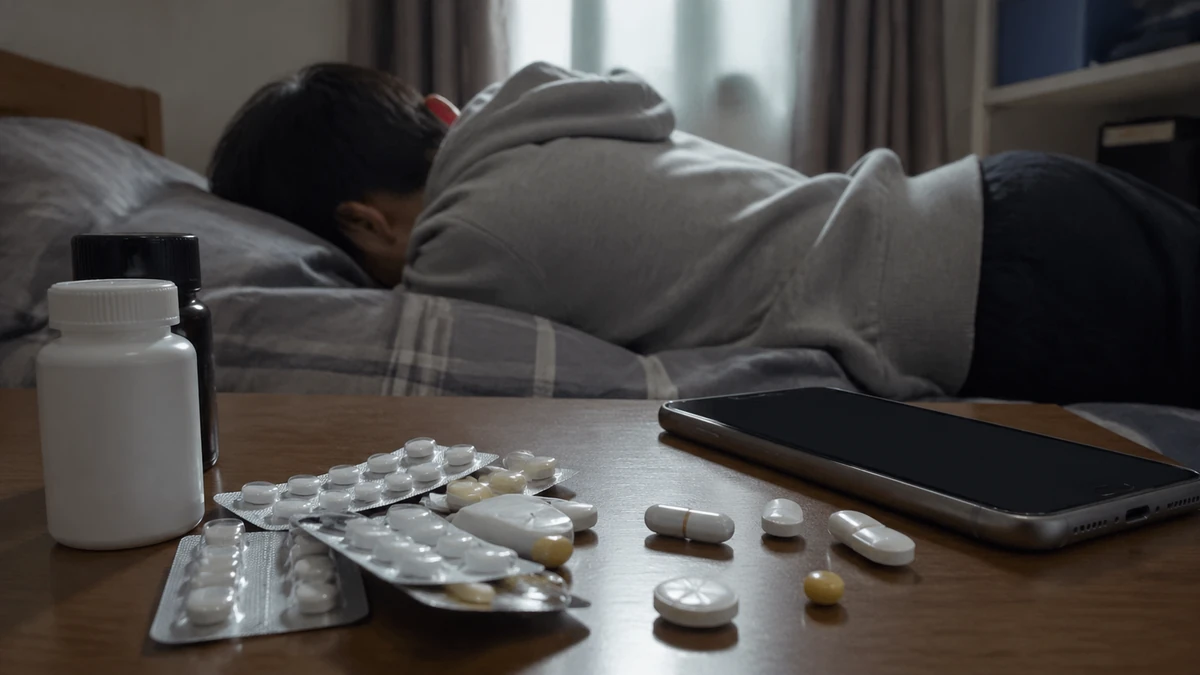
A dangerous trend built from ordinary medicine
South Korean health officials are sounding the alarm over a troubling social media trend among teenagers: young people taking excessive amounts of over-the-counter cold medicine and sleep aids, then posting about the experience online as if it were a challenge, a rite of passage or a bizarre form of entertainment.
In South Korea, the behavior has circulated under the label “OD party,” using the shorthand for overdose in a way that experts say makes a serious public health risk sound casual, social and even playful. Reports cited by Yonhap News Agency say some teenagers have described hallucinations and other abnormal reactions after swallowing multiple nonprescription medicines at once. What makes the issue especially unsettling is not only the age of those involved, but the fact that the substances in question are not illicit street drugs or tightly controlled prescription medications. They are common products sold at pharmacies and found in many homes.
That distinction matters. In the United States, parents, teachers and health officials have spent years worrying about the misuse of prescription opioids, stimulants and illicit substances such as fentanyl. But the South Korean case points to a different and in some ways more complicated problem: when familiar, everyday medicines are rebranded online as tools for experimentation, the barrier to risky behavior can fall dramatically.
Medicines that are designed to treat a cold, help someone sleep or relieve discomfort can begin to look harmless precisely because they are so ordinary. Their availability can create a false sense of safety. To many adolescents, something sold over the counter may not register as dangerous in the same way as a banned substance. But public health experts have long warned that dosage is not a small detail; it is the difference between treatment and poisoning.
The concern emerging from South Korea is therefore bigger than one slang term or one cluster of posts. It reflects a collision between youth digital culture and public health, where the language of trends, hashtags and “experience-sharing” can transform a warning sign into a badge of curiosity. And because the ingredients involved are easy to obtain, the trend carries implications that reach well beyond South Korea.
Why experts say the name itself is part of the problem
One of the clearest lessons from the South Korean reporting is that language can shape behavior. Calling something an “OD party” softens its meaning. The word “party” suggests a shared event, something communal, something fleeting and fun. In American terms, it works the way internet challenge culture often does: a serious act is stripped of context and repackaged as participation.
That reframing is not trivial. Public health campaigns have long struggled with the speed and style of social media, where content that is short, provocative and personal spreads more easily than sober medical advice. A teenager describing a strange sensation after taking too much medicine can attract attention faster than a health agency explaining drug interactions, liver stress, confusion, respiratory depression or the risk of cardiac problems.
In the South Korean case, some of the posts reportedly circulate as firsthand accounts of unusual reactions, including hallucinations. That matters because it turns the body’s danger signals into content. Instead of reading dizziness, disorientation or visual disturbances as reasons to stop and seek medical help, some users may interpret them as the point of the exercise. The harmful effect becomes the storyline.
This is a familiar dynamic in digital life. The internet often rewards extremes. Shock value can look like authenticity, and risky behavior can be mistaken for boldness or curiosity. For adolescents, who are still developing judgment and impulse control, that feedback loop can be especially powerful. In that setting, the issue is not just the medicine itself. It is the social meaning wrapped around it.
South Korean experts appear to be warning about exactly that shift in perception: not only misuse of medicine, but the normalization and glamorization of misuse. Once dangerous behavior acquires a recognizable label and an online format, it can become repeatable. It can be copied, tagged, joked about and detached from consequences.
Why over-the-counter drugs can be more deceptive than illegal ones
For American readers, one of the most important cultural points to understand is the role of over-the-counter medicine in daily life. In both South Korea and the United States, nonprescription drugs occupy a special place in the public imagination. They are not treated with the same fear or scrutiny as narcotics or controlled substances. They are products people buy quickly, keep in kitchen drawers, medicine cabinets and backpacks, and use with little ceremony.
That familiarity is exactly what makes misuse dangerous. “Over the counter” does not mean risk-free. It means the medicine can be sold without an individual prescription when used as directed. Cold medicines may contain ingredients that affect the brain, heart, blood pressure or liver, especially when mixed, taken in large amounts or combined with other substances. Sleep aids can impair breathing, cognition and coordination, and can become more dangerous if a person takes too much or mixes them with alcohol or additional medications.
Americans have seen related concerns before. Dextromethorphan, a cough suppressant found in some cold medicines, has long been misused by some teenagers in the United States for dissociative or hallucinatory effects at high doses. Acetaminophen overdose, often accidental but sometimes intentional, is a major cause of acute liver failure. Diphenhydramine, an antihistamine sold widely for allergies and sleep, can also cause serious toxicity in excessive amounts. None of these are obscure chemicals. They are familiar names in ordinary stores.
The Korean reports underscore a broader truth: the danger of a drug is not defined only by whether it is legal. It is defined by how it is used, in what amount, by whom, and in what combinations. A nonprescription label can lower psychological defenses. A teenager may think, wrongly, that if a product can be bought at a pharmacy without a doctor’s note, then taking more simply means getting more of the effect.
That misunderstanding can be deadly. Medicines are formulated for specific uses and dosages. Once they are taken in bulk, they stop functioning as routine health aids and start behaving like toxic agents. The line between the two can be crossed quickly, especially for smaller bodies, people with underlying conditions or those taking multiple products that contain overlapping ingredients.
That is why the South Korean case is drawing attention as more than a quirky internet phenomenon. It is a reminder that easy access can create a public health blind spot. The danger is not hidden in a dark corner of the drug market. It may be sitting in plain sight on a pharmacy shelf.
How social media can turn private risk into public imitation
According to South Korean health authorities, the spread of posts describing overdose experiences suggests the problem is no longer isolated. Once a risky act is documented and shared, it enters a system built for repetition. That changes the scale of the threat.
In the pre-social media era, reckless experimentation among teenagers still existed, but it was more likely to remain local and limited. Now a single post can become a template. A brief video, a caption, a hashtag or a casual reference in a chat room can reduce something complex and dangerous to a digestible visual cue. Instead of asking, “Should I do this?” a teenager may begin with, “Other people are already doing this.”
That is a powerful shift. Copycat behavior does not require full understanding. It only requires enough visibility to make the action legible and enough social reward to make it feel worth trying. Platforms built around short-form content intensify that problem because they prioritize speed, reaction and novelty over context.
Public health messaging, by contrast, often moves slowly and speaks in dense, careful language. Agencies warn about adverse reactions, dosage limits and emergency symptoms. Those are necessary messages, but they can struggle to compete with content that is emotionally charged, peer-driven and wrapped in the aesthetics of trend culture.
This gap between how danger spreads and how institutions respond is not unique to South Korea. American educators and pediatricians have faced similar challenges with viral dares involving household products, medications and self-harm-adjacent online content. The details differ, but the mechanism is recognizable: a risky act becomes a meme, and the meme strips away the gravity.
What the Korean story adds is a pointed example of how quickly everyday medical products can be absorbed into that ecosystem. The internet does not care whether a substance is a prescription pill, a pantry item or an over-the-counter capsule. If it produces a dramatic reaction and can be turned into shareable content, it becomes raw material for online performance.
What this says about teen stress, curiosity and health literacy
It would be a mistake to treat this issue only as delinquency. Risky behavior among teenagers rarely emerges in a vacuum, and experts often caution that the motivations can vary widely. Some adolescents may be driven by curiosity or boredom. Others may be responding to peer pressure, mental health struggles, social isolation or a desire to feel something intense and immediate in a highly controlled academic and family environment.
That context is especially relevant in South Korea, where students often face intense educational pressure and long study hours, conditions that are frequently discussed in reporting on youth well-being. That does not excuse dangerous behavior, but it does help explain why adults should resist simplistic narratives. A teenager experimenting with medicine for stimulation, escapism or social belonging may be sending up a flare about deeper distress.
At the same time, the reports highlight a more practical deficit: health literacy. Knowing the brand name of a medicine is not the same as understanding how to use it safely. Many families treat common remedies as routine household goods, not items that require ongoing conversations about dosage, interactions and misuse.
For American families, the parallel is easy to recognize. Plenty of parents teach children to stay away from illegal drugs but spend less time discussing what can go wrong with products bought at CVS, Walgreens or a supermarket pharmacy. Yet poison control centers in the United States regularly field calls involving exactly those substances.
In that sense, the South Korean case is not merely a foreign curiosity. It is a warning about a weakness many societies share. The most accessible products can also be the least respected. Familiarity can breed not only comfort, but complacency.
Health literacy also includes understanding intent. Medicine is not simply a chemical that creates sensations. It is a treatment with a purpose. When the purpose changes—from healing to thrill-seeking—the meaning of the product changes as well. That is a concept adults may need to explain more explicitly than they assume.
What families, schools and pharmacies can do
The South Korean reporting points toward a broad-based response, not a single fix. Because the issue sits at the intersection of youth culture, medicine access and online behavior, the most effective interventions are likely to involve families, schools, health officials, pharmacists and technology platforms.
At home, one of the simplest steps is to stop treating all household medicine as harmless background clutter. Parents can store over-the-counter drugs more carefully, keep track of quantities and talk openly with children and teenagers about what those medicines are for and what can happen if they are misused. That conversation does not need to be alarmist. It does need to be specific.
Schools can frame the issue not just as rule-breaking, but as a health literacy problem. Students often receive broad anti-drug messaging, but there is value in direct, practical instruction about common medicines: how dosage works, why combining products can be dangerous, and how social media can distort risk. The goal is not to sensationalize, but to replace online mythmaking with factual understanding.
Pharmacists also have a role. In both South Korea and the United States, pharmacies are among the most accessible points of contact in the health system. Pharmacists can help educate customers, spot patterns of concern and reinforce the basic truth that nonprescription does not mean consequence-free.
Technology companies, for their part, continue to face questions about responsibility. When harmful behaviors circulate under trendy labels, platforms can be slow to react, especially if the content does not look overtly violent or illegal at first glance. But recommendation systems can still amplify it. The Korean case is another reminder that moderation policies must account for coded language, seemingly casual slang and content that promotes self-harm indirectly through storytelling or humor.
Public health agencies may also need to adapt their communication style. Warnings matter, but so does format. If harmful trends spread through short, emotionally resonant posts, prevention campaigns may need to become more nimble, visual and culturally aware without sacrificing accuracy.
A Korean story with global implications
For overseas readers, the significance of this South Korean story lies in how ordinary it feels beneath the headlines. The country, often associated abroad with K-pop, beauty brands, high-speed internet and a hyperconnected youth culture, is confronting a problem that modern societies everywhere are vulnerable to: the conversion of everyday life into viral content, including the most dangerous parts of it.
The details are Korean, but the pattern is global. A digitally fluent generation encounters risk online. A familiar household product becomes the medium. Adults discover that access, language and platform culture can blur the line between routine behavior and serious harm. By the time institutions respond, the trend may already have acquired a name, a look and a social script.
That is why the South Korean warning should resonate in the United States and other English-speaking countries. It is not just about one nation’s teenagers or one set of pharmacy products. It is about how quickly medicine can be detached from medicine’s purpose. It is about what happens when the internet turns symptoms into spectacle and danger into participation.
If there is a takeaway more useful than panic, it is clarity. The most common medicines in a home can become risky when intention, dosage and context are stripped away. The best prevention may begin with a straightforward message that cuts through both slang and false reassurance: something does not become safe simply because it is familiar, legal or sold without a prescription.
South Korean health officials appear to be confronting that reality now. Other countries would be wise to pay attention before the same dynamic shows up more clearly in their own feeds, classrooms and medicine cabinets.
Comments
Post a Comment