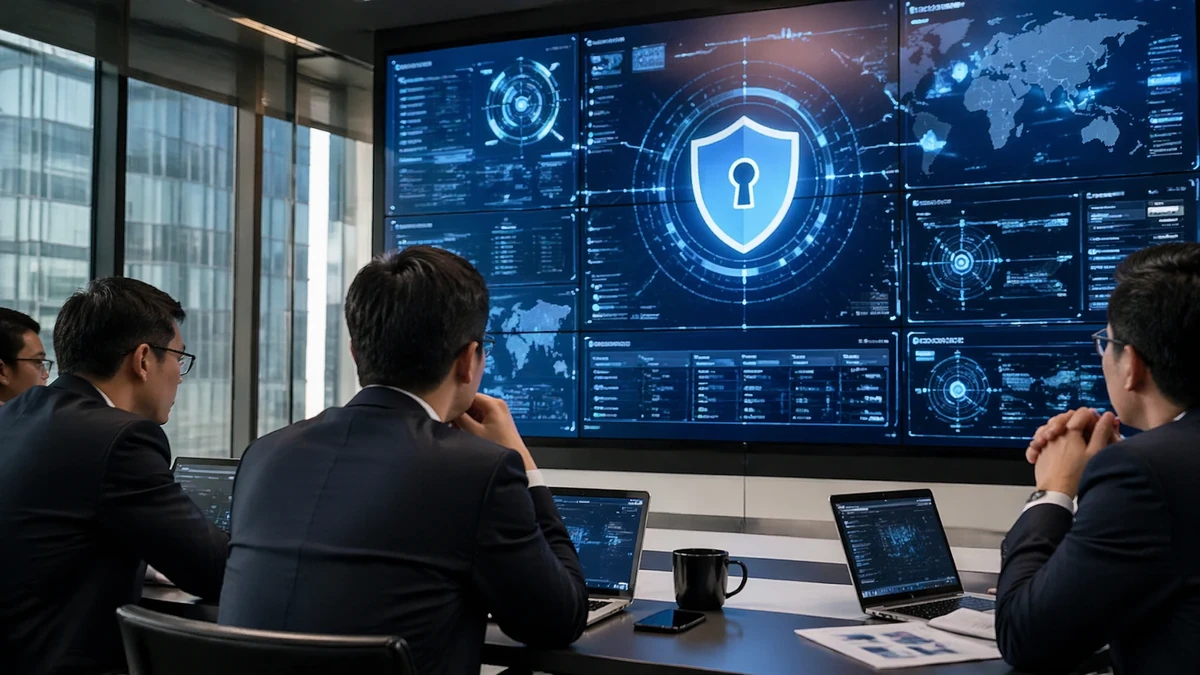
South Korea’s cybersecurity shift is getting harder to ignore
For years, cybersecurity in South Korea often occupied an awkward place in the country’s innovation story: indispensable, but rarely glamorous. It was the kind of sector everyone agreed mattered, especially after a breach or ransomware scare, yet it usually sat behind flashier national priorities such as semiconductors, artificial intelligence and biotech. That appears to be changing.
A cluster of developments in South Korea’s tech sector this spring suggests the country is beginning to move cybersecurity out of the category of general startup assistance and into something more consequential: industrial policy. In practical terms, that means the government-adjacent institutions shaping Korea’s innovation economy are starting to treat security companies not merely as small firms deserving grants or office space, but as strategic suppliers that underpin the broader digital economy.
The clearest sign came with news that the Korea Information Security Industry Association, or KISIA, and the Seoul Center for Creative Economy and Innovation agreed to work together to foster security startups. On its face, that might sound like just another memorandum of understanding, the kind of announcement that can blend into the bureaucratic background in any country. But the timing matters. The partnership arrived alongside other reports of interagency cooperation around security entrepreneurship, creating the impression not of a one-off event but of a coordinated turn.
That turn reflects a deeper reality in South Korea’s economy. The central question is no longer whether businesses and public institutions will digitize. That happened years ago. Cloud adoption, remote work systems, digital payments, data-driven operations and third-party software integration are now normal. The question has become whether those systems can run safely, continuously and at scale. In other words, digital transformation is no longer judged only by speed or convenience. It is judged by resilience and trust.
For American readers, the shift may sound familiar. In the United States, cybersecurity has also moved from a niche IT problem to a boardroom issue and a national competitiveness issue. After headline-making attacks on Colonial Pipeline, MGM Resorts, Change Healthcare and local governments around the country, cybersecurity stopped being a back-office expense and became a condition for doing business. South Korea appears to be reaching a similar conclusion, though in a context shaped by its own highly connected economy, powerful conglomerates and heavy reliance on digital public services.
What is striking about the Korean moment is that support for startups and measurement of public-sector security are rising at the same time. On one side, institutions are trying to build the pipeline of security vendors. On the other, public agencies are being graded more rigorously on how well they actually protect systems. That combination matters because markets develop best when supply and demand mature together. A startup ecosystem without serious buyers is fragile. A compliance regime without capable local vendors can become dependent on imported tools or a handful of dominant incumbents. South Korea’s latest moves suggest policymakers are trying to close that gap.
Why security startups matter now in South Korea
The rush of attention around security startups is not happening simply because policymakers have discovered a new buzzword. It is happening because the center of gravity in digital policy has shifted. The first phase of digital transformation in many countries, including South Korea, focused on adoption: getting services online, moving workloads to the cloud, modernizing customer interfaces and automating internal processes. The second phase is about operational stability. Once systems are built, they must be secured, monitored, audited and maintained.
That change alters the role of startups. In the past, small security firms often found themselves stuck on the margins. They might be noticed after a major incident, or they might sell specialized technology as subcontractors under larger government or enterprise contracts. Their value was real, but their market access was limited. Today, the security needs of both government and industry are becoming more specialized, which opens the door for smaller firms with deep expertise.
Those needs include regulatory compliance, vulnerability management, supply chain defense, identity and access control, internal governance, operational technology security and industry-specific risk management. For a country like South Korea, whose economy depends heavily on advanced manufacturing, logistics, finance, telecommunications and platform businesses, these are not abstract concerns. They are daily operational requirements. The rise of generative AI only sharpens the point. Even when AI captures the headlines, it still relies on trusted infrastructure: clean data, protected systems, controlled access and verified users.
That is one reason generalized startup programs are often a poor fit for cybersecurity companies. A consumer app startup may be able to show growth with a polished interface and low-friction user acquisition. A cybersecurity startup usually faces a very different path. It must prove reliability before customers will risk deployment. It may need expensive certifications. It often requires access to test environments, pilot programs and highly sensitive enterprise settings that are difficult for young companies to enter. The sales cycle is long, and trust is central.
That trust problem is especially acute in South Korea, where large institutions can be cautious about adopting tools from newer vendors. The country’s economy is famously concentrated around major conglomerates, known as chaebol, such as Samsung, Hyundai and SK Group. Those firms dominate supply chains, procurement standards and market visibility. For startups in almost any sector, getting in the door can be difficult. For cybersecurity startups, where failure can carry legal, financial and reputational costs, it is even harder.
That is why targeted support matters. If security startups are grouped too loosely with the rest of the startup ecosystem, policymakers risk missing what makes them different. It is not just a matter of capital. These firms need opportunities to validate products in real-world settings, establish reference customers, navigate compliance rules and connect with early demand from public and private buyers. A specialized support system recognizes that the barriers are structural, not simply entrepreneurial.
Seen in that light, South Korea’s new posture is significant. The language is changing from “let’s help founders” to “let’s build a strategic supply base.” That may sound subtle, but it is the difference between a temporary support program and a market-shaping agenda.
What the KISIA-Seoul innovation partnership really signals
The partnership between KISIA and the Seoul Center for Creative Economy and Innovation is important less for the ceremony than for what each institution represents. KISIA brings industry connections, sector expertise and credibility within the information security field. The Seoul innovation center, one of a network of government-backed startup support hubs created to foster entrepreneurship and regional innovation, brings incubation infrastructure, mentoring, corporate linkages and access to startup development programs.
Together, they could help solve one of the biggest problems confronting security startups in South Korea: the gap between technical capability and market trust. Many young companies do not fail because their technology is weak. They fail because they cannot secure enough opportunities to prove that technology in customer environments where trust must be earned before procurement begins.
For American readers, the analogy might be a partnership between a respected industry trade group and a major startup accelerator, but with a stronger quasi-public policy dimension. South Korea’s innovation ecosystem often operates through dense collaboration among ministries, local governments, public institutions, trade associations and large corporations. That structure can be bureaucratic, but when aligned, it can also move sectors quickly.
The broader context is also worth noting. South Korea has spent years promoting national champion industries through industrial coordination, targeted investment and ecosystem-building. It is a model Americans often associate with semiconductors or batteries, where Seoul has been explicit about strategic importance. Cybersecurity has not always enjoyed that same level of policy attention. It has been necessary, but often subordinate to bigger narratives around exporting hardware, scaling AI or leading in digital platforms.
Now that hierarchy appears to be shifting. As digital systems become more deeply woven into finance, public administration, manufacturing and energy, security becomes less like a support function and more like a market-entry requirement. A company cannot always win a contract and then worry about security later. In many sectors, especially regulated ones, robust cybersecurity is a prerequisite before any deal can happen.
That is why market access is the core issue. The most effective startup support for security firms is unlikely to be publicity or prize money alone. It is more likely to involve pilots with real customers, consulting around certifications, help entering public procurement channels and introductions to investors who understand the sector’s slower and more complex revenue cycle. If the KISIA-Seoul collaboration can create those pathways, it will amount to much more than a networking event.
There is another reason institutional backing matters in security: customers are conservative for good reason. When a company buys a project management tool and it underperforms, the damage may be limited. When a company buys a security product and it fails, the consequences can include data loss, service disruption, regulatory scrutiny and public embarrassment. In that environment, endorsement and validation from trusted institutions can carry unusual weight. South Korea seems to be recognizing that for security startups, public credibility is not incidental; it is part of the product.
Public-sector grading shows security is becoming operational, not rhetorical
If the startup side of the story is about supply, another piece of recent news points to demand. South Korean reports also highlighted that the Korea Petroleum Quality and Distribution Authority received a top rating for two consecutive years in a cyber preparedness assessment conducted under the National Intelligence Service framework. To outside readers, a public agency’s security score may not sound dramatic. In fact, it may be one of the more revealing details in the broader trend.
A two-year top-tier rating suggests that cybersecurity in the public sector is being treated less as a slogan and more as an ongoing management discipline. The phrase “two consecutive years” matters because it implies repeatability. It suggests a stable operating model rather than a one-time cleanup effort before an inspection. In the public sector, that kind of continuity is difficult unless security has been integrated into budgeting, staffing, process design and executive oversight.
That has implications for the market. The more sophisticated public-sector evaluation becomes, the more agencies need products and services that address real operational problems. Those may include threat monitoring, asset discovery, access control, network segmentation, vendor access management, incident response readiness and safeguards for industrial control systems. Sectors such as energy, public utilities, logistics and transportation are especially important because downtime can impose immediate social and economic costs.
Here again, there is a parallel Americans will understand. In the U.S., federal cybersecurity requirements and sector-specific regulations increasingly shape private procurement. Hospitals, pipelines, defense contractors, utilities and state agencies are all facing tighter expectations around reporting, resilience and vendor risk. South Korea is moving in a comparable direction, with public-sector assessment acting not just as an accountability measure but as a market signal.
In a healthier security ecosystem, those signals ripple outward. When public institutions are evaluated more rigorously, they demand better tools. When those tools are available from credible domestic suppliers, local companies gain experience, case studies and recurring revenue. That in turn can improve export competitiveness. The process is not automatic, but it creates the conditions for security firms to become durable businesses rather than grant-dependent experiments.
The quality of demand matters as much as the quantity. Security is not simply about buying hardware or licenses. The most durable opportunities often go to companies that can integrate products with services, understand agency workflows and provide long-term operational support. That is especially true in complex environments where existing systems, legacy processes and multiple vendors must coexist. As South Korea’s public-sector assessments become more demanding, the market is likely to reward firms that can move beyond one-time sales to ongoing performance.
That is why the public-sector rating news should not be dismissed as an isolated achievement. It is part of the same pattern as the startup support announcements. One side builds the vendor base. The other side sharpens the expectations of buyers. Together, they create a more self-sustaining security economy.
South Korea’s security market is shifting from breach response to trust infrastructure
For a long time, the cybersecurity business in many countries, South Korea included, followed a familiar cycle: a breach made headlines, budget pressure increased, and security briefly became urgent. Once the immediate crisis faded, the sense of urgency often did, too. The newest developments suggest a different model is taking shape, one where security is less about reacting to the latest incident and more about enabling commerce, public services and digital transactions in the first place.
That is what it means to think of cybersecurity as trust infrastructure. The term may sound academic, but the concept is simple. Before a customer buys software, before a hospital shares data, before an energy operator connects a vendor to critical systems, someone has to decide whether the system is secure enough to trust. Security, in that sense, is not just a defense mechanism. It is part of the conditions that allow a transaction, a partnership or a service relationship to exist.
That shift changes what customers expect from vendors. Technical performance still matters, of course. But buyers now evaluate much more than detection rates or engineering claims. They want to know whether a tool can be deployed smoothly, whether it integrates with existing systems, whether it helps satisfy compliance requirements, whether support will be available during an incident and whether the vendor can explain how it handles data. The competition is no longer just over who has the smartest technology. It is over who can deliver technology that can be adopted safely and managed responsibly.
For startups, that is both an opportunity and a burden. It is an opportunity because specialized demand is splintering into new submarkets. Threat intelligence, operational technology security, supply chain verification, insider risk management and automated compliance are all areas where smaller firms can carve out niches. But it is a burden because the bar is higher from day one. Early-stage firms must think not only about engineering, but about quality assurance, customer support, documentation, auditability and governance. In cybersecurity, trust is not a marketing slogan layered on top of the product. It is built into the product and the company around it.
This may be especially important in South Korea, where fast digital adoption has gone hand in hand with high public expectations for service continuity. Koreans are accustomed to efficient digital banking, online government functions, e-commerce, mobile services and connected infrastructure. That convenience can create little tolerance for disruption. It also means society feels the impact of cyber incidents quickly when they occur.
In that environment, security becomes less visible and more foundational, much like electricity or payment rails. People notice it most when it fails, but entire sectors depend on it every day. Once policymakers start to view it that way, the case for industrial strategy becomes easier to make.
What this means beyond South Korea
South Korea’s emerging approach carries lessons that stretch beyond one country’s tech policy. It suggests that as digital economies mature, cybersecurity will increasingly be treated not as a narrow technical specialty but as part of national industrial capacity. The same logic that drives investment in chips, batteries and cloud infrastructure can also apply to the systems that make those industries safe to operate.
That does not mean every cybersecurity startup will succeed, or that South Korea has solved the structural challenges in its market. Big firms still hold enormous influence. Procurement can still be slow. Public-private cooperation can still produce more announcements than outcomes. The gap between policy intention and commercial execution is real in every country, and South Korea is no exception.
Still, the signals are notable because they come from multiple directions at once. Industry associations and startup incubators are aligning around security entrepreneurship. Public institutions are demonstrating that cyber preparedness can be measured and sustained. And the underlying economic logic is changing: security is becoming a requirement for market participation, not just insurance against disaster.
For American observers, that should sound less like a Korean anomaly and more like a preview of where digitally advanced economies are headed. The more connected critical services become, the more cybersecurity shapes competitiveness. A secure energy network, a resilient hospital system, a trustworthy software supply chain and a dependable public-sector digital platform are not side issues. They are core economic assets.
South Korea, with its dense urban infrastructure, advanced broadband networks, export-driven economy and strong state role in innovation policy, often acts as a compressed laboratory for broader technology trends. When a shift becomes visible there, it is often worth watching closely elsewhere. The country now appears to be making a deliberate bet that cybersecurity deserves to be nurtured as an industry in its own right, with dedicated institutions, clearer demand signals and stronger bridges between startups and buyers.
If that bet pays off, the result will be bigger than a healthier startup pipeline. It will mean South Korea has begun building a domestic market for trusted digital operations, one in which security vendors are not peripheral players called in after a crisis, but central actors in the functioning of the modern economy. That may be the most important takeaway from this moment: cybersecurity in South Korea is no longer being treated as a supporting service that happens to matter. It is being repositioned as a strategic layer of national competitiveness.
And in an era when digital trust is becoming as economically valuable as digital speed, that is a shift with implications far beyond Seoul.
Comments
Post a Comment