South Korea Woke Up to Blue Skies and Dirty Air. For Millions, That Meant Another Spring Day Rewritten by Dust.
A spring morning that did not feel like spring
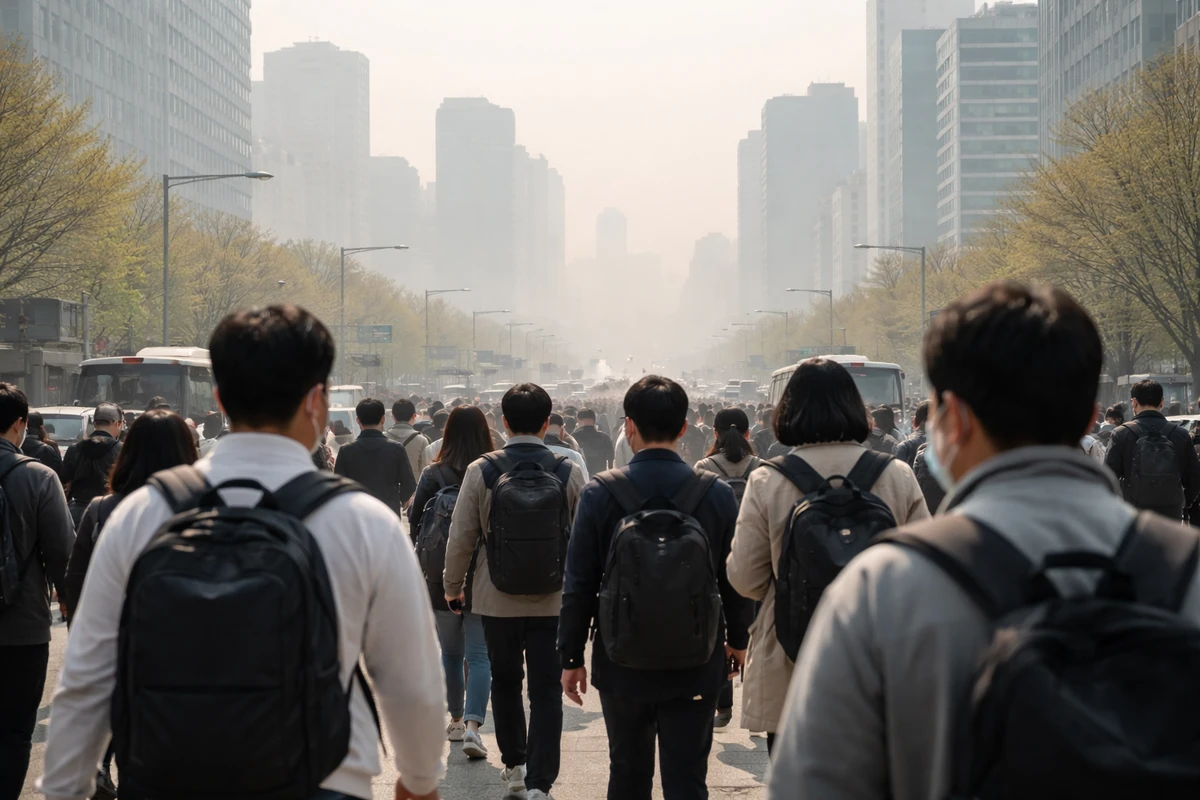
To look out the window in South Korea on the morning of April 21, 2026, was to see what seemed at first like a gift: clear skies across much of the country, daylight sharp and bright, the sort of scene that usually signals one of spring’s brief, cherished stretches of mild weather. But for many people heading to work, school or early appointments, the reality outside was far less inviting. Temperatures had dropped sharply from the day before, winds picked up, and in several regions the air itself turned hazardous.
In the southeastern cities of Busan and Ulsan and across much of South Gyeongsang province, officials said the area was under the influence of hwangsa, often translated as “yellow dust” — seasonal dust carried by winds from arid areas of northern China and Mongolia. In Daegu and parts of Gangwon province, authorities issued or maintained advisories for elevated fine dust levels. Hourly concentrations of particulate matter reached 153 micrograms per cubic meter in Daegu and 151 micrograms per cubic meter in northern parts of Gangwon, crossing the threshold South Korean officials use to trigger a dust advisory when those levels persist for two hours.
The contradiction was hard to miss: the sky looked clean, yet the air was not. Morning temperatures in Busan were around 55 degrees Fahrenheit, roughly 13 degrees Celsius, and even lower inland, while strong winds made it feel colder. Daytime highs were expected to recover into the upper 60s and low 70s in some places, but that did little to change the fact that many residents began the day not by enjoying spring weather, but by reaching for heavier jackets and face masks at the same time.
That combination matters. Americans are familiar with days when weather forecasts and lived experience do not quite line up — a sunny winter day with a brutal wind chill, or a summer afternoon when wildfire smoke turns a blue horizon eerie and threatening. In South Korea, spring increasingly brings a similar mismatch. A pleasant-looking morning can still come with a health warning, and a commute under bright skies can double as a lesson in how environmental risk now slips into the most routine parts of daily life.
What unfolded across South Korea on April 21 was not a spectacular disaster in the way a typhoon, flood or wildfire might be. There were no dramatic television images of neighborhoods underwater or hillsides in flames. Instead, it was the kind of disruption that modern societies often struggle to treat with the seriousness it deserves: pervasive, uneven, easy to normalize and difficult for many people to avoid.
What “yellow dust” and “fine dust” mean in South Korea
To understand why this kind of day carries such weight in South Korea, it helps to know that air quality occupies a distinctive place in Korean public life. Two terms appear frequently in weather reports and everyday conversation: hwangsa, or yellow dust, and mise먼지, commonly rendered in English as fine dust. They are related but not identical. Yellow dust refers to seasonal dust storms that can travel long distances across East Asia. Fine dust is a broader term used in South Korea for particulate pollution, including both PM10 and the smaller PM2.5 particles that can lodge deeper in the lungs and are associated with respiratory and cardiovascular harm.
For American readers, one point of comparison might be the way residents of California, Oregon and Washington now routinely check wildfire smoke forecasts during fire season, or how people in major Western cities have learned to read an air quality index before planning outdoor exercise. In South Korea, however, concern over fine dust has become not just a seasonal nuisance but a persistent social issue, one bound up with public health, diplomacy, urban planning and labor conditions.
That is in part because South Korea is densely populated, highly urbanized and deeply dependent on public transit, walking and compact city life. A shift in air quality reverberates quickly. Parents reconsider whether children should play outside. Schools debate recess and sports activities. Older adults with preexisting conditions think twice about routine errands. Workers in delivery, construction, sanitation and transportation often have no comparable choice at all.
The Korean government and public agencies have built extensive systems to monitor air quality and issue alerts. Those notices are familiar enough that many residents understand their basic implications immediately. Yet familiarity does not make the problem less disruptive. If anything, repetition can create a dangerous sort of resignation. A day with dust can start to feel ordinary even when the health burden is real.
That burden is not distributed evenly. Children’s lungs are still developing. Older adults are more likely to have heart and respiratory conditions. People with asthma or chronic illness can feel the effects more quickly, even after relatively short exposure. South Korean environmental authorities on April 21 urged older people, children and those with respiratory or cardiovascular disease to refrain from outdoor activity. Healthy adults, too, were advised to reduce time outside and wear masks. The science behind that advice is straightforward. The social reality of following it is not.
The numbers tell one story. Daily life tells another.
On paper, an air quality advisory can seem clinical. An hourly average exceeds a specific threshold. A notice is issued. Recommended precautions follow. The bureaucracy works as designed. In Daegu, the advisory threshold was met. In northern Gangwon, the threshold was met. In the southeast, yellow dust was affecting the air. To a policymaker, that sequence can look like a functioning system.
But one of the clearest lessons from South Korea’s April 21 episode is that an environmental warning is only the first step, not the solution. The more important question is what people can realistically do once that warning arrives. For a retired person who can stay indoors, the guidance may be inconvenient but manageable. For a parent taking a child to day care before work, it may be nearly impossible to follow in full. For a warehouse worker, bus driver, street cleaner or food delivery rider, avoiding exposure may not be an option at all.
That gap between information and action is where the social meaning of bad air becomes most visible. Governments can announce risk equally to everyone, but people do not have equal power to evade it. Some can work remotely or delay plans. Others cannot move their commute, cancel a hospital visit or skip a shift. As in the United States during extreme heat, poor air quality tends to reveal the fault lines already built into a society: who has flexible work, who has indoor alternatives, who has child care support, who has access to health care, and who bears the physical cost of keeping daily systems running.
South Korea’s spring dust season puts that inequality into particularly sharp focus because it collides with the morning rush. The commute to work and the trip to school are among the most predictable, unavoidable movements in modern urban life. They happen when cities are most crowded, transit systems are most packed and streets are busiest. On April 21, those same hours were defined by colder air, stronger winds and, in some regions, particulate levels high enough to trigger public advisories.
Even when an air quality event is short-lived, its consequences are not necessarily brief. Exposure during a morning school run or a shift spent outdoors still counts. So does the anxiety of deciding whether a child’s cough is seasonal, temporary or something more serious. South Korea’s warning system can identify a dangerous morning. It cannot by itself solve the practical dilemma faced by families and workers who still have to move through that morning.
Why commuting and caregiving become part of the story
Much of the social strain from days like this one comes from a simple fact: the people most vulnerable to dirty air are often the least able to avoid going out. Older adults may need to visit hospitals or clinics. Young children still need to be dropped off at day care or school. People with chronic illness may have regular treatment schedules that cannot be postponed lightly. Caregivers, who are often women and often juggling work and family responsibilities, must navigate those demands in real time.
That is why air quality in South Korea has become more than a science or weather story. It is a story about the organization of daily life. When officials say outdoor activity should be minimized, they are issuing sound medical advice. But they are also colliding with structures that make outdoor movement unavoidable. That includes school start times, work shifts, elder care routines and the demands of service-sector jobs.
For American readers, the dynamic may resemble the way public health guidance during heat waves, severe storms or pandemic surges often lands differently depending on class and occupation. “Stay home” is much easier to do if your job allows it and if staying home does not threaten your income. “Limit exposure” is more feasible if you have a car, indoor waiting areas, high-quality masks and some control over your schedule. If not, the warning can feel less like a protective tool and more like a reminder that you are exposed.
South Korea’s dense urban design magnifies the issue. Walking to the subway, transferring between bus lines, waiting at curbside stops and navigating crowded commercial districts are all normal parts of the day. On a bad air day, each segment becomes a point of exposure. That matters not only for office workers, but for the vast labor force that works largely outside or in semi-open environments: traffic officers, delivery couriers, construction crews, street vendors, sanitation workers and others whose jobs are essential to city life but poorly insulated from environmental stress.
There is also a psychological dimension. A day of dirty air under gray skies feels intuitively threatening. A day of dirty air under bright skies can be more disorienting. It asks people to distrust what they see. That cognitive dissonance has become part of everyday environmental awareness in South Korea. It is one reason masks and air quality apps became embedded in ordinary routines well before the COVID-19 pandemic gave mask-wearing a different global meaning.
From weather event to public policy test
South Korea has spent years trying to improve air quality through emissions controls, coal reductions, seasonal measures and regional diplomacy. The challenge is that days like April 21 expose how air pollution is not only an emissions problem, but a policy coordination problem. A warning from meteorological and environmental agencies is important, but it is only one layer. The harder question is whether schools, care facilities, employers and local governments have practical systems ready for vulnerable days.
That can mean straightforward things: improving indoor air filtration in schools and senior centers, ensuring that outdoor workers have access to higher-grade masks and protected break spaces, adjusting school outdoor activities on short notice, improving communication for people who may not closely follow environmental alerts, and designing labor rules that recognize repeated air pollution events as occupational health concerns rather than unavoidable background conditions.
It also raises questions familiar in the United States and elsewhere. When does a recurring environmental hazard stop being treated as a temporary inconvenience and start being treated as a structural risk that deserves built-in protections? Americans have had versions of that debate over extreme heat in warehouses, smoke exposure for farmworkers, and protections for outdoor labor during increasingly erratic weather. South Korea’s spring dust problem fits squarely in that same global conversation.
The April 21 conditions underscored why officials and advocates increasingly frame air quality as a matter of “living policy,” not simply environmental management. The phrase points to an idea that public systems should be designed around how people actually live: when they commute, who they care for, what work they do, how quickly they can change plans and what tools they have to protect themselves. If the warning system is robust but the social response remains thin, then the people with the least flexibility absorb the greatest burden.
That is especially important because the official categories of vulnerability — children, older adults, people with heart or lung disease — do not map neatly onto the practical realities of exposure. A grandparent escorting a child, a parent hurrying between jobs, a courier working a 10-hour shift and a patient going to the hospital may all be at heightened risk for different reasons. A modern city cannot protect those groups effectively with a one-size-fits-all message alone.
Why a “temporary inconvenience” can still be a serious public health issue
One reason societies often underestimate days like this is that the visible disruption seems limited. Flights are not grounded nationwide. Offices do not close en masse. Public transit keeps running. Stores open. Life goes on. Compared with a natural disaster, a dust advisory can appear minor, little more than an irritation in the forecast.
But temporary does not mean trivial. Public health risk is often cumulative, and repeated short exposures can matter, especially for people whose jobs or caregiving duties keep them outside again and again. A single morning of bad air may pass by noon. Yet if those mornings recur throughout the season, the burden adds up physically and economically. It also creates a background layer of uncertainty: Should children have soccer practice? Should older adults delay appointments? Should workers be compensated or protected differently on high-pollution days?
South Korea’s April 21 episode serves as a reminder that environmental vulnerability often hides in plain sight. The danger is not always dramatic enough to dominate headlines abroad, but it is substantial enough to reshape ordinary life at home. The parent packing an extra mask, the teacher keeping students indoors, the delivery rider spending hours in gritty air, the senior deciding whether to postpone a trip to the clinic — these are not side details. They are the story.
And because the day arrived beneath mostly clear skies, it offered a stark lesson in how environmental risk is changing in the 21st century. Threats do not always announce themselves in obvious ways. Some come wrapped in normalcy. They appear during a routine commute, a school drop-off, a walk to the bus. They ask people to adapt not to a singular catastrophe, but to a repeated condition that hovers between inconvenience and emergency.
That gray zone is precisely why policymakers have trouble responding with urgency. If an event is too frequent, it can become normalized. If it is not catastrophic enough, it can be dismissed. Yet for the people who bear the greatest exposure — those with fragile health, limited income, inflexible schedules or outdoor jobs — the distinction matters little. Dirty air still enters the lungs. Cold wind still makes a morning commute harder. Daily obligations still continue.
A warning for South Korea, and a familiar one beyond it
South Korea’s spring dust problems are shaped by regional geography, industrial patterns and weather systems unique to Northeast Asia. But the broader lesson is hardly unique to Korea. Around the world, more communities are learning that the most consequential environmental threats are not always rare. They are recurring, disruptive and embedded in ordinary routines. Whether the hazard is wildfire smoke in the American West, extreme heat in Texas and Arizona, or seasonal fine dust in Seoul, Busan and Daegu, the policy challenge is the same: how to build daily life around the expectation that air, weather and health can no longer be taken for granted.
On April 21, South Korea did what modern states are supposed to do in the face of environmental risk. Agencies measured the air. Advisories were issued. Guidance was released. But the day also illustrated the next question, the one that matters most in a society where bad air returns again and again: once people are told they are at risk, what concrete protections actually reach them?
That question has no easy answer, but it is the one worth asking. Not whether the sky looked blue. Not whether the dust advisory lasted only a few hours. Not whether spring weather returned later in the day. The harder issue is whether a society can protect those who cannot simply opt out of exposure.
For many South Koreans, the morning of April 21 was a familiar kind of warning — not dramatic enough to stop the country, but serious enough to alter how people dressed, moved, worked and worried. It was a reminder that clean-looking weather and safe living conditions are not always the same thing. And it was another sign that in an era of recurring environmental stress, the true measure of preparedness lies not only in forecasting danger, but in making everyday life more survivable when that danger arrives.
Comments
Post a Comment