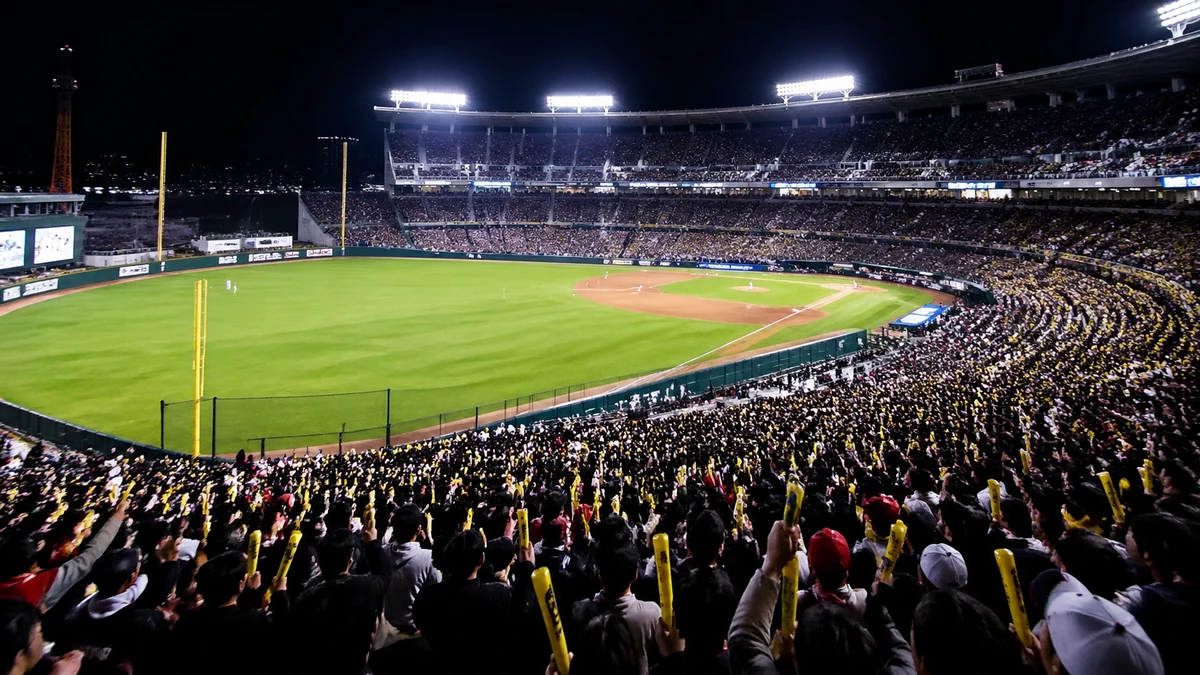
A record that says more than “baseball is popular”
South Korea’s top professional baseball league has crossed an eye-catching threshold at a pace it has never seen before, and the number matters for reasons that go well beyond a strong opening month.
The Korea Baseball Organization, or KBO, said its 2026 regular season surpassed 2 million cumulative fans on April 25 after just 117 games. Total attendance reached 2,094,481, with an average of 17,902 fans per game. On paper, the difference from last year’s record pace may look small: The league reached the same milestone in 118 games in 2025. But in sports business terms, breaking a record that was itself just set a year earlier can be more revealing than smashing an old mark that had stood for decades.
What makes this significant is not simply that Korean baseball is drawing large crowds. It is that the pattern of fan behavior appears to be changing. The early-season rush no longer looks like a one-off burst driven by opening-weekend excitement, good spring weather or a few glamorous teams carrying the league. Instead, what is emerging is something more durable: a broad, national habit of going to the ballpark.
For American readers, imagine if Major League Baseball suddenly showed signs that fans were not just returning for Opening Day, rivalry weekends or Shohei Ohtani road trips, but were making regular, repeat visits across multiple markets at once, including places where the home team was struggling. That is the deeper story in South Korea right now. This is not only about turnout. It is about conversion — turning casual spectators into routine customers.
That distinction matters because the KBO is not merely another sports league in Asia. It is one of the most visible pieces of contemporary Korean popular culture, a social ritual as much as an athletic competition. In a country already known globally for K-pop, K-dramas and Oscar-winning cinema, baseball has become one of the most accessible live entertainment products in the country — and increasingly, one of the most in-demand.
Five stadiums, one story: This is a league-wide surge
The clearest sign that something more structural is happening came from the attendance distribution on the day the league passed 2 million.
According to Korean media reports, 99,905 fans entered the five KBO stadiums hosting games on April 25. Stadiums in Seoul’s Jamsil area, Gwangju, Gocheok and Daejeon sold out, while Incheon drew 22,655 fans, effectively filling the venue as well. In other words, this was not a headline carried by one marquee club in one major city. It was a near-clean sweep across the schedule.
That breadth is important. In many sports markets, attendance spikes are easy to explain away. A superstar arrives. A team goes on a winning streak. A weekend date lands perfectly. A rivalry gets national attention. But when sellouts happen across several cities at the same time, the explanation shifts from isolated attraction to shared momentum.
South Korean sports have long dealt with the same kind of market imbalance familiar to American fans: larger cities usually have an edge, better teams often get a bigger share of the spotlight, and certain time slots naturally outperform others. What stands out in the KBO’s 2026 start is that the energy appears less concentrated than before. Fans are increasingly getting the sense that no matter which park they visit, there will be a real event waiting for them — noise, choreography, food, merchandise, fan rituals and a game that feels worth attending in person.
That may sound intangible, but leagues live and die by such intangibles. Once a market develops a reputation that “every game feels alive,” that reputation becomes an asset of its own. It nudges hesitant consumers into buying tickets, and it encourages repeat visits because people are no longer paying only for a result on the field. They are paying for atmosphere.
In the United States, teams often talk about the “ballpark experience” to explain why fans should leave the couch, pay for parking and sit through nine innings when highlights are free on their phones. The KBO is arriving at a similar moment, but with a twist: Its in-stadium culture is already famous for being louder, more communal and more choreographed than what most American fans expect at a baseball game. That gives the league a built-in advantage — if it can sustain it.
Why Korean baseball is selling an experience, not just wins
To understand this surge, Americans have to understand a basic truth about KBO fandom: Going to a game in South Korea is often as much about participation as observation.
Cheering in Korean baseball is highly organized. Teams have dedicated chants for individual players. Cheer captains and dance teams lead sections through synchronized songs and routines. Fans often know when to sing, clap and rise together. Concession culture matters. So do team goods, from jerseys and towels to light-up accessories and character merchandise. Many fans attend in groups — with friends, co-workers, dates or family — and the evening becomes a social outing that happens to include a baseball game, rather than a purely analytical exercise focused on pitch sequencing and defensive alignment.
That does not mean the baseball is secondary. It means the value proposition is broader. The ticket buys entry into a live entertainment ecosystem.
The attendance figures from Daejeon offer perhaps the best illustration. The Hanwha Eagles filled their 17,000-seat home ballpark on April 25 despite entering the game on a 10-game home losing streak. For a traditional sports economist, that should be a warning sign for demand. Bad results, especially repeated bad results, usually weaken attendance. But the stadium was full anyway, and the Eagles responded with an 8-1 win that snapped the skid.
The lesson is not that winning no longer matters. Winning still matters greatly, in Korea as in the United States. The lesson is that attendance is no longer tethered as tightly to the nightly result as it once was. A loyal base had already formed before the victory arrived. Fans showed up because the relationship with the club and the game day experience had already become strong enough to survive disappointment.
That is a major shift in consumption. In the past, one way to think about sports attendance was “victory consumption” — fans buy tickets to watch success, or at least to watch a team with a credible chance at it. Increasingly, KBO attendance reflects “experience consumption” — fans buy the outing itself. The game remains central, but it is no longer the sole product.
American teams have spent years trying to diversify what a ticket means, whether through kids’ zones, craft beer decks, fireworks nights or social media-friendly premium seating. The KBO appears to be benefiting from a version of that trend, but at a league-wide cultural level rather than only through isolated promotions. Fans are not simply visiting a stadium. They are participating in one of South Korea’s most energetic recurring public rituals.
The number behind the number: Growth on top of growth
The KBO said average attendance is up 7.9% from the same point last season, when the figure stood at 16,596 per game. That may not sound explosive at first glance, especially to readers used to giant percentage swings in startup leagues or after pandemic disruptions. But context matters. Growth becomes harder when a league is already operating at a high baseline. Adding nearly 8% on top of an already strong year is more difficult than making a similar leap from a weaker starting point.
That is why the 117-game milestone matters more than the single-game difference from 2025 might suggest. Beating an old attendance record by a wide margin can happen when the previous standard was soft or outdated. Beating a record that was just established last season is harder because the benchmark already reflects a modern, high-performing market. The KBO was not catching up to its past. It was raising its ceiling again.
There were hints early. The league had already announced in late March that, for weekend opening-series games, every game sold out on back-to-back days — only the second time that had ever happened, and the second straight year to do it. In other words, the 2 million figure did not emerge from nowhere. It is the continuation of a pattern that began at the season’s opening and continued without collapsing back to earth.
That should influence how executives, sponsors and broadcasters interpret the moment. A flash crowd can be celebrated, but it should not reshape a business model. A sustained acceleration in fan habits can. If fans are repeatedly choosing live baseball over other entertainment options, then team owners have a stronger case for investing in roster development, front-office staffing, regional marketing, upgraded concessions and stadium improvements.
There is also a broader cultural backdrop. South Korea is a digitally saturated society with world-class broadband, deep smartphone penetration and a consumer base fully accustomed to on-demand entertainment. In that environment, any live event product that continues to gain strength is doing something right. It means the in-person value is not being replaced by streaming clips or mobile highlights. It means being there still feels different enough to justify the cost and effort.
That may be the most encouraging sign for the league. Sports business leaders everywhere worry about whether younger consumers still feel attached to attending games in person. In South Korea right now, the early evidence suggests the answer is yes.
What this means in a country where baseball is local, loud and deeply social
For readers outside Korea, the KBO’s attendance story also offers a window into how sports function in everyday Korean life.
Baseball in South Korea has a distinctly regional identity. Clubs are strongly tied to their cities and provinces, and the emotional bond between teams and local communities can be intense. That local attachment is one reason KBO teams matter beyond the standings. They are not just entertainment brands. They are civic symbols.
At the same time, baseball is one of the few places where several strands of modern Korean culture intersect in public: corporate branding, regional pride, youth culture, food trends, pop-music-style staging and family recreation. A night at the ballpark can feel closer to a cross between an MLB game, a college football student section and a pop concert than to the quieter, more individualized fan experience many Americans associate with baseball.
This helps explain why the phrase “on-site experience” is so important in Korean sports coverage. The attraction is not merely statistical competition. It is physical presence. Seeing the game from the stands, joining the chant cycles, eating ballpark food, comparing one stadium’s atmosphere with another’s and sharing the event with companions are all part of the purchase. Korean media have increasingly described this as a move toward “experience consumption,” and the phrase fits.
That shift has major consequences. Once fans begin evaluating teams by total experience rather than only by record, competitive pressure changes. A club can no longer rely solely on baseball operations to maintain goodwill. It must think like a hospitality business, an event producer and a local cultural institution all at once.
There is an American comparison here too. U.S. franchises often talk about “third places” — places outside home and work where people gather habitually. For many Korean fans, the baseball stadium is becoming exactly that kind of place. The game remains the anchor, but the habit is broader. When that habit spreads across several cities simultaneously, it creates the kind of durable demand that leagues dream about.
The challenge now: Turn a boom into a long season
The danger in any attendance milestone is that celebration can outrun analysis. A league can hit a big number and still mishandle what comes next.
That is especially true if sold-out crowds become the new normal. Once fans grow used to paying to enter a packed stadium, their expectations rise quickly. They want smoother entry and exit routes, cleaner facilities, better sightlines, reliable concessions, safer cheering sections and a family environment that feels welcoming rather than chaotic. What begins as a triumph of demand can become a stress test for infrastructure.
In practical terms, the KBO and its clubs now face a responsibility familiar to any league that experiences rapid popularity growth: match service quality to audience growth. If the ticket becomes harder to get, the experience inside the stadium has to feel even more worth it. If fans are choosing live baseball over a thousand digital alternatives, that choice has to be rewarded.
There is also a competitive question. Strong attendance can create a virtuous cycle — more revenue, deeper investment, better player development, stronger scouting, improved coaching and smarter marketing. But that cycle does not happen automatically. Money can be wasted. Fans can sour if they feel ownership is cashing attendance checks without building a better product. When demand rises, scrutiny rises with it.
Korean baseball’s current boom therefore comes with a bill attached. The message from the market is not simply, “Baseball is doing great.” It is also, “Now prove you can sustain this.” That means better operations, stronger long-term planning and a recognition that crowd size is a lagging indicator of trust. Fans have shown up. The league now has to keep earning that choice.
Summer will be the real test. Seasons are long. Injuries pile up. Team records spread apart. Heat becomes a factor. Consumer novelty fades. Every baseball league in the world knows that the emotional geometry of April is different from the grind of midsummer. The question hanging over the KBO is whether this early electricity can survive when hope becomes more uneven.
More than a milestone, a question about Korea’s sports future
The KBO’s 2 million fans in 117 games is, in one sense, a clean statistical achievement. It is the fastest pace in league history, it edges last year’s record and it reflects near-capacity crowds across multiple cities. But statistics alone do not explain why this moment feels important.
The deeper meaning is that Korean professional baseball may be entering a new stage — one in which live attendance is less dependent on temporary hype and more rooted in habitual, repeat engagement. The strongest evidence is not just the total. It is the distribution, the resilience and the quality of demand. Multiple stadiums are filling at once. Fans are continuing to show up even when teams stumble. The game-day experience is becoming its own draw.
For American audiences accustomed to thinking of the Korean Wave mainly through streaming dramas, K-pop groups and award-winning filmmakers, this is a reminder that South Korea’s cultural influence also runs through live sports. Baseball is one of the country’s most powerful communal stages, and right now that stage is crowded.
Whether the boom becomes a lasting expansion of Korean sports culture will depend on what happens next. If teams and the league invest wisely, improve stadium operations and keep the in-person experience compelling, this season’s attendance record may be remembered not as a flashy headline but as a turning point. If not, it risks becoming a snapshot of peak enthusiasm that the system was not fully prepared to support.
For now, though, the signal is clear. South Korea’s baseball crowds are not merely arriving early. They are arriving often, arriving everywhere and increasingly arriving for reasons bigger than the box score. That is why 2 million in 117 games matters. It tells us not just that people are watching Korean baseball, but that more and more of them have decided the place to watch it is together, in the stadium, as part of a shared cultural event.
Comments
Post a Comment