South Korea’s Housing Debate Is Still Fixated on Seoul. The Rest of the Country Is Living a Different Reality.
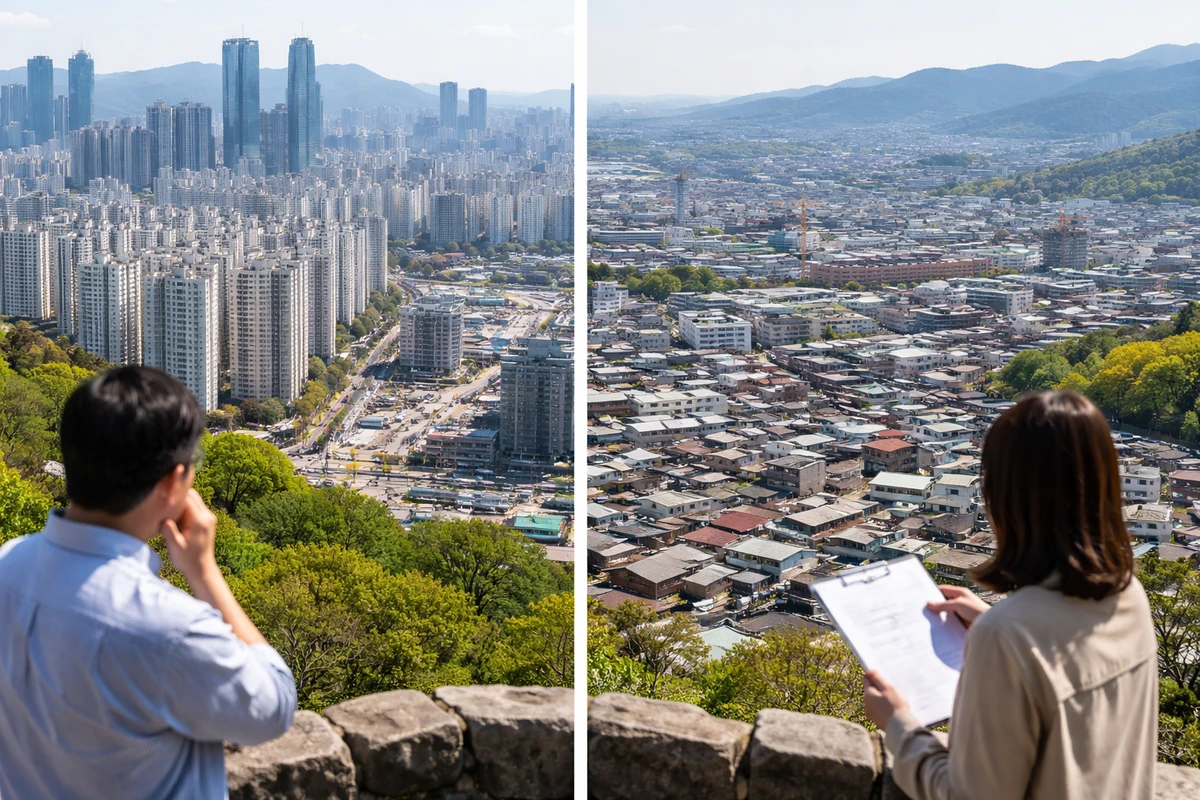
One country, two housing markets
South Korea’s housing story is often told through the skyline of Seoul: apartment towers rising over the Han River, bidding wars in coveted school districts, and fresh government attempts to cool a market that has long shaped household wealth, political debate and middle-class anxiety. In March, according to local reporting, home prices in Seoul rose 0.34%, while the country’s distinctive rental markets also climbed: so-called jeonse, or large lump-sum deposit leases, rose 0.56%, and monthly rents increased 0.51%. Those are the kinds of numbers that dominate headlines, government briefings and television panels.
But outside the capital region, a very different housing story is unfolding — and many critics say Seoul’s gravitational pull is so strong that national policy continues to miss it.
That matters because South Korea is not simply dealing with one national real estate market moving at different speeds. It is increasingly dealing with separate housing realities under the same policy umbrella. In Seoul and its surrounding metropolitan belt, the central questions are familiar to anyone who follows expensive urban housing markets in places like New York, Los Angeles or the Washington suburbs: How fast are prices rising? Who can still qualify for a loan? Will tighter regulation cool speculative demand without locking out ordinary buyers? How much tax pressure will homeowners bear?
In many provincial cities and towns, the questions are more basic and, in some ways, more troubling. Not how much prices are rising, but why transactions have stalled. Not whether demand is overheating, but whether demand is thinning out. Not whether another wave of speculative money is arriving, but whether younger residents are leaving for Seoul, hollowing out local labor markets and weakening long-term housing demand.
That gap is at the center of a growing debate in South Korea over whether housing policy has become too Seoul-centric — shaped by the fears and priorities of the capital region while failing to address the economic realities of the rest of the country.
Why Seoul dominates everything
There are obvious reasons the capital commands so much attention. Roughly half of South Korea’s population lives in the Seoul metropolitan area, which includes Seoul itself, Incheon and much of Gyeonggi Province. It is the country’s political center, its financial nerve hub, its media capital and the place where educational competition, white-collar job concentration and generational wealth anxieties collide most visibly. When home prices move in Seoul, they do not just affect household budgets. They influence consumer sentiment, election politics and broader views about fairness, class mobility and the future.
American readers can think of Seoul’s role in South Korea as a kind of supercharged version of New York, Washington and Silicon Valley rolled into one. The premium attached to being close to elite schools, major employers and transit links is enormous. The apartment market in particular functions not only as shelter, but also as a key store of wealth. So every small percentage increase in Seoul can take on outsized symbolic meaning.
That symbolism shapes news coverage. Price changes in Seoul are easy to quantify, easy to compare month to month, and easy to turn into a narrative about whether the government is winning or losing its battle against inflation, debt and speculation. If Seoul prices rise, it becomes a national story. If loan rules change, the first question is often what they will do to Seoul buyers. If tax burdens shift, analysts quickly assess what that means for owners of high-value homes in the capital region.
The problem, critics argue, is that Seoul’s market indicators have gradually come to stand in for the entire country’s housing condition. In public debate, “the housing market” often really means “the Seoul market,” even when the pressures facing provincial regions are structurally different.
This is not just a media distortion. It can become a policy distortion too. Once national policy is built around the assumption that the main danger is overheating in the capital region, every tool — credit controls, tax burdens, supply management, leasing rules — tends to be calibrated around restraining price surges rather than reviving weak local markets.
The housing problem outside the capital is often stagnation, not frenzy
In provincial South Korea, many markets do not behave like Seoul at all. Some areas are dealing with prolonged weak demand, softer prices, sluggish resale activity and deeper uncertainty about who, exactly, will be living there a decade from now. Demographic decline, aging populations, industrial restructuring and the continued migration of younger people toward the capital region all weigh on local housing markets.
That means a national headline about stricter mortgages can land very differently depending on where a buyer lives. In Seoul, tighter lending may be read as a brake on an active market, a way to temper speculation or slow the pace of price increases. In a smaller regional city, the same measure may feel like one more barrier in a market that already lacks enough buyers to sustain momentum.
This divide reflects a broader economic split in South Korea. The country has long struggled with regional imbalance, with jobs, investment, elite universities and cultural prestige heavily concentrated in and around Seoul. Housing is not separate from that story; it is one of the clearest expressions of it. Where jobs cluster, households follow. Where young households leave, demand softens. Where population prospects dim, housing becomes less a vehicle for appreciation and more a test of local durability.
So even if interest rates and national tax rules are uniform, their effects are not. A city with deep buyer demand, liquid transactions and persistent expectations of long-term value can absorb tighter rules in ways a weaker market cannot. In stronger regions, households may delay purchases, increase down payments or wait for a better entry point. In weaker regions, buyers may simply disappear.
That is why some Korean commentators say Seoul and provincial markets are now playing different games entirely. In Seoul, the question is often how to manage a market that still behaves partly like an asset market. In many non-capital regions, housing functions more narrowly as a place to live, tied closely to local wages, population trends and the viability of nearby industries. Using one national frame for both can produce blunt, sometimes counterproductive outcomes.
Three blind spots in a capital-centered policy
Critics of South Korea’s current approach point to three major gaps created when housing policy is designed primarily with the capital region in mind: a diagnostic gap, an institutional gap and an attention gap.
The first is the diagnostic gap. Policies aimed at cooling a hot market rely on a familiar language: price acceleration, leverage, speculative demand, tax disincentives and supply bottlenecks. But stagnating regional markets require a different vocabulary. The issue may be liquidity rather than excess. The core challenge may be how to restore transaction activity, preserve neighborhood vitality, maintain local jobs or match new housing supply to shrinking or aging populations. If the diagnosis starts and ends with price control, those realities barely register.
The second is the institutional gap. South Korea’s housing system is shaped by an interlocking set of tools: financial regulation, transaction taxes, property holding costs, public housing plans, subscription systems for new apartments, and rules governing rentals. When most of those tools are tuned to restrain the capital region, they can feel misaligned elsewhere. A regulation that sends a strong anti-speculation signal in Seoul may simply depress already fragile sentiment in a provincial city. A tax change intended to discourage multiple-home ownership in a high-demand market may have a different effect where investment demand is already weak.
The third is the attention gap. When policymakers, lenders, builders and consumers all focus on Seoul, the provincial market’s troubles can become oddly invisible. They are not absent, but they fail to rise to the level of national urgency. Sharp price gains make headlines; slow-burning regional decline often does not. That can delay intervention, narrow debate and reinforce the sense that local markets matter only when they mirror the capital’s drama.
These gaps feed one another. If diagnosis is too narrow, institutions stay too blunt. If institutions remain blunt, public attention keeps gravitating back to the markets that most visibly react. Over time, regions outside the capital are treated less as places with distinct housing ecosystems and more as background territory beyond the frame.
When finance pulls back, the burden can fall harder outside Seoul
One major trend in South Korea’s housing policy has been an effort to create more distance between easy credit and real estate. That includes tighter mortgage rules, closer scrutiny of borrowing, constraints affecting owners of multiple homes, and broader discussion about increasing the cost of holding property. From a macroeconomic standpoint, the logic is easy to understand. South Korea, like many developed economies, has wrestled with household debt and the risks that come when too much capital chases housing.
But there is a crucial regional complication: the same financial tightening can have very different effects depending on the underlying strength of a local market.
In Seoul, where demand remains deep and homeownership is tied to expectations of long-term scarcity and prestige, tighter credit may change behavior without necessarily paralyzing the market. Buyers with family support or substantial savings may adapt. Higher-income households may wait, reshuffle assets or reduce leverage. In other words, financing rules may alter the terms of participation without extinguishing it.
In provincial markets, the impact can be more severe. Where demand is thinner and fewer households are waiting on the sidelines, credit restrictions can quickly translate into fewer transactions. In such places, borrowing is not simply fuel for speculation; it may also be a practical bridge for ordinary households trying to move up, relocate within the area or enter the market for the first time. If that bridge narrows, the result may not be a calmer market, but a more frozen one.
There is also a social dimension. Many regional housing markets depend more heavily on what policymakers call “real demand” — households buying for occupancy rather than investment. That means broad lending restrictions can squeeze not only would-be investors, but also families trying to trade homes as their circumstances change. A policy that looks like discipline in Seoul can look like immobilization in a provincial city.
This is why some housing analysts argue that the issue is not whether South Korea should regulate credit, but how precisely it does so. A one-size-fits-all financial tightening may satisfy national concerns about debt while worsening regional disparities that are already rooted in population loss and uneven growth.
How media incentives can distort national priorities
Housing coverage everywhere tends to reward clarity, drama and numbers. South Korea is no exception. If a Seoul apartment district posts another month of gains, if rents jump, or if a benchmark complex breaks a price record, the story is immediate and legible. Readers understand the stakes. Television producers know what visuals to use. Policymakers know they will be asked to respond.
What is harder to capture in a headline is the slower-moving deterioration of a local market. A regional city where transactions keep thinning, new supply competes awkwardly with older stock, and younger residents continue to depart does not generate the same instant urgency — even if those trends may prove more structurally damaging in the long run.
That can warp how policy success is measured. If Seoul prices stabilize, the government may be seen as having made progress. If Seoul heats up again, pressure mounts for another round of restrictions. But if provincial markets remain stuck in prolonged weakness, that often does not trigger the same national alarm. The risk of overheating gets treated as a crisis; the risk of entrenched stagnation becomes background noise.
For American readers, the comparison may be familiar. National economic narratives in the United States are often shaped by what happens in coastal metros, even when smaller cities and rural communities are experiencing very different labor, housing and demographic conditions. But South Korea’s concentration is even sharper, making the effects more intense. When so much power, media production and institutional focus sit in one metropolitan region, the rest of the country can struggle to define the national conversation.
The consequences are not just rhetorical. Capital flows toward the places already considered safer and more liquid. Builders and lenders prioritize markets with stronger visibility. Households read the same headlines and conclude, rationally, that opportunity is concentrated where attention is concentrated. That can create a feedback loop in which Seoul’s centrality keeps reproducing itself — economically, politically and psychologically.
What a more region-sensitive housing policy might look like
If South Korea wants a housing strategy that reflects the country as it is rather than the capital as it appears on nightly news broadcasts, policymakers may need to stop treating regional difference as a secondary detail. That does not mean abandoning efforts to cool risk in Seoul. The capital region remains too important, too expensive and too politically sensitive for that. But it does mean acknowledging that housing stability is not the same thing everywhere.
A more region-sensitive approach would begin with a more segmented diagnosis. Instead of asking whether “the market” is rising or falling, officials would need to ask what kind of market exists in each region: one driven by speculative expectations, one sustained by local employment, one weakened by population decline, or one facing a mismatch between new supply and shrinking demand. Those are not semantic distinctions. They determine whether the appropriate response is tighter credit, targeted support for transactions, infrastructure investment, calibrated supply, or broader regional economic policy.
It would also require greater precision in financial regulation. Mortgage and tax rules designed for hot markets may need different thresholds, timelines or exceptions in areas where demand is structurally weak. The goal should not be to stimulate indiscriminately, but to avoid treating every local housing market as if it were a luxury district in Seoul.
Just as important, housing policy outside the capital cannot be separated from questions of jobs, transportation, education and public services. If younger residents believe the future exists only in Seoul, no housing tweak alone will reverse that. In that sense, the regional housing debate is also a debate about national balance: whether South Korea can build a model of development that does not require the rest of the country to orbit indefinitely around one dominant metro.
That is a challenge far bigger than property prices. But housing is where the consequences become visible in everyday life — in whether homes sell, whether neighborhoods age, whether young families stay, and whether local communities still feel viable.
The deeper issue is not just prices. It is whose reality counts.
At one level, the current debate may sound technical: percentages, loan rules, tax burdens and transaction volume. At another level, it is about recognition. Whose housing anxieties count as national concerns? Whose market conditions are seen as urgent enough to shape policy? Which parts of the country are treated as drivers of the story, and which are left as scenery?
South Korea’s housing divide is not only about the gap between expensive and affordable areas. It is also about the gap between visible and invisible ones. Seoul’s market remains the country’s loudest signal, and for understandable reasons. But when that signal drowns out everything else, the result can be a national debate that mistakes one region’s pressures for the whole country’s condition.
That may be increasingly untenable. A policy framework built to suppress overheating in the capital can coexist with quiet deterioration elsewhere, and both can happen under the same interest rates, the same laws and the same national headlines. If the government wants to address housing inequality in a meaningful way, it may have to confront a less comfortable truth: South Korea’s real estate challenge is not just how to cool Seoul, but how to govern a country whose housing markets have already drifted apart.
For years, Seoul has supplied the numbers that define the conversation. The harder task now is to notice the places that do not produce spectacular figures but still reveal where policy is falling short. In the end, the biggest imbalance in South Korean housing may not be the rise in prices alone. It may be the imbalance in attention.
Comments
Post a Comment