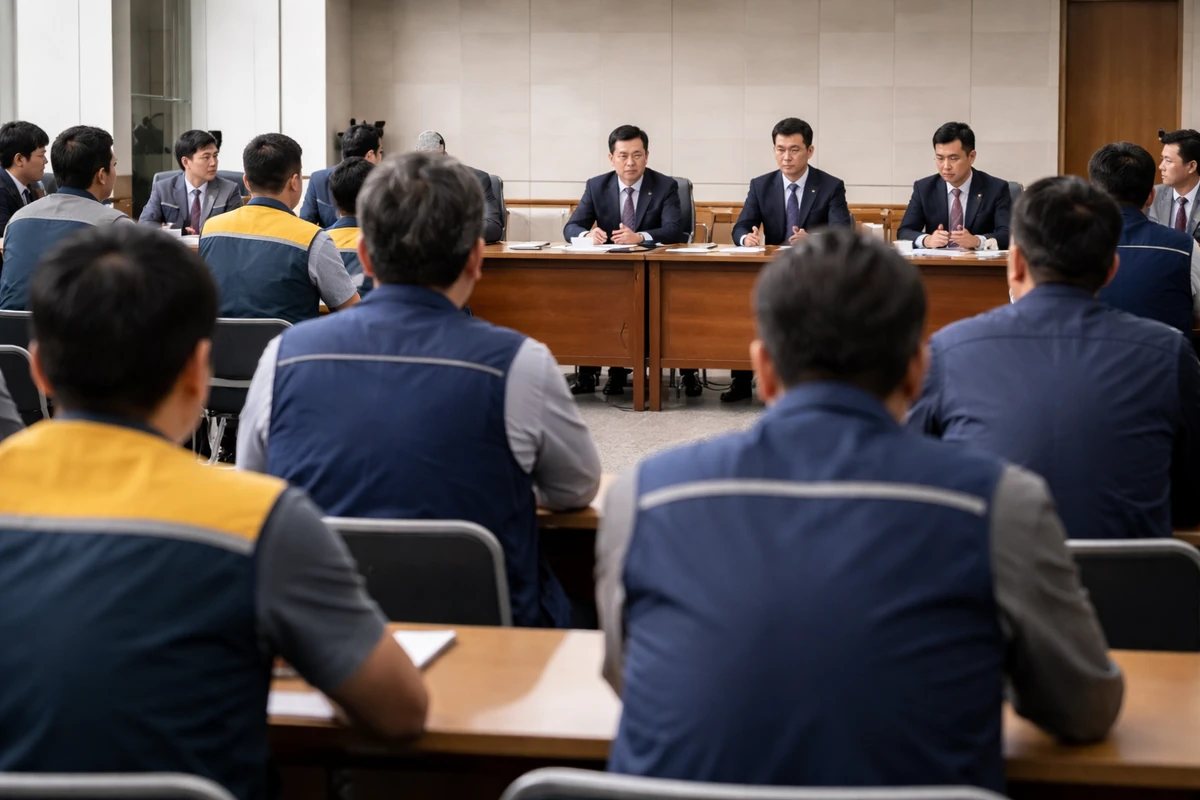
A labor law battle moves from slogans to the fine print
South Korea’s bitter fight over one of its most politically charged labor laws has entered a new and more complicated phase: deciding whether the government itself can be treated as an employer in collective bargaining.
The issue surfaced publicly during a National Assembly question-and-answer session on April 13, 2026, when Prime Minister Kim Min-seok said legal supplementation may be needed to clarify how far the government’s responsibility extends after the implementation of the revised Trade Union and Labor Relations Adjustment Act, better known in South Korea as the “Yellow Envelope Law.”
That may sound like a technical legal debate. It is not. In labor relations, identifying the real employer determines who has the power to negotiate wages, working conditions and the terms of union contracts. If workers are forced to bargain with a nominal supervisor who lacks budget or personnel authority, negotiations can become little more than theater. If, on the other hand, the government is recognized more broadly as the entity with ultimate power, the bargaining structure across South Korea’s public sector could be reshaped.
For American readers, the closest parallel may be disputes over who counts as a “joint employer” in the United States — an argument that has surfaced repeatedly in fights involving subcontracted labor, franchise systems and public institutions. The Korean version is emerging in a public sector with its own distinct layers of bureaucracy, where ministries, agencies and contracted workforces often overlap. The question is deceptively simple: If the state controls the money and the rules, can it deny being the boss?
That question now threatens to become the next major front in South Korea’s labor politics, moving the debate beyond whether the law should exist and into the harder question of how far it actually reaches.
What the Yellow Envelope Law is — and why it has become such a symbol
The Yellow Envelope Law has long carried outsized political meaning in South Korea. The name comes from a labor solidarity campaign in which supporters mailed small donations in yellow envelopes to help workers facing crushing lawsuits tied to strike activity. Over time, the phrase came to represent a broader push to protect union activity and limit the use of massive civil damage claims against workers.
Supporters have framed the law as a necessary correction in a country where labor activism has often collided with powerful corporate and institutional resistance. Conservatives and business groups have portrayed it as a measure that could encourage labor militancy and blur accountability. In that sense, the law has been a symbol, almost a shorthand, in the same way that “right to work” or “union-busting” can operate as political shorthand in the United States.
But once politically symbolic legislation takes effect, symbolism gives way to administration. That is what is happening now. According to South Korean reporting, after the amended law took effect last month, workers in government institutions who are classified as public-sector employees outside the formal civil service system began demanding direct bargaining with the government.
This is where the debate gets more consequential. The law was often discussed in broad moral and political terms before implementation: Was it pro-labor or anti-business? Did it restore workers’ rights or tilt the balance too far? Now the argument is narrower but more decisive: Who exactly must sit across the bargaining table?
That shift matters because the success or failure of a labor law is not measured only by what lawmakers declare when they pass it. It is measured by whether workers can use it to secure real leverage in the workplace. In South Korea, as in many countries, some of the hardest labor conflicts are no longer about abstract rights but about institutional design — who has authority, who bears legal responsibility and who can actually say yes to a demand.
Why public-sector contract workers are at the center of the fight
The workers now driving this dispute are often referred to in Korea as “gongmujik,” a category that does not translate neatly into American terms. They are not career civil servants, but they work inside government institutions, often in permanent or ongoing roles essential to day-to-day operations. They may handle administration, maintenance, support functions or other work that is regular and continuous, even if their employment status differs from that of formally appointed public officials.
To an American audience, one way to understand this is to think of workers who keep public institutions running but do not enjoy the same legal standing, pay protections or prestige as tenured government employees. They are not temporary in the everyday sense of the word, yet they exist in a different status system. In South Korea, that difference has long been tied to larger debates about irregular work, wage inequality and job security in the public sector.
For years, discussion around these workers has focused on fairness: equal pay for work of equal value, better treatment of non-regular workers and more stable employment in government-linked workplaces. The Yellow Envelope Law has pushed the issue into a more structural place. The question is no longer only whether these workers deserve better conditions. It is whether they are bargaining with the wrong counterpart.
That matters because authority in South Korea’s public sector can be fragmented on paper but centralized in practice. A worker may be employed by an institution or agency, but the budget, staffing ceilings, compensation rules or broader employment framework may be heavily influenced by a ministry or the central government. In that situation, bargaining with the head of a single institution may produce limited results if the institution lacks the power to change the issues under dispute.
From the workers’ perspective, the real employer is the entity that effectively determines pay and conditions. From the government’s perspective, recognizing that argument too broadly could impose sweeping bargaining obligations and alter how the state manages the public workforce. That is why Prime Minister Kim’s remark — that legal reinforcement may be needed to determine how far the government’s responsibility extends — has drawn attention. It suggests the administration recognizes the practical force of the issue even as it hesitates to define the boundary.
The real issue is not legal wording alone. It is whether bargaining means anything.
Much of the earlier controversy around the Yellow Envelope Law focused on restrictions on damage claims and the protection of union activity. The new dispute is different. It asks whether South Korea’s labor rights framework works in substance or only in form.
A union can be legally recognized and still remain ineffective if it must negotiate with someone who lacks decision-making power. That is a familiar idea in labor systems well beyond Korea. In the United States, disputes over subcontracting, staffing firms and franchise arrangements have often revolved around whether the visible manager is actually the decision-maker. If authority is split between local and central actors, the bargaining table may not reflect the real chain of power.
South Korea’s public sector presents an especially difficult version of this problem. Agencies may have operational independence, but key decisions can still be tied to central policy, fiscal controls or ministry oversight. Workers may see one manager in the office and another source of power in Seoul. When those two are not the same, collective bargaining becomes a test of institutional honesty.
This is why the debate over “employer status” is so significant. It is not simply a matter of textual interpretation. It goes to the heart of whether labor rights are designed to produce actual negotiation or merely the appearance of it.
Kim’s answer in parliament was cautious but notable. He did not reject direct bargaining demands outright, nor did he fully endorse a broad reading that would automatically treat the government as the employer in these cases. Instead, he acknowledged the need for legal clarification. That posture is politically careful, but it also reflects a governing reality: the existing legal framework may not provide a clean line in cases where nominal responsibility and real authority diverge.
In other words, the administration appears to understand that this is not an ideological talking point that can be dismissed with a slogan. It is an operating problem, and one with implications that reach far beyond one ministry or one group of workers.
South Korea’s conservatives and progressives are now fighting over scope, not just principle
Before the law took effect, South Korea’s debate often sounded like a familiar left-right clash. Labor advocates emphasized rights, dignity and protection from punitive legal pressure. Conservatives warned of industrial disruption, legal uncertainty and an imbalance in labor-management relations. That earlier fight was broad, emotional and highly symbolic.
Now the frame is changing. The question in the National Assembly posed by Rep. Lee Jong-bae of the conservative People Power Party captured that shift: Could the government, cabinet ministers or even the president be viewed as employers under this logic? The point was not merely rhetorical. Conservatives are signaling concern that a broad interpretation of employer status could make the state a standing bargaining party across wide swaths of public-sector labor relations, with significant consequences for budgeting, personnel policy and administrative control.
Supporters of a broader reading make the opposite case. They argue that bargaining is empty if the actor with real authority can hide behind legal form. In a multilayered public sector, they say, the distinction between the nominal employer and the actual decision-maker can frustrate meaningful negotiation. If the government controls the structure that determines labor conditions, then responsibility should follow power.
That means the political fight has matured. The core dispute is no longer simply whether the Yellow Envelope Law is good or bad. It is about range, boundaries and implementation. How far should the law extend? Under what conditions is direct bargaining justified? What makes the public sector unique, and should those differences narrow or expand workers’ rights?
These are less theatrical questions than the ones that dominated the original legislative battle, but they may be more important. In many democracies, the real policy struggle begins after a bill is signed. Legislatures write broad principles; bureaucracies, courts and political actors decide how much those principles matter in practice. South Korea is now in that stage. The legislative war may have ended, but the implementation war is just beginning.
What Kim’s call for ‘legal supplementation’ could really mean
In Korean politics, a call for “legal supplementation” can mean several things at once. It can be a genuine acknowledgment that the law is incomplete. It can be a signal that the government wants to refine unclear standards before disputes escalate. It can also serve as a politically strategic phrase — vague enough to reassure multiple audiences while postponing a direct choice.
That ambiguity is why Kim’s words matter. Labor groups may hear an opening for stronger recognition of workers’ rights and clearer rules that prevent the government from avoiding bargaining duties. Conservative critics may hear an attempt to place limits on the law’s reach before it expands further. The same phrase can imply clarification or containment, depending on who is listening.
For now, what seems clear is that the government does not believe the current system cleanly resolves the question. Future action could take several forms. Ministries could issue interpretive guidance. The administration could coordinate a cross-government position on when employer status applies. Lawmakers could pursue additional legislation. Or the matter could gradually be shaped through labor disputes, administrative practice and court rulings.
Each path carries different political risks. Administrative interpretation may be faster but can invite accusations of executive overreach or bad-faith narrowing. New legislation would provide a stronger foundation but could reopen the same partisan warfare that marked the original law. Case-by-case dispute resolution may be the most cautious route, but it would also be the slowest and least predictable, leaving workers and institutions in uncertainty.
There is also a broader strategic question for the government. If it moves too aggressively to limit employer status, it risks charges that it is hollowing out the law after its passage. If it accepts a broad reading, it may confront new bargaining demands, administrative complexity and fiscal pressure across the public sector. The space between those outcomes is narrow, and that is where the next round of Korean labor politics is likely to play out.
The stakes go beyond one law and one set of workers
The importance of this dispute is not confined to one statute or one labor category. If direct bargaining demands by public-sector contract workers gain traction, South Korea may have to reconsider how responsibility is organized across its public institutions.
The Korean state is not a single, uniform employer in the way the public may imagine. It is a complex ecosystem of ministries, affiliated bodies, delegated authority, outsourced functions and layered budget systems. A precedent recognizing the government as the real bargaining counterpart in one area could influence others quickly. Workers in similar structures would almost certainly ask why the same logic should not apply to them.
That, in turn, would raise difficult questions about consistency and fairness. If some institutions are deemed to have the government as the effective employer while others are not, workers doing comparable jobs may face sharply different bargaining power and different prospects for improving conditions. But if the government is recognized broadly as the responsible party, then South Korea may need a more centralized and coherent approach to wage standards, staffing rules and fiscal responsibility in the public sector.
In practical terms, this is where labor law intersects with the architecture of the state. Is the public sector to be understood mainly as a collection of autonomous institutions, each responsible for its own labor relations? Or is it better understood as a system in which the central government exercises enough practical control that it cannot disclaim employer responsibility when challenged?
That is not only a Korean question. Democracies around the world wrestle with versions of it, especially as governments rely on mixed employment models, quasi-public institutions and layers of contracted labor. But South Korea’s labor politics make the issue unusually visible. The country has a long history of intense union activism, confrontational labor disputes and legislation that carries strong ideological charge. That gives the current conflict a symbolic dimension even as it turns on details that can seem bureaucratic.
Ultimately, the fight over employer status asks something larger than whether the Yellow Envelope Law is being interpreted correctly. It asks how much responsibility the state is willing to own for the workers who keep public services running. It asks whether power in government will be measured by formal paperwork or by real-world control.
The next test is implementation
The immediate question is what happens next. The government must decide whether to formalize its position through legal interpretation, inter-ministerial coordination, additional legislative proposals or a more incremental process built around individual disputes. None of those options will be politically painless.
For the ruling camp, the challenge is especially delicate. It cannot afford to be seen as nullifying the practical effects of a law that has already become a major political marker. But it also has to account for the administrative and fiscal consequences of broadening the government’s bargaining obligations. For the opposition, the calculation is also complicated. Critics can warn about overreach and statewide bargaining pressures, but they must also contend with persistent public concerns over low pay, instability and inequality among workers in the public sector.
That is why this issue is likely to become a test not just of labor policy, but of governance. South Korea has moved beyond the easier phase of the debate, when politicians could score points by taking positions for or against a controversial bill. The harder phase is here now. It involves drawing lines, defining accountability and deciding whether the law changes daily life for workers or remains mostly symbolic.
For American readers used to seeing labor stories framed around strikes, wage demands or union drives at big-name companies, the Korean dispute may at first seem unusually procedural. But procedure is where power often hides. Who counts as the employer is not a side issue. It determines who has to answer when workers demand change.
And in South Korea, where labor law, political identity and the structure of the state are deeply intertwined, that answer may shape the next chapter of the country’s public-sector labor system. The Yellow Envelope Law was once the fight. Now it is the terrain on which a new one is being waged.
Comments
Post a Comment