Union Berlin’s Interim Hire of Marie-Louise Eta Breaks a Barrier in European Men’s Soccer — and Tests Whether the Game Is Ready for Real Change
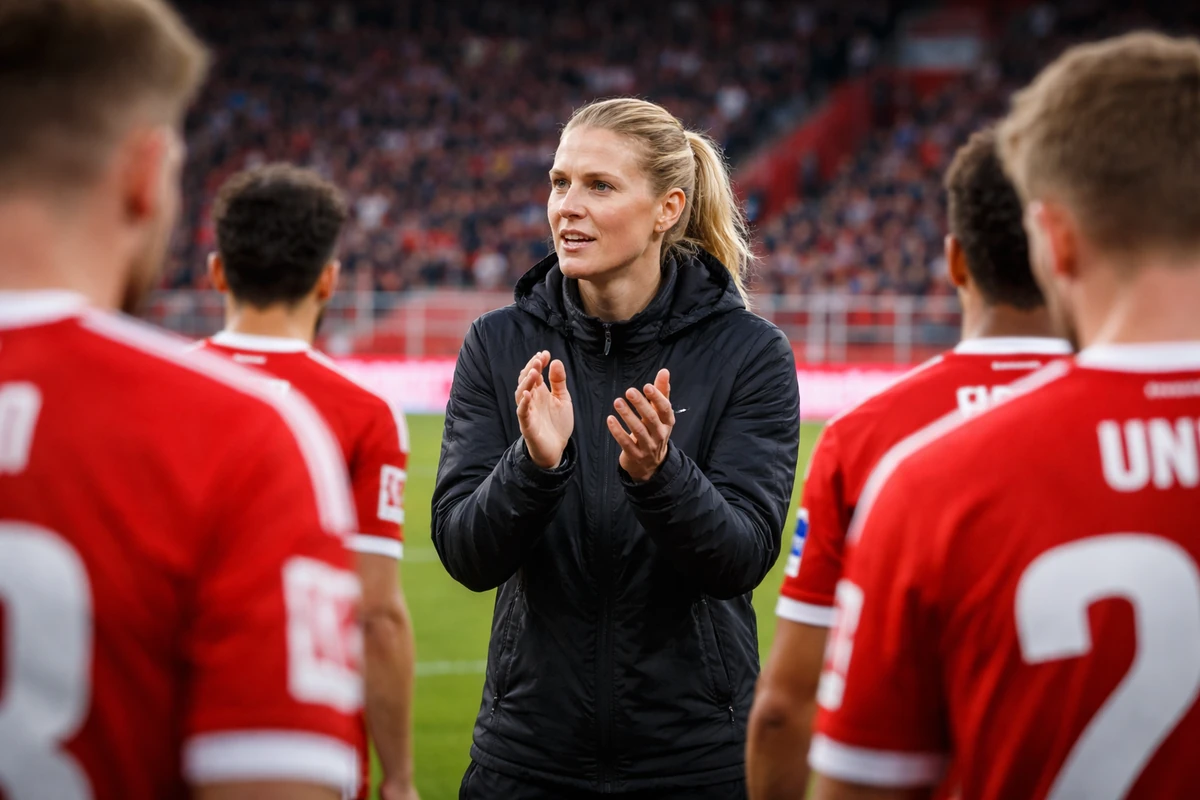
A historic first in one of sports’ most traditional spaces
For all the attention professional soccer gives to innovation — data analytics, global scouting networks, tactical reinventions and billion-dollar media deals — one of the sport’s most powerful institutions has remained remarkably unchanged: the men’s first-team manager’s office. That is why Union Berlin’s decision to appoint Marie-Louise Eta as interim head coach is about more than a coaching change at a struggling Bundesliga club. It is a landmark moment for European soccer and, potentially, for the broader conversation about who gets to lead in elite men’s sports.
Union Berlin’s move makes Eta, 34, the first woman to take charge of a men’s senior first team in any of Europe’s five biggest domestic leagues: England’s Premier League, Spain’s La Liga, Germany’s Bundesliga, Italy’s Serie A and France’s Ligue 1. In a sport that often talks about meritocracy but has long operated through old networks and ingrained assumptions, that fact alone is significant. But the deeper meaning lies elsewhere. This was not a ceremonial appointment or a symbolic ambassador role. Union Berlin made this change in the middle of a relegation fight, with five matches left and the club’s top-flight future at stake.
That context matters. In American sports, it would be like an NFL team turning to a first-time head coach during a late-season playoff or survival push, or an MLB club handing the dugout to a new manager with the postseason or relegation equivalent hanging in the balance. The message, intentional or not, is that the club believes Eta is not merely historically notable. It believes she gives the team a real chance to survive.
For many American readers, especially those who follow women’s sports in the United States or have watched the slow expansion of opportunities for women in coaching, the milestone may sound overdue. U.S. fans have seen women break into coaching staffs in the NBA, NFL and Major League Baseball, even if the top jobs still remain overwhelmingly male. European men’s soccer, however, has proven especially resistant. The head coach in top-flight men’s soccer occupies an almost mythic role — part tactician, part motivator, part public face and, in moments of crisis, a lightning rod for every frustration in the club. That role has long been treated as one of the last closed doors in the game.
Union Berlin has now opened it, even if only on an interim basis. And once a barrier breaks in a visible league, it becomes harder to argue that the barrier was ever based on anything inevitable or natural in the first place.
Why the word “interim” may matter more than the word “woman”
There is an understandable temptation to focus on the most obvious headline: the first woman to lead a men’s first team in a European major league. But if you want to understand why this appointment carries real weight, the most important word may actually be “interim.” Eta has not been hired for a distant developmental project or a low-pressure transition period. She has been put in charge for the final stretch of a season in which every point matters.
That makes this decision feel less like branding and more like necessity. If Union Berlin had wanted a public-relations win, there were easier ways to get one. Clubs make symbolic gestures all the time — diversity statements, ceremonial appointments, carefully timed announcements during quieter stretches of the calendar. Instead, Union made this move in a moment of stress, when a club fighting to stay in the Bundesliga cannot afford sentimentality. Germany’s top division, like the Premier League and other major European leagues, comes with enormous financial consequences. Dropping to the second tier does not simply hurt pride. It affects television revenue, sponsorship, transfer planning and a club’s long-term competitiveness.
In other words, Eta’s appointment comes inside the most unforgiving kind of evaluation period possible. She will not be judged mainly on the symbolism of her hire. She will be judged on results, points, organization, substitutions, lineups and whether Union Berlin remains in the top flight. That is precisely what makes the appointment meaningful. It suggests that inside the club, decision-makers saw enough tactical and leadership value to trust her in a moment when stakes are highest.
The temporary nature of the job also reflects a familiar pattern in soccer. Interim managers are often asked to do what permanent hires sometimes cannot do quickly: simplify the message, stabilize morale and get immediate buy-in from a squad that has stopped responding to the previous staff. With only five matches left, there is little time for a philosophical overhaul. Eta’s task is more immediate and more practical: restore clarity, sharpen execution and help a tense team rediscover enough belief to get over the line.
For women in leadership, that setup cuts both ways. It offers a real chance, not a token one. But it also comes with the kind of compressed scrutiny that can define a narrative before it has time to breathe. A male interim manager in a five-game rescue mission might be judged as a specialist brought in for chaos control. A woman in the same role may find every tactical choice interpreted as evidence in a much larger cultural argument. That is unfair, but it is also the reality of being the first.
Eta’s résumé suggests preparation, not a publicity stunt
It is easy to describe a groundbreaking hire as “bold” or “radical,” but those labels can sometimes obscure what actually matters: whether the person got there through a serious professional pathway. By that standard, Eta’s appointment looks less like a leap into the unknown and more like the delayed recognition of a coach who has been building toward this level for years.
Before entering coaching, Eta played at a high level in Germany, including time with Turbine Potsdam, one of the country’s storied women’s clubs. She experienced elite competition as a player and was part of environments where winning was not an abstract concept but an expectation. That kind of top-level playing background has often served as an unofficial credential in men’s soccer, where former players routinely move into youth coaching, assistant roles and eventually first-team leadership.
After retiring in 2018, Eta followed a path that would look familiar — and respectable — for many coaches in the men’s game. She worked in youth development at Werder Bremen and later coached within Germany’s youth national team structure. Those jobs matter. Youth coaching in Europe is not busywork or a side assignment. It is often where future first-team coaches prove their ability to teach complex systems, manage player development and operate within professional club or federation structures. In some ways, it is a purer test of coaching ability than the celebrity-driven world of senior management, because the work is less about profile and more about instruction, detail and consistency.
That career arc complicates one of the most common defenses of the status quo in men’s soccer: the idea that women have simply lacked the relevant experience. Eta’s case suggests something different. The issue may not have been a shortage of qualified women. It may have been the unwillingness of elite men’s clubs to treat those qualifications as sufficient when the final gate — the senior men’s first team — came into view.
American readers may recognize this pattern from other industries, including politics, business and sports, where women are often told they need more experience, more proof, more credentials or a cleaner résumé than men competing for the same role. Then, when a woman finally reaches the position, the conversation frames her as an exception rather than asking why the system delayed the opportunity for so long. Eta’s appointment invites exactly that question. If the qualifications were there, what changed now? And why did it take until 2026 for a club in one of Europe’s biggest leagues to make this move?
The answer is likely a mix of pressure and pragmatism. Union Berlin needed a solution. Eta was available. Her work inside the system had earned trust. The club decided that competence mattered more than convention. That sounds obvious. In professional soccer, it has too often not been.
What this means for Union Berlin on the field
Historic as the appointment is, Union Berlin still has soccer games to win — or at least enough points to secure survival. That makes the sporting side of this story impossible to ignore. Union’s decision comes after the departure of coach Steffen Baumgart amid poor results, and the club now faces a familiar end-of-season equation: stabilize quickly or risk the chaos of relegation.
For U.S. audiences less familiar with European league structure, relegation is one of the defining pressures of soccer outside North America. Unlike the NFL, NBA or MLB, where a bad season may bring a high draft pick, struggling teams in European soccer can be demoted to a lower division. The consequences are immediate and severe. Budgets shrink. Talent often leaves. Prestige drops. Plans are rewritten. The final weeks of a relegation battle are therefore not just about avoiding embarrassment; they are about preserving a club’s economic and competitive future.
That reality is likely to shape Eta’s approach. With only five matches remaining, there is little incentive to chase grand tactical experiments. End-of-season rescue jobs are usually about sharper defensive transitions, cleaner roles, more disciplined pressing, better set-piece organization and emotional reset. The challenge is not to invent a new football philosophy in a month. It is to make the players execute a manageable plan under pressure.
Coaching changes can also reset internal hierarchies. Players who had slipped down the depth chart may get fresh looks. Veterans may be asked to lead more visibly. Marginal contributors can suddenly become important if they fit the interim manager’s immediate priorities. Training habits and off-ball work often take on greater significance because short-term managers tend to favor reliability over theoretical upside. In that sense, every Union player is being re-evaluated in real time.
That includes South Korean international Jeong Woo-young, whose presence adds another layer to why this story has drawn special attention in Korea. For many Korean fans, overseas soccer coverage often centers on the most measurable outcomes: goals, assists, minutes, transfer rumors. But a managerial change shifts the lens from individual statistics to structure and leadership. A player’s role can change dramatically under a new coach — position, defensive duties, pressing triggers, even set-piece assignments. A coaching change can be a setback or an opening.
For Jeong, as for the rest of the squad, the question is how quickly he can become useful to a coach with no time to wait. Interim managers often prioritize players who can absorb instructions immediately, contribute without extensive adjustment and help execute a simple plan under stress. That can elevate attributes that do not always show up in highlight packages: defensive work rate, positional discipline, pressing intensity and trustworthiness in transition moments. In a survival race, “immediately dependable” can matter more than “theoretically exciting.”
It is possible that Eta’s biggest early job will be psychological rather than tactical. Teams deep in a slump often look not merely disorganized but burdened. Passes become safer, runs less committed, mistakes more contagious. A new manager can interrupt that cycle by redistributing responsibility and changing the emotional temperature around the group. Whether Union Berlin responds that way over the next five matches will determine not only the club’s league status but also the first chapter of Eta’s story.
Why European men’s soccer has been so slow to change
To understand why this appointment feels so seismic, it helps to understand how conservative men’s soccer leadership can be, even in an era when the sport presents itself as global and modern. The game may be international, wealthy and analytically sophisticated, but its most senior coaching jobs are still often filled through networks of familiarity. Former players recommend former teammates. Executives prefer candidates who “look like” previous managers. Clubs in crisis default to names that feel safe, even when those names come with their own record of failure.
That pattern is not unique to soccer, of course. American sports have their own versions of it. The NFL has long wrestled with how minority coaches are hired and evaluated. Major League Baseball has repeatedly been criticized for how few women hold senior on-field roles. The NBA has made visible progress with women in assistant coaching positions, yet the head coach role remains a difficult final frontier. In each case, institutions often defend themselves by saying leadership is about experience — while quietly deciding which experiences count and whose credentials are seen as transferable.
Men’s soccer in Europe adds another layer: the cultural mythology of the manager. In England and Germany especially, managers are often judged through a lens of command, authority and hard-edged charisma. The stereotype is not merely tactical brilliance; it is a particular style of control that has historically been coded as male. This has made it easier for clubs to imagine unconventional formations than unconventional leaders.
That is why Eta’s appointment matters beyond Germany. It pushes the conversation from theory to precedent. For years, one could say a woman coaching a men’s first team in a major league was possible in principle, while avoiding the choice in practice. Now the precedent exists. Other clubs may still hesitate, and one case does not guarantee a broader transformation. But future decision-makers can no longer say it has never happened.
There is another reason this moment stands out: it happened at the highest level of pressure, not in a developmental side room of the sport. This was not a youth academy experiment, a reserve-team trial or a lower-stakes public gesture. It happened in a top division where survival, money and reputation are all in play. That makes the hire harder to dismiss. A woman was not placed in charge of a symbolic project. She was placed in charge of a professional emergency.
Still, the scrutiny ahead will likely be uneven. Male coaches are often allowed to fail in ordinary ways. A tactical gamble does not work. A lineup choice backfires. A relegation battle ends badly. Those outcomes are usually attached to the individual and the circumstances. Women in pioneering roles are more likely to see failure generalized into commentary about whether they belonged there at all. That double standard is one of the quiet forces that has kept doors closed for so long. Union Berlin has now tested it in public.
What audiences in Korea — and the U.S. — can take from this moment
In South Korea, this story resonates partly because of Jeong Woo-young’s connection to Union Berlin. Familiar players often serve as entry points for broader sports stories, and that is true in the U.S. as well. American coverage of European soccer often expands when a U.S. international joins a club, because audiences suddenly care not just about the league table but the manager, the style of play and the club’s internal politics. Jeong’s presence gives Korean audiences a similar stake in a story that might otherwise have felt remote.
But the significance goes well beyond one player or one club. For Korean sports, as for many sports systems around the world, the story raises a basic institutional question: How are coaches developed, evaluated and promoted? If leadership pipelines remain narrow, relationship-driven or poorly structured, then breakthrough appointments will continue to look like exceptions instead of expected outcomes from a healthy system.
That question travels easily across borders. In the United States, women’s sports have produced world-class coaches, athletes and executives, but pathways into men’s leadership positions remain uneven. There has been real progress, especially in assistant roles and player development positions, yet the highest on-field authority is still treated differently. Eta’s rise does not solve that. What it does is supply a live example from one of the world’s most visible sports ecosystems that competence and opportunity do not always arrive on the same timeline.
For American readers, there is also a useful cultural lesson in how Korean audiences are likely to read this development. Korean sports coverage often pays close attention to overseas clubs with Korean players, but those stories increasingly extend beyond individual box-score performance to include institutional and structural change. That shift mirrors a broader maturation of sports fandom globally. Fans are not just tracking goals and assists anymore. They are tracking who gets hired, what kinds of leadership are valued and how industries evolve around their athletes.
Ultimately, Union Berlin’s decision will be remembered in one of two ways, and perhaps both at once. In the short term, it will be judged by an unforgiving football metric: Did the club stay up? That is the nature of elite sports. Results rule. In the longer term, though, the appointment is already larger than the standings. A door that remained closed across Europe’s biggest leagues is now open. Maybe only slightly, maybe only conditionally, but open nonetheless.
If Eta succeeds, the story will quickly move from “first woman” to “credible top-flight coach,” which is exactly where it should go. If she does not, the precedent still exists. Another club, in another crisis or another transition, will find it harder to pretend the option is unthinkable. That may be the most important outcome of all. In sports, as in many institutions, the first breakthrough rarely changes everything overnight. What it changes is the imagination of what future decisions can look like.
And for a game that has long prided itself on seeing every angle except this one, that is no small shift.
Comments
Post a Comment