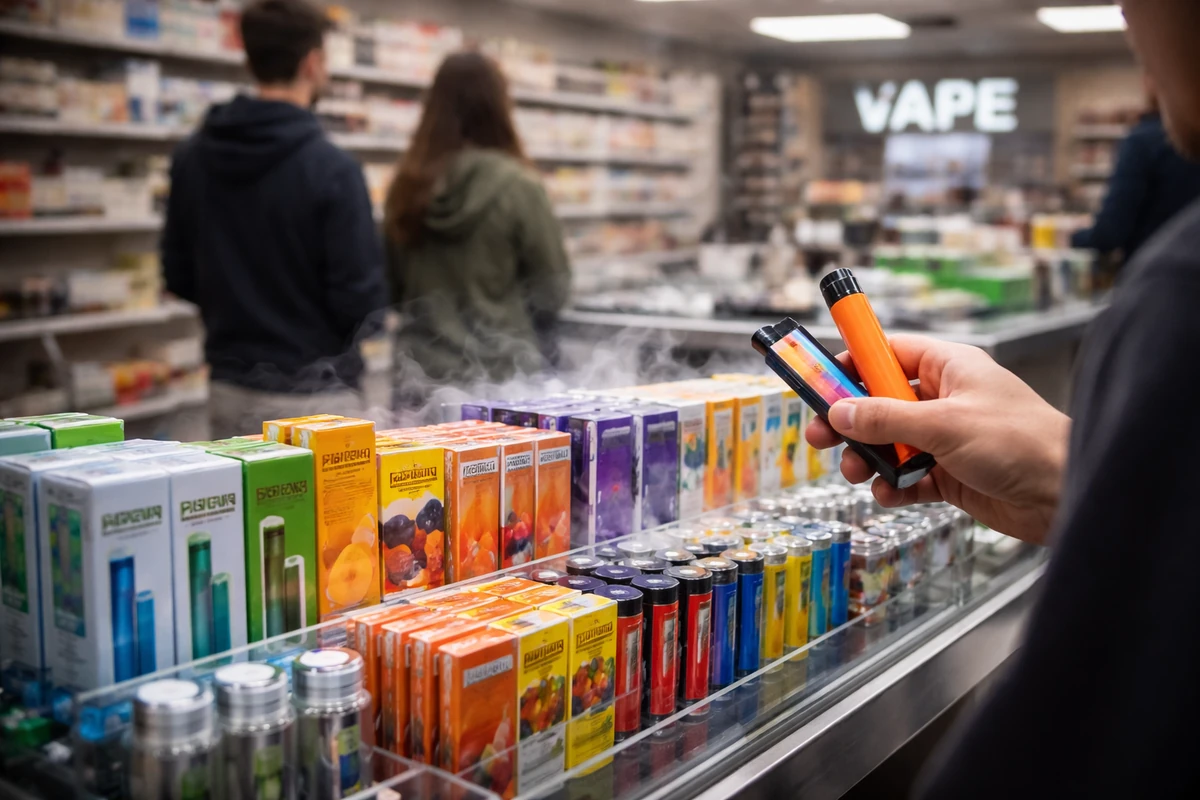
A Washington policy fight with global consequences
A debate now unfolding in Washington over flavored e-cigarettes may sound, at first glance, like a narrow fight about product approvals. It is not. If the Trump administration moves ahead with plans to broaden access to flavored vaping products — including menthol and fruit-inspired varieties such as mango and blueberry — the decision would mark one of the most consequential U.S. shifts in tobacco and nicotine policy since the government cracked down on youth vaping at the start of the decade.
That is why the issue is drawing attention far beyond the United States. America is not just another market for nicotine products. It is one of the world’s most influential regulatory arenas, and when Washington changes course, companies, health agencies and lawmakers in other countries often reassess their own positions. In this case, a U.S. move toward wider approval of flavored e-cigarettes could ripple through global supply chains, public health strategies and political debates over how to balance adult smoking cessation against youth addiction risks.
According to reports cited in recent discussions around the issue, the White House is considering allowing a broader range of flavored e-cigarette products than has effectively been permitted under the system that has been in place since 2020. That existing framework did not amount to a total ban on vaping products, but it sharply constrained the flavored products most often accused of appealing to teenagers. The result was a compromise of sorts: tobacco- and menthol-flavored products remained on firmer footing, while many sweet, fruity and dessert-like options faced far steeper obstacles.
Now that compromise appears to be under pressure. Supporters of a looser approach argue that adult smokers need more alternatives if the government is serious about helping them move away from combustible cigarettes, which remain far deadlier than e-cigarettes by most public health measures. Critics counter that the same flavors marketed as tools for adult choice can also serve as an on-ramp for teenagers, especially when nicotine is packaged in forms that feel more like consumer lifestyle products than traditional tobacco.
In other words, this is not simply a fight over mango pods or minty vapor. It is a fight over what U.S. public health policy is supposed to prioritize, how much political leaders should influence science-based regulators, and whether harm reduction for adults can coexist with credible protections for children and teens.
Why flavors matter so much in the U.S. vaping debate
To understand why this issue has become so explosive, it helps to understand the role that flavor plays in the modern vaping market. For many adult smokers, especially those trying to quit cigarettes, non-tobacco flavors have long been central to the argument for e-cigarettes. The theory is simple: If a smoker is trying to stop using combustible tobacco, products that do not taste like cigarettes may help break the sensory and behavioral tie to smoking. Fruit, mint or menthol flavors may make the switch more appealing and, in some cases, more sustainable.
That argument fits into a broader concept public health officials often call harm reduction — the idea that while eliminating nicotine use altogether would be ideal, moving people away from more dangerous forms of consumption can still save lives. Americans have seen versions of this logic before in debates over needle exchange programs, opioid treatment medications and nicotine replacement tools such as patches and gum. The question is not whether a product is harmless; it is whether it is meaningfully less harmful than the alternative.
But flavored vapes occupy a far more politically charged space than patches or gum. In the United States, the youth vaping surge of the late 2010s transformed what had been framed by many as an adult smoking-cessation story into a youth public health emergency. Sleek devices, social media-friendly branding and flavors that resembled candy or soft drinks made many parents, teachers and pediatricians feel the industry had crossed a line. For Americans, the comparison that often comes up is the old Joe Camel controversy: products that companies may insist are for adults but that critics say inevitably attract younger users.
That history matters because it explains why flavor, more than almost any other variable, became the symbolic center of the regulatory fight. Nicotine concentration, marketing practices and packaging all matter too, but flavor became shorthand for a larger fear: that the vaping industry had found a way to repackage nicotine in a form that did not carry the same stigma or sensory harshness as cigarettes. A tobacco-flavored vape could be defended, however imperfectly, as a transitional product for smokers. A blueberry or mango vape is much harder, politically and culturally, to separate from youth appeal.
So when policymakers revisit flavors, they are really reopening a broader moral and regulatory question: Is vaping primarily a smoking off-ramp for middle-aged cigarette users, or is it a new consumer nicotine category that risks hooking a younger generation? Depending on which answer a policymaker starts with, the same product can look either like a harm-reduction tool or like a public health setback.
The legacy of the 2020 crackdown
The current debate cannot be understood without going back to 2020, when the federal government, under pressure from mounting evidence of youth use, moved to tighten the rules around flavored e-cigarettes. That action came after years of increasingly alarming data and intense media coverage showing that teenage vaping had spread rapidly in American middle schools and high schools. Parents’ groups, anti-tobacco advocates and many state officials argued that the federal response had lagged behind the speed of the problem.
The 2020 framework was not a blanket prohibition on all e-cigarettes. Instead, it operated more like a selective barrier. In practice, products with tobacco and menthol flavors remained more viable, while many cartridge-based flavored products associated with youth demand became far harder to market legally. The policy attempted to occupy a middle ground between two politically risky extremes: a full-scale ban that could alienate adult users and businesses, and a permissive market that critics said had already failed to protect minors.
That compromise reflected a very American regulatory instinct. Rather than fully shutting down an entire category, federal officials tried to create a distinction between products that could plausibly be defended as adult-oriented and products more likely to attract younger users. Whether that distinction worked is still hotly debated. Some health advocates said it was too weak and too easy to evade, especially as disposable devices and gray-market channels proliferated. Industry backers said it unfairly punished adult consumers while leaving the cigarette market, the most dangerous option, comparatively intact.
Still, the political and institutional logic of the 2020 shift was clear: youth protection had become the dominant public health priority. That changed the regulatory mood in Washington. Once e-cigarettes stopped being treated mainly as a disruptive innovation and started being treated as a youth addiction issue, the burden on manufacturers rose dramatically. Companies had to do more than argue that their products were less harmful than cigarettes in the abstract. They had to persuade regulators that the benefits to adult smokers outweighed the risks of attracting adolescents.
If the administration now broadens the path for flavored products, it would not just be tweaking a technical rule. It would be revisiting the assumptions that defined the post-2020 system. The shift would suggest that adult cessation and market access are once again gaining weight against the youth-protection framework that drove the earlier crackdown.
The White House and the FDA appear to be reading the moment differently
One reason this issue has become especially significant is the apparent tension between political leadership and the Food and Drug Administration, the agency responsible for evaluating whether tobacco and nicotine products meet the legal standard for marketing authorization. That standard is supposed to be grounded in public health evidence, not simple consumer demand or industry preference.
If the White House pushes aggressively for wider flavored-vape approvals while the FDA leadership remains more skeptical, the clash would underscore a long-running question in American governance: How independent are expert agencies when their conclusions collide with the priorities of a president and his political advisers? This is not unique to nicotine policy. Americans have seen similar tensions around environmental rules, drug approvals, pandemic response and food safety. But vaping is especially sensitive because it sits at the intersection of health, business, youth culture and electoral politics.
Supporters of FDA caution argue that the agency’s hesitancy is not bureaucratic foot-dragging but a direct reflection of the evidence and the agency’s mandate. The central problem, from this perspective, is that whatever flavored products may do for adult smokers, they also carry obvious risks of broadening experimentation among young people. Regulators are not being asked to approve a medicine for a narrow patient population; they are being asked to authorize mass-market products in a culture saturated with advertising, peer influence and digital trends.
Those favoring broader access, however, often frame the FDA as too slow, too rigid and too unwilling to embrace harm reduction. They point to the millions of Americans who still smoke cigarettes and argue that an overly restrictive approach ends up protecting the most dangerous product on the market by making safer substitutes less attractive or harder to obtain. In that telling, the government has become so focused on preventing youth uptake that it has lost sight of the adults who might benefit from alternatives.
What makes this moment important is not just whether a handful of products get approved. It is what the process signals. If political pressure can meaningfully reshape the standards applied by regulators, other industries will notice. If the FDA resists and keeps its existing posture, that too sends a message — namely, that public health agencies can still impose continuity even when administrations change. Either way, flavored e-cigarettes have become a test case for the boundary between scientific review and political direction.
The industry sees a market opening. Public health advocates see a familiar risk.
For manufacturers, the possibility of a broader flavored-vape market in the United States is about more than winning approval for a few individual products. It is about reducing uncertainty in one of the world’s most lucrative and influential consumer markets. Companies have spent years and substantial sums navigating applications, compliance requirements and shifting enforcement signals. When a product appears close to approval after a long wait, the implications extend well beyond that single brand.
From a business perspective, expanded approval of flavored products could unlock two major advantages. First, it could help companies compete more effectively for adult smokers who do not want a product that tastes like tobacco. Second, if the administration pairs regulatory flexibility with broader messaging about domestic manufacturing or market competition, the move could be framed not just as a public health decision but also as an industrial policy choice. In Washington terms, that means vaping could be discussed not only as a health matter but also as a jobs, investment and market-innovation story.
That kind of overlap is increasingly common in U.S. policymaking. Electric vehicles, semiconductors, pharmaceuticals and clean energy have all been debated through dual lenses of public value and industrial strategy. Flavored vaping products are obviously different in social meaning and health impact, but the political mechanics can look similar. Once a White House starts talking about a category in terms of American competitiveness or domestic production, regulatory decisions often carry more symbolic weight.
Yet the market logic does not erase the public health concerns. Anti-tobacco groups, pediatric associations and many school administrators are likely to argue that the industry’s confidence in adult switching cannot justify the renewed visibility of flavors that have long raised alarms. In the United States, where youth culture and consumer branding are deeply intertwined, critics worry that any message normalizing flavored nicotine risks outpacing whatever guardrails regulators try to impose.
There is also the basic political reality that Americans tend to be especially wary when corporations claim they can simultaneously grow a market and protect children. The history of tobacco litigation and deception still casts a long shadow. Even if today’s vaping companies are not the same as the cigarette giants of earlier decades, many voters, parents and lawmakers instinctively view industry promises through that older lens. That skepticism is one reason flavored-vape policy remains so combustible: the evidence can be debated, but trust is harder to rebuild.
Why the rest of the world is watching Washington
Although this is a U.S. regulatory fight, its effects are likely to extend well beyond American borders. The vaping business is global. Devices, ingredients, flavoring components, packaging and marketing strategies move across countries, as do ideas about what constitutes responsible regulation. When the United States changes course, it affects not just what can be sold domestically but also how multinational tobacco companies, nicotine-substitute firms and foreign regulators map the future.
That is especially true because the United States functions as both a giant market and a reference point. Other governments do not automatically copy Washington, but they do study it. If U.S. officials decide that carefully selected flavored products can be justified as smoking alternatives for adults, regulators elsewhere may feel more comfortable making similar arguments. If the United States keeps restrictions tight or reimposes barriers after a political push, governments that favor stricter controls will cite that as validation.
The global significance also lies in how nicotine policy is increasingly tied to competing philosophies of public health. Some countries lean more heavily into harm reduction, arguing that adults should have access to lower-risk alternatives even if the products are not risk-free. Others place more emphasis on preventing normalization, especially among youth, and fear that accepting flavored nicotine undermines decades of progress in denormalizing tobacco use. The U.S. decision matters because it may help determine which framework gains momentum internationally.
There is a cultural dimension as well. Flavors are not merely sensory details; they shape who a product appears to be for. A market limited largely to tobacco flavor sends one social signal. A market with a wide range of fruit, beverage and mint profiles sends another. International companies understand that, and so do public health agencies. The question is not only whether people vape, but what kind of consumer identity vaping is allowed to project.
That is one reason this story is drawing attention in places such as South Korea, where debates over public health, youth culture and U.S. regulatory influence often intersect. American tobacco and nicotine policy has a habit of becoming an international benchmark, whether other countries are trying to emulate it, challenge it or anticipate its market effects.
What is really at stake now
At its core, the flavored-vape debate asks the United States to decide which risk it is more willing to tolerate. Is it more dangerous to make potentially less harmful nicotine alternatives less appealing to adult smokers who might otherwise keep smoking cigarettes? Or is it more dangerous to widen the legal space for products that, whatever their intended users, may also attract adolescents?
There is no politically painless answer. If regulators approve more flavored products and youth use rises, the administration will face accusations that it ignored the lessons of the last decade. If regulators maintain a restrictive stance and adult smokers remain with combustible cigarettes, critics will say ideology and bureaucratic caution blocked a potentially life-saving transition. That is why the fight is so intense: both sides can plausibly claim the language of public health.
For American readers, the best way to understand the moment may be to think of it not as a niche vaping story but as a broader stress test of modern regulation. It combines the familiar ingredients of a 21st-century policy clash: scientific uncertainty, polarized politics, distrust of institutions, aggressive industry lobbying, concern for children and a global marketplace waiting for signals from Washington.
Whether the Trump administration ultimately succeeds in opening the door wider to flavored e-cigarettes, or whether the FDA maintains a harder line, the outcome will shape more than the vaping aisle. It will help define how the United States balances consumer freedom with youth protection, how much independence expert agencies retain in politically charged sectors, and what kind of message America sends to the rest of the world about nicotine policy in the years ahead.
That is why a debate over menthol, mango and blueberry has become much bigger than flavor. It is now a referendum on the values built into U.S. health regulation — and on whether the country believes the next chapter of tobacco control should be written mainly around preventing new users or converting old ones.
Comments
Post a Comment