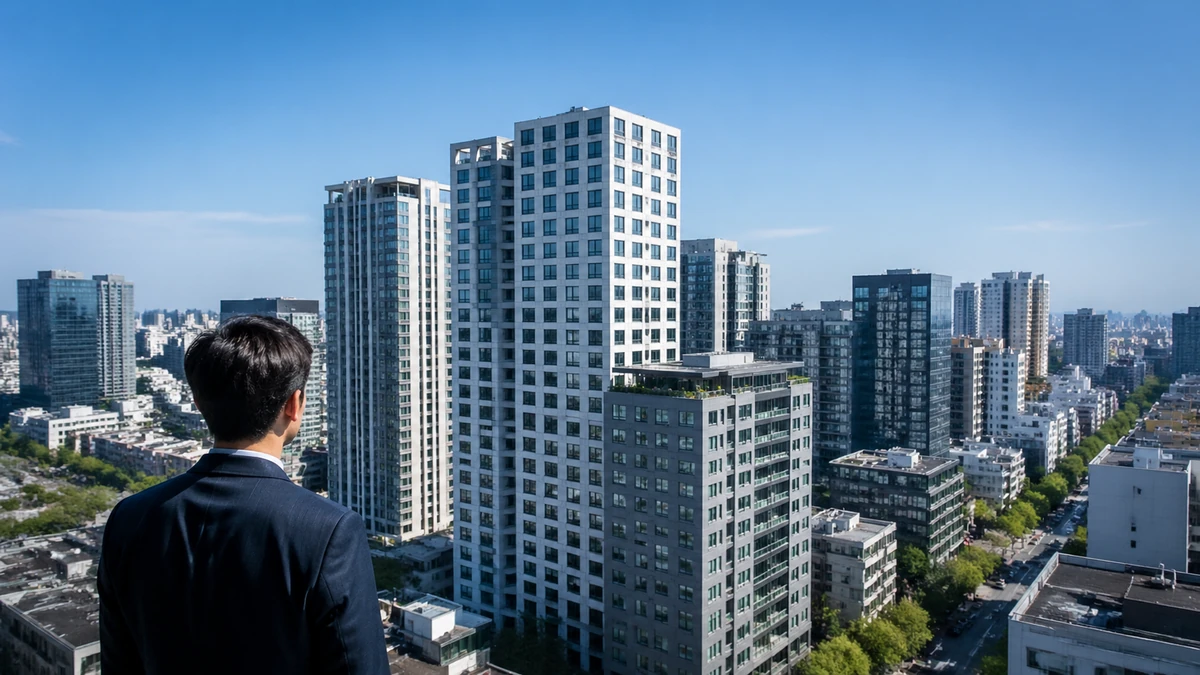
A little-known housing type is moving to the center of South Korea’s property market
In the United States, the clearest signs of a shifting housing market might be bidding wars in suburban starter homes or surging rents in downtown apartments. In South Korea in 2026, one of the most telling signals is coming from a property type many Americans have never heard of: the officetel.
An officetel is a distinctly Korean real estate product, blending the words “office” and “hotel.” In practice, it usually refers to a compact urban building unit that can function as both workspace and residence, though in recent years many have been used primarily as homes. Think of it as something between a studio condo, a small apartment and a live-work unit, often near subway stations, business districts and university neighborhoods.
For years, officetels were often treated as a secondary option — a fallback for people priced out of traditional apartments or an investment vehicle for landlords seeking rental income. But that view is changing. As new move-ins for officetels fall to historically low levels and record-high transaction prices appear in some neighborhoods, the market is beginning to treat them less as substitutes and more as a housing category with its own identity and staying power.
That shift matters because it says something broader about South Korea’s urban housing strain. The issue is not simply that officetel prices are rising. It is that a growing number of households are turning to them as one of the few realistic ways to stay close to jobs, transit and city life without paying full apartment-level prices in Seoul and the surrounding capital region.
In other words, this is not just a niche real estate story. It is a window into how one of Asia’s most densely urbanized, apartment-centered housing systems is struggling to accommodate younger workers, newlyweds and small households that still want access to the country’s economic core.
The supply crunch is doing more than pushing up prices
It is tempting to explain any housing rally as a story of revived buyer confidence or speculative enthusiasm. But in the case of South Korea’s officetels, the more immediate force appears to be a shortage of new supply.
Reports in the Korean press point to move-in volume for officetels dropping to the lowest level on record. That is an important distinction. It does not merely mean fewer new projects were announced or fewer units marketed. It means fewer newly completed homes are actually reaching residents and investors who can occupy or lease them now.
In real estate, supply shortages often show up with a lag. A project delayed or canceled years ago can suddenly become today’s empty pipeline. By the time consumers begin to feel the shortage on the ground, the gap can feel much larger than the headline numbers suggest.
That is especially true for officetels, which are generally smaller in scale than major apartment complexes and far more sensitive to neighborhood-specific demand. A nationwide average can conceal real scarcity in highly sought-after pockets of Seoul, Incheon and Gyeonggi Province, the vast metropolitan region surrounding the capital. Areas near subway lines, major office clusters, colleges and newly built residential districts tend to feel the squeeze first.
In those neighborhoods, a decline in new move-ins quickly translates into fewer available listings. That puts upward pressure not only on sale prices but also on rents and deposit-based leases. The most competitive properties — newly built units, efficient layouts, solid building management, decent parking and easy access to business districts — can pull away from the rest of the market fast.
That helps explain why record-high transactions have surfaced first in core urban locations rather than across the entire sector. This is not a broad-based boom in every officetel. It is a selective repricing of the best-positioned properties in places where residents plainly need housing and alternatives are limited.
Americans might compare this to what happens when housing inventory dries up near major job centers in places like Northern Virginia, Queens or the Seattle metro area. Not every condo or apartment building benefits equally. But the best-located units, especially newer ones, can suddenly command prices that would have seemed unlikely just a few years earlier.
Why more Koreans are choosing ownership over the country’s unusual rental system
One reason officetels are drawing renewed attention is that they are increasingly tied to changes in how Koreans think about renting versus owning.
To understand that shift, Americans need a bit of context about South Korea’s housing system. Alongside monthly rent, Korea has long relied on a leasing arrangement called jeonse, in which tenants provide a large lump-sum deposit — sometimes amounting to half or more of a home’s value — in exchange for living in the property with low or no monthly rent during the lease term. Landlords invest that deposit, and tenants receive the principal back at the end, at least in theory.
For decades, jeonse served as a distinctive middle ground between renting and ownership. But in recent years, volatility in home prices, higher interest rates and a series of deposit-return disputes have shaken confidence in the system. For many younger households, coming up with an enormous deposit can be as daunting as making a down payment, while feeling less secure.
That has made alternatives more attractive. Some would-be renters are deciding that if they must tie up substantial cash anyway, they would rather put that money toward purchasing a smaller property. For buyers who cannot afford a conventional apartment — long the dominant symbol of middle-class housing wealth in South Korea — officetels can become the next-best, or simply most realistic, option.
This trend appears particularly relevant for one- and two-person households, young professionals who prioritize a short commute, newly married couples not yet ready for a larger family home, and consumers who value location and new construction over square footage. In a country where long commutes in and out of Seoul can consume hours each day, proximity to work and transit can carry as much weight as unit size.
That logic is familiar to urban Americans. A younger buyer in Brooklyn, Arlington or Chicago may accept fewer bedrooms in exchange for easy train access and a shorter trip to the office. The Korean version of that calculation is now helping lift officetels.
What makes the current moment especially significant is that several pressures are converging at once: anxiety over the jeonse market, high apartment prices, limited supply of newly built homes in desirable city locations, rising acceptance of smaller households and a preference for units that are ready for immediate move-in. Taken together, those forces suggest this may be more than a temporary fad.
Officetels are no longer just apartment substitutes
It is easy to describe officetels as a side story to the apartment market. That would be misleading.
South Korea’s housing system has long revolved around apartments, which are not merely places to live but central vehicles for household wealth, school district strategy and social status. Apartment prices dominate news coverage, shape political debate and influence how policymakers talk about supply. But that focus can obscure what happens outside the apartment category.
Officetels have quietly served a real housing function for years, especially in major cities. Their problem has been less a lack of demand than a lack of stable recognition. Because they sit at the boundary between residential and commercial use, they have often been treated inconsistently in regulation, taxation, lending and public perception.
At times, officials and investors have viewed them chiefly as yield-generating products. At other times, they have been embraced as a stopgap way to expand housing stock when apartment supply was tight. In still other periods, they have operated as a release valve for people who needed to live in the city but could not break into the apartment market.
The latest rebound looks different because it carries a stronger owner-occupancy element. These are not just speculative buyers chasing the next hot asset. Many are households making a practical decision about where they can realistically live.
That distinction matters. Luxury apartment markets tend to respond heavily to financing conditions, tax burdens and buyer sentiment at the high end. But small urban housing products often move for more immediate reasons: the cost of staying in the city, the feasibility of commuting, the ability to lock in a place to live, and the possibility of collecting rental income if circumstances change.
Seen that way, the rise in officetel prices is not merely a curiosity. It is evidence that the market for urban stayers — people who need to remain near jobs, schools, services and transit — is becoming tighter and more expensive. When that segment heats up, it can signal stress that goes beyond the headline apartment market.
Record-high deals matter because they reflect scarcity, not just exuberance
In any housing market, record-high transactions draw attention. On their own, they do not prove a lasting trend. A single motivated buyer can produce an eye-catching number. But when new highs appear in an environment of shrinking supply, they may reveal something more durable: a change in how market participants value scarcity.
That appears to be happening in the officetel market. Buyers and landlords seem to be concluding that certain units — especially new, well-located, move-in-ready ones — may become harder to secure if current supply conditions persist. Once that perception takes hold, price behavior can shift quickly.
Officetels are particularly sensitive to this dynamic because they are less standardized than large apartment complexes. Unit quality, floor plan efficiency, building maintenance, shared amenities and access to transit can vary dramatically, even within the same district. That means the best properties can be repriced upward while weaker ones stagnate.
So when analysts say officetels are rising, it does not necessarily mean every aging unit in every neighborhood is suddenly booming. A more accurate reading is that high-quality assets are being reevaluated first. In market terms, this looks less like a generalized tide lifting all boats and more like investors and residents crowding into the strongest vessels.
Still, the broader effects can spread. When sale prices rise for new officetels, landlords may raise their rent expectations. As rents rise, some residents may reconsider whether buying makes more sense than leasing. As more renters become buyers, vacancy rates can tighten further. In a supply-constrained market, that cycle can reinforce itself in a relatively short period.
Americans have seen comparable patterns in condo-heavy urban neighborhoods where rental demand and for-sale demand overlap. Once the best small units start trading higher, rent benchmarks can follow, and the divide between tenants and buyers begins to blur.
That is why Korea’s recent record-high officetel deals are worth more than a passing glance. They may be an early signal that urban housing scarcity is becoming embedded in a broader set of property types, not just the apartment market that usually commands the spotlight.
What this says about policy blind spots in a housing system built around apartments
The policy implications are substantial. South Korean housing policy has historically been designed with apartments at its center. Supply plans, lending restrictions, tax measures and anti-speculation rules often assume the apartment market is the market. But the resurgence of officetels suggests that assumption is increasingly incomplete.
If policymakers treat officetels only as investment products, they risk missing the growing number of actual residents relying on them. If they treat them only as emergency substitutes for missing apartments, they may also fail to appreciate how deeply they are woven into city living for specific groups.
Those groups are not all the same. A 27-year-old office worker seeking a studio near a subway line has different needs from a newly married couple delaying a larger home purchase, or from a household waiting for a chance to buy through Korea’s highly competitive apartment subscription system, known as cheongyak. Lumping them together as one bloc can lead to clumsy policy responses.
A more effective approach would be granular. In some neighborhoods, the key issue may be accelerating supply of small, well-located residential units. In others, it may be monitoring speculative trading or evaluating whether properties are serving as genuine homes rather than short-term investment chips. In still other areas, it may mean adjusting financing rules or zoning treatment so that viable non-apartment housing options are not inadvertently squeezed.
This is a familiar lesson beyond Korea. American cities, too, have learned that one-size-fits-all housing policy often fails because demand differs sharply by neighborhood, household type and price point. A downtown one-bedroom market does not behave like a family-home market in the suburbs, even within the same metro area. Korea’s officetel revival is another reminder that housing ecosystems are more layered than policymakers often admit.
There is also a social dimension. When a market increasingly relies on products once seen as marginal to absorb basic urban housing demand, it suggests the mainstream system is not fully meeting the needs of the people trying to enter it. In South Korea, where housing access is deeply tied to class mobility, marriage timing and long-term financial security, that is not a minor issue.
The next question is not whether prices rise, but how long the shortage lasts
Looking ahead, the most important variable may not be whether officetel prices keep climbing month to month. It may be how long the supply gap persists.
If new supply recovers meaningfully, some of today’s price pressure could ease, especially in areas where demand is real but not overwhelming. More inventory would give renters and buyers more options and reduce the scarcity premium currently benefiting top-tier properties. It could also help prevent a tighter feedback loop in which rising sale prices feed rising rents and vice versa.
But if the shortage drags on, officetels may cement their place as a mainstream first-home or city-home product in the capital region. That would represent a notable shift in Korea’s residential hierarchy. Instead of being viewed mainly as apartment alternatives, they could become a more permanent rung on the housing ladder for a generation of smaller households.
That does not mean every officetel is poised to soar. Older buildings with poor layouts or weak locations may continue to lag, and the market is likely to remain highly segmented. But the broader direction is clear enough: demand is concentrating in practical urban housing products that combine livability, relative affordability and access to economic opportunity.
For American readers, the closest parallel may be the way condos, micro-units and transit-oriented apartments have taken on outsized importance in expensive coastal cities where detached homes are out of reach for many younger residents. They may not match the traditional ideal of housing success, but they increasingly define what entry into city life looks like.
That is what makes South Korea’s officetel story so revealing. Beneath the jargon of transaction records and supply data is a simpler, more universal reality: people still need a place to live near where opportunity is concentrated. When the dominant housing type becomes too expensive, too scarce or too rigid, the market does not stop. It reroutes demand into whatever product can still carry it.
Right now in South Korea, officetels are carrying more of that demand than they have in years. Whether that proves to be a temporary adjustment or the start of a deeper structural change will depend largely on supply. But the message from the market is already hard to miss. In one of the world’s most apartment-focused societies, housing demand outside the apartment universe is no longer peripheral. It is becoming central.
Comments
Post a Comment