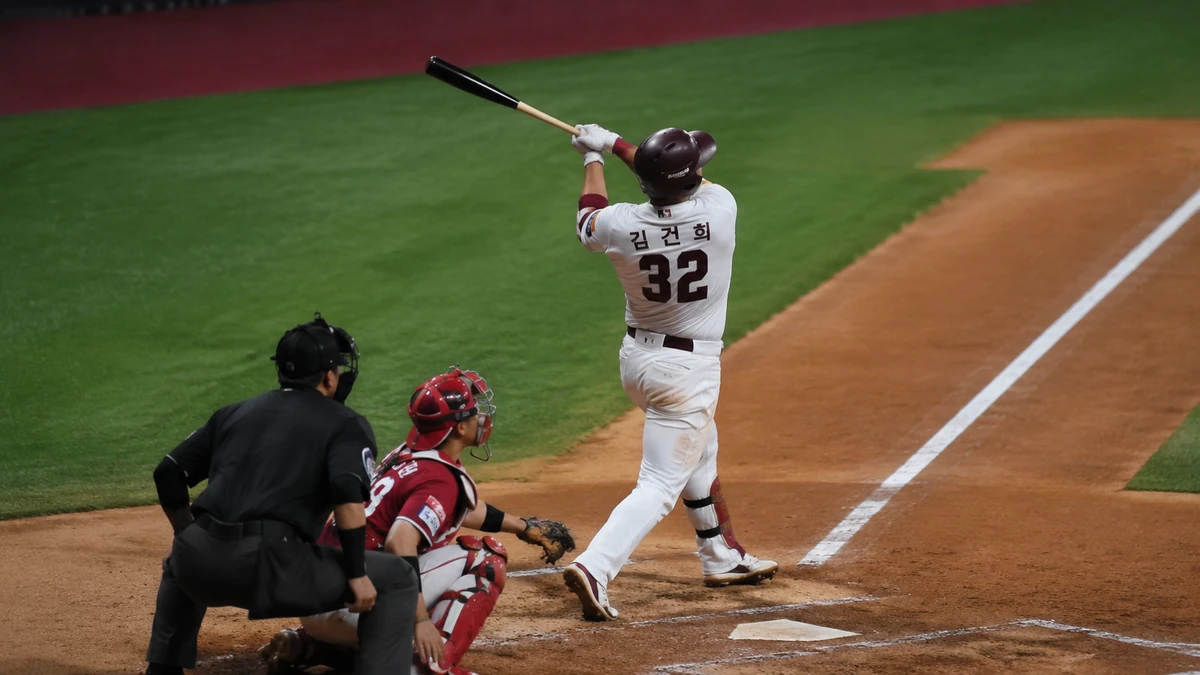
A breakout night in Seoul
On a humid spring night at Gocheok Sky Dome in Seoul, a 21-year-old catcher named Kim Geon-hee delivered the kind of moment baseball fans anywhere instantly recognize: bases loaded, one swing, game changed. Kim, playing for the Kiwoom Heroes of South Korea’s KBO League, launched the first grand slam of his professional career and helped power Kiwoom to a 6-0 win over the SSG Landers on Wednesday. For an American audience, imagine a young backup catcher on a last-place or near-last-place Major League club suddenly becoming the center of a week’s worth of highlights, not only with a dramatic homer but with the kind of all-around game that makes a manager believe he may be watching a cornerstone emerge in real time.
That is the larger significance of this game. The box score shows Kim went 1 for 3 with a walk and four RBIs. It also shows that Kiwoom won its fourth straight game and still sits near the bottom of the standings at 19-26-1, good for ninth place in the 10-team KBO. But the raw numbers do not fully explain why this performance landed with such force. Kim had homered the night before too, hitting a game-tying two-run shot in the eighth inning. Then he came back the next day and supplied the decisive blow, while also handling starting pitcher Raul Alcantara behind the plate during eight shutout innings. In other words, he did not just have a good swing. He influenced the entire shape of the game.
That matters in any league, but especially in the KBO, where momentum, emerging young stars and emotionally charged fan culture all carry real weight over the course of a long season. A four-game winning streak in May does not erase a weak start. It does, however, change the conversation. And for Kiwoom, a club still trying to climb out of the lower half of the table, Kim’s performance offered something every team in that position needs: a believable reason to think better days may not be theoretical.
Why this swing mattered beyond the score
The game’s turning point came in the bottom of the third inning with one out and the bases loaded. Kim did not miss. His grand slam broke the game open and shifted control decisively to Kiwoom. In baseball terms, it was the kind of inning that can deflate one dugout and energize the other all at once. American fans know that feeling from October baseball, when one blast can make a stadium feel like it is shaking. At Gocheok, a domed ballpark that amplifies noise and energy, the effect was immediate.
What made the home run especially meaningful was not only that it produced four runs. It was that it came from a player who is still at an age when many top catching prospects are learning the finer points of game-calling, pitcher management and the physical grind of the position. Catcher is one of baseball’s most demanding roles. In the United States, fans often talk about the position as part quarterback, part traffic controller, part field general. That comparison works in Korea too. A catcher is asked to think through the game pitch by pitch, settle a pitcher in trouble, control the running game, block balls in the dirt and still contribute at the plate. When a 21-year-old catcher changes the game offensively and helps direct a shutout, people pay attention for good reason.
There is also the issue of timing. A solo homer in a lopsided game may pad a stat line, but it does not carry the same emotional weight as a grand slam in the first truly decisive moment. Kim’s blast came when the game was still up for grabs. That is why it felt larger than one at-bat. It tilted the field. It gave Alcantara room to attack hitters. It put pressure on SSG to play from behind. It gave Kiwoom’s dugout a visible jolt of confidence. And because it came one day after Kim’s dramatic late homer, it started to look less like a fluke and more like a player catching fire.
Baseball people are usually careful not to overstate two games in a season that stretches for months. That caution is fair. But baseball is also a game that turns on stretches, rhythms and confidence. Players talk about seeing the ball better, slowing the game down and building conviction from one big moment to the next. Kim appears to be in that kind of pocket right now, and his team is riding it.
The cultural weight of a young catcher in Korea
To understand why Korean fans responded so strongly, it helps to understand the cultural profile of a catcher in Korean baseball. In Korea, as in the United States, the catcher is often viewed as the emotional and strategic backbone of a team. But the symbolism can feel even sharper in the KBO, where fans and media often refer to the catcher as the “home captain” or the one who guards the “home room,” language that emphasizes stewardship and responsibility. The position carries a sense of authority that goes beyond throwing out runners or framing pitches.
So when a 21-year-old holds that job and thrives under pressure, the response is not simply admiration for raw talent. It is recognition of maturity. Korean baseball culture places value on composure, preparation and respect for the game’s demands. A young player who can handle the emotional pressure of calling a game and the spotlight of a defining at-bat stands out quickly. Kim’s postgame comments only added to that impression. Rather than sounding polished or self-congratulatory, he reportedly reacted with a kind of disbelief, saying he realized it was his first career grand slam only after a coach asked him about it. That modest, slightly stunned reaction played as authentic rather than staged.
For American readers, think of the appeal of a young player who has not yet learned to deliver the media-trained answer. There is something compelling about an athlete who still sounds like he is living inside the surprise of his own rise. In Kim’s case, that feeling paired well with the performance itself. He was not just emotional after the fact. He had already done the difficult part under the brightest pressure. That combination — visible humility and visible production — is how fan attachments form quickly.
Korean sports culture also tends to magnify sincerity. When players speak candidly about frustration, exhaustion or determination, fans often take those statements seriously if the effort on the field matches the words. Kim reportedly said he had been so frustrated that he even dozed at the ballpark, and he vowed that Kiwoom would make the postseason. In Korea, the phrase often used is “autumn baseball,” a shorthand for the playoffs because the postseason arrives in the fall. To American readers unfamiliar with the term, it carries roughly the same emotional resonance as saying a team still believes it can play meaningful games in October. It is simple, direct and, for a team in ninth place, undeniably bold.
More than a slugger: The defensive side of the story
The easiest way to tell this story would be to center only on the grand slam. That would also be incomplete. Kim’s offensive line was important, but so was his work behind the plate in guiding Alcantara through eight scoreless innings. The veteran right-hander allowed only two hits, and while pitchers ultimately own the ball leaving their hand, catchers shape the rhythm and architecture of the outing. They help sequence pitches, spot hitters’ weaknesses and maintain calm when a game threatens to wobble.
American baseball discourse has become much more comfortable in recent years with the idea that catchers contribute in ways traditional stats do not always capture. Fans now talk about framing, game-calling and pitcher comfort with more sophistication than they once did. The same is true in Korea, where the battery — the pitcher-catcher partnership — remains a central unit of baseball analysis. A strong night from a catcher can show up not only in his batting line but in the confidence of the man on the mound.
That is part of what made Kim’s performance feel so complete. He did the loud thing and the quiet thing. He gave Kiwoom a lead with a dramatic swing, and then he helped preserve the clean sheet. That is a rare combination for any player, let alone one this young. Teams are always looking for catchers who can hit enough to stay in the lineup without sacrificing defensive trust. If a club believes it has one who can impact both sides consistently, that player becomes disproportionately valuable.
It is also significant in the context of Kiwoom’s season. A club trying to climb the standings does not only need stars. It needs stability. It needs someone who can help a veteran starter stay efficient, control the tempo of a game and convert an early opening into a low-stress victory. Shutouts are often collective works, but catchers stand at the center of that collaboration. The numbers from Wednesday — eight innings, two hits, no runs — speak to more than one player’s excellence. They suggest that Kiwoom looked organized, synchronized and confident from battery to bench.
A team still in ninth, but no longer playing like one
Kiwoom’s record remains a reality check. At 19-26-1, the Heroes are still digging out of a hole, and no one should confuse a four-game winning streak with a finished turnaround. The KBO standings remain crowded in the middle, and teams can move quickly with a strong week or slide back with a bad one. Still, this is where sports narratives begin. They begin not when the standings say a team is safe, but when a team suddenly looks and sounds different.
That difference can be subtle at first. A struggling team starts winning close games. A bullpen that had been unstable begins locking down leads. A young player starts taking over situations that previously seemed too big for him. Those changes do not guarantee a playoff spot, but they change the emotional climate of a club. They are the building blocks of a comeback story, even if the final outcome remains uncertain.
Kiwoom appears to be at that early stage now. The team is still below .500, but it is showing signs of energy that were harder to see earlier in the season. Kim’s emergence fits neatly into that possibility because lower-ranked teams often need an internal breakout more than they need a tactical adjustment. A lineup can become more dangerous when a young hitter suddenly lengthens it. A pitching staff can settle when a catcher grows into the position faster than expected. A clubhouse can start believing when one of its younger players backs up confidence with production.
That is why Wednesday’s win resonated beyond the final margin. A 6-0 result is convincing, but the more important detail may be how it happened: one decisive swing, one composed pitching performance, one young catcher at the center of both. For teams outside the top tier, the path back into contention rarely begins with perfection. It begins with identity. Kiwoom may be discovering part of its identity in Kim.
The KBO’s bigger moment, and why this story travels
Kim’s performance also arrived during a broader surge of interest in the KBO. On the same day, the league crossed the 4 million mark in attendance, another reminder that professional baseball remains one of South Korea’s most powerful and consistent spectator sports. For Americans who may only remember the KBO from the early months of the COVID-19 pandemic — when ESPN broadcasts introduced U.S. audiences to bat flips, organized cheering sections and team names like the NC Dinos and Doosan Bears — the league has continued to grow as a robust local product with its own stars, rhythms and traditions.
That context matters because breakout performances land differently when the sport around them is thriving. Fans are not only watching the top clubs chase first place. They are also scanning the league for the next compelling face, the next player who makes a neutral viewer stop and pay attention. A first-place race may drive the standings, but a 21-year-old catcher hitting a grand slam on back-to-back nights of heroics drives imagination.
For English-speaking readers, this is one of the easiest KBO stories to understand on a human level. You do not need deep familiarity with Korean baseball history to grasp why this mattered. A young catcher on a struggling team hit the biggest swing of his life, then helped guide a near-flawless pitching performance, and afterward sounded more overwhelmed than triumphant. That is clean sports storytelling. It translates across leagues and languages because it is built on familiar emotional architecture: pressure, surprise, responsibility and belief.
There is another reason the story travels. Catchers are baseball’s interpreters. They connect plans to execution, nerves to results. When one this young appears capable of influencing a game in so many ways, the intrigue is immediate whether you watch in Seoul, Los Angeles, New York or Dallas. Baseball fans understand the rarity instinctively. Teams can find power bats. They can find defensive specialists. Finding both traits in one developing catcher is something else.
What comes next for Kim and Kiwoom
The challenge now is the same challenge that follows every breakout performance: repetition. Opposing pitchers will adjust. Scouting reports will thicken. Expectations will rise. The league has a way of testing whether a big night was a spark or a foundation. Kim does not need to hit another grand slam immediately to prove Wednesday mattered, but he will need to keep doing the less glamorous work that turned this game from a highlight into a statement.
That means continuing to manage pitchers, controlling the game defensively and avoiding the emotional swing that can follow sudden attention. For young catchers, development is rarely linear. There are stretches where the body feels heavy, the bat slows and the constant mental demands of the position show up all at once. If Kim can keep steady through that, Kiwoom may have more than a feel-good story. It may have a player around whom a meaningful second half can form.
As for the team, the postseason remains an ambitious goal from ninth place, but not an absurd one this early in the season. The KBO calendar allows room for momentum swings, especially in a league where the middle of the standings can bunch tightly. Kiwoom does not need to leap to the top overnight. It needs to keep making each new week feel less like survival and more like pursuit.
That is the enduring value of Wednesday’s game. It did not erase Kiwoom’s flaws or settle its season. What it did was offer a clear image of what progress could look like. It looked like a young catcher stepping into the batter’s box with the bases loaded and not blinking. It looked like a veteran pitcher working briskly with trust in the target. It looked like a dugout and a fan base allowing themselves, maybe for the first time in a while, to imagine a climb rather than merely hope to stop a fall.
In baseball, the moments people remember are often the ones that announce possibility before they confirm it. Kim Geon-hee’s grand slam was that kind of moment. For one night in Seoul, the standings mattered a little less than the feeling inside the stadium — that a player had arrived, and that his team, still far from where it wants to be, might finally have found a reason to believe.
Comments
Post a Comment