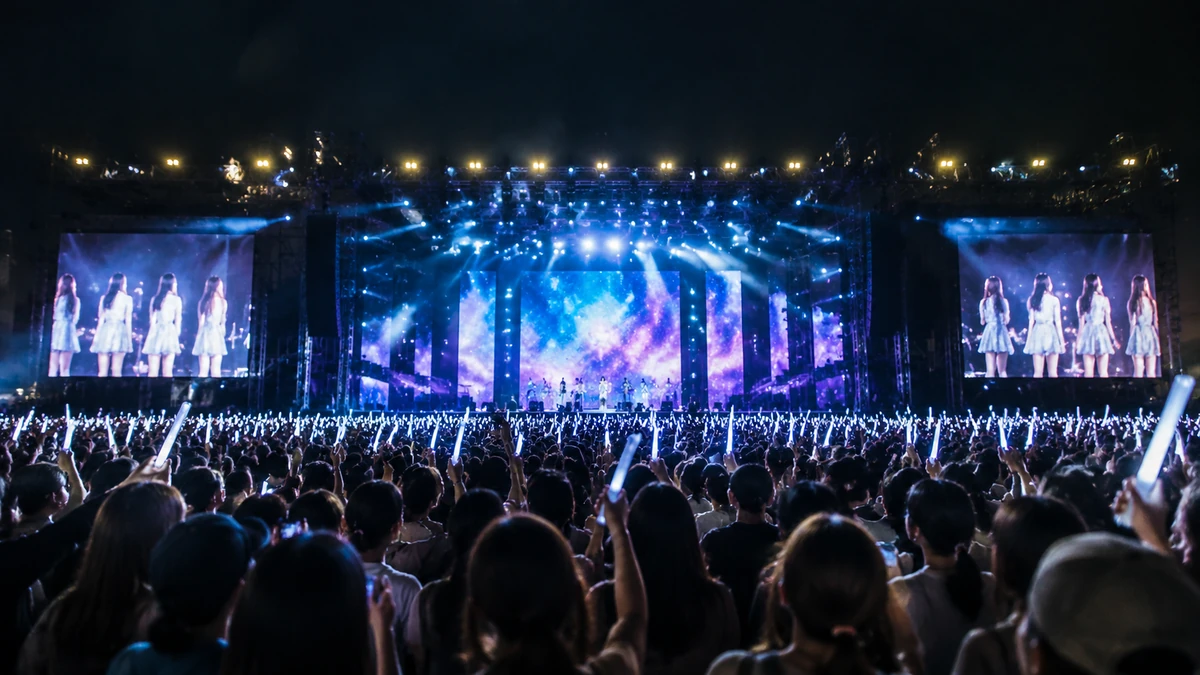
A K-pop group known for grit turns toward joy
For much of its career, LE SSERAFIM has sold something more durable than a catchy chorus. Since debuting in 2022, the five-member K-pop group has built its identity around resolve: being unafraid, pushing through setbacks, and emerging stronger on the other side. Songs like “FEARLESS” and “ANTIFRAGILE” did not simply function as pop singles. They doubled as statements of purpose, presenting the group as one defined by self-belief and forward motion rather than by sweetness, innocence or easy familiarity.
That is what makes the group’s latest return notable. With its second full-length album, PUREFLOW pt.1, and its title track “BOOMPALA,” LE SSERAFIM is not abandoning the identity that brought it here. Instead, it is broadening the way that identity is delivered. If the group’s earlier music often felt like a declaration, “BOOMPALA” is pitched more like an invitation — a song designed to feel like a shared celebration, the kind of high-energy chorus meant to land instantly in a stadium, at a festival or on social media clips moving at internet speed.
That distinction matters in K-pop, where groups often operate with unusually coherent long-term narratives. In the American pop industry, artists certainly cultivate images and eras, but K-pop acts frequently present each comeback as another chapter in an ongoing story, complete with visual concepts, recurring themes and carefully calibrated shifts in tone. LE SSERAFIM’s move toward a more openly festive sound is significant not because it erases the past, but because it suggests the group believes its core message is now strong enough to travel in a more accessible form.
Seen that way, “BOOMPALA” is less a pivot than an expansion. The bones are familiar: confidence, challenge, motion. What has changed is the wrapping. The sharper edges of self-assertion have been paired with a more immediate rhythmic payoff, a hook built to be felt before it is fully analyzed. For casual listeners who may have found the group’s earlier persona intense, that shift could serve as a new doorway. For longtime fans, it reads more like the next phase of a story that has already been under way.
Why LE SSERAFIM’s narrative has mattered
To understand why this release is drawing attention in South Korea, it helps to understand why LE SSERAFIM has occupied a distinctive lane in the first place. In a crowded girl-group field, many acts build mass appeal through bright concepts, approachable charm or polished variations on youthful confidence. LE SSERAFIM, by contrast, arrived with a more forceful posture. Even its name and early catalog signaled a group less interested in appearing agreeable than in projecting discipline and nerve.
That approach can be risky. Pop, especially idol pop, often rewards immediacy. The easiest path to a wide audience is usually not a heavy thematic framework but a mood that can be grasped in seconds. LE SSERAFIM’s early work asked for a bit more buy-in. The music and messaging were not obscure, but they were not built entirely around comfort either. There was steel in them.
Over time, however, that insistence became persuasive precisely because it aligned with the group’s real-world trajectory. K-pop fans follow more than songs; they track performances, interviews, livestreams, controversy, injuries, scheduling pressures and the broader emotional weather surrounding a group. In LE SSERAFIM’s case, the theme of resilience did not remain confined to lyrics and promotional copy. As the members navigated a demanding industry and the scrutiny that comes with top-tier visibility, their message began to feel less like branding and more like a narrative reinforced by experience.
That helps explain why a lighter, more celebratory title track does not automatically register as a dilution. In some cases, when a group known for a strong concept suddenly moves toward a more mainstream sound, fans worry that the edge has been sanded off for commercial reasons. Here, the change appears to be read differently: not as surrendering identity, but as translating it. The group is keeping the same emotional thesis and presenting it through a format that reaches more people more quickly.
For American readers, there is a rough analogy in the way certain artists move from proving themselves to owning the room. Think of the difference between a breakout album that insists on credibility and a later arena tour single that turns that credibility into communal release. The artist has not necessarily become less serious; they have become more fluent in commanding a crowd. That seems to be the territory LE SSERAFIM is now exploring.
From 'CRAZY' and 'SPAGHETTI' to a wider pop language
The shift did not appear overnight. Recent releases had already hinted that LE SSERAFIM was experimenting with a looser, more playful vocabulary. Songs such as “CRAZY,” with its repetitive, high-energy EDM structure, and “SPAGHETTI,” which reportedly leaned into cheekier phrasing and a more mischievous tone, suggested a group testing how far it could stretch without snapping the thread that ties its discography together.
That is an important distinction. In pop, experimentation often gets described as risk, but not all risks are equal. Some artists change genres entirely. Others keep their thematic center while updating the delivery system. LE SSERAFIM appears to be doing the latter. Rather than discarding its established emphasis on drive and self-possession, it has been learning how to package those ideas in ways that are faster, punchier and more immediately legible to a broad audience.
That process mirrors a broader trend in global pop, where the line between message and meme, performance and participation, has become thinner. A hook needs to work not only in headphones but in a 15-second clip, in a dance challenge, in a live festival setting and across audiences that may not speak the same language. K-pop, perhaps more than any other mainstream music ecosystem, has adapted to that reality with remarkable sophistication. It builds songs that are both highly structured products and highly shareable experiences.
“BOOMPALA,” by all indications, sits squarely in that sweet spot. The track’s stated ambition — to create something like a festival song that people around the world can enjoy together — is revealing. The members are not simply saying they wanted a brighter single. They are describing an environment: a song as a public square, a song as an event. In that sense, “festival” is not just an aesthetic adjective. It is a strategy.
That strategy also reflects growing confidence. Once a group has demonstrated it can sustain a concept and maintain fan loyalty, it has more room to emphasize pleasure without being mistaken for shallow. LE SSERAFIM’s recent steps suggest it understands that distinction. It is not trying to become generic. It is trying to make its energy easier to enter.
What 'festival' means in a K-pop context
American readers may hear the word “festival” and think immediately of Coachella, Lollapalooza or an all-day summer lineup where the point is collective release as much as individual artistry. In the context of LE SSERAFIM’s new music, the term carries some of that same sense of communal excitement, but it also does more. It signals a move away from intensity as a solitary posture and toward intensity as shared joy.
That distinction is culturally meaningful. K-pop groups are often built around synchronization — not just in dance, but in identity. Fans do not simply consume songs; they participate in a collective experience through chants, streaming events, fan signings, coordinated online campaigns and a dense ecosystem of content that blurs the line between audience and community. A “festival-like” song in that environment is one that lowers the barrier to entry. You do not need to know the entire backstory to feel your way into the chorus.
At the same time, “festival” does not necessarily mean carefree in the empty sense. In LE SSERAFIM’s framing, celebration seems to emerge as the reward for endurance. That may be the most interesting part of this comeback. The group is not swapping struggle for fun as if the two were opposites. It is suggesting that fun can be the culmination of struggle — that after proving you can withstand pressure, you earn the right to turn that pressure into release.
That gives the music a different emotional architecture than a simple summer anthem. Plenty of pop songs aim to be breezy and instantly likable. LE SSERAFIM appears to be aiming for something a little more layered: music that still feels grounded in challenge, but now expresses that challenge through movement, repetition and exhilaration rather than through blunt declaration. In practical terms, that means a heavier story delivered with lighter feet.
There is also a business logic to it. The more global K-pop becomes, the more valuable songs are that can cross linguistic and cultural barriers on first listen. Even for audiences who do not understand Korean, an explosive refrain, a recognizable rhythmic pattern and a visually bold performance can communicate enough to spark interest. The wordless elements of pop — beat, choreography, collective energy — become the bridge. In that sense, LE SSERAFIM’s use of “festival” is not just poetic. It reflects the mechanics of how global hits now travel.
Four years in, expansion may be the smartest move
Timing matters here. LE SSERAFIM is marking its fourth anniversary, a meaningful point in the life of any idol group. In K-pop, where the pace is intense and the market brutally competitive, four years is long enough for identity to harden — but also long enough for stagnation to become a risk. A group at this stage has to answer a difficult question: How do you evolve without losing the reason people cared in the first place?
LE SSERAFIM’s answer, at least with PUREFLOW pt.1, appears to be that evolution does not have to come through rupture. The group has spoken in interviews about liking challenges and seeking the kind of music that best fits the message it wants to express. That framing is telling. It suggests the members and their team are not chasing novelty for novelty’s sake. The sound follows the thesis, not the other way around.
That is a subtle but important marker of artistic confidence in the idol system, where outside producers, market trends and label strategies can heavily shape output. When a group says it is searching for the right form to express a consistent message, it is claiming continuity even amid change. Whether listeners fully buy that claim is another matter, but the underlying logic is clear: this is not a rebrand. It is a widening of the frame.
That framing is especially persuasive because LE SSERAFIM’s earlier chapters were so clearly defined. “FEARLESS” announced a refusal to flinch. “ANTIFRAGILE” sharpened that into a philosophy: not merely surviving adversity, but gaining strength from it. Once a group has established those coordinates, a festive track like “BOOMPALA” can be heard as a destination rather than a detour. It is where confidence goes once it no longer needs to prove it exists.
For an American audience, the closest parallel may be when an artist known for intensity reaches a point where the biggest flex is ease. Not passivity, but command without strain. When a performer no longer has to push the message so hard because the audience already recognizes it, the room opens up for pleasure, humor and scale. That appears to be the opportunity LE SSERAFIM is trying to seize.
The bigger K-pop lesson: story and mass appeal are not opposites
LE SSERAFIM’s comeback also says something useful about K-pop as an industry at a moment when it is often discussed in narrow terms. In the United States, K-pop coverage can still flatten the genre into either sheer spectacle or fan-driven commerce. Both are real, but neither fully captures why certain groups endure. The stronger acts are often those that can balance narrative coherence with broad accessibility — giving dedicated fans a deep archive to interpret while still offering newcomers an easy entry point.
That balancing act is what “BOOMPALA” seems designed to accomplish. It takes a group with a fairly sturdy internal mythology and translates that mythology into a format built for instant reaction. The song does not need every listener to know the entire back catalog on day one. It only needs them to feel the energy, recognize the confidence and perhaps become curious enough to trace the path backward.
This is where K-pop differs from many Western assumptions about pop authenticity. In American music culture, the word “manufactured” is often used as a criticism, implying that commercial precision undermines emotional truth. K-pop complicates that binary. It is unquestionably strategic, often intensely so, but strategy does not automatically cancel feeling. A song can be engineered for mass participation and still communicate a real and resonant emotional arc. In LE SSERAFIM’s case, the emotional arc is one of resilience turning into release.
The broader Korean entertainment business is also increasingly adept at building multiple avenues for that release to be experienced. On the same day as news of LE SSERAFIM’s comeback circulated in South Korea, another K-pop-related item highlighted Samsung Electronics’ collaboration with SM Entertainment on concert content for Samsung TV Plus. That may seem like a separate story, but it points to the same industrial reality: K-pop is no longer just about songs and albums. It is about performances, streaming channels, exclusive content drops and continuous fan engagement across platforms.
Within that environment, a song like “BOOMPALA” is not merely a track to be heard once. It is raw material for stages, shorts, fancams, fan edits, brand tie-ins and communal moments online and off. The more instantly a song can convert attention into participation, the more valuable it becomes. LE SSERAFIM’s “festival” language reads as an acknowledgment of exactly that.
What American listeners should watch for next
For English-speaking readers new to LE SSERAFIM, the easiest mistake would be to treat “BOOMPALA” as either a complete reinvention or just another energetic K-pop single. It appears to be neither. The more revealing way to read it is as a test of whether the group can scale its message outward without thinning it out. Can a team built on a tougher, more narrative-driven identity become more broadly inviting and still sound like itself? That is the question this comeback is trying to answer.
There are reasons to think the answer may be yes. LE SSERAFIM already has the advantage of a clearly defined point of view, something not every idol act sustains over multiple years. It also has the timing. Four years in, the group is established enough to take this kind of step without seeming unmoored, but still early enough in its career for the move to shape what comes next. If “BOOMPALA” connects the way its creators hope, it could mark the moment LE SSERAFIM stops being known primarily for intensity and starts being known for its ability to turn intensity into a communal experience.
That would be a meaningful development not just for the group, but for the way K-pop continues to evolve globally. As the genre reaches wider audiences, the acts most likely to endure may be those that can do more than provide polished hooks or viral choreography. They will need stories sturdy enough to support expansion, identities flexible enough to absorb change and songs that work both as artifacts and as events.
LE SSERAFIM’s new release suggests the group understands all of that. It is not leaving behind the traits that made it distinctive. It is seeing how far those traits can travel once they are set to a rhythm designed for everybody in the room. In pop, that can be one of the hardest transitions to pull off. Anyone can make noise. The challenge is making that noise feel like an opening. With “BOOMPALA,” LE SSERAFIM is betting that celebration can be its next form of persuasion.
Comments
Post a Comment