A Century-Old Ginkgo Tree Sparks Outrage in Seoul, Raising Questions About Who Owns Nature in the City
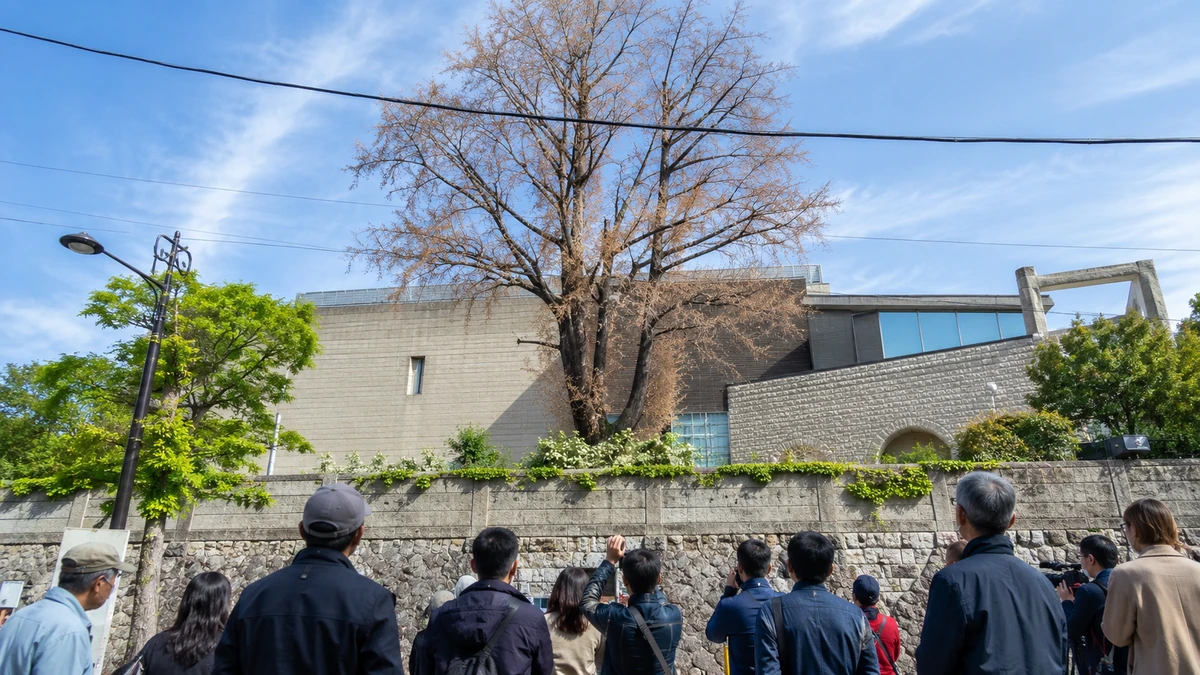
A dying tree becomes a public controversy in one of Seoul’s oldest neighborhoods
In a quiet hillside neighborhood of Seoul known for its art galleries, steep alleys and old residential homes, a single ginkgo tree has become the center of a heated public dispute about urban nature, civic responsibility and the limits of private authority in shared spaces.
Residents of Buam-dong, a historic neighborhood in central Seoul’s Jongno District, gathered outside the Whanki Museum on Monday alongside environmental activists to accuse unknown individuals of intentionally poisoning a century-old ginkgo tree standing outside the museum’s stone wall. According to local residents and the Seoul Environmental Federation, surveillance footage allegedly shows workers drilling into the trunk and injecting herbicide into the tree several weeks ago.
The allegations have not yet resulted in any official legal conclusion, and no public authority has confirmed criminal wrongdoing. But the incident has already resonated far beyond a neighborhood dispute because of what the tree represented to local residents: continuity, memory and public space inside one of Asia’s fastest-changing megacities.
For many Americans, the emotional response might resemble public reactions when old oak trees are removed from Southern towns, or when centuries-old redwoods face development pressure on the West Coast. The outrage is not only about the biological life of a tree. It is also about identity, belonging and the idea that certain natural landmarks become part of a community’s collective inheritance.
In Seoul, where redevelopment projects regularly reshape neighborhoods at astonishing speed, old trees often survive as rare physical reminders of what existed before the city became a global technological and cultural powerhouse. That context explains why this particular ginkgo tree — estimated by residents to be more than 100 years old — has triggered such an intense civic response.
The Whanki Museum itself occupies an important cultural position in South Korea. Named after pioneering Korean abstract painter Kim Whanki, the museum is known as a refined cultural institution in Buam-dong, a neighborhood long associated with artists, intellectuals and older residential architecture. The allegation that a tree standing outside a cultural institution may have been deliberately damaged has therefore amplified public attention and sharpened questions about moral responsibility.
The surveillance footage at the center of the accusations
According to residents and environmental groups, concern first emerged when local resident Hong Se-jin noticed large numbers of dried leaves falling from the tree unusually early. In a city where longtime residents become familiar with the seasonal rhythms of neighborhood trees, the sudden change immediately drew suspicion.
Residents then reportedly reviewed CCTV footage provided by a nearby resident. Activists say the footage shows two workers in green uniforms approaching the tree on April 22 around 9 a.m., drilling holes into the trunk and injecting an unidentified substance believed to be herbicide.
In South Korea, where extensive CCTV infrastructure exists in both public and private spaces, surveillance footage frequently becomes central to local disputes, from traffic accidents to environmental complaints. The detailed nature of the allegations — including the time, clothing and described method — has pushed this case beyond vague suspicion into a more concrete public confrontation.
Still, important distinctions remain. What has been publicly established so far is not that the tree was definitively poisoned, but that residents and environmental groups are alleging deliberate damage and presenting footage they believe supports that interpretation. The legal status of the footage, the identity of the individuals shown and the exact substance allegedly injected remain unresolved.
That distinction matters in South Korea’s media culture, where defamation laws are relatively strict and factual precision carries legal significance. As a result, news coverage has largely focused on describing the residents’ claims and the public reaction rather than making definitive accusations.
Yet even without legal conclusions, the images described by residents have already shaped public perception. The idea of drilling into an old tree and injecting chemicals carries a symbolic violence that many people immediately understand emotionally, regardless of whether they know the full legal details.
Environmental activists at the press conference demanded not only an apology but also acknowledgment that the alleged act constituted intentional destruction of a valuable urban tree. Their broader concern is that without stronger protection systems, similar incidents could occur elsewhere in Seoul without attracting public scrutiny until it is too late.
Why the phrase “outside the wall” matters so much in Korea
One of the most repeated phrases in Korean reporting about the case is that the tree stood “outside the museum wall.” To international readers, this may initially sound like a minor geographic detail. In reality, it sits at the heart of the conflict.
South Korean cities often contain complicated overlaps between private property and semi-public environmental space. A tree planted near a private facility may still function socially as part of the neighborhood landscape if it occupies visible, accessible space along public roads or pedestrian areas.
Residents argue that the ginkgo tree was not simply decorative landscaping attached to a building but part of the daily visual life of Buam-dong. Children passed it while walking to school. Elderly residents watched the leaves change color every autumn. Neighbors reportedly viewed it less as an isolated plant and more as a shared landmark.
That emotional framing helps explain why this issue escalated so quickly. In many global cities, residents increasingly worry that urban development treats nature as expendable unless it generates commercial value. Seoul, despite its reputation for high-tech infrastructure and modern urban planning, faces similar tensions.
Ginkgo trees hold particular symbolic significance in Korea. Their bright yellow leaves are strongly associated with autumn landscapes, university campuses and older city streets. Some are treated almost like neighborhood mascots, quietly anchoring rapidly changing urban environments.
Unlike newly planted decorative trees, old ginkgo trees often evoke a sense of historical continuity. Many survived wars, authoritarian redevelopment eras and dramatic economic transformation. To residents, losing such a tree can feel like losing part of a neighborhood’s accumulated memory.
The fact that the dispute centers on a museum deepens the symbolism. Cultural institutions are generally expected to coexist harmoniously with their surroundings and contribute positively to local civic identity. Whether or not the institution itself bears responsibility, the controversy has exposed tensions between institutional property management and community expectations about environmental stewardship.
That tension is familiar in American cities as well. Museums, universities and large cultural nonprofits often face criticism when development projects threaten longstanding neighborhood features, whether parks, historic buildings or mature trees. The Seoul dispute fits into that broader global conversation about how elite institutions interact with the communities around them.
From neighborhood complaint to environmental movement
One reason the case gained national attention is that it did not remain an isolated complaint among a handful of residents. The involvement of the Seoul Environmental Federation transformed the issue into a broader discussion about environmental governance and public accountability.
Environmental movements in South Korea have evolved significantly over the past several decades. During the country’s rapid industrialization in the late 20th century, activism often focused on factory pollution, river contamination and large-scale development projects. Today, environmental disputes increasingly revolve around urban quality-of-life issues: green space preservation, pedestrian environments, air quality and neighborhood ecology.
The Buam-dong tree controversy reflects this newer phase of urban environmental politics. Instead of protesting a massive industrial project, residents are defending a single tree as part of a wider argument about who has the authority to shape shared urban environments.
The role of local observation is also central. According to activists, the case began not with government monitoring but with residents noticing unusual changes in the tree’s condition. That detail has become symbolically important because it highlights how ordinary citizens often serve as the first line of environmental oversight.
In highly dense cities like Seoul, residents develop intimate awareness of their immediate surroundings. Small changes — a damaged tree, altered sidewalk, disappearing garden or unusual construction activity — become noticeable quickly because people live in such close physical proximity to one another.
Environmental groups argue that this kind of community vigilance is increasingly necessary in urban settings where official oversight may lag behind fast-moving development pressures. The activists’ message is that public environmental protection cannot depend solely on government agencies; it also requires engaged residents willing to document and challenge suspicious activity.
The alliance between residents and environmental organizations also demonstrates how local grievances can become national social issues in South Korea. A neighborhood complaint often gains broader traction once civic groups frame it as part of a structural problem involving public values, institutional accountability or legal gaps.
That transition appears to be happening here. What started as concern over a dying tree has evolved into a larger debate over whether South Korea adequately protects historically significant urban trees before damage occurs.
The push to designate the tree as protected heritage
At the center of the residents’ demands is a call to designate the ginkgo tree as a “protected tree,” a formal status in Korea that grants special management and preservation protections to historically or ecologically significant trees.
Such designations are not merely symbolic. Protected status can impose restrictions on removal, alteration or nearby construction activity while also increasing public oversight and maintenance responsibilities.
Residents argue that the current controversy demonstrates how vulnerable old urban trees remain without formal legal recognition. If the allegations prove accurate, they say, the damage may have occurred gradually and discreetly enough that the tree’s decline was not immediately obvious.
That concern resonates with arborists and urban ecologists worldwide. Tree poisoning cases in cities often involve delayed visible symptoms, making enforcement difficult unless someone directly witnesses suspicious behavior or records evidence.
The residents’ demand therefore extends beyond this specific tree. They are effectively arguing that cities need preventive systems rather than reactive outrage after environmental damage becomes visible.
South Korea already has examples of culturally significant trees treated almost like public monuments. Some ancient trees near temples, shrines or villages are associated with folklore, spiritual traditions or local identity. These trees often receive intense community protection and regular maintenance.
But urban trees occupying ambiguous spaces — especially those near private facilities yet visible to the public — may fall into regulatory gray zones. The Buam-dong case has exposed how unclear those boundaries can become.
For many residents, formal designation would acknowledge that certain natural features possess collective social value regardless of property lines. That idea reflects a broader philosophical shift taking place in many global cities: the recognition that urban nature is not merely decorative infrastructure but part of civic life itself.
In American terms, the debate resembles disputes over landmark status for historic buildings. Once a structure receives landmark protection, society effectively declares that private ownership alone cannot determine its fate because the asset carries broader public significance. Residents in Buam-dong appear to be making a similar argument about this tree.
What the controversy says about modern Seoul
Beyond the immediate allegations, the controversy reveals deeper anxieties about life in one of the world’s most densely developed capitals.
Seoul is a city where hypermodern skyscrapers coexist with narrow hillside neighborhoods, royal palaces and aging residential districts. Development pressure remains constant, and residents often feel that historically meaningful spaces can disappear almost overnight.
In that environment, old trees become emotionally loaded symbols. They represent stability inside a city defined by relentless transformation. Losing one can therefore trigger reactions disproportionate to what outsiders might expect from a dispute involving a single plant.
The case also highlights evolving public attitudes toward urban ecology in South Korea. Earlier generations often viewed modernization and environmental sacrifice as unavoidable trade-offs for economic growth. Younger residents increasingly reject that logic, emphasizing sustainability, livability and local environmental identity.
That shift parallels trends in many Western cities where residents demand more pedestrian-friendly design, tree canopy preservation and climate-conscious urban planning. Seoul’s debates are becoming less about whether modernization should occur and more about what kind of modernization people are willing to accept.
The Whanki Museum controversy also illustrates how environmental disputes now unfold publicly and rapidly in the digital era. Surveillance footage, neighborhood messaging apps and social media allow local concerns to escalate into national conversations within hours.
At the same time, the case demonstrates the caution built into Korean public discourse around unresolved allegations. Much of the discussion remains framed around claims, evidence presentation and civic demands rather than definitive judgments.
That restraint reflects both legal realities and broader cultural sensitivities surrounding public accusation. Yet it has not diminished the emotional force of the controversy.
For many South Koreans following the story, the central question is no longer merely whether someone damaged a tree. The deeper issue is whether cities still recognize certain elements of the urban environment as belonging morally — if not legally — to the community as a whole.
That question extends far beyond Seoul. As cities across the world densify and redevelop, conflicts over trees, parks and neighborhood landscapes are becoming increasingly common. The Buam-dong ginkgo controversy may be deeply local in detail, but its underlying tensions are global.
In the end, the fate of one aging ginkgo tree has become a test of how modern societies define public responsibility toward nature that exists inside human-built environments. Whether the tree survives may ultimately matter less than the broader civic debate it has already set in motion.
Comments
Post a Comment