Bridge Demolition Accident in Central Seoul Injures Workers, Halts Trains and Raises Broader Questions About Urban Safety
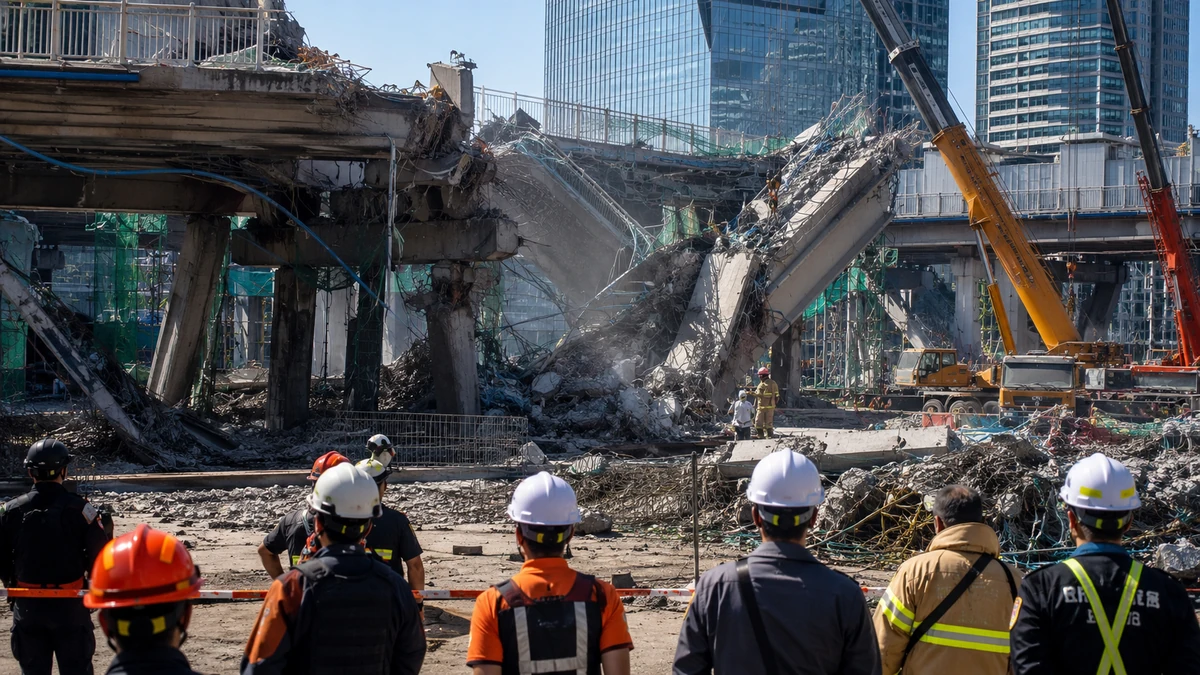
A demolition accident in the heart of Seoul
A structural collapse at a bridge demolition site in central Seoul on Sunday injured at least six people and disrupted rail service in one of South Korea’s busiest urban corridors, renewing scrutiny of how major cities manage aging infrastructure while trying to keep daily life moving.
According to South Korean authorities and local reports, the accident happened at about 2:32 p.m. at the Seosomun overpass demolition site in Seodaemun District, near downtown Seoul. Officials said part of the elevated structure being dismantled fell during the work. Rescue crews were still trying to reach two people trapped under the bridge, and emergency responders were working to stabilize the scene.
The collapse did not happen in an isolated industrial zone or on the far edge of a metropolitan area. It unfolded in the center of Seoul, a city of nearly 10 million people where roads, rail lines, office districts, shopping areas and dense residential neighborhoods operate in close quarters. In a city built around speed, volume and interconnection, a single construction accident can ripple far beyond the work site.
That appears to be what happened here. In addition to the injuries at the scene, rail service between Seoul Station and Sinchon Station was suspended, according to Korail, South Korea’s national railroad operator. The disruption immediately turned what might otherwise have been viewed as a work-site accident into a wider public event, affecting commuters, nearby businesses and confidence in the safety of a major public works project.
At this stage, key facts remain unsettled. Authorities have not publicly determined the cause of the collapse, and it is not yet clear what specific stage of the demolition was underway when the structure fell, what safety measures were in place at that moment, or whether mechanical failure, structural miscalculation, sequencing problems or another factor played a role. In fast-moving accidents like this, responsible reporting requires a clear line between what is known and what is still under investigation.
What is known is enough to make the incident significant: a large structure came down during a city-ordered demolition project, multiple workers were hurt, two people remained trapped during the initial response, and one of the capital’s transportation links was interrupted almost immediately.
Why this location matters to Seoul
For readers outside South Korea, it helps to understand just how central this area is to the daily rhythm of the city. Seoul Station is more than a train stop. It is one of the country’s most important transportation hubs, connecting regional rail, high-speed KTX service, subways, buses and airport links. If New York’s Penn Station, Washington’s Union Station and a major freeway interchange were folded tightly into one urban zone, the result would offer some sense of the pressure points involved.
Sinchon, meanwhile, is a busy district known for shopping, restaurants, schools and youth culture. It sits near several universities and sees heavy foot traffic throughout the day. The corridor between Seoul Station and Sinchon is not a remote rail segment with modest usage. It is part of a dense web of urban movement used by workers, students and visitors.
The Seosomun area itself sits near historic and administrative parts of Seoul. Like many sections of the city, it reflects decades of layered development: older road systems, elevated traffic structures built during earlier eras of rapid industrial growth, and newer efforts to redesign the urban landscape for safety, aesthetics and efficiency. South Korea transformed itself from war devastation into a modern industrial economy in a matter of generations, and that speed left many cities with infrastructure that is both heavily used and increasingly old.
That larger context matters. The demolition of aging overpasses and elevated roadways is often presented as a sign of urban renewal, much as U.S. cities have debated removing outdated expressways, replacing old bridges and reconnecting neighborhoods cut off by mid-20th-century road design. These projects can promise safer structures, better traffic flow and more appealing streetscapes. But the process of taking down large, load-bearing structures in a crowded city is itself dangerous, particularly when roads, rail lines and pedestrian routes are packed into the same narrow geography.
In Seoul, where infrastructure is intensely networked and available space is limited, there is little room for error. An accident at one point in the system can quickly produce consequences elsewhere, not because the city is uniquely fragile but because it is highly integrated.
Injuries, rescue efforts and the immediate emergency response
Officials said at least six people were injured in the collapse. Emergency crews also continued rescue efforts for two people pinned beneath the fallen structure. Seoul city officials were quoted as saying one side of the overpass had subsided, an indication that the site remained structurally unstable even after the initial collapse.
That detail is important. In incidents involving heavy concrete and steel, the first emergency is obvious: getting to the injured. The second emergency is less visible but just as urgent: preventing a secondary collapse that could kill trapped workers, rescuers or others nearby. Rescue work in such settings often requires a balance between speed and caution, especially when construction equipment, broken structural members and shifting loads can make the site unpredictable.
South Korean fire authorities issued an initial emergency response alert, signaling that the situation required a significant public rescue mobilization. While terminology can differ from U.S. emergency systems, the underlying meaning is familiar to American readers: a local accident had escalated into an incident serious enough to trigger a broader, coordinated response among fire, rescue and city agencies.
In South Korea, major public accidents often attract intense public attention not only because of the human toll but because they raise immediate questions about whether authorities reacted quickly enough, communicated clearly enough and coordinated effectively enough. That sensitivity has been shaped by past national traumas, including ferry and crowd disasters that left deep marks on public trust. As a result, the first hours of an emergency in South Korea are often judged not just on outcomes, but on the visible competence of official response.
So far, the available information points to an active rescue effort rather than a completed assessment. That means casualty numbers could change and early descriptions of the collapse could be refined. For now, the central human fact remains stark: workers were injured while dismantling a large public structure, and two people were still awaiting rescue during the initial phase of the emergency.
How a road project became a rail disruption
One of the most telling aspects of the accident was how quickly it spread from a construction zone into the city’s transportation system. Korail said train service between Seoul Station and Sinchon Station was suspended after the incident, and emergency teams were dispatched for temporary restoration work.
That kind of overlap may surprise readers more familiar with cities where highways, commuter rail and neighborhood streets are more physically separated. In Seoul, however, infrastructure often stacks and intersects in compressed ways. Elevated roads can run above or beside rail corridors. Construction staging areas can sit close to active transit lines. A problem in one mode of transportation can therefore become a problem for another almost instantly.
The interruption also illustrates the hidden dependence of big cities on uninterrupted circulation. Many residents will never see a demolition plan, structural diagram or municipal work order. What they do notice is whether they can get to work, school or home on time. In that sense, the public experience of infrastructure is usually indirect — until something goes wrong. Then the system becomes visible all at once.
American readers have seen versions of this dynamic before. A bridge failure can snarl freight routes across a region. A tunnel closure can paralyze commuting patterns. A derailment, sinkhole or construction accident can create cascading delays across multiple transit lines. The lesson is not uniquely Korean. Dense cities depend on redundancy, coordination and disciplined risk control. When those fail, the effects spread fast.
In Seoul, where public transit use is high and train reliability is woven into everyday expectations, even a temporary shutdown on a central segment can be deeply disruptive. It also amplifies public anxiety. Once an accident spills from a construction site into ordinary travel routines, it ceases to feel like a contained occupational hazard and starts to feel like a citywide safety question.
What is known, and what remains unclear
At this point, the factual boundaries are crucial. Based on the information available, several points appear established: the accident occurred at 2:32 p.m. on May 26, 2026, at the Seosomun overpass demolition site in Seoul’s Seodaemun District; part of the structure fell during demolition; at least six people were injured; two people were trapped and being rescued; the project had been commissioned by the Seoul city government; and train service between Seoul Station and Sinchon Station was suspended.
What remains unclear is just as important. Authorities have not publicly identified the cause of the collapse. It is not yet known whether there was a failure in load calculation, support sequencing, crane or cutting operations, communication among crews, oversight procedures or some combination of factors. It is also not yet publicly established whether warning signs appeared beforehand, whether work conditions had changed, or whether nearby transit operations had been adjusted appropriately for the phase of demolition underway.
This distinction matters because major accidents often generate immediate speculation. In any country, and especially in the age of social media, the pressure to assign blame can outrun the facts. But in structural failures, the difference between proximate cause and systemic cause can be substantial. A piece of concrete may fall because of a technical misstep in the moment. It may also fall because of deeper issues involving contracting, scheduling pressure, fragmented oversight or a safety culture that treats final-stage demolition as routine when it remains highly dangerous.
None of those conclusions can responsibly be drawn yet. Still, the unanswered questions already point to the larger issues likely to dominate subsequent investigation: how demolition risk was assessed, how the work zone was coordinated with nearby rail operations, what contingency planning existed and whether the final stretch of the project received the same level of caution as earlier, more visibly hazardous phases.
The fact that the project was reportedly nearing its planned completion in early June also adds an uncomfortable dimension familiar to construction and infrastructure experts worldwide. The end of a project is not necessarily the safest stage. In some cases, dismantling can become more delicate as structural balance changes and fewer original supports remain in place. A project being almost finished does not mean the danger is almost gone.
A warning about aging infrastructure in high-density cities
Even before investigators determine exactly what happened, the collapse is already being read in South Korea as a warning about the risks attached to dismantling and replacing old urban infrastructure. That reading is not unreasonable. Many major cities are entering an era in which structures built during postwar expansion and late-20th-century growth are reaching the end of their useful life. Bridges, overpasses, tunnels and elevated roadways do not simply age quietly; they must eventually be repaired, reinforced or removed.
The public policy challenge is that maintenance and renewal are inherently double-edged. Cities cannot postpone infrastructure work indefinitely without increasing long-term danger. Yet the act of repairing or removing large structures can itself create acute short-term risk. In other words, doing nothing is unsafe, but doing the work also carries danger if not managed with extraordinary care.
Seoul’s situation may feel especially intense because of the city’s density and pace, but the underlying issue is global. In the United States, debates over aging bridges, highway decks, transit tunnels and water systems have become routine after years of deferred maintenance. Americans have watched disasters or near-disasters force overdue attention onto infrastructure that most people notice only when it breaks. Seoul’s accident fits into that broader modern problem: the systems that make urban life possible are old, interconnected and difficult to renew without disruption.
There is also a deeper lesson in the accident’s spillover from road demolition to rail shutdown. Infrastructure is often discussed in categories — roads, bridges, trains, utilities — as if each were a separate box. In real cities, they function as one ecosystem. When officials plan a project in one part of that ecosystem, they are also managing consequences for the rest. The Seosomun collapse appears to have exposed that interdependence in the most direct way possible.
That does not mean Seoul is uniquely negligent or uniquely vulnerable. It means the city, like many others, is confronting the central infrastructure challenge of the 21st century: how to modernize aging systems without introducing unacceptable new risk in the process.
Public trust, worker safety and the politics of infrastructure
Beyond engineering and transportation, the accident touches a more political question: public trust. Large public works projects are usually justified in terms of long-term benefit — safer roads, smoother traffic, improved urban design, reduced maintenance costs. Those arguments can be persuasive on paper. But for ordinary residents, trust is built less by planning language than by visible safety in the here and now.
When a major structure falls in a familiar part of the city, the public’s first reaction is rarely to revisit the project’s strategic goals. It is to ask whether the work was being carried out safely, whether corners were cut, whether agencies were communicating and whether workers were adequately protected. Those questions are not anti-development or anti-renewal. They are the baseline demands citizens place on any government that undertakes disruptive work in shared public space.
Worker safety is likely to remain at the center of that discussion. Demolition workers perform some of the most hazardous labor in urban development, often in conditions where sequencing, timing and technical accuracy matter immensely. When things go wrong, the workers closest to the structure bear the first and greatest risk. The fact that the injured appear to include people at the site, and that two people were reportedly pinned beneath the bridge, underscores the human cost that can lie behind abstract phrases like redevelopment and infrastructure improvement.
In South Korea, as in the United States, labor safety in construction has been the subject of recurring debate. Advocates have pushed for stricter enforcement, clearer accountability for contractors and stronger consequences when preventable hazards lead to injury or death. Depending on what investigators find, the Seosomun collapse could become part of that larger argument.
It could also influence how city governments communicate future projects to the public. Officials often emphasize completion dates and expected benefits. After an accident like this, there may be greater demand for transparency about demolition methods, safety protocols, emergency coordination and how nearby transportation systems are protected when heavy work unfolds next to active rail corridors.
The broader significance of one afternoon in Seoul
For now, the most urgent concern remains the rescue effort and the condition of those injured. But the broader significance of the accident is already coming into focus. In a matter of moments, one demolition failure revealed several layers of vulnerability at once: the danger inherent in removing aging structures, the exposure of workers on the front lines of public projects, and the fragility of tightly linked transportation systems in a megacity.
That combination is why this story resonates beyond South Korea. It speaks to a dilemma familiar in cities around the world, including in the United States: how to rebuild essential infrastructure without losing public confidence in the process. The answer is not to stop renewing old systems. It is to recognize that infrastructure work is not only a technical exercise. It is a public trust exercise.
Seoul is one of the world’s most advanced and efficient urban capitals, but efficiency can create its own illusion of permanence. Systems that run smoothly every day can seem almost automatic until a sudden failure reveals how much careful coordination they require. Sunday’s collapse appears to have done exactly that.
Investigators will eventually determine what caused part of the Seosomun overpass to fall. They may identify specific operational failures, design assumptions, oversight gaps or other contributing factors. Those findings will matter. But even before they arrive, the accident has already delivered a harder truth that big cities from Seoul to Chicago to Los Angeles would recognize: when infrastructure is old, dense and deeply interconnected, safety cannot be treated as a box to check at the edge of a project schedule. It has to remain the central discipline from the first day of work to the last cut of steel.
Until more is known, restraint is warranted. But concern is warranted, too. A bridge demolition in central Seoul has become a reminder that in modern cities, public construction is never just about concrete and traffic. It is about whether the systems people rely on every day are being remade with the care their lives require.
Comments
Post a Comment