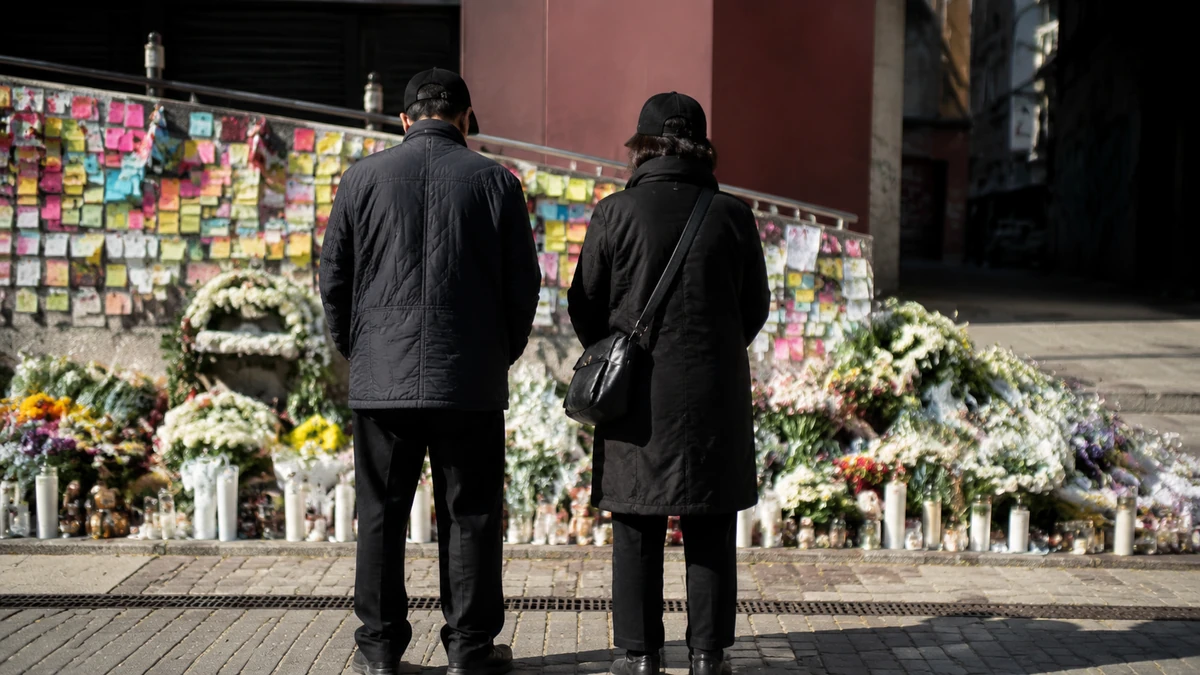
A quiet donation carries a public weight
More than three years after the crowd crush in Seoul’s Itaewon nightlife district killed 159 people and shocked South Korea, a small act of private giving has reopened a larger public conversation about grief, trauma and who is counted among the victims of a disaster.
On May 20, the bereaved families’ organization representing victims of the Oct. 29, 2022, Itaewon disaster said it had received a donation earlier this month from the father of a local merchant who took part in rescue efforts that night and later died after suffering severe psychological trauma. The amount of the donation was not disclosed. Neither were many personal details about the family. But the symbolism of the gesture was unmistakable.
The donor was not the parent of someone killed in the initial crush itself, at least not in the direct sense most people understand when they hear the phrase “disaster victim.” His son was an Itaewon-area businessman, someone whose life and livelihood were rooted in the neighborhood where the tragedy unfolded. On that night, he joined efforts to pull people from the crowd and help the injured. In the months and years that followed, according to the families’ association, he struggled with trauma and eventually died.
His father’s decision to send money to the group formed by families of those killed in the crush is easy to read as a simple act of gratitude. It is also much more than that. It suggests that the human toll of the Itaewon disaster did not end when the streets were cleared, the memorial altars were packed away or the television cameras turned elsewhere. The pain of that night continued to move outward, into homes, businesses and bodies that remained standing after the world’s attention moved on.
For American readers, the pattern may feel familiar. In the United States, public memory of disasters often centers first on the dead, the visibly wounded and the immediate failures of police, fire departments or government agencies. Over time, however, another layer emerges: survivors who live with post-traumatic stress, bystanders who replay what they saw, neighbors whose ordinary routines become inseparable from horror, and first responders or volunteers who discover that doing the right thing in a crisis can leave lifelong scars. The story now surfacing from Itaewon belongs to that second layer — the one that tends to arrive quietly, long after headlines fade.
If the initial disaster was a sudden rupture, the donation from this father is a reminder that its aftermath is not past tense. It is ongoing, intimate and unresolved.
What Itaewon means in South Korea — and why that matters
To understand why this gesture has resonated in South Korea, it helps to understand what Itaewon is. The neighborhood, in central Seoul’s Yongsan district, has long occupied a distinctive place in the country’s cultural map. Near a former major U.S. military base, Itaewon developed over decades into one of the capital’s most international areas — a place known for nightlife, global food, music, tourism and a level of social mixing unusual in a country that has often prized conformity and social order.
For many younger South Koreans, Itaewon represented freedom and cosmopolitan energy. For foreign residents and visitors, it was one of the most recognizable neighborhoods in the country, something like a compressed mix of nightlife district, restaurant corridor and crossroads of cultures. On Halloween weekend in 2022, its narrow alleyways were packed with revelers. That density, combined with poor crowd control and a lack of effective emergency response, turned celebration into catastrophe.
The Itaewon disaster quickly became one of the most searing public traumas in recent South Korean history. Comparisons inside Korea were often drawn to the 2014 Sewol ferry sinking, another calamity that forced national soul-searching over state accountability, public safety and the treatment of victims’ families. In both cases, the anger was not only over lives lost but over a sense that the losses were preventable and that institutions failed in the moment that mattered most.
But Itaewon was also different in important ways. This was not a remote maritime accident or an industrial disaster at a work site. It happened in one of the country’s busiest urban leisure spaces, amid crowds of ordinary young people out for a holiday weekend. It unfolded in public, in a place built around movement, nightlife and commerce. That meant the blast radius of the trauma extended beyond the dead and their relatives to bartenders, servers, shopkeepers, club employees, taxi drivers, residents and passersby — people whose connection to the tragedy was bound up with the neighborhood itself.
The merchant whose father has now donated money embodied that layered reality. He was not only someone who witnessed the scene. He was a local business operator, a member of the community whose daily life was tied to Itaewon before, during and after the disaster. In him, several identities overlapped at once: neighbor, worker, rescuer and ultimately someone harmed by the event in ways that were not immediately visible.
That matters because disaster narratives, in Korea as in the United States, often sort people into neat categories: victim, witness, responder, family member, official. Real life is messier. In a neighborhood tragedy, a single person can occupy several roles at once. The merchant’s story forces that complexity into the open.
The victims we do not always know how to count
One of the most difficult questions after any large-scale tragedy is who belongs inside the circle of concern. The answer can shape everything from media coverage and compensation to mental health support and public remembrance.
In the immediate aftermath of a disaster, governments and news organizations understandably focus on the dead, the missing and the physically injured. Those are the most urgent facts, and they are often the easiest to verify. But trauma does not always leave visible evidence. It can settle into people who were not crushed, burned, shot or hospitalized. It can take hold in volunteers who moved bodies, in store owners who heard screams from a block away, in parents who waited for a phone call that never came, and in workers who returned the next day to the same street and found that nothing about it felt ordinary anymore.
The merchant at the center of this story appears to have been one of those people. According to the bereaved families’ group, he participated in rescue activities during the Itaewon crush and later suffered trauma that persisted until his death. That brief description contains a larger indictment of how societies talk about post-disaster suffering. Rescue work is typically cast in heroic terms, and often rightly so. But heroism can obscure vulnerability. People who step in during emergencies are frequently praised for courage while receiving little sustained attention for the psychological burden that courage may carry.
Americans have seen versions of this pattern after Sept. 11, mass shootings, hurricanes, wildfires and school tragedies. In New York after the collapse of the World Trade Center, years of reporting and advocacy were required before the country fully confronted the long-term health consequences borne by first responders, cleanup workers and lower Manhattan residents. After mass casualty events, communities routinely rally around the dead and wounded, yet support for survivors’ mental health often proves uneven, temporary or bureaucratically difficult to access. The emotional aftershock unfolds on a timeline that rarely fits public attention spans.
South Korea is confronting a similar issue here. The merchant’s death, as described by the families’ association, raises uncomfortable but necessary questions: What systems existed to identify people like him after the crush? What mental health care was available to local residents and business owners who witnessed or participated in rescue efforts? How long did that support last? And who, exactly, was responsible for ensuring that psychological harm did not become another quiet casualty of the disaster?
These questions are larger than any single case. They point to a recurring blind spot in disaster response. Societies tend to be more prepared to count bodies than to measure enduring anguish. Yet if the point of public safety is not only to prevent death but to protect the conditions for human life afterward, then mental trauma cannot be treated as an afterthought.
Why a donation to bereaved families matters so much
The most striking detail in this story may be the direction of the gift. The father of a man who suffered after participating in rescue efforts did not donate to a hospital, a church or a general charity. He donated to the association of bereaved families from the Itaewon disaster. That choice suggests an understanding of loss that is communal rather than competitive.
Disasters can produce a hierarchy of grief, whether anyone intends it or not. Families of the dead may be seen as the “real” victims. Others who were affected can feel pushed to the margins, uncertain whether their pain counts or whether speaking about it will seem like an intrusion on someone else’s tragedy. In that context, the father’s donation reads as a refusal to divide suffering into separate camps. His family’s loss and the families’ losses are not being set against one another. They are being recognized as connected.
That act carries particular meaning in South Korea, where family associations formed after major tragedies have often played a central civic role. These groups are not simply support networks. They are also advocates, public witnesses and, at times, moral pressure points on the state. They seek investigations, memorialization, policy changes and accountability. But they also do quieter work that is harder to quantify: they create a place where the bereaved, the traumatized and the socially isolated can feel seen.
The father reportedly made the donation out of gratitude toward the association. The public does not know all the reasons behind that gratitude, and it would be wrong to speculate beyond the facts. Still, the meaning is powerful even in outline. Somewhere in the years after his son’s rescue efforts and eventual death, the families’ group appears to have become, for him, an object of appreciation rather than abstraction — not merely an advocacy organization on television but a community that helped carry memory, pain or recognition.
In a media culture that often reduces civic groups to their political demands, that is a crucial distinction. The bereaved families’ association is clearly involved in public claims about truth and prevention, as groups like this often are. But this donation underscores another function: It serves as a social meeting point where different forms of aftermath can acknowledge one another.
There is something profoundly American readers may recognize in that, too. After disasters in the United States, family-led organizations frequently become the custodians of public memory. They push for memorials, legislation, reforms and records. They also become the people others turn to when institutions feel cold or insufficient. The father’s gift fits that pattern. It says, in effect: You helped hold something the rest of society might have dropped.
A neighborhood can be wounded, too
When a disaster strikes a particular place, the damage is never only personal. It is spatial. Streets, stairways, storefronts and intersections acquire emotional charge. Places that once represented routine or pleasure become inseparable from mourning.
That is especially true in Itaewon. Before the crowd crush, the district was associated with nightlife, multicultural openness and a kind of urban spontaneity. Afterward, its name became shorthand for one of South Korea’s most painful recent traumas. Businesses faced not only economic disruption but the burden of operating in a landscape marked by death and public scrutiny. Residents and workers had to navigate a daily environment in which remembrance and normalcy collided.
The merchant whose father has now donated money lived within that double exposure. He was a businessman in the neighborhood and also a participant in rescue efforts. He was connected to Itaewon as both a workplace and a site of trauma. That overlap is important because recovery policy often separates economic restoration from emotional healing, as though a community can reopen first and process later. In reality, the two are intertwined.
Anyone who has spent time in an American community after a school shooting, a devastating storm or a high-profile act of violence knows the feeling. Restaurants reopen. Traffic resumes. People go back to work. But the location itself feels altered. A parking lot, a concert venue, a church, a bridge — ordinary geography takes on the force of memory. Recovery becomes less about returning to “before” than about learning how to live in a place that now contains both everyday life and permanent absence.
Itaewon has had to carry that burden in a country where dense urban neighborhoods are central to social life and local commerce. Merchants and residents are not just adjacent to public tragedy; they are custodians of the spaces where it happened. That can make them invisible in policy terms. They are neither outside observers nor official responders. Yet they absorb the consequences in deeply personal ways.
The father’s donation throws that reality into relief. It shows that what happened in Itaewon was not confined to a single night of horror. The neighborhood continued to produce casualties of a different kind — people who kept living there, working there and remembering there.
The limits of accountability without care
In South Korea, as in many democracies, public discussion after a major disaster often centers on responsibility: Who failed? What rules were missing? Which officials ignored warnings? Those questions are necessary. They are the backbone of prevention. Without them, grief risks becoming ritual rather than reform.
But accountability debates can also crowd out another question that is less politically dramatic and no less urgent: What happens to the people who survive in damaged ways?
The merchant’s case, as presented by the families’ group, brings that question into focus. If he died after suffering trauma tied to his rescue efforts, then his story points to a gap not only in emergency prevention but in post-emergency care. Disasters do not end when investigators issue reports or legislators hold hearings. They continue inside families, especially when mental injury is persistent, undertreated or poorly understood.
That is true even in wealthy, highly developed societies. The United States has spent decades grappling with the stigma around mental health among veterans, police officers, firefighters and emergency medical personnel. Civilian volunteers and community members often receive even less structured support. In many cases, people are expected to “move on” because they were not among the officially counted dead or wounded. That expectation can itself become a form of abandonment.
South Korea has made broad advances in public health and social services, but like many countries it continues to wrestle with how openly psychological suffering is discussed and how consistently mental health systems reach those in need. The details of this individual case remain limited in the public record. Even so, the broader implication is difficult to ignore: trauma can be fatal in ways that are delayed, indirect and socially hard to classify.
This is why the father’s gift should not be reduced to a feel-good anecdote. It is moving, yes. But it is also a warning. A society can acknowledge a disaster, investigate it and memorialize it while still failing people who carry its aftereffects in silence. The emotional resonance of the donation lies partly in the question it leaves behind: If families and civic groups are still doing the work of recognition years later, where were the institutions that should have done more sooner?
What this moment says about memory, solidarity and the work that remains
There is a temptation, especially in news cycles driven by novelty, to treat acts like this as minor updates from an old story. That would miss the point. The donation is news not because of its monetary value, which was not disclosed, but because it reveals how the meaning of Itaewon is still evolving.
In one sense, the father’s action is deeply personal — an expression of gratitude from one grieving family to another community shaped by the same disaster. In another sense, it is public testimony. It tells South Korea, and anyone watching from abroad, that the social life of a catastrophe extends far beyond the event itself. The crush killed 159 people on one night. But the disaster’s legacy has continued to affect parents, neighbors, merchants, rescuers and bereaved families in ways that statistics alone cannot capture.
That should resonate well beyond Korea. Whether in Seoul, New York, New Orleans, Uvalde or Lahaina, communities facing mass tragedy confront the same fundamental challenge: how to maintain care after the cameras leave. Memorials matter. Investigations matter. Reforms matter. But so does the less visible work of sustaining attention to those whose injuries are psychological, delayed or socially ambiguous.
The father’s donation also offers a model of solidarity that feels especially important in an era when public grief is often politicized or fragmented. He did not use his family’s suffering to claim a separate status. He reached toward others whose lives were shattered by the same event. That does not erase the differences in what they experienced. It acknowledges that disaster creates overlapping circles of loss and that healing, however incomplete, may depend on recognizing those connections.
For Americans reading this from across the Pacific, the story is a reminder that the Korean Wave so often exported through music, television and film exists alongside another Korea: one wrestling, as every country does, with institutional failure, civic mourning and the uneven burden of recovery. Itaewon is not just an international district in Seoul or a place associated with Halloween tragedy. It is now also a case study in how a modern society remembers, argues and struggles to care for people long after an emergency is over.
The father’s gift will not resolve those struggles. It does something quieter, and perhaps more enduring. It insists that the people left standing after a disaster are still part of the story. It asks the public not to confuse survival with recovery. And it reminds us that, sometimes, the most revealing measure of a catastrophe is not only who died that day, but who continues to live — and grieve — in its shadow.
Comments
Post a Comment