A Korean AI Short Film Is Winning Awards Abroad, Signaling a New Phase in Global Screen Storytelling
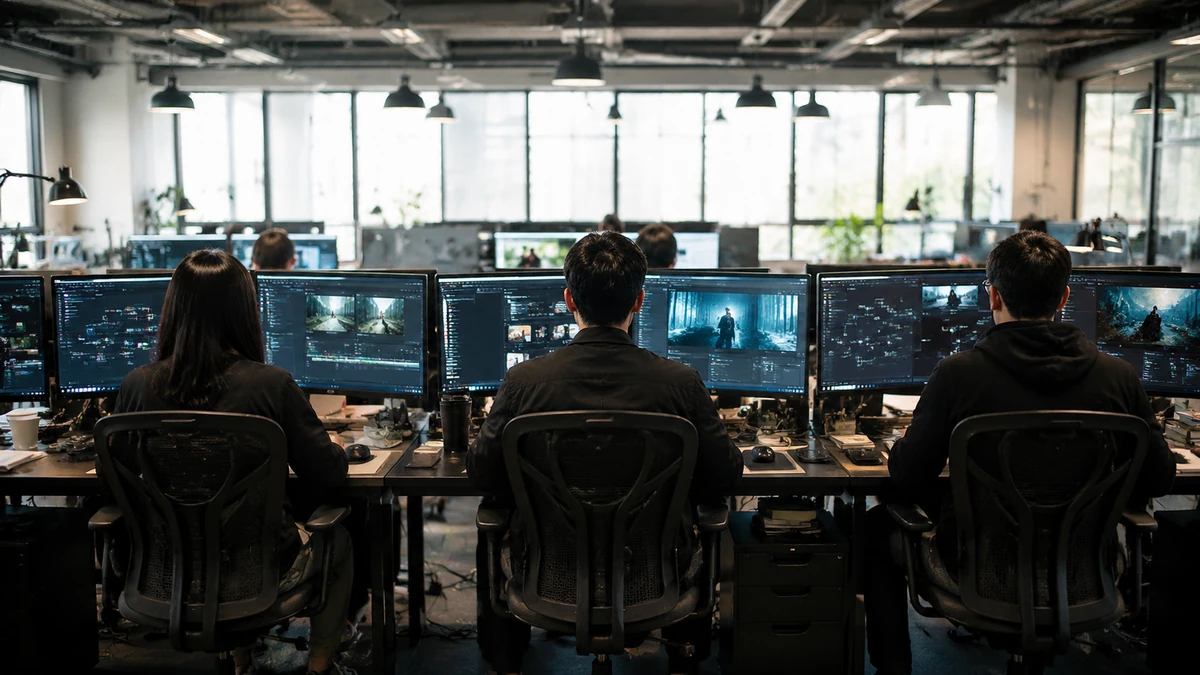
A South Korean short film made entirely with generative AI is starting to draw international attention
A short science-fiction thriller from South Korea is beginning to make waves on the global festival circuit, and not just because of its story. The film, titled Messenger, was created entirely with generative artificial intelligence over roughly two months, according to South Korean reports, and has now won best AI film honors at five international festivals. That string of awards may sound niche at first glance, but it points to something bigger: AI-generated filmmaking is moving beyond tech demos and advertising experiments and entering a more public, competitive cultural space.
For American audiences, the easiest comparison may be the way streaming once moved from being viewed as a side lane to becoming central to Hollywood. AI filmmaking is nowhere near that level of industry transformation yet, and the technology remains controversial. But Messenger suggests the conversation is shifting. Instead of asking only whether AI can make images or imitate voices, industry observers are increasingly asking whether it can support a complete narrative work that viewers and judges will take seriously as cinema.
That shift matters in South Korea, where entertainment industries have become a major export engine and a key part of the country’s global identity. Over the past two decades, the Korean Wave — often referred to by the Korean term Hallyu — has expanded from TV dramas and K-pop into film, gaming, beauty, fashion and digital culture. Korean creators and companies have built a reputation for moving quickly when technology and storytelling intersect. The rise of Messenger fits squarely into that pattern.
The film was made by Park Dong-hwa, an AI director affiliated with HSAD’s AI Directors Team. HSAD is best known in South Korea as a major advertising company, which makes this case even more notable. The project did not emerge from a traditional movie studio or a public film school. It came from a corporate creative environment that has expertise in visual storytelling, branding and rapid production cycles — areas that increasingly overlap with AI-based content creation.
According to South Korean coverage citing Yonhap News Agency, the eight-minute, five-second film has won top AI film awards from the New York Film Awards 2026, the World Film Festival in Cannes, the Los Angeles Film Awards, the Filmmakers Connect Awards and Kaicon 2026. It has also been invited as an official selection to the AI Film Awards in Cannes 2026, suggesting that dedicated exhibition platforms for AI cinema are becoming more established.
A time-travel warning story gives the technology a familiar human stakes test
At the center of Messenger is a setup that would be recognizable to fans of mainstream American science fiction: a scientist receives a message from the future and learns that a technology he developed will lead to catastrophe. The protagonist, Ethan Reed, is told by way of a message sent from the year 2030 that tragedy is tied to an AI-based small modular reactor he created. He is then forced into a moral and intellectual dilemma — whether, and how, to change the course of events.
That premise places the film in a tradition American viewers would likely associate with movies such as 12 Monkeys, Minority Report or even elements of Interstellar: stories in which the future intrudes on the present, and technology becomes both salvation and threat. In other words, Messenger is not using AI merely to show off surreal visuals or to prove a technical point. It is using a recognizable science-fiction framework to ask enduring questions about responsibility, foresight and unintended consequences.
The small modular reactor element also gives the story an extra layer of contemporary relevance. In the United States and elsewhere, small modular reactors, often discussed as SMRs, have been promoted by some policymakers and industry leaders as a possible part of future clean-energy strategies. At the same time, nuclear technology continues to trigger anxiety because of safety risks, waste concerns and the long shadow of disasters from Chernobyl to Fukushima. That makes the film’s central anxiety easy for global audiences to grasp, even if they know little about the specifics of South Korea’s energy debates.
The short runtime may be part of the project’s effectiveness. At just over eight minutes, Messenger does not need to build a sprawling world or explain every technical detail. Instead, it can focus on a single pressure point: what happens when a person learns too late that innovation and catastrophe may be intertwined. That compression suits both the thriller genre and AI-assisted production. A tightly framed premise is often more compatible with fast-turnaround visual experimentation than a feature-length story requiring dozens of deeply developed characters and environments.
There is also a fitting symmetry in the film’s concept. A movie about the dangers and ambiguities of advanced technology is itself made through advanced technology. In that sense, the form and the subject mirror each other. The audience is invited to think not only about the fictional machine at the center of the plot, but also about the real-world tools used to bring that plot to life.
What makes this case unusual is the claim that the entire production pipeline relied on generative AI
The most striking part of the story is not simply that AI was used, but how extensively it was reportedly used. South Korean reports say Messenger was completed through a 100% generative AI production process spanning planning, shooting and editing over about two months. In practical terms, that means AI was not limited to polishing visual effects, generating a few background images or assisting with postproduction. It was treated as the core production engine.
That distinction is important because AI in film is often discussed in vague or inflated terms. Many productions already rely on software-assisted tools, from de-aging effects to automated cleanup to script-analysis programs. But those tools typically supplement a conventional production model with actors, cameras, sets, editors and crews. The claim around Messenger is much more expansive: that the creative process itself was structured around generative systems from start to finish.
For American readers, a useful analogy might be the difference between using Photoshop to retouch a movie poster and using AI to generate the poster, create the trailer, storyboard the scenes and simulate the final cinematography. One is enhancement. The other is a redefinition of workflow.
That does not mean human creativity disappears. If anything, the opposite may be true. A fully generative process still depends on a creator making choices about pacing, framing, emotional tone, world-building and narrative structure. The tools may be new, but artistic judgment remains central. What changes is where that judgment is exercised. Instead of directing performers and camera crews on a physical set, the filmmaker may be directing prompts, iterations, visual references and compositional parameters inside software systems.
This is one reason the film’s festival run matters beyond the novelty factor. In public debates about AI art, skeptics often argue that machine-made content is shallow, derivative or incapable of sustaining dramatic tension. Supporters respond that the technology is simply another medium, like animation or CGI once were. Messenger does not settle that argument. But it does provide a concrete example that can be evaluated on more than theory. It exists as a finished work, it has a defined runtime, a plot, a production timeline and now an awards record.
Behind the scenes, “cinematic prompt engineering” is becoming a creative skill of its own
One of the more revealing ideas to emerge from the South Korean reporting is the use of what has been described as “cinematic prompt engineering.” That phrase may sound technical, but the underlying concept is fairly intuitive. Rather than asking an AI system in broad terms to create a futuristic scene, a filmmaker can feed it instructions that resemble the language of a real production set: camera model, lens behavior, lighting design, mood, texture, composition and movement.
In other words, the prompt becomes something like a hybrid of a screenplay note, a cinematographer’s shot list and a production designer’s mood board. The filmmaker is no longer just requesting an image. The filmmaker is specifying how that image should feel, what visual grammar it should follow and how it should communicate emotion or suspense.
This matters because much of the criticism of AI-generated imagery has focused on its generic quality. Early AI visuals often looked glossy but hollow, technically impressive but artistically thin. What projects like Messenger suggest is that the next stage of AI filmmaking may be less about the raw power of the model and more about the sophistication of the human directing it. Put simply, better language in produces better cinematic language out.
That is an important distinction in South Korea’s content industries, which have long emphasized polish, discipline and format-specific expertise. Korean entertainment companies are known for training systems, tightly managed production pipelines and a willingness to invest in process as much as talent. In K-pop, that has meant elaborate performance development. In television, it has meant highly efficient drama production. In advertising, it has meant meticulous brand storytelling. AI filmmaking may now be absorbing some of that same production culture.
It also complicates the common fear that AI automatically erases the role of the artist. The labor may be changing, and many legitimate ethical and economic concerns remain, especially around training data, job displacement and authorship. But a film like Messenger points toward a model in which new expertise emerges rather than vanishes. The creative bottleneck shifts from physical production logistics to conceptual precision: how clearly a director can imagine a scene, describe it, refine it and integrate it into a larger narrative whole.
That shift could eventually influence film education, advertising production and even newsroom multimedia work. Just as digital editing transformed what editors needed to know in the 1990s and 2000s, AI prompting and orchestration may become part of the baseline toolkit for visual storytellers in the years ahead.
The awards themselves may be modest, but their geographic spread gives the story weight
Festival laurels can sometimes be misleading. Not every award carrying the name of New York, Los Angeles or Cannes has the stature of the Oscars, Sundance or the Cannes Film Festival’s Palme d’Or competition. That is worth stating plainly. Still, the significance here lies less in the prestige hierarchy of any one event than in the repeated recognition across multiple platforms.
When a work wins in one place, it can be dismissed as a novelty. When it wins in five separate venues, including those linked by branding to major global film hubs, it becomes harder to ignore. The pattern suggests that festival programmers and judges are increasingly willing to treat AI cinema as a category worthy of dedicated evaluation, not just as a curiosity tucked away on the margins.
That matters because categories shape industries. Once awards circuits, festival sections and formal competition structures emerge, creators have stronger incentives to develop work specifically for those spaces. Audiences become more familiar with the format. Standards begin to form. What counts as strong AI filmmaking, weak AI filmmaking, derivative work or breakthrough technique starts to be debated in more systematic ways.
The official invitation to the AI Film Awards in Cannes 2026 reinforces that sense of institutionalization. Whatever one thinks about AI-generated art, it is clearly becoming organized enough to sustain its own exhibition ecosystem. That is a notable development for a technology that, until recently, was discussed largely through viral clips, startup demos and online controversy.
For South Korea, the global spread of those recognitions is especially meaningful. Korean creators have spent years proving they can compete internationally in traditional media forms — from Bong Joon Ho’s Oscar-winning Parasite to the global streaming impact of Squid Game. AI cinema is a very different field, but the broader pattern is familiar: a South Korean production enters a new global arena, gains traction quickly and forces outsiders to pay attention.
Why it matters that the film came from an ad company, not a movie studio
Perhaps the most consequential part of the Messenger story is the identity of its producer. HSAD is not primarily known as a film studio. It is an advertising company. In the United States, that would be somewhat like an agency or in-house branded-content unit suddenly becoming a serious player in a fast-evolving cinematic format. That kind of crossover says a great deal about where the market may be headed.
Advertising has often functioned as a testing ground for new visual technologies because brands are willing to finance short-form experimentation and because agencies are accustomed to rapid turnaround. Computer graphics, motion design, virtual production and social-video aesthetics all benefited from that ecosystem long before some of those techniques became mainstream in feature filmmaking. AI may follow a similar path.
In South Korea, where corporate creative divisions are often deeply integrated into the broader media environment, that kind of migration can happen quickly. Skills developed for commercials, branded films and digital campaigns can be repurposed for narrative entertainment. The boundary between ad craft and screen storytelling is more porous than many viewers might assume.
That has practical implications. If a company outside the traditional film industry can produce an award-winning AI short in a relatively compressed timeframe, the barrier to entry for certain forms of filmmaking may change. Independent creators, design studios, tech companies and hybrid media teams could all seek a place in this new field. That does not mean they will replace conventional cinema. Big-screen filmmaking still depends on actors, crews, financing systems, unions, distributors and audience habits that AI cannot simply dissolve. But it does mean the ecosystem around short-form narrative work may become more crowded and more diverse.
For an American audience, there is an echo here of how YouTube creators, game-engine animators and streaming-era production houses all began outside the old studio center of gravity, then gradually influenced or merged with it. AI cinema may be entering a similar phase, where prestige is still unsettled but momentum is visibly building.
South Korea’s AI film moment reflects larger tensions in global culture industries
It would be easy to read Messenger as a clean success story: a technologically advanced Korean short film wins awards and showcases innovation. But that interpretation would leave out the broader tensions surrounding AI-generated art. Across the world, writers, actors, illustrators and filmmakers have raised urgent concerns about compensation, consent, originality and the erosion of creative labor. Those questions do not disappear just because a film is polished or award-winning.
In fact, projects like Messenger may intensify the debate precisely because they are more accomplished than early experiments. The more persuasive AI-generated films become, the more seriously industries will have to confront the legal and ethical framework around them. Who owns the aesthetic output of a system trained on vast image datasets? How should human creative input be credited when much of the visual execution is machine-generated? What new standards should festivals, guilds and distributors adopt?
South Korea is a useful place to watch these questions unfold because its entertainment sector often acts as both a fast adopter and a global trend amplifier. The country’s media industries are highly competitive, export-driven and deeply comfortable with digital platforms. When a production method gains traction there, it can become a signal of where international markets may be heading next.
That does not mean AI filmmaking will follow the same path as K-pop or Korean TV drama. Audiences still respond foremost to story, character and emotional truth, and many viewers remain skeptical of art produced through algorithmic means. But the success of Messenger indicates that AI-made films are no longer confined to the status of novelty clips shared for shock value. They are beginning to enter the grammar of professional cultural production.
For now, the film’s biggest achievement may be symbolic. In just over eight minutes, it captures a set of pressures that define this moment in media: speed versus craft, innovation versus anxiety, technology versus human judgment. Its plot warns of a future disaster unleashed by advanced systems. Its production method embodies the very technological acceleration that makes such warnings feel plausible. And its awards run suggests that, whether audiences are ready or not, AI cinema is moving from the fringe toward the center of the conversation.
That conversation is likely to expand quickly. As more festivals create AI categories, more brands and studios experiment with generative workflows and more audiences encounter these works in public settings, the question will no longer be whether AI can participate in filmmaking. The question will be what kind of filmmaking it encourages, what kind it displaces and who gets to shape the rules.
In that sense, Messenger is more than a short film from South Korea with a growing list of awards. It is an early marker in a larger cultural shift — one in which the future of screen storytelling may be negotiated not only on film sets and sound stages, but also inside prompt windows, training models and creative systems still being invented in real time.
Comments
Post a Comment