A breakthrough in Seoul, and a reminder of how baseball’s math can lie
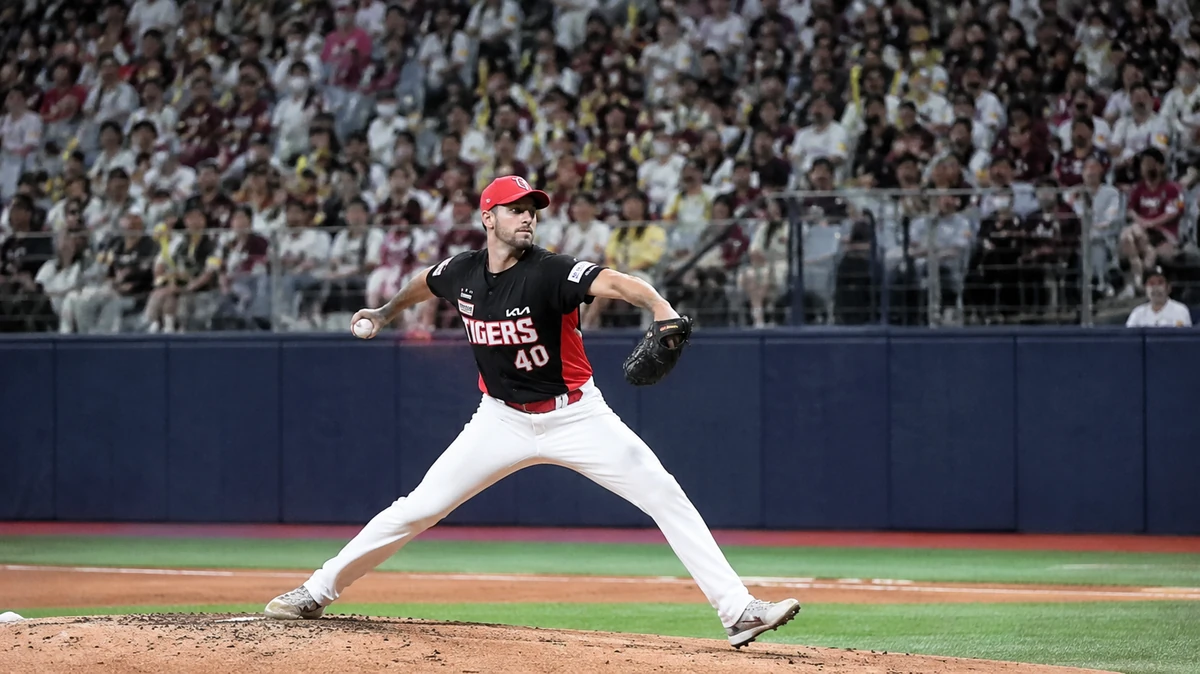
SEOUL — On paper, the line looked straightforward enough: seven innings, six hits, one run, eight strikeouts. The KIA Tigers beat the Kiwoom Heroes 9-2 on Tuesday at Gocheok Sky Dome, and right-hander James Naile earned the victory. In any box score, that reads like an excellent night at the office.
But baseball, whether in the major leagues in the United States or in South Korea’s Korea Baseball Organization, rarely feels as simple as the final numbers suggest. For Naile, an American pitcher in his third season in Korea, this was not just another win to slot into the standings. It was the end of a frustrating stretch in which he often pitched well enough to deserve better results but kept walking away without a decision that matched his effort.
According to Yonhap News Agency, Naile had not won since May 10 against the Hanwha Eagles. That drought stretched across eight starts, a span long enough to become a story inside any season and psychologically heavy enough to test even an experienced professional. Pitchers know better than most players that wins are an imperfect stat, dependent on run support, bullpen help and timing as much as personal execution. Still, that does not make the wait easier.
So when Naile said after the game that a victory can be very hard to get, he was not offering a cliché. He was describing one of baseball’s oldest truths: a pitcher can do almost everything right and still come away feeling empty. On this night, finally, performance and outcome matched. The Tigers got the kind of start that can stabilize a week, maybe even sharpen the shape of a season.
For KIA, one of the KBO’s most followed and historically significant franchises, the importance went beyond one tally in the win column. Naile’s outing offered evidence that the club’s rotation is regaining firmness at a moment when contenders begin looking for signs that can carry them through the grind of summer. In a league where momentum can swing quickly and where nightly travel, pressure and packed schedules wear on rosters, dependable starting pitching remains one of the clearest markers of a serious team.
Why this result mattered more than a midsummer box score
To American fans who are only casually familiar with the KBO, the Tigers are not just another team in another league. They are one of Korean baseball’s flagship brands, a club with a deep championship tradition and a fan base that expects relevance. If the New York Yankees, St. Louis Cardinals or Los Angeles Dodgers evoke a sense of historic weight in the United States, KIA occupies a somewhat similar cultural space in South Korean baseball, even if the markets and economics are different.
That context matters because every strong performance by a starting pitcher can feel amplified when a team is chasing the top of the standings. KBO teams play 144 regular-season games, the same number as Nippon Professional Baseball in Japan and not far from the long-haul wear of Major League Baseball’s 162-game schedule. Over that many games, a rotation does not just fill innings. It creates emotional order. It sets the tone for the bullpen. It lets hitters breathe. It gives a manager choices later in a series.
Naile’s win came after a period in which the results had not reflected his work. That kind of mismatch can be especially maddening for foreign pitchers in Korea, where imported starters are expected to be more than competent. They are often signed to be anchors. In the KBO, the label “foreign player” carries a different kind of visibility than it does in many U.S. pro sports because roster rules sharply limit the number of overseas players each team can carry. Those players are usually counted on to deliver top-of-the-rotation innings or middle-of-the-order production, and they can quickly become focal points of public scrutiny.
That scrutiny is not always unfair. The league’s foreign-player system is designed partly to preserve opportunities for domestic talent while also raising the level of competition. But it means every slump can become more conspicuous, every stretch of bad luck more emotionally draining, and every rebound more significant. Naile’s outing against Kiwoom landed squarely in that space. It was a personal release, but it also served as a signal to the Tigers that one of their most important arms may be settling back into a rhythm that can carry real weight in the pennant race.
Seven innings of control in a game that stayed tense for a long time
The final score suggests a comfortable KIA victory. The game itself was tighter than that for most of the night.
Through seven innings, this was more of a pitcher’s duel than a blowout. Naile matched up with Kiwoom starter Raul Alcantara in a game that demanded patience, sequencing and nerve. Those are the kinds of contests baseball purists tend to love: not an endless parade of offense, but the steady tightening of pressure in each at-bat, where one missed location can flip momentum and one well-placed fastball can restore order.
Naile did more than simply survive that tension. He controlled it. His seven innings were defined not only by limited damage but by the sense that he dictated the pace. The eight strikeouts underscored how often he put hitters on the defensive. Even when Kiwoom managed contact, he kept the game from unraveling.
That distinction matters. A line of one run over seven innings can come from a pitcher who is constantly escaping trouble or from one who is consistently setting the terms of engagement. By all indications, Naile’s performance was closer to the latter. He did not just hang around long enough for KIA’s offense to rescue him. He handed the offense time to find the game’s opening.
In modern baseball analysis, innings are currency. A starter who can cover seven frames while allowing just one run gives his manager almost everything he could ask for: bullpen relief, tactical flexibility and the opportunity to let the offense win the game on its own schedule rather than out of desperation. That was the shape of Tuesday night. KIA did not need to rush. It could wait for the lineup to break through, because its starter had kept the game stable.
Then, late, the Tigers did what good teams do when a game is still within reach: they landed hard. KIA’s offense came alive in the closing innings and turned a taut contest into a 9-2 final, the kind of score that flatters the lineup but should not obscure the starter’s role in making it possible.
The cultural and competitive challenge of being a foreign ace in Korea
Naile’s postgame comments were striking for their honesty. He said that in his third year in Korea, things can feel even harder. That may sound counterintuitive to outsiders. Shouldn’t experience make everything easier? Shouldn’t familiarity with hitters, travel, food, expectations and routine smooth the edges over time?
Sometimes it does. But in professional sports, greater familiarity can also sharpen the pressure.
By the third season, a player is no longer adjusting. He is expected to deliver. The league knows him better. Opposing hitters have a thicker book on him. Coaches and fans have established a baseline for what success is supposed to look like. Any gap between performance and results can begin to feel larger, not smaller, because it comes wrapped in expectation.
That dynamic is especially pronounced in the KBO, where foreign pitchers often arrive with résumés from the United States, minor league systems or other international leagues, and are immediately asked to function as tone-setters. For American readers, the closest comparison may be the pressure on an imported soccer striker in the English Premier League or a high-priced free-agent starter in Major League Baseball: even when the surrounding team context matters, the imported player becomes a referendum on roster construction, ambition and return on investment.
There is also the practical challenge of working in another baseball culture. Korean baseball shares the same basic architecture as the American game, but the texture around it can feel distinct. Fan culture is louder and more coordinated. Cheer sections are highly organized. Ballparks often pulse with songs, chants and instruments in ways that can feel more like college sports or international soccer than the average MLB game. The pace of public attention can be intense, and the emotional connection between team and supporters is visible every night.
For foreign players, adapting to that environment means more than learning a new clubhouse routine. It means finding professional equilibrium in a setting where every start unfolds before a highly engaged audience and where expectations are both immediate and communal. A poor outing does not vanish quietly. A strong one can turn into a shared catharsis. That helps explain why Naile’s long-awaited win resonated beyond his stat line. It was the release of a tension that had built over multiple outings, and one his teammates and fans were likely feeling with him.
A duel with Raul Alcantara gave the night its shape
Part of what made Naile’s performance compelling was who stood on the other side. Kiwoom starter Raul Alcantara kept the game under control into the seventh inning as well, creating the kind of head-to-head battle that makes baseball feel almost like a chess match played at 95 mph.
Naile said afterward that the opposing pitcher’s presence helped fuel his competitive edge. That comment captured something casual fans do not always see. Although pitchers are technically competing against hitters, there is a parallel contest happening all game between the two starters. One throws a scoreless inning and hands pressure back across the field. The other answers. One escapes a jam. The other knows he cannot afford a lapse. In low-scoring games, the psychological exchange can become as important as raw stuff.
This was that kind of night. Through the early and middle innings, every shutdown frame increased the stakes. For a starter in the middle of a winless stretch, those are the hardest games to navigate emotionally. It is easy to overthrow, to chase strikeouts instead of trusting contact, or to let one baserunner expand into a sense of doom. Naile did the opposite. He remained composed, stayed in his rhythm and kept the game in a manageable shape until KIA’s bats opened the door.
That composure is a skill in its own right. Baseball fans in the U.S. often talk about “bulldog” starters or veterans who know how to slow the game down. The same quality translated clearly here. Naile’s outing was not just good in a technical sense. It showed competitive management, the ability to operate inside a high-tension game without allowing the moment to distort his approach.
Those are the performances coaches remember because they scale. A pitcher who can dominate in a low-pressure game is useful. A pitcher who can maintain his shape while the entire night hangs on each inning is the kind of arm a contender leans on in meaningful stretches of the season.
KIA’s late offense turned a strong start into a statement win
If Naile gave KIA the platform, the Tigers’ offense supplied the finish. After a relatively tight contest for much of the evening, KIA found life late and pulled away. The 9-2 scoreline gave the game a decisive feel, but it also highlighted something Naile himself emphasized afterward: satisfaction not simply in winning, but in seeing the lineup break through at the end.
That perspective says a lot about how players experience these games. A starting pitcher can be credited with a victory, but he is rarely under the illusion that he won it alone. In fact, pitchers in prolonged winless stretches often become acutely aware of how team-dependent the stat is. A night like Tuesday’s can therefore feel especially validating because it aligns the whole structure of the game — strong start, patient offense, late surge, secure finish.
From a team standpoint, that alignment matters. When a lineup supports a starter late, it sends its own kind of message: stay with the game, and we will meet you there. That trust can become self-reinforcing over a long season. Hitters do not press as quickly when they believe the starter will keep them close. Starters attack the zone more confidently when they trust the team will eventually score. Bullpens settle when they are not being asked to cover too much too early.
Managers and front offices often talk in broad terms about “playing good baseball,” a phrase that can sound vague to outsiders. What they usually mean is this kind of connectedness. A team plays well not only when individual pieces perform, but when their performances fit together in a coherent way. KIA’s win over Kiwoom looked like that kind of game. Naile controlled the middle. The offense waited and then struck. The result was not just a win, but a cleanly structured one, the sort contenders point to as proof of identity.
Naile also said he was proud of his team and noted that the club had learned from last year’s mistakes. Without more detail, that comment still offers a revealing window into clubhouse thinking. Teams that believe they are building on previous failures often speak with a different tone. There is less panic in rough patches and more confidence that process will eventually pay off. For KIA, the significance of Tuesday’s game may lie partly in that internal belief: this was not an isolated relief moment, but another indication that the group trusts its direction.
What American readers should take from a night like this in the KBO
For readers in the United States, the easiest way to frame Naile’s performance is to think of it as one of those midsummer starts that can reset the emotional temperature of a team. Every baseball season produces them. The veteran starter who had been snakebit finally gets a crooked number of run support. The talented arm whose ERA looked better than his win total finally sees the scoreboard cooperate. The team that felt slightly off for two weeks suddenly looks coherent again.
What makes this case worth attention beyond Korea is that it reflects how global baseball has become while preserving the deeply local character of each league. The KBO is not a minor echo of Major League Baseball. It is its own ecosystem, with its own rhythms, histories and demands. Yet the emotional core of this story is universal to anyone who has followed the sport closely. A pitcher labors through weeks of frustration. He keeps pitching, keeps explaining, keeps waiting. Then one night the game gives something back.
That is why the story works on two levels. At the personal level, it is about Naile, a foreign pitcher in a demanding league, speaking candidly about how hard wins can be to secure and then finally getting one. At the team level, it is about the Tigers looking more complete because one of their important starters found his footing in a game that required both execution and endurance.
There is a temptation in sports coverage to overstate every turning point, to treat one game as destiny. That would be premature here. One victory in late June does not settle a season, and one strong outing does not erase every question a rotation may still face. But not all single games are equal. Some simply count. Others clarify. This one did a little of both.
Naile’s line will live in the standings as one win after eight starts without one. For KIA fans, and perhaps for the pitcher himself, it likely felt heavier than that. It felt like the end of a burden, the reward for perseverance through a statistic’s unfairness, and maybe the beginning of a stretch in which the Tigers look just a little more dangerous.
In a sport that often reduces players to numbers, Tuesday night in Seoul offered a useful correction. The numbers mattered. So did the emotion behind them. And for one evening at Gocheok Sky Dome, James Naile had both.
Comments
Post a Comment