KBS Takes ‘The Seasons’ Outdoors, Turning a Seoul Riverfront Music Show Into a Climate-Era Statement
A late-night Korean music show steps into the open air
One of South Korea’s best-known TV music franchises is leaving the studio for the banks of the Han River, a move that says as much about where Korean pop culture is headed as it does about one special broadcast.
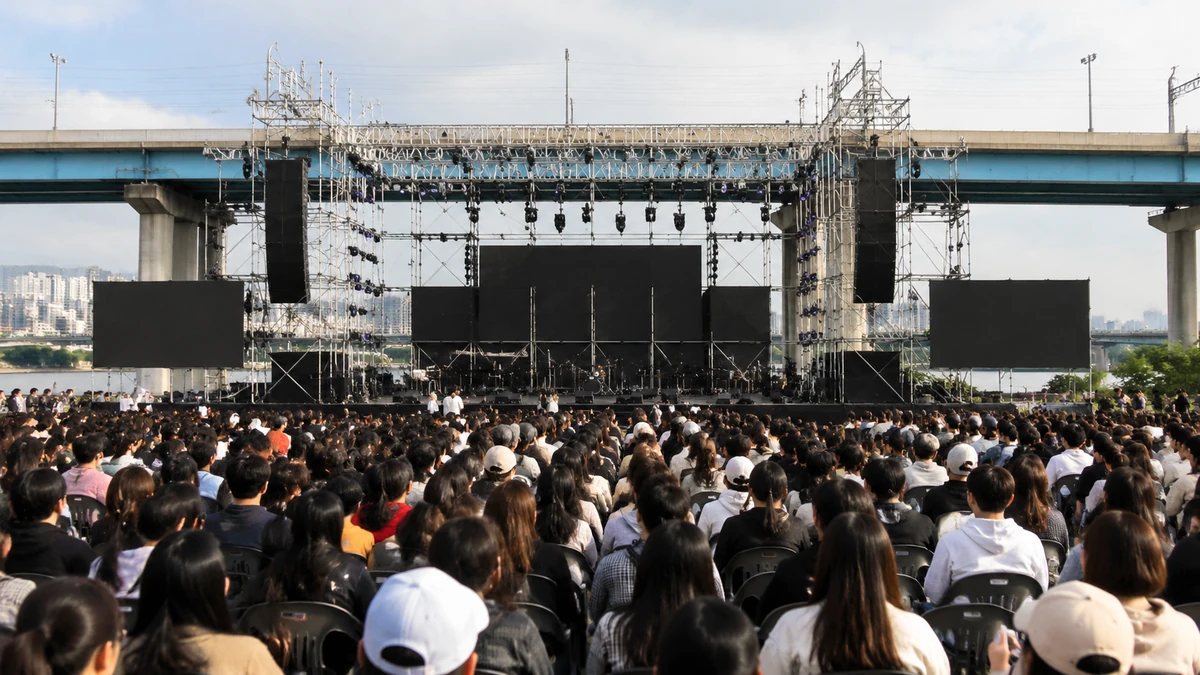
KBS, South Korea’s public broadcaster, said its KBS 2TV music talk show “The Seasons — Sung Si Kyung’s Gokmak Boyfriend” will record its first outdoor special on June 5 at Jamwon Hangang Park in Seoul. The taping will follow a roughly hourlong Environment Day ceremony and a launch event for a national climate action campaign beginning at 4:30 p.m., according to details reported by Yonhap News Agency.
For viewers in the United States, it may help to think of this not simply as a TV show changing locations, but as something closer to a prestige music program deciding to stage a special in Central Park, on the National Mall or along Chicago’s lakefront — and explicitly tying the performance to a public message about climate and civic responsibility. The setting matters. The sequencing matters. And in an era when K-pop is as much about imagery and values as it is about songs, the symbolism matters too.
That symbolism is especially notable because “The Seasons” is not an occasional festival special or a one-off concert event. It is part of Korea’s long-running tradition of music-and-talk programming, where live performance, intimate conversation and carefully shaped atmosphere all work together. The show’s current season is fronted by ballad singer Sung Si Kyung, a veteran artist known in South Korea for his steady live vocals and relaxed, warm on-camera manner. The subtitle attached to this season, “Gokmak Boyfriend,” is Korean entertainment shorthand that does not translate neatly into English but refers to a man whose voice is so pleasing it feels like a romantic companion to one’s ears.
That kind of branding may sound unfamiliar to American readers, but it points to an important cultural distinction: Korean music television often builds a broader emotional identity around its hosts. The host is not just introducing acts. He or she helps define the mood, the conversational rhythm and the emotional promise of the program. Taking that format outside, into a major public space, creates a different kind of encounter between artist, audience and city.
In that sense, the upcoming Han River taping looks less like a gimmick than a calculated evolution. It preserves the DNA of a late-night music show while testing whether its intimacy can survive — and perhaps even deepen — in a wide, shared outdoor setting.
Why the Han River matters in Seoul, and why international fans will notice
The choice of venue is not incidental. The Han River, which runs through Seoul, occupies a place in the South Korean imagination that is part civic landmark, part leisure zone and part cultural symbol. If New Yorkers think of the Hudson or the East River as defining the city’s geography, the Han plays an even more central emotional role in Seoul’s daily life. Its parks are where residents bike, picnic, date, jog, gather with friends and watch festivals or fireworks. It is both backdrop and living public space.
Jamwon Hangang Park, where the recording is set to take place, sits along that corridor of urban recreation. For a television music show, that means the scenery is not just decorative. The river, the skyline, the wind, the fading daylight and the ambient feel of a Seoul evening all become part of the performance language. A studio can control acoustics, lighting and framing with precision. An outdoor venue introduces variables: breeze against the microphone, natural light shifting by the minute, wider crowd energy and a less insulated relationship between performer and environment.
Those are production challenges, but they are also aesthetic opportunities. K-pop and Korean music television have trained audiences — especially international digital audiences — to care deeply about staging. Fans do not just discuss songs; they dissect camera angles, set design, styling, choreography and what many would call the “vibe” of a performance. Moving a show like “The Seasons” outdoors gives the production a new atmospheric vocabulary.
That could matter far beyond Korea. Much of K-pop’s global reach now depends on short clips, online fan circulation and image-making that travels quickly across languages. A beautifully staged performance against the Han River at dusk may communicate something instantly, even to a viewer who knows no Korean. The location itself becomes legible. It tells international audiences that this is not merely a generic soundstage performance but a distinctly Seoul moment.
There is also a softer political dimension to the location. Public space in a major capital carries democratic symbolism. By staging the special in a riverfront park rather than behind studio walls, KBS appears to be positioning music television as something in conversation with everyday civic life. The show is not just broadcasting from a city; it is occupying one of the city’s most recognizable communal spaces.
A music program linked to Environment Day sends a broader message
The most striking part of the announcement may be the program’s connection to Environment Day and a national climate action launch event. According to the production team, the special is designed to deliver “the values of environmental protection and climate action” alongside high-quality live performances. That is a carefully chosen formulation. It suggests that the show is not treating public messaging as an afterthought tacked onto an entertainment product. Instead, it is framing the event as a combined experience: ceremony, civic theme and music performance in one continuous arc.
For American readers, the comparison might be to artists appearing at an Earth Day concert or a public television special tied to a social cause. But the Korean context gives this a slightly different texture. K-pop and Korean television are often highly polished and commercially savvy, yet they are also increasingly attentive to how image, ethics and public sentiment intersect. Fans now expect not only strong performances but signals about what artists and programs stand for, or at least what kinds of public values they are willing to amplify.
That does not mean every entertainment event becomes overt activism. In fact, one reason this special is interesting is that it appears to take a more restrained route. Rather than turning the music show into a speech platform, the structure suggests something subtler: place the performances in a context where the environmental message is already present, and let mood, setting and sequencing do some of the storytelling. In other words, the values are embedded in the format.
That approach reflects a broader shift in global pop culture. Whether in American award shows, European music festivals or Korean variety programming, audiences have grown used to entertainment carrying some social meaning, even if lightly. Climate anxiety, in particular, is no longer a niche concern. It is part of the background reality for younger viewers everywhere, including the core demographics that power K-pop fandom online.
By aligning a flagship music talk show with a climate-themed public event, KBS is effectively asking whether a mainstream broadcast can do more than entertain without becoming heavy-handed. The answer may depend on execution. But the ambition itself is clear: to make a televised music event feel timely, place-based and values-aware, not just technically polished.
What “The Seasons” represents in Korean television
To understand why this matters, it helps to know what “The Seasons” is in the Korean TV ecosystem. The series is built around a rotating host model, with each season shaped by a different musician. Since 2023, the show has cycled through a notable lineup of hosts, including Jay Park, Choi Jung Hoon of Jannabi, sibling duo AKMU, Lee Hyori, Zico, Lee Young Ji, actor-singer Park Bo Gum, singer-songwriter 10CM and now Sung Si Kyung.
That relay-style system is significant. In American television, viewers are accustomed to brands built around a stable host identity, especially in late-night programming. Korean variety and music television can be more modular. A format may remain intact while its emotional tone changes dramatically with each new figure at the center. One host may tilt the show toward indie credibility, another toward playful banter, another toward veteran glamour, and another toward conversational warmth.
“The Seasons” has used that flexibility as a survival strategy. Rather than letting the format grow stale, it reinvents itself through the personality and musical instincts of each host. Sung Si Kyung’s season carries a reputation for comfort and polish. He is the kind of singer whose strength lies less in spectacle than in familiarity, emotional steadiness and vocal control. In a studio, that can create the feeling of a private serenade. Outdoors, it may translate into something more communal: less like a closed-room session, more like a citywide evening gathering.
There is an additional layer here for international readers who may know K-pop primarily through high-intensity idol performances. Korean music culture is broader than the idol system. Ballad singers, indie acts, singer-songwriters and veteran entertainers remain central to the country’s music ecosystem and to its television culture. Shows like “The Seasons” often serve as meeting points where those currents overlap. An outdoor special at the Han River could widen that appeal by making the program feel more event-like and visually expansive while keeping its talk-show roots intact.
That balance may be exactly what KBS is testing. If the relay-host format was one way of refreshing the franchise over time, changing the physical setting may be the next logical step. The host changes the mood; the venue changes the grammar of the show itself.
Why first-time outdoor staging is more than a novelty
The announcement emphasizes that this will be the show’s first outdoor special, and firsts matter in television because they reveal what producers believe the audience is ready to accept. Taking a music talk show outside sounds simple on paper, but it alters nearly every part of the viewing experience.
Live music in a studio benefits from control. Audio can be tightly mixed, camera paths carefully rehearsed, audience sightlines managed and visual intimacy manufactured with precision. Outdoor production introduces uncertainty. Sound behaves differently in open air. The audience is physically and psychologically less contained. Weather becomes a factor. Natural surroundings compete with the set rather than supporting it invisibly.
Yet those same uncertainties can create a feeling of authenticity that viewers increasingly value. In a digital landscape saturated with perfected content, a performance that feels rooted in a real place can stand out. The camera captures not just the singer but the environment reacting around the singer. A gust of wind, the river in the background, crowd noise carrying differently in the evening air — these elements can make a broadcast feel alive in ways a studio rarely does.
There is also a branding advantage. Korean broadcasters and music producers understand that memorable visual settings generate shareable moments. In the age of clips and screenshots, place is part of content. An outdoor Han River special gives “The Seasons” a chance to create imagery that may linger in fan memory long after the lineup is forgotten.
That is especially important because, as of the announcement, the specific guest list and detailed program structure have not been made public. The story, for now, is not about who will perform which song. It is about what kind of scene is being built. That is often how successful entertainment rollouts work: establish the concept first, then let anticipation build around the execution.
Seen that way, the first outdoor special is not just a change of scenery. It is a signal that the show is broadening its identity. It wants to be not only a place where songs are sung and conversations are held, but also a platform capable of reflecting the city, the season and a public issue all at once.
What this says about K-pop’s evolving relationship with public meaning
For years, critics sometimes dismissed K-pop as pure surface — dazzling, efficient and highly engineered, but detached from larger social concerns. That stereotype was never entirely accurate, and it is growing less useful by the year. The Korean music industry today is deeply entangled with public storytelling, national branding and transnational fan culture. Whether through philanthropy, cause-based campaigns or subtle thematic framing, entertainment products increasingly carry messages beyond the music itself.
This Han River special fits into that broader evolution. It does not appear to be making a partisan statement. It is not presenting artists as policy experts. But it is asserting that a mainstream music program can align itself with climate consciousness and environmental stewardship without abandoning its entertainment mission. That may sound modest, yet modesty is often how durable cultural shifts begin.
For American audiences, there is a familiar pattern here. U.S. pop culture institutions from public broadcasters to major festivals have long used music as a bridge to civic themes, whether around disaster relief, voting, public health or environmental awareness. What is notable in the Korean case is how intentionally the aesthetic and symbolic dimensions are being deployed. The Han River setting, the public-broadcast context and the emotional style of Sung Si Kyung’s season all point toward a message delivered through tone as much as text.
International fans will likely read the event in layered ways. Some will simply enjoy the novelty of seeing a beloved program outside the studio. Others will treat it as another example of how Korean entertainment continues to reinvent familiar formats. Still others may see it as evidence that K-pop-adjacent media is becoming more comfortable attaching itself to broadly shared values, especially issues that resonate with younger global audiences.
That last point may be the most consequential. Climate change is one of the few topics that instantly connects viewers across borders. You do not need to speak Korean to understand what an Environment Day event means, or why pairing it with music might help broaden its reach. In a media world where cultural products compete for attention across languages and platforms, such instantly understandable framing is powerful.
What to watch for when the special airs
Until KBS releases more detailed information, several practical questions remain unanswered. The guest lineup has not been disclosed. Neither has the exact shape of the special beyond its link to the Environment Day and climate action events. But even with those details still under wraps, the upcoming taping already offers a few clues about what viewers and industry watchers will be looking for.
First, there is the question of balance. Can the production maintain the musical quality and intimate conversational feel that define “The Seasons” while embracing the scale and unpredictability of an outdoor setting? That challenge is technical, but it is also emotional. A show like this works because it feels close-up, even on television. Recreating that closeness outdoors will be crucial.
Second, there is the question of integration. Will the environmental message feel organic to the special, or merely appended to it? The strongest version of this concept would allow the setting, the performance choices and the event structure to reinforce one another naturally. If done well, viewers may barely distinguish between the entertainment frame and the civic frame. They will simply experience the evening as one coherent event.
Third, there is the matter of visual legacy. Korean music programs live long after broadcast through online clips, fan edits and social media circulation. If the special delivers one or two unforgettable images — a skyline shot, a sunset performance, a crowd moment along the river — it could travel widely, especially among international fans hungry for performances that feel unique rather than interchangeable.
More broadly, this special may help clarify where Korean television music programming is headed next. As streaming, social video and global fandom reshape the economics of attention, broadcasters are under pressure to offer more than traditional studio broadcasts. They need moments, atmosphere and a sense of occasion. They need programming that looks good on television but also lives well online. An outdoor Han River special tied to a public cause checks many of those boxes.
In the end, that may be the real significance of KBS’s announcement. A respected Korean music show is not just stepping outside for a night. It is testing whether live television, civic symbolism and pop-cultural storytelling can still create a shared public moment. In Seoul, on the Han River, with climate messaging in the air, that experiment feels especially of the moment.
Comments
Post a Comment