A World Court Opinion on Strikes Resonates in South Korea, Reframing a Longrunning Debate Over Workers’ Rights
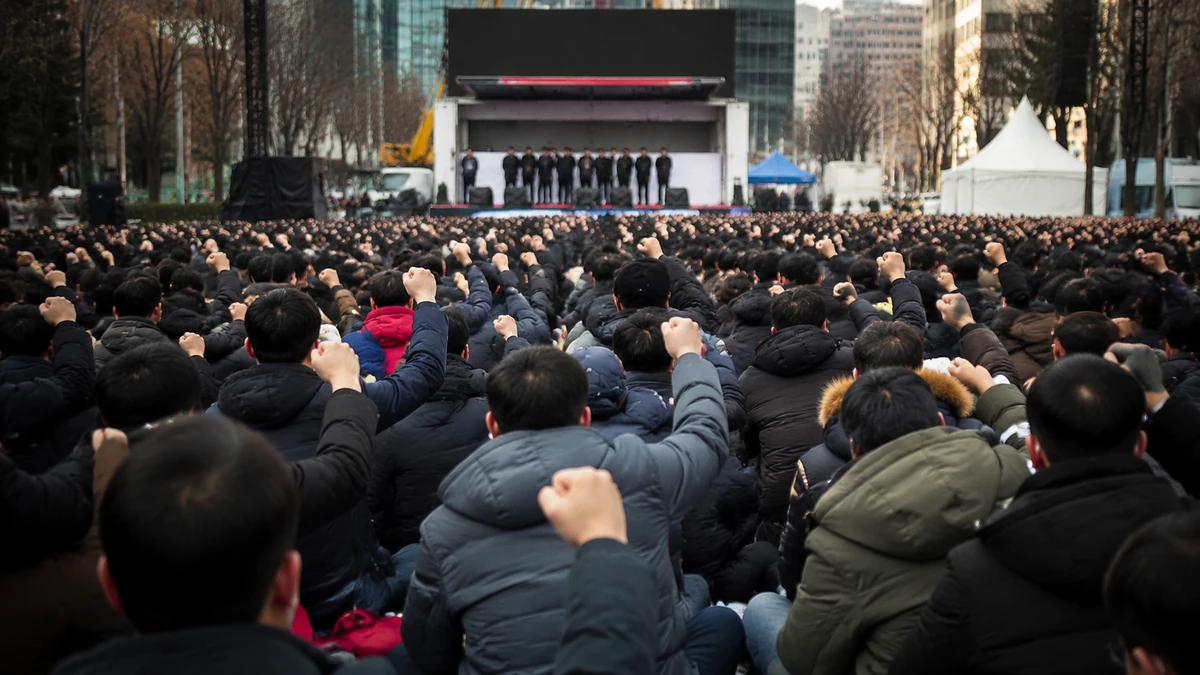
A global legal opinion lands in a country where labor fights are never abstract
SEOUL — A new opinion from the International Court of Justice, the United Nations’ top judicial body, is being welcomed by South Korea’s labor movement as a major affirmation of a principle unions here have argued for years: The right to strike is not a side issue or a loophole in labor law, but a core part of workers’ freedom to organize.
The court said in an advisory opinion issued Wednesday that workers and their organizations are protected in exercising the right to strike under Convention No. 87 of the International Labor Organization, the treaty that covers freedom of association and the right to organize. That may sound technical, even distant, to readers more accustomed to domestic court rulings or congressional fights. But in South Korea, where labor disputes regularly spill into national headlines and shape debates about democracy, inequality and economic growth, the opinion carries real symbolic and political weight.
The key point is not that the treaty explicitly spells out a right to strike. It does not. The significance of the court’s view is that the right is still understood to be embedded within the broader protections of association and collective action. In plain terms, the judges signaled that the freedom to form a union means little if workers do not also have meaningful tools to act together when bargaining breaks down.
South Korea’s two major national labor federations responded quickly, saying the opinion reaffirms that striking is a fundamental means of securing decent work. That phrase — “decent work” — is important. It frames the strike not merely as a disruptive tactic, but as part of a larger struggle over wages, hours, safety and dignity on the job.
For American readers, there is a familiar echo here. In the United States, arguments about labor rights often turn on a similar question: Is a union simply an organization workers are allowed to join, or is it a vehicle for real bargaining power? The difference matters. A union with no practical leverage can exist on paper while remaining weak in practice. South Korean unions and labor advocates say the same logic applies here, and the ICJ’s opinion lends international support to that view.
The court’s statement does not automatically rewrite South Korean law or decide any specific strike dispute. Advisory opinions are not the same as direct orders in a domestic courtroom. But they can shape how governments, courts, unions and employers understand international standards. In a country where labor policy is often caught between export-driven economic priorities and demands for stronger social protections, that kind of clarification can influence the next round of legal and political battles.
Why this matters in South Korea, where labor conflict is part of modern political life
To understand why the response in South Korea was immediate and emphatic, it helps to understand how central labor questions are to the country’s recent history. South Korea is a high-income democracy, home to global brands in cars, chips, batteries, ships and consumer electronics. It is also a society where rapid industrialization left a legacy of punishing work culture, sharp hierarchies and recurring clashes between organized labor, government and business.
Labor unions in South Korea occupy a more visibly political role than many Americans may expect. Street rallies by workers are common in major cities, especially in Seoul. Union demonstrations can involve marches, overnight sit-ins, hunger strikes and dramatic acts of protest that reflect both the intensity of disputes and a long history in which labor activism was closely tied to broader pro-democracy movements.
That history matters. During the authoritarian decades before South Korea’s democratic consolidation in the late 1980s, independent labor organizing was often suppressed. Workers’ movements helped push back against that system, so labor rights here are often discussed not just as workplace rules but as democratic rights. In that context, the right to strike is seen by many supporters not simply as an economic weapon, but as part of the infrastructure of citizenship — a way for ordinary people to make collective demands in a society dominated by large institutions.
At the same time, organized labor in South Korea has long faced criticism from business groups, conservative politicians and portions of the public who see strikes as excessively confrontational or economically damaging. That tension surfaces whenever transit workers walk off the job, hospital workers threaten disruption, or manufacturing stoppages hit supply chains. As in the United States, public sympathy for labor can shift depending on whether people see workers as defending basic fairness or causing hardship for commuters, patients or consumers.
That is why the ICJ opinion stands out. It does not settle those arguments, but it shifts the frame. Instead of treating strikes mainly as a public nuisance or an industrial relations problem, it places them within the architecture of internationally recognized rights. For unions, that is a powerful change in language. It supports the argument that strikes should be judged not only by the inconvenience they cause, but by the role they play in making freedom of association meaningful.
In South Korea, where labor issues often get filtered through concerns about economic competitiveness, this reframing may prove especially significant. The country’s economic model has long depended on disciplined production, close state-business coordination and fierce international competition. Employers and policymakers have often warned that labor militancy could undermine investment or weaken key industries. The world court’s opinion does not erase those concerns, but it strengthens the counterargument: that durable prosperity also depends on workers having enforceable, not merely symbolic, rights.
The legal question: How can a right be protected if it is not written out word for word?
At the center of the matter is a deceptively simple legal question. If an international treaty does not explicitly mention a “right to strike,” can that right still be protected under the treaty? The court’s answer was yes.
Convention No. 87 of the International Labor Organization focuses on freedom of association and protection of the right to organize. Those phrases can sound abstract, especially outside labor law circles. Freedom of association means workers can form and join organizations of their choosing without undue interference. The right to organize means those organizations must be allowed to function as something more than ornamental clubs.
The ICJ’s reasoning, as reflected in the summary of the opinion, is that these guarantees have practical content. A union that cannot act collectively in defense of its members is a union in name only. By that logic, the right to strike is not an optional add-on but one of the tools that make organization effective.
This interpretive move is important because it rejects an unusually narrow reading of treaty language. In many legal disputes, opponents of broader labor protections argue that if a specific right is not spelled out, courts and international bodies should not infer it. The court here took the opposite approach. It looked not only at the literal text, but at the structure and purpose of the convention. That is a familiar method in law, including in the United States, where judges sometimes ask what a statute is meant to do, not only what isolated words say in the most cramped possible reading.
In labor disputes, this distinction has concrete consequences. If freedom of association is defined narrowly, governments and employers can claim to respect unions while severely limiting the tools unions need to bargain. Workers may be allowed to meet, elect leaders and pay dues, yet still be denied meaningful leverage in negotiations. The court’s opinion pushes back on that formalistic approach.
It also reinforces a broader principle in labor rights discourse around the world: collective rights are meaningful only when backed by mechanisms of collective action. That does not mean every strike is lawful, wise or immune from restriction. Even countries with robust labor protections impose rules around timing, essential services, notice requirements and public safety. But the baseline assumption changes when the right itself is treated as protected rather than merely tolerated.
For American readers, one rough comparison might be free speech doctrine. A country could claim to allow free expression, but if it banned public assembly, protest and most practical means of amplification, the underlying freedom would be hollow. Labor advocates see strike rights through a similar lens. Without the possibility of withholding labor, the right to organize risks becoming procedural rather than substantive.
Why Korean unions say this is about “decent work,” not just conflict
South Korea’s two umbrella labor federations — the country’s best-known national union groupings — said the opinion confirms that the right to strike is fundamental to securing quality employment. Their wording is revealing, and it reflects a shift in how labor movements increasingly present themselves to broader society.
In public debate, strikes are often portrayed through the lens of disruption: delayed trains, shuttered worksites, interrupted classes, delayed deliveries, tense negotiations. That story line is not unique to South Korea; it is common in the United States and elsewhere. But unions argue that focusing only on disruption misses the underlying imbalance that makes strikes necessary. Workers resort to walkouts, they say, because ordinary negotiations are not enough when employers hold greater power over pay, schedules, benefits and job security.
The phrase “decent work,” which has roots in international labor discourse, expands the argument beyond wages alone. It encompasses safe conditions, predictable hours, protection from arbitrary treatment, the ability to balance work and family life, and the dignity of being heard on the job. In South Korea, that message resonates in a society still grappling with long working hours, a deeply competitive professional culture and periodic industrial accidents that have drawn public outrage.
That helps explain why unions did not celebrate the ICJ opinion as a mere technical legal win. They presented it as validation of a broader moral and social claim: that labor rights are part of the machinery for improving everyday life. In that telling, the strike is not the opposite of social stability. It is one of the tools used to force attention to conditions that would otherwise remain invisible or unaddressed.
This framing also matters because South Korean labor is often discussed in fragmented ways. Highly visible unions at large manufacturers can dominate the headlines, creating the impression that organized labor is mostly about well-paid workers fighting for better terms. But the country’s labor market also includes vast numbers of nonregular workers, subcontracted laborers, platform workers and service employees with weaker bargaining power and fewer protections. For those workers, the principle at stake is not just whether unions can win marginal gains, but whether collective action is recognized as legitimate at all.
Seen that way, the world court’s opinion speaks to more than a legal doctrine. It bolsters a social argument about the quality of democracy in the workplace. If workers can associate but not effectively press demands, then labor rights remain incomplete. Korean unions are betting that an international affirmation of strike rights can help move that argument closer to the political mainstream.
The opinion’s practical impact may be indirect, but its political impact could be real
Adary opinions from international courts do not function like an emergency injunction from a national judge. They do not instantly invalidate domestic statutes, reopen closed cases or compel police, ministries or companies to change course overnight. The practical effect of this ICJ opinion in South Korea is therefore likely to be gradual rather than immediate.
Still, “indirect” does not mean unimportant. International legal interpretations can shape future court arguments, influence legislation, guide administrative agencies and alter the tone of public debate. They can become part of the reference framework used by activists, labor lawyers, employers and policymakers. In contentious areas of public life, that kind of reframing can matter a great deal.
In South Korea, disputes over labor rights often center on the permissible boundaries of collective action. Those conflicts include questions about who counts as a worker for union purposes, what forms of protest are lawful, how broadly employers can seek damages from unions over strike-related losses, and how the state should balance public order with freedom of assembly and industrial action. Any international opinion that clarifies the status of strike rights under a major labor convention is likely to become a new point of citation in those debates.
It may also deepen pressure on policymakers to align domestic practices more closely with international standards. South Korea has spent years navigating scrutiny over how fully it meets global expectations on labor rights, especially as its economy has become more deeply integrated with international trade and supply chains. For a country that prides itself on being a leading democracy and a rule-based global player, questions about compliance with international labor norms carry reputational weight as well as domestic significance.
That does not mean business groups or more conservative officials will simply accept the unions’ interpretation. Employers are likely to argue, as they often do, that even if strike rights are protected in principle, governments still have broad authority to regulate their exercise. Essential services, economic security and public safety will remain central points of contention. In the United States, too, labor rights have never been absolute; they are mediated through laws, agencies and courts that often impose significant limits. South Korea is no different in that respect.
But the ICJ opinion may alter the starting point of the conversation. Instead of first asking whether strike rights deserve protection at all, the debate may more often begin from the premise that such rights are protected and then move to the narrower question of how they can be regulated without being emptied of substance. That may sound subtle, but in law and politics, the baseline assumption often determines the outcome of the argument.
What this says about South Korea’s place in a global labor conversation
There is also a broader story here about South Korea’s relationship to international norms. The country is no longer viewed simply as a fast-growing Asian economy or a manufacturer of globally recognized products. It is also a major exporter of culture, technology and political example — a country whose democratic successes and stresses are watched closely abroad.
That includes labor. South Korea’s workplace struggles are domestic, but they are also part of an international conversation about how advanced economies should handle inequality, precarious employment, shrinking union power in some sectors and worker resistance in others. Questions that animate labor politics in Seoul — how much leverage workers should have, how much disruption society will tolerate, how rights should be balanced against economic demands — are recognizable in Los Angeles, Detroit, London and Paris as well.
The ICJ opinion highlights how those local conflicts are increasingly mediated through international institutions. The International Labor Organization sets standards. The International Court of Justice interprets how those standards are understood. National unions then translate those judgments into local political language. South Korea’s swift union response shows that this translation can happen almost instantly. What begins as a legal interpretation in an international forum becomes, within hours, a domestic argument about fairness, power and social legitimacy.
That process is itself revealing. It suggests that labor rights in South Korea are not treated as abstract ideals removed from everyday life, but as active and contested principles with consequences for commuters, factory workers, nurses, office employees and delivery drivers. In other words, international law is not hovering above society; it is being pulled into ordinary political struggle.
For American audiences, this offers a useful reminder that the Korean Wave — the global reach of South Korean culture through film, music, television and fashion — exists alongside another Korean story that gets less attention abroad: the story of how a deeply modern, affluent democracy manages conflict between capital and labor. The same country that exports K-pop and Oscar-winning cinema also stages fierce debates over workplace democracy, union power and the meaning of social rights.
Those stories are not unrelated. The global appeal of South Korean culture has helped make the country more legible to outside audiences, but it can also flatten public understanding by emphasizing style, creativity and soft power over the structural tensions beneath them. Labor news like this one points back to those tensions. It reminds us that South Korea’s success is built not only on innovation and entertainment, but also on contentious negotiations over who benefits from growth and under what conditions people work.
After the affirmation, the harder questions begin
The advisory opinion answers one important question, but leaves many others open. If strike rights are protected as part of freedom of association, how far does that protection extend? What limits are legitimate in essential industries? How should governments treat workers in fragmented employment arrangements, such as subcontracting or app-based work? When does regulation become restriction in everything but name?
Those are not uniquely Korean questions, and they will not disappear because an international court clarified a principle. But principles matter, especially in disputes where one side has long argued that a right must be seen as fundamental rather than discretionary.
For South Korea’s labor movement, that is the immediate value of the ICJ opinion. It confirms that strike rights belong inside, not outside, the family of protected labor freedoms under ILO Convention No. 87. For employers and officials, it raises the stakes of any attempt to treat strikes as merely disruptive acts detached from the underlying right to organize. And for the broader public, it offers a chance to rethink a familiar debate in less reactive terms.
South Korea will still argue over the costs of strikes. Commuters will still be frustrated when services are interrupted. Businesses will still warn about uncertainty and lost productivity. Politicians will still sort themselves into camps that emphasize order, growth, fairness or social dialogue. None of that changes overnight.
What does change, at least potentially, is the language available to each side. The court’s opinion strengthens the idea that the right to strike is not simply a bargaining tactic tolerated by the state when convenient. It is part of the larger promise that workers can organize in ways that actually matter. In a country where labor rights have long been entangled with democratic identity, that is more than a legal footnote. It is a statement about what freedom at work is supposed to mean.
And that is why a decision that might look, from a distance, like a technical interpretation of an international treaty has landed in South Korea as a major social and political development. At stake is not only the reading of a convention, but the boundaries of collective power in one of Asia’s most economically advanced and politically dynamic democracies.
Comments
Post a Comment