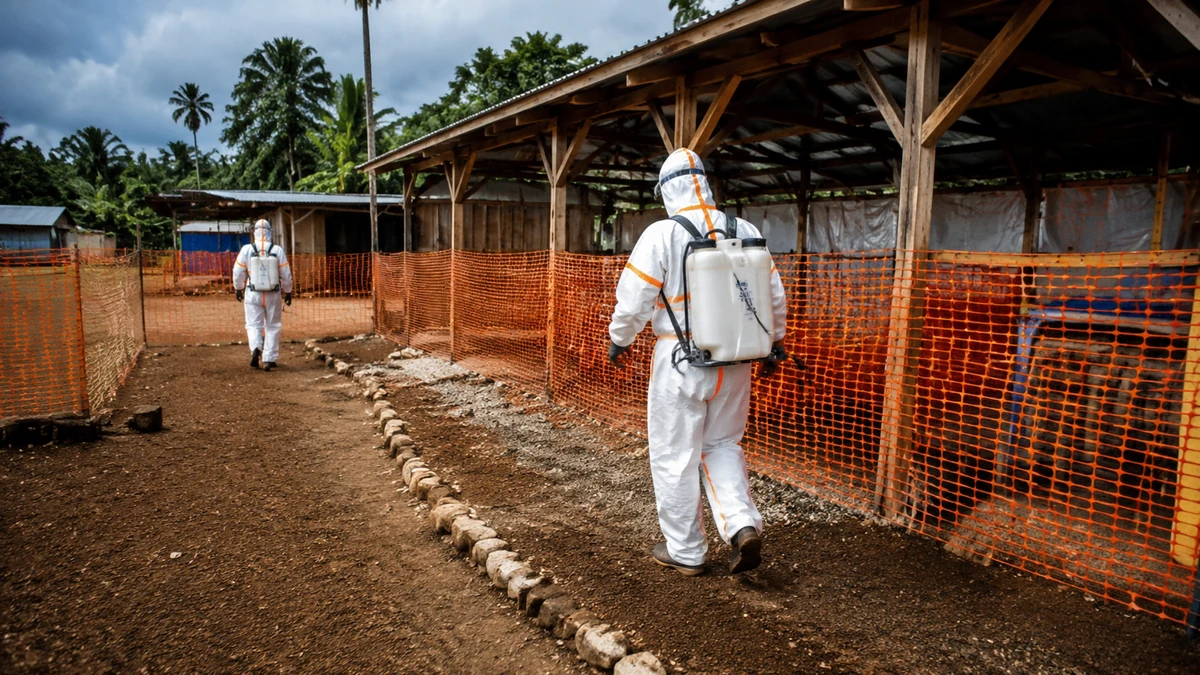
South Korea moves quickly as Ebola concerns grow
South Korea has expanded its highest-level travel ban in the Democratic Republic of Congo, adding Ituri province to a list of places its citizens are effectively prohibited from visiting because of the spread of Ebola and rising deaths tied to the virus. The measure, announced by Seoul’s Foreign Ministry and taking effect at 2 p.m. on the 22nd, pushes the number of Congolese provinces under South Korea’s travel ban to three, alongside North Kivu and South Kivu.
That may sound like a routine consular update, but in the South Korean system it carries unusually serious weight. This is not the diplomatic equivalent of a yellow light or a general “be careful overseas” advisory. A Level 4 travel alert in South Korea means a government-designated travel prohibition, the strongest restriction Seoul can impose on civilian travel to a foreign destination. In practical terms, it is the state telling its citizens: Do not go. If you are already there, leave unless you have a compelling and approved reason to remain.
The decision came in response to what South Korean officials described as a worsening Ebola outbreak and an increase in deaths. While Ebola outbreaks in Central Africa are often followed closely by global health agencies, the South Korean government’s move is notable because it treats the development not merely as foreign health news, but as an urgent matter of citizen protection, border-aware public health policy and legal enforcement.
For American readers, it may help to think of this as more stringent than a typical U.S. State Department warning. The United States issues travel advisories ranging from “Exercise Normal Precautions” to “Do Not Travel,” but those advisories generally do not, by themselves, make travel illegal for U.S. citizens. South Korea’s top-tier warning system goes further. It can trigger legal consequences for South Korean passport holders who travel to or remain in the affected area without special authorization.
That distinction is central to why this development matters. In an era shaped by COVID-19, mpox, avian flu scares and continued global concern about fast-moving outbreaks, countries are increasingly judged not just on how they react medically, but on how they manage the movement of their own citizens abroad. South Korea’s latest action shows a government willing to use the full force of its overseas safety apparatus when it believes a health threat has become severe enough.
What a Level 4 alert means in South Korea
To understand the significance of the announcement, it helps to understand the way South Korea organizes travel warnings. The Foreign Ministry, which handles foreign policy and the protection of South Koreans overseas, uses a four-tier alert system for destinations abroad. The lower levels are closer to what Americans would recognize as cautionary guidance: pay attention, reconsider nonessential travel, avoid high-risk areas. Level 4 is different. It is a travel ban.
Once an area is designated Level 4, South Korean nationals generally are not supposed to enter or stay there unless they receive an exceptional passport-use permit from the government. Officials have said that those who violate the rule by visiting or remaining in the area without permission may face penalties under South Korea’s Passport Act and related regulations. In other words, this is not simply advice that travelers may weigh against personal preference or business need. It is a formal state restriction backed by the possibility of punishment.
That legal dimension gives South Korea’s announcement a sharper edge than many travel notices elsewhere. For journalists, aid workers, business travelers, missionaries and family members with ties to the region, it means personal judgment alone no longer governs the decision. The state has formally concluded that the risk is grave enough to override ordinary travel freedom.
That is especially important in South Korea, a country with one of the world’s most globally mobile populations. South Koreans travel widely for work, tourism, religious activities, education and humanitarian missions. The government maintains an extensive consular alert system in part because overseas mobility is so deeply woven into modern Korean life. When Seoul redraws the map of forbidden travel, people in a range of professions pay attention.
For readers in the United States, where government warnings are often filtered through a culture of individual choice, the Korean approach can feel more directive. But it also reflects a broader East Asian tendency, strengthened after past outbreaks, to see public safety and travel governance as closely linked. In South Korea, overseas danger is not treated as somebody else’s problem simply because it happens on another continent. If Koreans are likely to be affected, the government treats it as a domestic policy concern.
Why Ituri matters beyond a map update
The addition of Ituri province is significant not just because it adds another name to a list, but because it broadens the geography of what South Korea now considers an acute Ebola risk zone inside Congo. North Kivu and South Kivu were already under travel prohibition. By adding Ituri, Seoul is signaling that the danger is no longer confined to the areas previously designated, or at minimum that the outbreak’s practical impact now extends far enough to require a wider cordon in policy terms.
That matters because travel restrictions are often one of the clearest windows into how governments assess real-time risk. Public statements about outbreaks can be cautious and technical, and officials frequently avoid dramatic language. But when a government broadens a travel ban, it is making an operational judgment. It is saying the facts on the ground have deteriorated enough to justify stronger action now, not later.
South Korean officials tied the decision specifically to the recent spread of the Ebola virus and rising fatalities. That wording suggests the move was not merely precautionary in the abstract, but responsive to a worsening situation already producing deadly results. Governments generally escalate travel advisories when a threat becomes more immediate for citizens who might be living in, passing through or planning to visit the area. In that sense, the Ituri designation represents an administrative acknowledgment that conditions have crossed a more serious threshold.
It also underscores how outbreak response has changed in a world accustomed to rapid international mobility. Even when a disease remains geographically concentrated, governments no longer assume that distance alone reduces relevance. The chain from a provincial outbreak in Central Africa to a policy decision in Seoul can be surprisingly short: local cases rise, international monitoring intensifies, consular risk analysis is updated, and citizens are told not to go.
For South Korea, a country highly attuned to crisis management and institutional messaging, the expansion from two prohibited provinces to three is more than a numerical adjustment. It is a public statement about how the state is reclassifying danger. The affected territory has widened, and so has the official scope of concern.
When a health emergency becomes a foreign policy issue
Ebola is first and foremost a medical crisis, but the response to it never stays confined to medicine. Outbreaks quickly spill into diplomacy, immigration policy, airport screening, emergency planning, aid logistics and the legal obligations governments feel toward their citizens overseas. South Korea’s action is a reminder that public health threats are often handled through foreign ministries as much as through health ministries.
That is especially true when the challenge involves people who may be living, working or traveling abroad. A government cannot dispatch hospital systems into another sovereign country at will, but it can regulate its own citizens’ movements, issue warnings, coordinate evacuations, restrict passport use and decide what level of consular support is appropriate under dangerous conditions. In that sense, a travel ban is not just a health measure. It is an instrument of statecraft.
South Korea’s announcement also reflects the way international news becomes local policy in a globalized society. An outbreak in Congo might appear distant to people in Seoul or Busan, just as it may feel remote to readers in Chicago or Dallas. But once a government determines that its citizens could be exposed through travel, work or extended residence, the issue shifts from foreign headline to domestic governance. It becomes a question of what the state owes its nationals and how far it should go to protect them.
That is one reason the Foreign Ministry’s wording matters. By specifying the affected province, the alert level and the legal consequences of violating the restriction, the ministry is doing more than relaying bad news. It is setting the terms of acceptable behavior. It is also telling the public what kind of risk it believes deserves its strongest response.
In the American context, debates over overseas warnings often revolve around whether the government is overreaching or simply informing. In South Korea, that line can be drawn differently, especially when the issue involves sudden danger abroad. The political and bureaucratic culture tends to place a premium on clear, centralized guidance during crises. That does not eliminate debate, but it helps explain why a legal travel prohibition can be presented as a matter of straightforward public safety rather than a controversial expansion of state power.
South Korea’s broader approach to protecting citizens abroad
The travel ban on Ituri also highlights a larger point about how South Korea thinks about overseas risk. This is a country whose global footprint is larger than its size might suggest. South Korean corporations operate across continents. Churches and faith-based groups have active missionary networks. Aid organizations, journalists, students and construction firms routinely send Koreans into challenging environments. The government’s consular system has had to evolve accordingly.
That helps explain why Seoul’s foreign ministry often treats travel alerts as a serious extension of domestic governance. To many Americans, the phrase “travel advisory” can sound optional, something you read before a vacation and then ignore if airfare is cheap enough. In South Korea, the strongest version of that warning is not built for leisure travelers alone. It is also designed for a globally dispersed citizenry whose work and obligations sometimes place them in unstable or high-risk settings.
There is a long institutional memory behind that posture. South Korea has spent years refining systems for emergency texts, overseas registration, embassy outreach and public warnings as it has become more internationally connected. Episodes involving political unrest, kidnappings, natural disasters and disease outbreaks have all reinforced the expectation that the government should speak clearly when foreign conditions turn dangerous.
Seen in that light, the decision on Ituri is less an isolated reaction than part of an established framework. The message is simple: high-risk areas are monitored, the map can change quickly and official policy will be updated when conditions worsen. For anyone planning travel linked to business, reporting, aid work or family obligations, the announcement functions as a hard boundary.
It also sends a subtler signal to domestic audiences. The South Korean government wants the public to know it is watching global developments closely and is willing to act decisively when danger escalates. In a country where confidence in crisis response can carry political importance, that signaling matters. Even when the number of citizens directly affected may be relatively small, the state’s visible readiness is part of the story.
The global lesson in a faraway outbreak
There is an understandable temptation, especially in wealthy countries far from Central Africa, to treat Ebola news as a tragic but distant category of international reporting. South Korea’s decision pushes back against that instinct. It suggests that in a world of constant air travel, transnational labor and dense institutional ties, a disease outbreak in one region can rapidly become a matter of legal, diplomatic and personal consequence elsewhere.
This is one of the enduring lessons of the post-pandemic era. Infectious disease threats are no longer viewed solely through the lens of hospitals and laboratories. They are also understood through movement: who is traveling, who is staying, who may need evacuation, which passports remain valid where and how quickly governments are prepared to tighten the rules. That makes ministries of foreign affairs central actors in outbreak response, even when the crisis originates thousands of miles away.
South Korea’s move is a case study in that convergence. The immediate target is specific—three provinces in Congo, now including Ituri. But the broader message is about interconnectedness. A change in health conditions in Ituri leads to a decision in Seoul, and that decision directly affects how South Korean citizens may use their passports and organize their travel. Health, law, mobility and diplomacy are all folded into a single policy act.
For American readers, there is something familiar here as well. The COVID-19 pandemic made clear that the phrase “over there” has limited meaning when public health is involved. What begins as a regional emergency can soon shape airline routes, border rules, visa policy, supply chains, corporate travel and everyday assumptions about safety. The Korean government’s response to the Ebola outbreak reflects that same reality, only in a narrower and more targeted form.
And that may be why this announcement deserves attention beyond South Korea. It shows how one U.S. ally is translating a foreign outbreak into concrete protective policy for its own citizens. It shows the threshold at which advisory language gives way to prohibition. And it shows how, in today’s world, governments increasingly see global health threats not as distant humanitarian concerns alone, but as immediate matters of national responsibility.
A restrained announcement with a strong message
One of the striking things about the South Korean announcement is how restrained it is. There is no sensational language, no attempt to dramatize the threat beyond the facts cited by officials: Ebola is spreading, deaths are rising and another province is now subject to a Level 4 ban. Yet that restraint arguably makes the message more powerful. The severity is embedded in the action itself.
That is often how serious government warnings work best. They do not need rhetorical flourish when the policy speaks clearly enough. Expanding a travel prohibition from two Congolese provinces to three is, on paper, a small change. In practice, it communicates a larger shift: the area Seoul considers too dangerous for ordinary civilian travel has widened. The government’s tolerance for exposure has narrowed accordingly.
For South Koreans with plans involving the region, the implications are immediate. For the broader public, the move reinforces a growing awareness that international health crises can ripple into legal and bureaucratic life at home. For observers abroad, it offers a revealing example of how a close U.S. partner handles the intersection of public health and foreign policy.
At a moment when many countries are still recalibrating how aggressively to respond to overseas threats, South Korea has chosen clarity. It has identified the place, raised the warning to the maximum level and attached potential legal consequences to noncompliance. Whether other governments would go as far is a separate question. What is clear is that Seoul believes the Ebola situation in Ituri warrants the strongest signal it can send to its citizens: stay away.
Comments
Post a Comment