A Young Doosan Right-Hander Is Turning Heads in South Korea, and His Rise Says Plenty About Where the KBO Season Is Going
A breakout performance in Seoul carries weight beyond one night
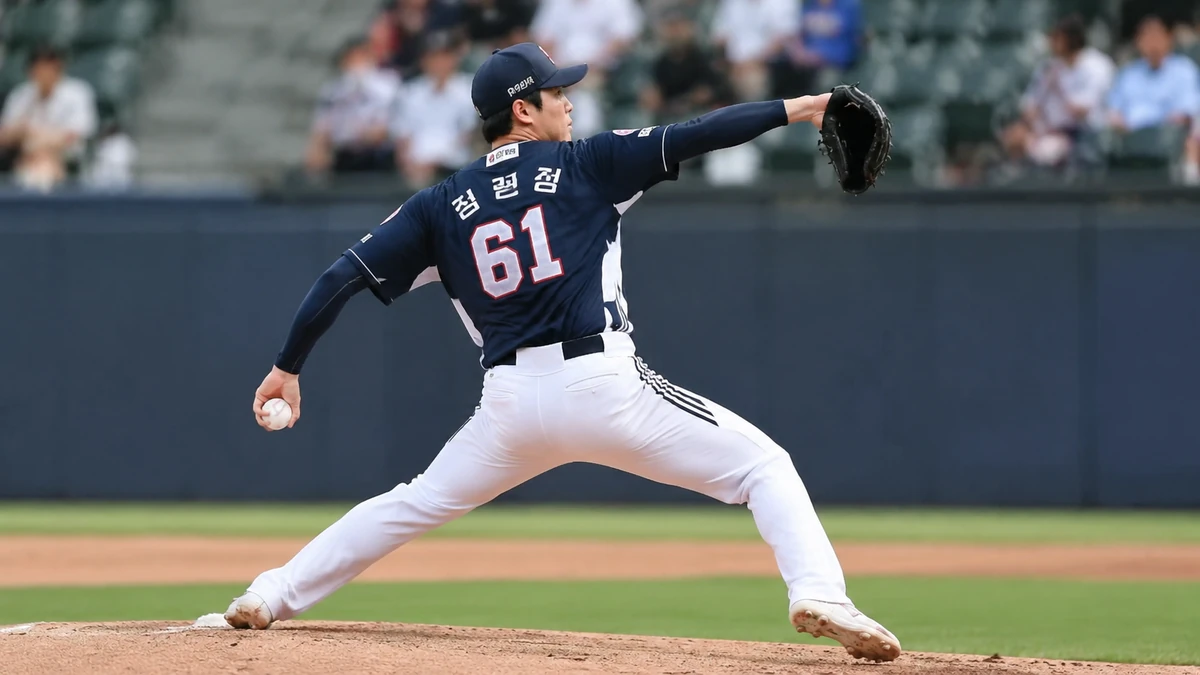
On paper, it looked like the kind of box score baseball produces every day over a long season: a strong start, a comfortable win and another small adjustment to the league standings. But in South Korea on Monday night, Doosan Bears right-hander Choi Min-seok delivered a performance that resonated far beyond a single result. In a 9-2 win over the NC Dinos at Jamsil Baseball Stadium in Seoul, Choi worked seven innings, allowed just two hits, issued one walk, struck out seven and gave up one unearned run. By the end of the night, his earned run average had dropped from 2.56 to 2.17, the best mark in the Korea Baseball Organization, or KBO, among qualified pitchers.
That statistical jump matters. So does the way it happened. Choi is not a veteran polishing an already established resume. He is a second-year pitcher, a player who debuted last season and is now navigating his first full year as a regular starter. In a league where imported arms often occupy the top tier of starting pitching and where young domestic pitchers can take time to settle into the grind, Choi’s surge to the top of the ERA leaderboard feels like more than a hot streak. It looks, increasingly, like an arrival.
For American fans who know South Korean baseball mostly through highlights, bat flips or the brief period in 2020 when ESPN aired KBO games during the pandemic, this is the sort of story that helps explain why the league has such a devoted following. The KBO is not just a place of lively offense and boisterous cheering sections. It is also a league where the emergence of a homegrown ace can quickly become one of the biggest stories in the sport. Choi’s outing against NC was the kind of start that changes expectations inside a clubhouse and sharpens the attention of everyone else.
Doosan improved to 21-22-1 and extended its winning streak to three games. That record still leaves the Bears in the middle of the pack, not perched atop the standings. But baseball seasons are often reshaped not by one dramatic offensive explosion, but by the moment a team realizes it can trust one starter to control the pace of a game every fifth day. Choi’s start suggested Doosan may have found exactly that.
Why this outing stood out, even in a sport built on numbers
Pitching lines can sometimes blur together. Seven innings, two hits and seven strikeouts certainly look excellent, but what made Choi’s outing so persuasive was the completeness of it. He was not surviving traffic on the bases or leaning on defensive escapes inning after inning. He limited contact, kept the walk total down and paired command with swing-and-miss stuff. In baseball terms, it was economical without being passive, forceful without being reckless.
That matters because evaluating a starting pitcher goes beyond the final score. A pitcher who throws seven innings with scattered hard contact and a few fortunate breaks has done his job. A pitcher who dictates the rhythm of the game, avoids free passes and keeps hitters from ever looking comfortable sends a stronger message. Choi did the latter. By the time he exited with Doosan ahead 9-1 in the eighth inning, the Bears had already received what every manager wants from a starter: innings, stability and a game that never felt in danger of tipping away.
His lone run was unearned, another indication that he largely kept NC from mounting real pressure. In an era when many fans in the United States are accustomed to carefully monitored pitch counts, early bullpen calls and lineups designed to force starters out by the fifth inning, there is something notably reassuring about a young pitcher covering seven full frames with authority. That kind of outing preserves a bullpen, settles a defense and gives an offense room to play without urgency. For a team hovering around .500, those are not luxuries. They are essential ingredients for a climb.
The ERA drop, from 2.56 to 2.17, also underlines that this is not a quirky sample from a pitcher with only a handful of innings. Choi has reached the qualifying threshold, meaning his numbers now stand on a foundation broad enough to matter in the season-long race. Passing former league ERA leader Ariel Jurado of the Samsung Lions, who had been at 2.33, put Choi at the head of one of the sport’s most closely watched categories. In any baseball culture, an ERA leader gets attention. In South Korea, when that leader is a young domestic starter doing it in a league full of experienced foreign pitchers, the story takes on extra significance.
The meaning of a “domestic ace” in Korean baseball
American readers may need a bit of context here. In Korean sports coverage, the term often translated as “domestic” or “native” pitcher refers to a Korean player, as opposed to one of the league’s foreign imports. The distinction is not just rhetorical. KBO teams, like clubs in several Asian leagues, rely heavily on imported pitchers, often from the United States, Latin America or elsewhere, to anchor rotations. Those pitchers are expected to be impact players, and many are. It is common for foreign starters to dominate the league’s leaderboard in strikeouts, ERA or innings.
That is why a Korean starter moving to the top of the ERA rankings carries broader symbolic value. It speaks to player development, roster flexibility and even identity. A team with a reliable Korean ace has more room to build its rotation creatively and less pressure to have every imported arm function as a savior. Over a six-month season, that can change everything from bullpen usage to matchup strategy. More subtly, it gives fans someone who feels like the face of the club’s baseball future, not just the best pitcher currently passing through.
If that sounds abstract, imagine the difference between a major league team finding a controllable young starter from its farm system and patching a rotation with expensive short-term help. Both can work. But one offers a different kind of optimism, the kind tied to continuity. That is the emotional current underneath Choi’s rise. His success is not simply his own. For Doosan supporters, it represents the possibility of team stability in a season that has, until now, offered uneven results.
The KBO has long had star Korean pitchers, of course, and American fans know some of the most famous examples. Hyun Jin Ryu became an ace in Korea before reaching the majors. Kim Kwang-hyun built his reputation there before starring in St. Louis for a time. Yang Hyeon-jong became a familiar name through international tournaments and a brief stint in the Texas Rangers organization. Choi is not in that class yet, and it would be premature to push him there after a strong start to one season. But Korean baseball tends to recognize quickly when a young pitcher begins to look less like a prospect and more like a pillar. Monday was that kind of checkpoint.
Why Doosan’s winning streak matters more than its place in the standings
The Bears are still chasing rather than leading. At 21-22-1, they remain behind a crowded group of contenders, with Samsung and KT at the top and clubs like LG, SSG and KIA also ahead. To an American audience, this is the baseball equivalent of a team sitting a few games under .500 in late May or early June: not desperate, but hardly secure. The season remains open enough that a strong two-week stretch can redraw the standings, especially in a league where margins are tight and momentum swings quickly.
That is why Doosan’s three-game winning streak deserves attention even beyond the final score against NC. Winning streaks are often described as products of hot hitting, and the Bears certainly benefited from run support in a 9-2 win. But the sturdier version of momentum begins on the mound. When a team receives length and command from its starter, every other part of the roster functions better. Relievers are fresher. Matchups become cleaner. The offense can attack without feeling it must score in bunches every night.
For Doosan, Choi’s emergence suggests the club may be developing the one thing middling teams most often need to break upward: a rotation centerpiece who can interrupt slumps and prevent losing streaks from compounding. Over 144 games, which is the length of the KBO regular season, that skill is invaluable. One ace-level starter does not erase every roster flaw, but he changes the emotional and tactical equation of a series. When that starter takes the ball, a team expects to win. Expectations like that can build quickly once results follow.
The setting added to the significance. Jamsil Baseball Stadium, shared by Doosan and the rival LG Twins, is one of the most recognizable venues in Korean baseball, a place where big performances tend to take on extra visibility. In Seoul, and especially at Jamsil, a dominant start does not stay local for long. It moves through highlight shows, fan communities and morning sports pages with speed. Choi’s outing was not just another strong game tucked into a regional schedule. It was a statement in one of the league’s central stages.
Rest, workload management and the modern pitcher’s development curve
Another detail from Choi’s season helps explain why this start drew so much interest. Earlier this month, on May 8, he was removed from the top-level roster as a precaution tied to injury prevention and condition management. In American sports language, it was the kind of move that reflects modern workload thinking: not a dramatic shutdown, but a strategic pause designed to protect a young arm over the long haul.
This is one of the biggest tensions in baseball development everywhere, whether in Seoul, Los Angeles or Atlanta. Teams want their young starters to learn through innings. They also know those innings carry risk. The challenge is to let a pitcher grow without asking his body to carry more than it can sustain. Fans do not always love such decisions in the moment, particularly when a player is pitching well. But organizations increasingly think in terms of August and September, not just the next turn through the rotation.
What made Choi’s return especially compelling is that he did not come back looking rusty or diminished. He came back sharper. That does not prove every rest decision is wise, but in this case it supports the idea that Doosan is handling its young right-hander with something close to balance. The club is not simply riding a hot hand until it breaks. It appears to be trying to protect a valuable piece while still trusting him with meaningful innings.
For American readers, there is a familiar parallel in the way major league teams now monitor younger pitchers, sometimes frustratingly so from a fan perspective. The logic is simple even if the execution can be contentious: preserving effectiveness over the full season matters more than squeezing maximum output from a pitcher in May. Choi’s dominant return offers a persuasive case study in that logic. He looked refreshed, efficient and in control, all signs that the temporary pause may have done exactly what it was supposed to do.
That also affects how teammates and coaches view him. A young pitcher who returns from a managed break and immediately dominates does more than help in the standings. He reinforces trust. He shows that his preparation can withstand interruption and that his performance is not dependent on perfect circumstances or uninterrupted routine. Those are subtle but meaningful steps in the transformation from promising arm to dependable starter.
A new star in a league that thrives on recognizable faces
Every baseball league depends on the emergence of new stars, but the KBO may be especially adept at turning those moments into shared cultural events. The league’s fan culture is famously expressive, with coordinated chants, thunder sticks, team songs and an atmosphere that often feels closer to college football or European soccer than to a quiet evening at the ballpark. In that environment, a rising pitcher can become more than a producer of outs. He becomes a storyline fans can follow from start to start, a figure around whom expectations and rituals grow.
That is part of what makes Choi’s season so interesting right now. He is no longer just a young player putting up a few intriguing numbers. He is beginning to represent a larger idea: that Doosan may have found a Korean starter capable of leading games, rotations and eventually perhaps even bigger stages. In Korea, those stages can include not only pennant races and postseason series but also international competition. Choi has publicly expressed interest in representing South Korea at the Asian Games, another sign of how quickly his profile is rising.
For U.S. readers, the easiest comparison may be to the moment a young starting pitcher in the majors stops being introduced as a top prospect and starts being discussed as a legitimate All-Star candidate. The language shifts. So do the stakes. Each outing becomes less about projection and more about confirmation. That seems to be where Choi is heading. His performance against NC did not clinch an award or decide a playoff race, but it gave shape to a narrative that had been building underneath the surface.
It also arrived at a useful time for the league. The KBO, like every sports league, benefits when its established powers are challenged by emerging names and evolving team identities. A second-year pitcher climbing to the top of the ERA leaderboard injects freshness into the conversation. It gives neutral fans a reason to tune in and gives rival clubs a new scouting problem to solve. Baseball’s marathon can sometimes flatten interest when the same stars dominate every headline. A new ace changes that dynamic.
What Monday night may say about the months ahead
There is still plenty of season left, and baseball punishes overreaction. One excellent start does not guarantee a Cy Young-level campaign, just as one rough outing would not erase what Choi has already accomplished. The sensible view is the measured one: he has positioned himself as one of the most effective starters in the KBO, and now the challenge becomes sustaining it through the physical and tactical adjustments that the rest of the league will make in response.
Hitters will study him more closely. Opponents will game-plan more aggressively. The novelty of his emergence will give way to the burden of expectation. That is where young pitchers learn what being a true ace actually means. It is not just about brilliance. It is about repeatability. Can he keep limiting walks? Can he maintain his stuff deep into games as weather warms and innings accumulate? Can he carry the mental rhythm required to anchor a rotation through the inevitable rough patch?
Those questions remain, but they do not diminish the significance of what happened at Jamsil. If anything, they clarify it. Choi did not merely pitch well. He offered a glimpse of how a team in the middle of the standings might begin to think bigger. He reminded observers that in a league often celebrated for offense and energy, elite starting pitching can still set the tone for everything else. And he did it in a way that translates across borders, because baseball fans everywhere understand the feeling of watching a young pitcher seize a game and, for a night at least, make the future look different.
For Doosan, Monday’s 9-2 win over NC was two things at once: a needed victory and a possible marker. The standings say the Bears still have work to do. The performance on the mound says they may have the most important ingredient required to do it. Choi Min-seok lowered his ERA to 2.17, moved to the top of the league in that category and helped push his club to a third straight win. Those are the facts. The larger story is that South Korean baseball may be watching the early rise of its next homegrown frontline starter, and that development has a way of changing not just one game, but the shape of an entire season.
Comments
Post a Comment