A summit puts Andong in the spotlight
When most people think about diplomacy, they picture motorcades, banquet tables and carefully choreographed photo ops. What they do not always picture is a rural city trying to turn that burst of international attention into hotel stays, restaurant traffic, export deals and repeat tourism. That is the opportunity officials in South Korea’s North Gyeongsang Province say they now see in Andong, a historic city that recently hosted a Korea-Japan summit and is suddenly being discussed not just as a ceremonial backdrop, but as a destination.
According to provincial officials, leaders met this week to discuss how to convert interest generated by the June 19 summit in Andong into something more durable: expanded tourism, stronger food and beverage branding, closer industry ties and deeper exchange between local governments in South Korea and Japan. In practical terms, that means a strategy built around the things Andong already has rather than around flashy new construction. The city is betting on heritage villages, traditional performances, Korean-style lodgings, regional cuisine and the kind of slow-travel experience that increasingly appeals to international visitors tired of seeing destinations only through a smartphone camera.
For American readers, Andong may be less familiar than Seoul, Busan or even Jeju Island. But in South Korea, it occupies a distinct place in the national imagination. It is widely associated with preserved Confucian traditions, family lineage culture and long-standing rituals. It also carries political symbolism as the hometown of President Lee Jae-myung, who took office in June 2025. That combination of political visibility and cultural depth helped push the city to the center of conversation after the summit.
The larger point goes beyond one city. South Korea has spent years promoting K-pop, K-dramas, beauty products and cutting-edge urban culture abroad. But another side of the Korean Wave, or Hallyu, involves persuading overseas visitors that Korea is more than Seoul’s neon districts and global pop exports. The Andong push reflects a broader effort to translate diplomatic attention into regional tourism and to show how older forms of Korean culture can still compete in a global travel market shaped by experience, authenticity and local storytelling.
That matters because many countries now face the same challenge: how to spread tourism beyond the capital and major gateway cities. In the United States, that is the difference between travelers who only visit New York and Washington and those who venture farther for Charleston’s architecture, Santa Fe’s adobe culture or New Orleans’ foodways. In South Korea, Andong is trying to make a similar argument. Come for the summit headlines, officials are essentially saying, but stay for a much older story.
Why Andong matters in Korean culture
To understand why Andong has emerged as such a compelling symbol, it helps to know what the city represents inside Korea. Andong is often described as a keeper of traditional Korea, especially the social and ritual life associated with the Joseon Dynasty, the long Confucian era that shaped Korean family structure, scholarship and etiquette. It is home to historic clan villages, old academies and culinary traditions that have been passed down through elite family lines for generations.
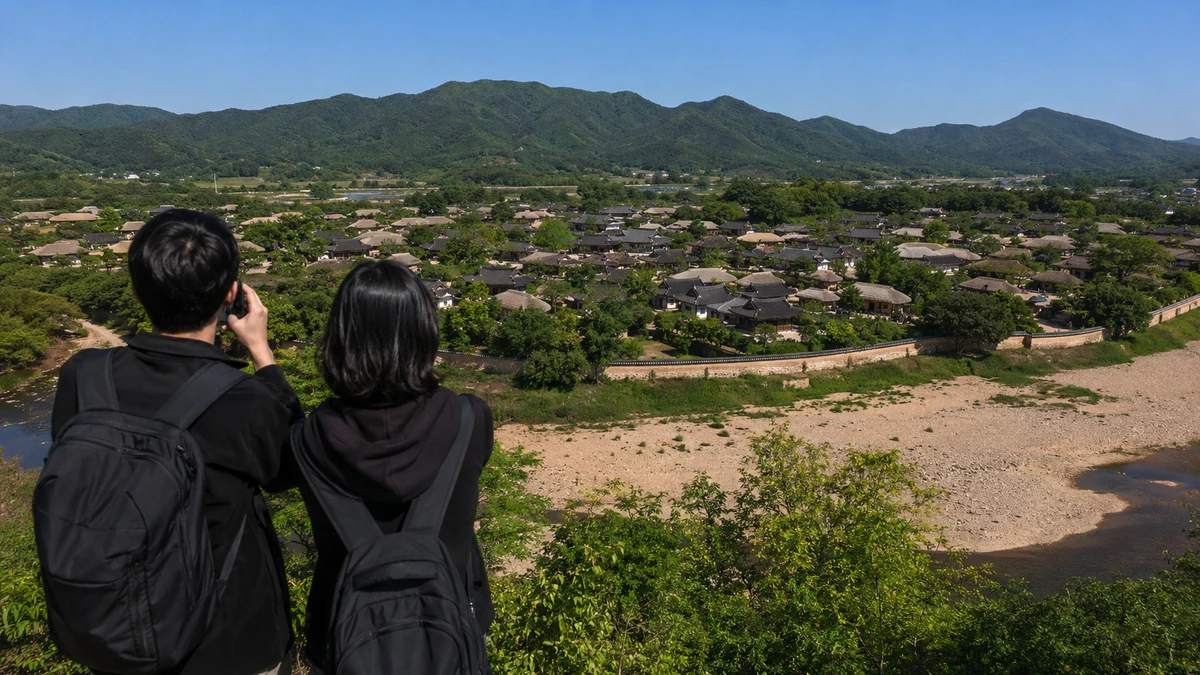
One of the city’s best-known sites is Hahoe Folk Village, a UNESCO-listed village where descendants of the same clan have lived for centuries. The village is known for its tiled-roof homes, river-bend setting and a landscape that feels preserved rather than reconstructed. For foreign visitors, it can offer something different from the polished efficiency of contemporary Korean cities: a window into how social hierarchy, architecture and daily life were once organized. It is not a theme park version of the past. It is a place where the past still shapes the present.
That distinction is important. In the United States, heritage tourism often centers on restored districts, museums or living-history sites where the past is carefully interpreted for visitors. In Andong, officials want to emphasize that the attraction lies in continuity. The village, the rituals, the food and even the style of lodging form part of a broader cultural ecosystem. This is why provincial planners appear so focused on packaging Andong not as a checklist stop, but as a place where visitors can spend time and understand Korean tradition as a lived environment.
The summit seems to have sharpened that message. Rather than treating the meeting as a one-day diplomatic event, officials are framing it as an international endorsement of Andong’s symbolic value. Hosting foreign leaders in a place like this sends a signal: the city is not simply scenic; it is representative. It stands for a Korea that is rooted, ceremonial and regionally distinct, even as the country remains one of the world’s most technologically advanced societies.
That contrast may be one of Andong’s greatest assets. International audiences often encounter South Korea through extremes: either glossy futurism or highly exportable pop culture. Andong offers a third image, one that broadens how Korea is understood abroad. For tourism planners, that is not just culturally meaningful. It is commercially useful.
From sightseeing to staying: building an immersive destination
The province’s tourism strategy appears to center on a simple but increasingly important idea: a destination becomes stronger when visitors have reasons to stay overnight, spend locally and build an itinerary around experience instead of quick consumption. In that sense, Andong’s appeal lies in how several traditional attractions can be linked into one narrative.
Officials specifically pointed to Hahoe Folk Village, the Seonyu Julbul Nori fire spectacle and stays in hanok, the traditional Korean house. Each element works on its own, but together they create a more immersive travel arc. A visitor might walk through the village by day, watch a nighttime performance rooted in older ritual and leisure traditions, then sleep in a hanok whose architecture embodies Korean ideas about space, seasonality and relation to the natural environment.
For readers unfamiliar with the term, a hanok is not just an old house. It refers to a traditional Korean home designed with features such as ondol, an underfloor heating system, and architectural principles that historically sought harmony with wind, light and terrain. A hanok stay can feel less like booking a boutique hotel and more like inhabiting a cultural philosophy, however briefly. That is part of why hanok lodging has become attractive to travelers looking for something beyond standard accommodation.
The same is true of Julbul Nori, a traditional fire play performance that combines communal festivity, landscape and spectacle. It is visually dramatic, but it also carries cultural memory, linking recreation to older village life and seasonal celebration. South Korean officials seem to understand that for global visitors, especially those used to carefully branded travel experiences, the emotional impact of a place often comes from these layered moments: the feel of old wood underfoot, the dark river setting, the communal anticipation before the lights flare over the water.
This is where Andong may align with broader shifts in international tourism. Travelers increasingly say they want fewer rushed stops and more meaningful stays. They want a reason to linger, to learn, to eat locally and to feel they have entered a place instead of merely passing through it. That trend is visible everywhere from rural Italy to small-town Japan to heritage trails across the American South. Andong’s local officials appear to be positioning the city within that same travel logic.
In other words, the summit may have supplied attention, but the province is trying to convert attention into duration. That is the real economic prize. Day-trippers buy snacks. Overnight guests buy dinner, drinks, souvenirs, second meals and, often, return tickets.
Courting Japanese visitors with practical upgrades
One of the clearest signs that this strategy is moving beyond symbolism is the province’s focus on Japanese travelers in particular. Officials say they plan to develop customized tourism products for Japanese visitors while improving infrastructure such as lodging, transportation, multilingual guidance and payment systems.
That may sound mundane compared with summit diplomacy, but in tourism, logistics often matter as much as scenery. A destination can be beautiful and historically rich, yet still fail to convert curiosity into repeat visits if transportation is confusing, booking systems are opaque or cashless payment is inconsistent. For international travelers, especially older visitors or first-time visitors outside a capital city, convenience can determine whether a trip feels welcoming or exhausting.
This is a lesson the global travel industry has learned repeatedly. The magic of a destination often lives in the moments between major attractions: finding the train platform, reading the museum sign, ordering dinner, checking into a room, buying a local bottle to take home. If those points of contact are smooth, visitors remember a place as accessible. If they are frustrating, even memorable landscapes can feel remote.
The emphasis on Japan is also significant. Rather than vaguely targeting all foreign tourists, provincial planners appear to be segmenting the market by geography, language and likely travel patterns. That is a more sophisticated approach than broad slogans about attracting overseas guests. Japan is a natural market for South Korea because of proximity, frequent air links, cultural familiarity and a long, sometimes complicated history that nonetheless supports robust people-to-people travel.
For American readers, there is an additional layer here. Korea-Japan relations carry deep historical sensitivities rooted in Japan’s colonization of the Korean Peninsula from 1910 to 1945. Political ties between Seoul and Tokyo can fluctuate sharply, and issues of wartime memory remain potent. That makes any effort to convert summit goodwill into regional exchange more notable. The province is not pretending history disappears. Instead, it is trying to create practical, mutually beneficial spaces where visitors can encounter each other through food, heritage and local culture rather than only through national political narratives.
If successful, that approach could serve as a model for other Korean regions. Tourism policy is increasingly less about glossy promotion and more about managing the visitor experience from search to arrival to checkout. By stressing multilingual signage and payment environments alongside cultural attractions, officials are signaling that they understand the difference between being interesting online and being easy to visit in real life.
Food and drink as soft power with a local accent
No tourism strategy is complete without food, and in Andong’s case, food may be one of the strongest bridges between local identity and international appeal. Provincial officials said the city’s culinary profile, including Andong jjimdak, Andong soju and dishes associated with historic family traditions, should be leveraged for exchange with Japan and for broader branding efforts.
For people new to Korean cuisine, Andong jjimdak is a braised chicken dish typically cooked with soy sauce, glass noodles and vegetables. It is savory, hearty and widely popular in South Korea, though its connection to Andong gives it regional branding power much like Kansas City barbecue or Philadelphia cheesesteaks do in the United States. Andong soju, meanwhile, is a traditional distilled liquor with a stronger, more artisanal identity than the mass-market green-bottle soju most international consumers know.
That distinction matters. Outside Korea, soju is often understood as a cheap, approachable drinking spirit commonly consumed with barbecue. Andong soju belongs to a different conversation, one closer to craft distilling and heritage alcohol. It carries a sense of place, method and lineage. In an era when consumers increasingly care about provenance, tradition and local production, that gives Andong a useful story to tell.
Officials are reportedly considering exchanges linking Andong soju with sake from Japan’s Nara Prefecture, along with promotional events in Japan and export consultations with invited buyers. On one level, that is straightforward economic development: market local agricultural and food products abroad. On another, it is a form of cultural diplomacy rooted in the dining table rather than the conference room.
Food works especially well in that role because it is immediate and memorable. A traveler may forget a speech but remember a meal. A buyer may understand a region’s brand faster through taste than through brochures. And when food is tied to ritual, family history and traditional techniques, it becomes more than a commodity. It becomes a narrative vehicle.
That is especially true in Andong, where elite family cuisine and inherited recipes form part of the city’s identity. In Korea, the phrase often translated as head-family cuisine refers to dishes associated with long-established lineages and ancestral households. These meals can reflect seasonal ingredients, ceremonial practices and cooking methods preserved through generations. For foreign audiences, that may sound rarefied, but it is not so different from the way Americans speak about Creole cooking, Appalachian preservation techniques or family-run wineries in California. The value lies in continuity and distinctiveness.
By linking tourism with food exports and culinary exchange, the province is acknowledging a reality many destinations have come to accept: travel no longer stops at the point of departure. If visitors return home looking for a bottle, a packaged ingredient or a restaurant collaboration, the destination extends into the marketplace. That is where tourism shades into trade, and where local identity can become an export brand.
Local diplomacy, national meaning
Perhaps the most intriguing part of the province’s plan is its emphasis on what might be called subnational diplomacy: the use of ties between local governments to build a cross-border cultural story. Officials said they are reviewing ways to deepen exchange with Japan’s Nara Prefecture, potentially through jointly produced comparison content focused on traditional culture, food and what has been described as a prime minister-themed route or narrative connection.
For an American audience, this may sound unusual, but it reflects a growing global trend. Cities, states and provinces increasingly act as diplomatic players in their own right, especially in tourism, economic development and cultural exchange. Sister-city programs are a familiar U.S. example. So are state trade missions or regional wine and food partnerships abroad. The difference here is that the cultural material is unusually rich, and the political symbolism unusually immediate.
Nara is one of Japan’s most historically significant regions, often associated with classical Japanese culture, temples and an older political center. Pairing it with Andong invites comparison between two places that each serve as repositories of national tradition. That can be a powerful tourism tool. Travelers often understand a destination more clearly when it is placed in relation to another one they can compare it with.
A Korea-Japan cultural comparison built around local history, cuisine and traditional alcohol could give visitors a more textured way to think about both countries. It shifts the frame from competition to conversation. Instead of asking which tradition is older or better, the material can ask how each region expresses heritage differently: in architecture, ritual, table manners, brewing, festival culture and landscape.
This approach also translates high politics into ordinary experience. A summit statement can feel abstract to most people. But a travel route, a shared food event or a regional cultural campaign makes diplomacy visible in ways citizens and visitors can actually use. In that sense, provincial officials are trying to convert international statecraft into something tangible: a train ticket booked, a hanok reserved, a dinner shared, a bottle purchased, a return visit imagined.
That is not a small ambition. It suggests that regional South Korea increasingly sees itself not just as scenery around national policy, but as a producer of policy outcomes in its own right. Tourism, in this framework, is not merely marketing. It is infrastructure, storytelling, cultural preservation and soft power rolled together.
What Andong signals about the next phase of Korean tourism
The biggest takeaway from the Andong story may be what it says about South Korea’s tourism evolution. For years, the country’s global image has been driven by recognizable exports: K-pop, prestige television dramas, cosmetics, gaming and urban style. Those industries remain enormously important, but they can overshadow another Korea that local governments are increasingly eager to foreground: provincial, historical, food-centered and rooted in place.
What officials in North Gyeongsang Province appear to understand is that international attention alone is not enough. A viral moment, a summit venue or a popular filming location only becomes economically meaningful if it is followed by careful design. That design includes transportation and signs, yes, but also narrative structure. Why should someone go to Andong instead of stopping in Seoul? Why stay a night rather than a few hours? Why bring home soju from this city rather than anywhere else? Why tell a friend to visit?
The answers the province is building are notably modern even though the content is traditional. The strategy is segmented, experience-based and export-aware. It links tourism to agriculture, hospitality to trade and diplomacy to local branding. It treats traditional culture not as static inheritance, but as usable contemporary capital.
There is another lesson here for English-speaking readers who mostly encounter Korea through entertainment headlines. The Korean Wave has matured. It is no longer just about songs, streaming hits or beauty routines. It also includes the global circulation of older local identities once thought too specific or too rural to travel well. In fact, those very qualities may now be the selling point.
That is why the Andong moment matters. It suggests that South Korea’s next tourism frontier may not depend on inventing something entirely new. It may depend on explaining, packaging and supporting what has long been there: a village, a performance, a house, a recipe, a bottle, a river at night. The summit gave Andong visibility. What provincial officials do next will determine whether that visibility fades like a diplomatic flash or settles into something more lasting: a place on the map for travelers looking to understand a deeper, slower and more regionally textured Korea.
For American travelers and readers, the appeal is easy to recognize. Every country has places that carry its memory more densely than its capitals do. In South Korea, Andong is making a case that it is one of them.
Comments
Post a Comment