Cambodian Court Gives Life Sentences to Six Chinese Nationals in Killing of South Korean Student, Spotlighting a Brutal Transnational Scam Network
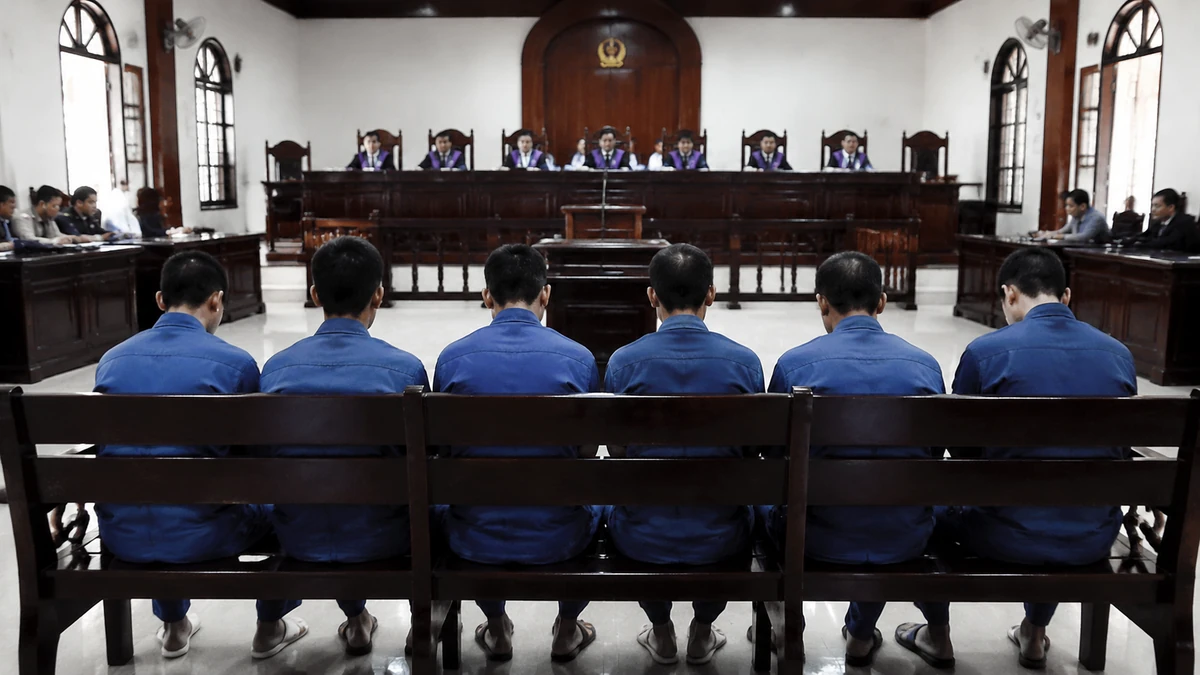
A life sentence in a case that reaches far beyond one courtroom
A Cambodian court has sentenced six Chinese nationals to life in prison in the torture and killing of a South Korean college student, a ruling that underscores both the severity of the crime and the growing alarm surrounding violent scam compounds in Southeast Asia.
The decision, handed down this week by a provincial court in Cambodia’s southern Kampot region, is being read as more than a punishment for a single homicide. Prosecutors had brought charges including murder, torture and organized fraud, and the court convicted all six defendants and imposed the maximum penalty available: life imprisonment. In practical terms, that means the Cambodian judiciary treated the case not as an isolated act of violence, but as part of a larger criminal enterprise.
For American readers, it may help to think of this not simply as a murder abroad, but as a case sitting at the intersection of organized crime, human trafficking, cyber fraud and diplomatic pressure. Over the past several years, law enforcement agencies, human rights groups and governments from Washington to Seoul have warned that parts of mainland Southeast Asia have become hubs for sprawling scam operations. These operations often lure workers or victims across borders, confine them in guarded compounds and use coercion, debt bondage or outright violence to keep the machinery running.
That larger reality is what gives this case its international weight. The victim was a young South Korean student. The convicted men were Chinese nationals. The crime took place inside Cambodia. And the alleged criminal ecosystem behind it has drawn concern from multiple governments, including the United States and Britain, which have separately increased pressure on Cambodia over illicit fraud networks operating on its soil.
In South Korea, the case has been especially wrenching because the victim was a university student, a detail that immediately made the story feel personal to many families. In a country where overseas study, travel, job-hunting and international networking have become routine parts of young adulthood, the idea that an ordinary student could end up trapped in the orbit of a violent foreign scam operation has landed with unusual force.
The ruling does not end the broader problem. But it does send a message: authorities can no longer pretend that these compounds are mere online fraud dens or distant regional nuisances. In this case, the violence was alleged to be systematic and fatal, and the court appears to have treated every convicted participant as fully accountable.
How the case became an international story
According to the case summary reported by South Korean and Cambodian media, the killing happened last August inside what Korean reports described as a “crime compound” in Cambodia. That phrase deserves some explanation for readers outside Asia. In Korean coverage, terms such as “beomjoe danji,” or crime complex, and “sagi jak-eopjang,” roughly meaning scam workshop, refer to concentrated compounds where illegal operations are organized at scale. These are not just random apartments where a few fraudsters make phone calls. They are often described as secure sites with management structures, financial backing, communications systems and layers of enforcement.
In the American imagination, the word “compound” may call up a cartel safe house, a militia enclave or an industrial site under private guard. None of those analogies is perfect, but they help explain why the term carries such dread. These places are alleged to combine white-collar crime and physical coercion. Online fraud may be the business model, but violence is the management tool.
The six defendants were reportedly arrested in Phnom Penh, the Cambodian capital, on Nov. 27 of last year. From there, the case moved through investigation, prosecution and trial, culminating in this week’s sentencing. The fact that all six received identical life terms is significant. Courts do not always distribute blame evenly in multidefendant cases. Here, the equal punishment suggests the court viewed the crime as a coordinated act rather than a hierarchy in which only one or two men bore the real responsibility.
The nationality mix is also part of what turned this into a regional story. The victim was Korean, the perpetrators Chinese, and the host country Cambodia. That combination reflects a pattern that has become increasingly common in Asian organized crime: criminal networks that recruit, move money and target victims across multiple countries, exploiting the seams between legal systems.
For U.S. audiences, there is a useful comparison in the way fentanyl trafficking or online financial scams often span borders, moving through a chain of jurisdictions that makes accountability harder. But the Southeast Asian scam-compound phenomenon adds another layer. It is not just cross-border crime. It is often place-based crime, centered in physical sites where people can be confined, intimidated and punished.
That helps explain why the case resonated well beyond South Korea. It was not simply the killing of a foreign student, tragic though that would be on its own. It was an illustration of how transnational criminal structures can absorb individual lives, turning mobility, technology and weak enforcement into a deadly mix.
What the charges say about the nature of the crime
One of the most important details in the case is the combination of charges: murder, torture and organized fraud. Taken together, they tell a story far more disturbing than a single act of interpersonal violence.
If a defendant is charged only with homicide, the public may reasonably wonder whether the death followed an argument, a robbery gone wrong or some other discrete event. But when prosecutors add torture and organized fraud, the case begins to look more structural. It suggests that the victim’s suffering was not incidental. It may have been bound up with the operation of a criminal system.
That is why this ruling matters as a legal signal. It indicates that Cambodian authorities were prepared to connect the violence to the broader environment in which it allegedly occurred. In many countries, including the United States, prosecutors often try to show that a killing tied to racketeering, trafficking or organized fraud is not merely a private crime but part of a business model built on coercion. Cambodian prosecutors appear to have made a similar argument here.
There is also a moral dimension to the verdict. By sentencing all six men to life terms, the court sent the unmistakable message that participation in this kind of system carries the gravest consequences. That matters because organized criminal networks often rely on diffusion of responsibility. The boss orders, the enforcer strikes, the recruiter lies, the money handler collects, and each person can claim to be only a small cog. Courts cut through that logic when they assign equal culpability to participants in a jointly executed crime.
For policymakers and diplomats, the case is likely to serve as a reference point in future discussions about enforcement. A tough sentence in a high-profile case does not erase the existence of a broader network, but it can create precedent, deterrence and political pressure. It may also reassure foreign governments that their citizens’ cases will not simply disappear into opaque local systems.
Still, sentencing is the easiest part of the story to understand and the hardest part to mistake for a solution. A courtroom can punish six defendants. It cannot, by itself, dismantle the ecosystem that allowed the alleged abuse to happen in the first place.
Why scam compounds in Southeast Asia have become a global concern
Over the past few years, the phrase “scam compound” has entered the vocabulary of diplomats, aid groups and security analysts following Southeast Asia. These operations, often linked to cyber-enabled fraud, have been reported in countries including Cambodia, Myanmar and Laos. They are accused of running everything from romance scams and cryptocurrency fraud to fake investment platforms and online impersonation schemes.
Americans have increasingly encountered the downstream effects without always knowing the source. A text from a stranger that turns into an investment pitch. A social media message that slowly escalates into a request for money. A polished trading app that looks real until the funds vanish. U.S. law enforcement has warned repeatedly about these schemes, especially so-called “pig butchering” scams, in which victims are groomed over time before being financially drained.
What has shocked investigators is that some of the people running these operations are themselves coerced laborers, trafficked workers or captives who were lured by fake job offers. In those settings, violence is not an exception to fraud; it can be one of its operating principles. Beatings, confinement and threats are reportedly used to force productivity or punish resistance.
That context is crucial in understanding why the Korean student’s death has been viewed as emblematic. The story is not just about a murder that happened to occur inside a criminal site. It is about a criminal model in which deception and physical brutality may be tightly intertwined.
Cambodia has been under growing scrutiny over these networks. International pressure has mounted as foreign governments and advocacy groups accuse authorities of failing, at least for years, to fully curb illicit compounds that prey on both victims and workers. In recent months, that pressure has included sanctions and other punitive measures by Western governments targeting actors linked to fraud operations and related abuses.
For Cambodia, the political stakes are considerable. The country wants foreign investment, tourism and international legitimacy. But the persistence of scam compounds threatens to brand it, fairly or not, as a permissive environment for organized cybercrime. High-profile prosecutions therefore serve not only judicial purposes but also diplomatic ones. They tell outside observers that the government is responding, even if the durability of that response remains an open question.
For the United States, the issue matters because American citizens are frequent targets of online financial scams, and because the networks behind them often lie beyond easy reach of U.S. law enforcement. When Washington pressures governments in the region to act, it is partly an anti-fraud agenda, partly a human rights agenda and partly a recognition that cyberscams have become a transnational public safety threat.
Why this case hits so hard in South Korea
South Korea is often viewed abroad through the glossy lens of K-pop, K-dramas, beauty brands and technology exports. Those are real and important parts of the country’s global identity. But this case is a reminder that a more internationally connected South Korea also means more exposure to international risk.
In Korea, overseas travel and international career ambitions are commonplace, especially among students and young professionals. Studying abroad, chasing work opportunities overseas or building cross-border social networks is no longer unusual; it is part of normal middle-class life. That is why the victim’s status as a college student carries such emotional force. He was not an obvious underworld figure or a reckless adventurer. He represented a generation for whom global mobility is ordinary.
There is also a broader public debate in South Korea about the state’s responsibility to protect citizens abroad. Traditionally, that has meant consular support, travel advisories and diplomatic intervention in emergencies. But cases like this expose the limits of those tools. When threats come from organized networks operating in semi-protected spaces, citizen protection depends not only on embassy hotlines or passport services but on intelligence-sharing, international policing and the willingness of host governments to aggressively prosecute.
South Korean media have followed the case closely because it touches on anxieties familiar to many Korean families: online vulnerability, overseas safety and the fear that young people can be pulled into danger through seemingly mundane points of contact. A digital message, a job lead, a travel opportunity or an online acquaintance can become the first step into an environment that is difficult to escape.
That concern has parallels in the United States. American parents worry about sextortion, trafficking through fraudulent recruitment and online scams aimed at teenagers or college-age adults. The platforms differ, the geography differs, but the underlying fear is recognizable: that global connectivity makes opportunity easier and predation easier at the same time.
For South Korea’s government, the case is also diplomatically sensitive. Seoul has to show that it is advocating for its citizens while working with foreign authorities in a complex legal environment. A life sentence for the convicted defendants gives Korean officials some evidence of accountability, but it also increases pressure to push for deeper action against the networks behind such crimes.
The wider crackdown and the question of whether it will last
The court ruling comes amid a broader campaign against illicit operations in Cambodia. Reports cited in Korean coverage say the Cambodian government has also moved against figures alleged to be connected to major criminal compounds, including a prominent businessman who was reportedly arrested earlier this year and sent to China. That kind of move is significant because it suggests attention is shifting beyond low-level operators to the backers and facilitators who provide space, money, logistics and protection.
That distinction matters. Organized fraud on this scale does not function because a handful of men buy laptops and improvise. It requires real infrastructure: buildings, transportation, communications, money channels and, in some cases, corrupt or complicit intermediaries. Going after enforcers without touching financiers and patrons is like arresting call-center staff while ignoring the executives leasing the office floors, wiring the accounts and hiring security.
Whether Cambodia can sustain a deeper crackdown is the real test. In many parts of the world, governments respond to international outrage with bursts of enforcement that fade once headlines move on. The challenge is not staging a raid or securing a conviction in a horrific case. It is creating a durable system in which these operations become harder to establish, harder to shield and less profitable to run.
There are reasons for skepticism. Transnational criminal networks are adaptive. When pressure rises in one jurisdiction, operations can migrate, fragment or rebrand. Assets can be hidden behind shell companies or local partners. Workers and victims can be moved quickly. And because the fraud itself is digital, the physical site is only part of the business.
Still, high-profile sentences do matter. They change the risk calculations of participants. They strengthen the hand of reform-minded officials. They give foreign governments a concrete case to point to when demanding more action. And they remind the public that what may look like faceless online deception can rest on very tangible systems of violence.
For American readers, the lesson is not that Southeast Asia is uniquely dangerous or alien. It is that 21st-century crime increasingly blends the digital and the physical in ways that cross borders with ease. A scam text can originate in one country, be managed from another, target a victim in a third and be enforced by violence in a fourth. That is the world this case lays bare.
The life sentences imposed in Cambodia are, in that sense, both a moment of justice and a warning. Justice, because a court has imposed the heaviest available punishment on six men convicted in the torture and killing of a young foreign student. A warning, because the crime appears to have emerged from a system much larger than any one defendant or any one trial.
For South Korea, this is a national tragedy with international implications. For Cambodia, it is a test of whether law enforcement resolve can outlast diplomatic embarrassment. And for the rest of the world, including the United States, it is a stark reminder that online fraud is no longer just about lost savings or stolen identities. In its most extreme form, it is tied to captivity, abuse and death.
That is why this verdict is likely to resonate far beyond Phnom Penh or Seoul. It marks accountability in one case, but it also exposes a hard truth about modern transnational crime: the people behind a glowing phone screen may be operating inside a system of fear, and the consequences can be brutally real.
Comments
Post a Comment