An 8-Minute Police Escort in South Korea Helped Save an Unconscious 4-Year-Old — and Offered a Window Into How Everyday Public Safety Works
A desperate stop at the nearest police post
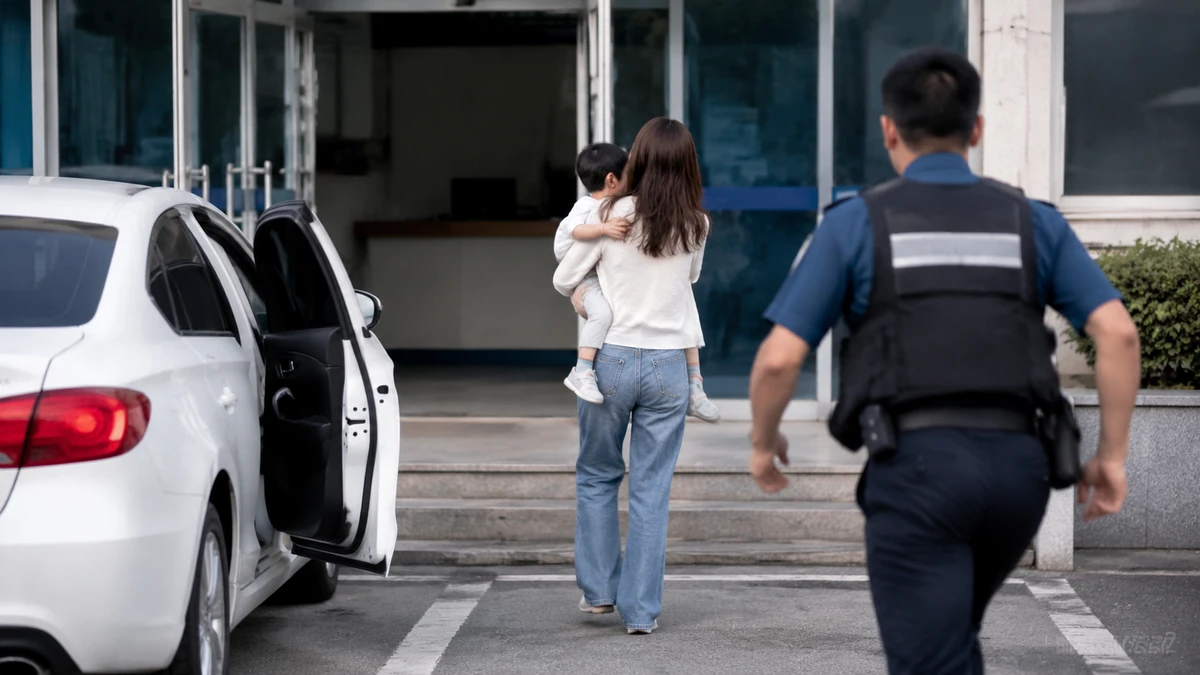
In the middle of an ordinary weekday afternoon, a mother in South Korea made the kind of split-second decision that parents everywhere hope they will never have to make. She was driving her 4-year-old son toward a children’s hospital when the boy’s condition suddenly worsened. According to South Korean police, the child lost consciousness and began foaming at the mouth inside the car. Instead of trying to complete the trip on her own, the woman veered into the parking lot of a small neighborhood police post in Pyeongtaek, a city south of Seoul, and ran inside asking for help.
What happened next took about eight minutes. Police officers at the Jinwi Police Substation quickly assessed the emergency, started a patrol car and escorted the child and his mother to a hospital in nearby Osan, cutting what could have been a roughly 20-minute drive to less than half that time, according to the Gyeonggi Nambu Provincial Police Agency. Authorities publicly disclosed the case on June 23, describing it as an example of rapid on-the-ground decision-making in a medical crisis.
On paper, the facts are simple: a woman in distress, a child in medical danger, two officers who moved quickly, and a hospital reached faster than expected. But the story has drawn attention in South Korea for a reason that goes beyond the emotional pull of a child rescue. It highlights something more structural and, in many ways, more universal: how ordinary public institutions function in the first crucial minutes of a crisis.
For American readers, the closest analogy might be a parent driving toward an emergency room, then pulling into the nearest sheriff’s substation, local precinct or state police barracks because a child in the back seat suddenly stops responding. The drama is familiar. So is the underlying question: When seconds matter, what public institution is close enough — and trusted enough — to bridge the gap between home, road and hospital?
In this case, the answer was not an ambulance dispatched from afar or a large government office downtown. It was a neighborhood police outpost, the kind of place many people might ordinarily associate with reporting a theft, asking for directions or handling minor local disturbances. For a few urgent minutes in Pyeongtaek, it became something else: the first link in a life-saving chain.
What happened in Pyeongtaek
The incident took place at about 3:15 p.m. on May 25, according to the police account summarized by Yonhap News Agency. A passenger vehicle pulled abruptly into the parking lot of the Jinwi Police Substation. The driver, identified only as a woman, rushed into the building and asked officers for immediate help. Her 4-year-old son, she told them, had suddenly lost consciousness while she was on the way to a children’s hospital in Osan.
The officers on duty were identified as Lt. Kang Min-sung, the head of a team at the substation, and Senior Patrol Officer Lee Chan-woo. Rather than prolong the interaction with extensive questioning or formal intake, police said, the officers acted at once. They used a patrol car to escort the family to the hospital, getting there in eight minutes. Authorities said the route could have taken about 20 minutes under ordinary conditions.
That time difference is at the center of why the case resonated. In most daily life scenarios, shaving 12 minutes off a trip might seem helpful but not extraordinary. In a medical emergency involving an unconscious child, it becomes the entire story. Time in emergencies is not measured the same way it is in commuter traffic or errand-running. A short delay can feel endless. A short gain can be decisive.
The police agency’s retelling of the event also emphasized the sequence of judgment. The mother recognized that continuing alone might not be the fastest or safest option. The officers recognized that the situation required immediate movement rather than bureaucratic process. The hospital then became the destination within a chain already in motion. The rescue, in other words, was not only about speed. It was about how quickly several people understood their roles.
South Korean officials did not release extensive medical details about the child’s condition or subsequent treatment in the summary provided to the press. The public message instead focused on the transport itself — the moment between crisis and care, and how local police responded when a citizen turned to them in desperation.
Why a police substation matters in South Korea
To understand why this story has landed so strongly in South Korea, it helps to understand what a local police substation, known in Korean as a pachulso, represents. These neighborhood-level posts are smaller than full police stations and are woven into everyday urban and suburban life. They are not just symbols of law enforcement in the abstract. In practice, they often function as one of the most accessible points of contact between the public and the state.
Americans may think of police infrastructure primarily in terms of city precincts, county sheriffs or 911 response systems. South Korea has those broader law enforcement structures too, but the pachulso plays a particularly visible role in daily life. Residents may stop by for help with lost property, local disputes, directions, missing-person reports or immediate neighborhood concerns. In that sense, these outposts often sit closer to the rhythms of ordinary life than a distant central headquarters would.
This is part of what makes the Pyeongtaek episode notable. The mother did not arrive at a hospital, a fire station or a large emergency operations center. She arrived at a familiar, nearby civic space embedded in her route. The substation served as a point of conversion: a place where private panic became public response.
That role is worth pausing over. In many societies, people experience government most vividly not through speeches, national laws or headline-grabbing policy debates, but through small encounters at the local level. A school office that solves a problem. A sanitation worker who keeps a neighborhood functioning. A transit employee who helps in a crisis. A police officer who makes a judgment call. These moments build — or erode — public trust far more directly than abstract rhetoric does.
In South Korea, where dense urban development and tightly connected road networks can place public facilities relatively close to one another, the idea of a neighborhood police office as an immediate safety node is especially tangible. The Pyeongtaek case showed how a substation can become more than a place to report a problem; it can become a place from which a rescue begins.
The meaning of 20 minutes versus 8
There is a reason the numbers in this story — 20 minutes and 8 minutes — have become its defining shorthand. They translate a frightening event into something concrete and easy to grasp. In journalism, numbers often do more than provide data. They create scale. They tell readers how to feel the weight of a situation.
In this case, 20 minutes represents the world as it was supposed to work: a parent driving to a hospital, traffic unfolding as it does, distance remaining distance. Eight minutes represents what happened when the state intervened at exactly the right moment. That gap is not merely mathematical. It captures the difference between isolation and assistance, between helpless waiting and coordinated action.
For parents, especially, the emotional logic of those numbers is instantly legible. Anyone who has sat in a car with a sick child knows how quickly a routine drive can turn into a tunnel of fear. The same red lights, intersections and lane changes suddenly feel hostile. Every delay takes on moral weight. Every minute demands explanation. In that state of mind, reducing a drive by more than half is not a convenience. It is relief, possibility and hope compressed into a single statistic.
Emergency medicine professionals often say that outcomes can hinge on what happens before a patient even reaches the hospital. Americans are familiar with concepts like the “golden hour” in trauma care, or the need for rapid intervention during stroke, cardiac arrest or severe allergic reactions. Although officials have not characterized the boy’s exact medical episode in those terms, the broader principle is recognizable: speed is not a secondary factor in emergencies. It is a form of treatment support.
The South Korean police agency appears to have understood that symbolic power when it publicized the case. A story like this communicates something specific to the public: government authority is not only about enforcement or punishment. It is also about shortening dangerous time. In a period when public institutions in many democracies are under scrutiny, stories that illustrate competence at street level carry real weight.
A mother’s decision and the architecture of trust
The mother’s decision to turn into the police substation may have been instinctive, but it also reveals something deeper about how public safety is imagined in South Korea. In a crisis, people do not always move toward the ideal destination. They move toward the nearest workable one. The hospital may have been the ultimate goal, but the police post became the bridge that made reaching it more plausible.
That decision reflects a kind of civic map that people carry in their heads. We all have one, whether we live in Seoul, Chicago or a small town in Texas. We know where the emergency room is. We know where the nearest firehouse might be. We know which roads clog at certain hours. And, crucially, we know which institutions we think will respond if we physically show up in distress.
Trust is often discussed in sweeping national terms, but in practice it is profoundly local. A citizen trusts that a nearby public office will not turn them away, waste precious minutes or become paralyzed by procedure. The Pyeongtaek incident suggests that, in that moment at least, the mother believed the closest state institution could still help even though it was not a medical one. The officers’ response reinforced that belief.
There is also a broader lesson here about emergency systems. Public safety is rarely the product of a single institution acting alone. It is usually a relay. A family recognizes distress. A nearby public office responds. Police clear a path. Hospital staff take over. Each handoff matters. Each delay compounds risk. Each competent decision increases the odds that the next link can do its work.
That is why stories like this resonate far beyond their local geography. They are not simply uplifting anecdotes about good people doing the right thing. They are case studies in how civic infrastructure feels from the inside — from the perspective of the person who needs it right now, without warning, while something precious is slipping away.
What this says about everyday safety, not just one rescue
The Pyeongtaek case was reported alongside other public-safety stories in South Korea, including a much grimmer account from South Chungcheong province, where an elderly person who had gone out to gather wild bracken was later found dead after a search. The two cases are obviously different in circumstance and outcome. One ended with a successful emergency transport; the other ended in loss. But together, they illuminate the same beat of daily journalism: the thin line between routine life and sudden danger.
That is often the true subject of local news, whether in South Korea or the United States. Not grand ideology, but vulnerability. Not abstract policy, but the places where systems either meet people effectively or fail to get there in time. The stories that matter most to readers are often those that show how institutions function at the exact point where ordinary life breaks down.
In South Korea, as in the United States, there is ongoing public debate about policing, state power and the obligations of local government. But the practical legitimacy of those institutions is often formed in less ideological settings: a roadside stop, a welfare check, a missing-person search, a late-night call from a frightened resident, or a mother sprinting into a neighborhood police office with an unconscious child in her car.
This is one reason the episode has significance beyond its emotional appeal. It presents a version of policing that many communities say they want more of: responsive, situational, rooted in immediate public need and measured by whether it helps people survive a crisis. It does not erase larger debates about law enforcement in either South Korea or the U.S. But it does show how public trust can be built in practical, highly visible ways.
The case also underscores the importance of physical proximity. In modern cities, infrastructure is often discussed in terms of highways, rail systems, power grids and broadband networks. Yet social infrastructure — the placement of public offices, health facilities and emergency response nodes — can be just as important. The fact that the rescue began not in an ambulance bay but in a police parking lot says something about how life-saving systems are distributed across everyday space.
Why international readers should care
For readers outside South Korea, and especially for American audiences used to seeing Korean news filtered largely through the lenses of geopolitics, North Korea, semiconductors or K-pop, this story offers a different and more intimate entry point. It is about no celebrity and no diplomatic standoff. It is about the texture of civic life — the mundane but essential ways a society organizes help.
That matters because South Korea is often portrayed abroad in extremes: as a global pop-culture powerhouse, a technological giant, a politically tense neighbor to the North or a highly competitive society under strain. All of those frames contain truth. But they can crowd out another reality: the daily workings of local institutions and the ways citizens encounter them not as abstractions, but as doors they can run through in an emergency.
There is also something broadly recognizable in the emotional structure of the story. Every country has its own version of the question at its center: If the worst happens in transit, on a road between destinations, who helps first? In the United States, answers vary dramatically depending on geography, wealth, traffic, health care access and emergency response capacity. In rural areas, the nearest help may be miles away. In urban centers, response may be physically close but slowed by congestion or overstretched systems. That is part of why a story about eight minutes can feel so resonant from half a world away.
The Pyeongtaek rescue does not prove that every emergency in South Korea ends well, nor does it suggest that public systems are uniformly effective. No single anecdote can do that. What it does show is smaller and perhaps more meaningful: one moment when a citizen reached for the nearest public institution and it worked as hoped. That is not a policy paper. It is not a campaign slogan. It is a lived example.
In the end, the story’s power lies in its compression. A mother, a child, two officers, one route, eight minutes. Within that narrow window sits a broader truth about modern societies: people experience the value of government most clearly not in speeches or statistics, but in whether someone responds when time is running out. In Pyeongtaek, according to South Korean authorities, they did.
That is why this episode has drawn notice far beyond the immediate relief that the child reached care more quickly. It is a reminder that public trust is often built in the smallest units of time and distance. A nearby office. A fast decision. A road cleared just enough. In a crisis, those modest civic facts can become the difference between panic and possibility.
Comments
Post a Comment