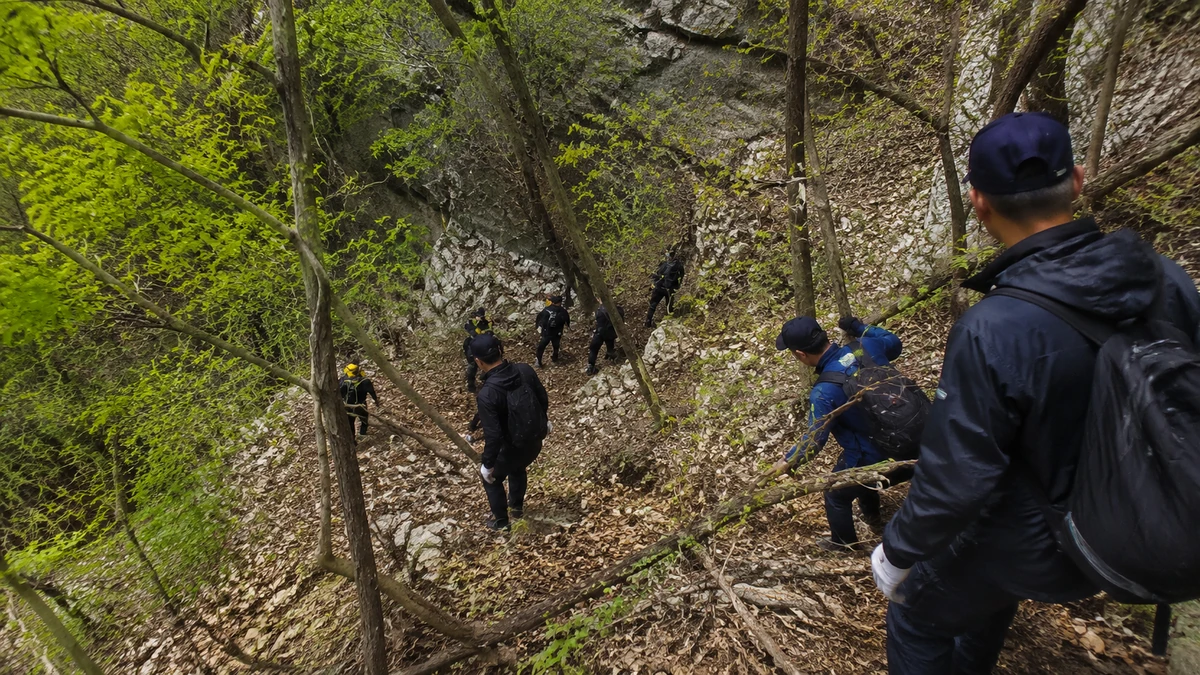
A routine trip into the hills ends in tragedy
An elderly resident in South Korea was found dead after disappearing while gathering wild bracken fern on a wooded hillside, a tragedy that authorities say unfolded in the kind of ordinary rural setting many locals know well. According to South Korean police in Nonsan, a city in South Chungcheong Province, the man, who was in his 80s, was discovered around noon on April 23 below a cliff roughly 10 meters, or about 33 feet, down a slope in a low mountain area in the district of Bujeok-myeon.
The search began a day earlier after a resident reported at about 10:15 a.m. that the man, who had been picking bracken in the hills, was nowhere to be seen. Police continued searching into a second day and ultimately found him dead, according to the South Korean news agency Yonhap. Officials have not publicly released extensive details beyond the location and circumstances of the disappearance, but the recovery site alone suggests how quickly a familiar outing can turn fatal in uneven terrain.
For American readers, the broad outline may sound recognizable even if the cultural details are not. In the United States, local news outlets regularly report on older hikers, mushroom hunters, hunters or berry pickers who go missing in wooded areas they know well. What makes this case distinctly Korean is the activity itself: gathering seasonal mountain vegetables, including bracken fern, is not a niche pastime but part of a longstanding food culture and rural rhythm of life. That context matters, because this was not an extreme sport, an expedition or a backcountry adventure. It was a routine seasonal task, one that can appear deceptively safe precisely because it is so common.
That tension between familiarity and danger is at the heart of why the story has resonated in South Korea. It is not simply a missing-person case or an isolated accident. It is also a reminder that in an aging society, the hazards of daily life are often found not in dramatic disasters but in customary activities carried out close to home.
What bracken gathering means in Korea
To understand why this story carries weight beyond a single tragic death, it helps to understand what the man was doing. The Korean word “gosari” refers to young bracken fern shoots, a spring edible that is commonly collected, dried, cooked and served in a range of dishes. Americans may be most likely to encounter it in bibimbap, the Korean mixed rice dish that has become widely familiar in the United States, where bracken often appears as one of several seasoned vegetable toppings.
But in Korea, gosari is more than an ingredient in a restaurant meal. In many rural and small-town communities, foraging for spring greens and mountain vegetables remains woven into everyday life. Families gather herbs, shoots and greens in nearby wooded areas, both for personal consumption and, in some cases, to supplement household income. The practice sits at the intersection of food culture, seasonal tradition and local knowledge. It can also be social, with neighbors or relatives comparing locations, timing and harvest quality the way American gardeners might talk about heirloom tomatoes or morel hunters might discuss a good patch after a warm spring rain.
Because of that familiarity, the act of entering a “yasan,” or low mountain/hill area, may not feel especially risky to people who have done it for decades. South Korea is a mountainous country, and hillsides and forested slopes are deeply integrated into both daily life and national identity. Unlike the American image of wilderness as distant and remote, many Korean mountains and wooded ridges exist right at the edge of towns, villages and farmland. A person can leave home, walk into a nearby hillside and be foraging within minutes.
That accessibility can obscure danger. These are not necessarily manicured parks with clear trail systems, emergency call boxes and regular ranger patrols. A hillside used by local residents may be navigable in a general sense but still contain steep drops, loose earth, dense brush and blind spots that complicate a rescue. In a country where generations have learned to move through mountainous terrain as part of ordinary life, familiarity can sometimes substitute for caution until something goes wrong.
A search shaped by terrain, time and community
The facts released by authorities are straightforward but telling. A resident noticed the man was missing and alerted authorities. Police then mobilized a search that extended into a second day, including the use of investigative personnel, before locating the body around midday on April 23. Even in the absence of a detailed public timeline, those facts point to several realities about rural search operations.
First, the search appears to have begun not through technology but through observation: someone noticed that a person who should have been visible or should have returned was gone. In smaller communities, especially among older residents, safety often still depends on precisely that kind of social awareness. A neighbor knows who went into the hills. A local resident notices someone has not come back when expected. The first line of public safety is not always a high-tech tracking system; often it is simply another person paying attention.
Second, the effort took time. That matters. To readers used to GPS pings, smartphone location sharing and near-constant digital connectivity, a search lasting into a second day can sound surprising. But in wooded terrain, even a short physical distance can become extraordinarily difficult to search. A cliff or drop-off may not be visible from above. Dense vegetation can conceal a person from view. Informal footpaths, game trails and foraging routes do not provide the clear directional logic that paved roads or marked urban spaces do.
Third, the location where the man was found, below a drop of about 33 feet, underscores how dangerous topography can be in a setting that might look modest on paper. This was not a Himalayan ascent or a dramatic alpine accident. It was a low mountain area near a local community. Yet a fall in such a place can be just as deadly, especially for an older adult. Searchers in these environments must account for slopes, ledges, ravines and patches of ground that are stable until suddenly they are not. The difficulty is compounded when the last confirmed location is general rather than precise.
For police and emergency responders, such cases often require balancing urgency with methodical coverage. The decision to continue searching into a second day reflects the reality that rural disappearances can quickly absorb public resources, especially when the missing person is elderly and the terrain is difficult. In South Korea, as elsewhere, a missing person in a mountainous area is never just a private family crisis. It becomes a community concern and a public response problem at the same time.
The broader safety question in an aging society
South Korea is one of the world’s fastest-aging societies, and that demographic reality frames how stories like this are understood domestically. The man who died was in his 80s, but that fact does not suggest passivity or isolation. Quite the opposite: many older South Koreans, particularly in rural areas, remain highly active in farming, household labor, food preparation and seasonal outdoor routines well into advanced age. Their lives do not necessarily conform to the American stereotype of old age centered on retirement communities, assisted living or sharply reduced physical activity.
That vitality is important to acknowledge, because it is part of what makes the issue complicated. The problem is not that older adults are engaging in life. The problem is that the ordinary environments in which they remain active can carry unrecognized or underestimated risks. A hillside path used for years may become more hazardous as balance, stamina or reaction time changes. A short solo outing may still feel manageable, even when it poses higher stakes than it once did. Rural independence, which many communities value deeply, can exist side by side with vulnerability.
In the United States, similar conversations often follow stories involving older drivers, seniors living alone in remote areas, or elderly hikers who set out on familiar routes and do not return. South Korea’s version of that debate increasingly centers on everyday mobility and safety within aging local communities. The concern is not only major disasters or institutional care. It is the gap between active daily life and the safety systems surrounding it.
Cases like this also raise questions that do not lend themselves to easy policy fixes. Should older residents be discouraged from solo foraging or fieldwork? Should local governments expand safety education, encourage buddy systems, or map risk zones in frequently used hillside areas? Would such efforts be welcomed as protective, or rejected as intrusive by people who have navigated those spaces their entire lives? Those are the practical, sensitive questions that often follow tragic incidents in aging rural societies.
There is also a cultural dimension. In many Korean communities, older residents are not merely retirees; they are knowledge holders. They know seasonal cycles, edible plants, local topography and food traditions that younger generations may be losing touch with. When accidents happen during activities like bracken gathering, the loss is therefore felt not only as an individual death but also as a rupture in a way of life that is already under pressure from depopulation, urbanization and demographic change.
Why “ordinary” mountain spaces can be so dangerous
To many outsiders, the phrase “mountain foraging” may conjure images of remote wilderness. In much of South Korea, however, the danger lies precisely in the ordinariness of the setting. The nation’s hilly landscape is densely inhabited and heavily used. People hike before work, climb local peaks on weekends, visit hillside graves during family observances and gather edible plants in season. The mountain is not a distant frontier; it is an extension of neighborhood life.
That everyday closeness can foster a kind of psychological downshifting. A place that is nearby, familiar and repeatedly visited may not trigger the same mental checklist as a special expedition. People may head out without telling others exactly where they are going, without carrying enough water, without a fully charged phone or without protective gear, because the outing is framed as routine rather than risky. For older residents who have spent decades doing the same activity, the very repetition of the habit can reinforce the sense that it is manageable.
Yet terrain does not become safer because it is local. A hidden ledge, slick patch of soil, overgrown edge or unstable step can be enough to cause a fall. In the spring, when foraging is active, undergrowth begins to thicken, visibility can be uneven and the impulse to focus on the ground for edible shoots may reduce attention to footing. A person bending, reaching or stepping off an informal path can quickly become disoriented or lose balance. A drop of 10 meters is not enormous by mountaineering standards, but it is more than enough to be fatal.
In the U.S., there are parallels in Appalachian hollows, wooded areas near farming communities, or even suburban preserves where local residents feel comfortable enough to underestimate risk. Search-and-rescue teams often emphasize that people get lost or injured not only in spectacular landscapes but also in familiar ones. The Nonsan case fits that pattern. It illustrates how danger is often embedded in the landscapes people trust most.
The role of neighbors and the public response
One striking detail in the case is that the disappearance was reported by a resident who realized something was wrong. That may sound minor, but it is central to how safety still functions in many rural Korean communities. Despite rapid modernization and a hyperconnected national image built around Seoul’s technology culture, local life in many parts of the country still depends on interpersonal awareness. A person who does not return on time is noticed. A deviation from routine is recognized. In emergencies, that informal social net may determine how quickly authorities are called.
That does not romanticize rural life; it simply reflects reality. Community attentiveness can be lifesaving, but it also exposes the limits of systems when people are alone in difficult terrain. Once a report is made, the burden shifts to police and emergency personnel. In this case, authorities deployed additional manpower and continued the search into a second day. The response shows that what begins as a neighbor’s concern can quickly become an operation involving public institutions, time and labor.
For news consumers, this is one reason local social stories matter even when they do not involve crime, politics or a mass-casualty event. They show how a society actually functions under stress. Here, the chain is clear: a resident notices a problem, authorities mobilize, the search extends as terrain complicates access, and the case ends in a heartbreaking recovery. The scale is small compared with a national disaster, but the social meaning is large. It reveals the intersection of community vigilance, state response and environmental risk.
American audiences may recognize a similar pattern in sheriff’s office statements after a missing hunter is found, or when volunteer fire departments spend hours searching rough back roads after a senior citizen with dementia wanders off. The specifics differ, but the underlying civic logic is familiar: neighbors notice, public agencies respond, and the natural environment often determines whether time is on anyone’s side.
A small story with outsized meaning
Not every significant public-safety story arrives with dramatic numbers or national political implications. Sometimes the most revealing stories involve one person, one place and one chain of events that lays bare broader vulnerabilities. The death of an elderly man gathering bracken in Nonsan belongs to that category.
It speaks to the realities of an aging society in which older adults remain active but are not insulated from risk. It highlights how customary food-gathering traditions, cherished as part of Korean seasonal life, can carry physical danger. It shows that low mountains and wooded hills near home can be as unforgiving as more obviously remote terrain. And it reminds readers that public safety often begins at the human scale, with someone simply noticing that another person has not come back.
In South Korea, where demographic change is reshaping everything from labor markets to family structures, stories like this resonate because they expose the practical edge of aging. Policy discussions about birth rates and elder care can feel abstract. A local death during spring foraging does not. It puts a human face on the question of how people grow older in communities that still expect self-reliance, mobility and participation in daily labor.
For American readers, the lesson is not about cultural distance but about recognition. The details may be Korean: gosari, a hillside near Nonsan, a spring foraging tradition tied to local cuisine. But the underlying story is universal. It is about an older person doing something familiar, a landscape that turns dangerous in an instant, a search that depends on both neighbors and authorities, and a family or community left to absorb a loss that arrived through the routines of ordinary life.
That is what gives the incident its weight. It is not only a report of a body found below a cliff. It is a portrait of how everyday customs, aging, geography and community response collide in the real world. And in that sense, the story travels well beyond one hillside in central South Korea.
Comments
Post a Comment