As Temperatures Rise in South Korea, a Surge in City Mosquitoes Offers an Early Warning About Urban Summer
A jump in mosquitoes turns a routine health bulletin into a broader urban story
A seasonal mosquito update from South Korea might sound, at first glance, like the kind of local bulletin that rarely travels beyond a city hall press office. But in the southwestern city of Gwangju, public health officials say the number of mosquitoes collected in urban monitoring traps in May was, on average, 1.8 times higher than during the same month last year. That sharp increase, documented by the Gwangju Institute of Health and Environment, is more than a simple summer nuisance story. It is a small but vivid sign of how quickly everyday city life can change when temperatures align with the biology of a persistent pest.
According to the institute, weekly mosquito trap index levels in May ranged from 10 to 29 mosquitoes per trap. Compared with the same period a year earlier, that amounted to weekly increases of roughly 1.5 times to as much as double. Because the measurements were taken in the same city, during the same month and with the same monitoring methods, the comparison carries unusual clarity. This was not merely a feeling among residents that bugs seemed worse this year. Officials had numbers showing that something had measurably changed.
For American readers, it may help to think of the report less as a bug story and more as an urban quality-of-life indicator, the kind that sits somewhere between an allergy forecast, a heat advisory and a sanitation update. Mosquitoes occupy that frustrating space between inconvenience and public health concern. They affect whether people open windows at night, linger in neighborhood parks, walk along rivers after dinner or let children play outside at dusk. A rise in mosquito activity may not carry the drama of a typhoon or wildfire, but it can alter the rhythm of daily life in a city with surprising speed.
That is especially true in South Korea, where dense apartment neighborhoods, narrow local streams, busy parks and mixed-use commercial districts often sit close together. Seasonal changes are felt collectively and immediately. A shift in temperature does not stay abstract for long; it appears in public spaces, transit commutes, evening walks and household routines. In that sense, Gwangju’s mosquito count is not just about insects. It is about how a modern city experiences the threshold between spring and summer.
The report also underscores something many cities around the world are grappling with: the need to treat seemingly minor ecological changes as meaningful public data. A mosquito spike can be an annoyance, but it is also a signal. It tells officials and residents alike that environmental conditions have moved into a new range, one with practical consequences for comfort, health and municipal response.
Why officials say warmer weather is the main reason
The Gwangju institute traced the increase primarily to temperature. Officials said the city’s high temperatures in May ranged from 24 to 28 degrees Celsius, or roughly 75 to 82 degrees Fahrenheit. That matters because mosquito activity is known to become especially vigorous in temperatures between 25 and 30 degrees Celsius, a range that translates to about 77 to 86 degrees Fahrenheit. In other words, much of May in Gwangju fell squarely near the sweet spot for mosquito activity.
That explanation is notable for its restraint. Rather than describing the increase as a mysterious anomaly, officials pointed to a straightforward relationship between weather and insect behavior. When temperatures land in the range mosquitoes prefer, mosquito activity rises. Residents may experience that as a sudden explosion of bites and buzzing, but from a scientific standpoint, the increase is less a surprise than a predictable response to favorable conditions.
There is something useful in that distinction. News coverage about climate and environment can sometimes lean heavily on the language of extremes, but many of the most consequential changes in daily life happen through ordinary mechanisms that become newly persistent or newly intense. A warmer stretch of days does not need to break records to change the urban experience. It only needs to create the right conditions for mosquitoes to feed, breed and spread more actively across spaces people use every day.
For readers in the United States, the logic will sound familiar. From the Gulf Coast to the Mid-Atlantic and parts of the Midwest, Americans know that humidity, standing water and warm evenings can turn backyards and public parks into mosquito territory almost overnight. South Korea’s urban landscapes differ in density and design, but the underlying lesson is universal: temperature is not just a line on a weather app. It can reorganize how people use a city.
The Gwangju data also highlight how quickly a threshold can matter. If a city enters mosquito-friendly temperatures earlier or more consistently, the discomfort residents associate with midsummer may begin sooner than expected. That has implications not only for pest control but also for public messaging, park management and the timing of seasonal prevention efforts.
In South Korea’s dense cities, small ecological shifts become public issues fast
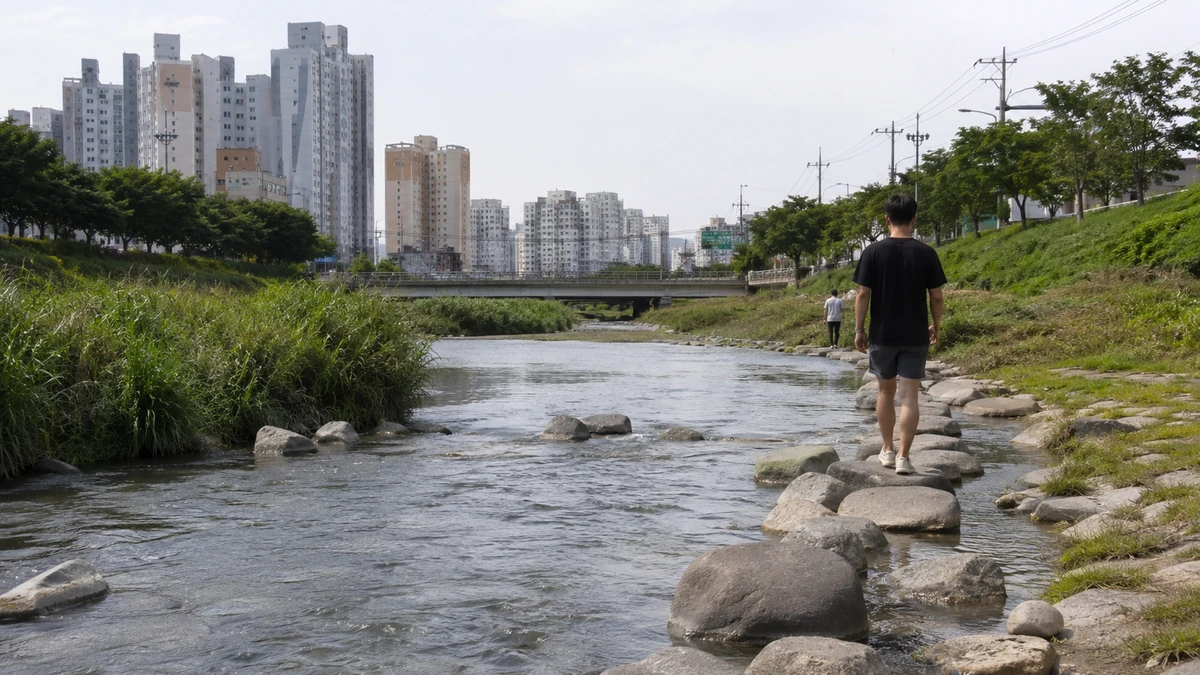
To understand why this story carries weight in South Korea, it helps to understand the way Korean cities function. Gwangju, like many South Korean cities, combines high residential density with public spaces that are heavily used and tightly woven into everyday life. Apartment complexes, schools, markets, small neighborhood parks and riverside walking paths exist in close proximity. During milder months, those spaces fill quickly. Evening walks are common, outdoor exercise is routine and windows are often opened to let in air before the peak summer heat sets in.
That means a mosquito surge is rarely confined to a single kind of place. It can affect the riverbank where retirees walk after dinner, the playground where children gather after school and the apartment block where residents debate whether to keep windows open at night. A seemingly small ecological change becomes a shared civic experience.
This is one reason local environmental data can carry outsized significance in Korea. In an American context, a pest bulletin might be dismissed as neighborhood-level news unless tied to a disease outbreak. In South Korea, where municipal governance is often highly visible in daily life and where urban residents are acutely aware of seasonal changes in their surroundings, the same report can become a broader measure of how well a city is tracking and managing its living environment.
The article from Gwangju also points to a larger truth about city living: the most important public concerns are not always spectacular. They are often cumulative. Traffic noise, fine dust, summer heat, odors near waterways and mosquito activity all shape whether residents feel a city is comfortable, healthy and well run. In that sense, mosquitoes belong in the same conversation as many other quality-of-life issues that local governments monitor closely even when they do not rise to national headlines.
And while Gwangju is the focus here, the question extends well beyond one city. How quickly does a change in weather translate into a change in urban life? How prepared are city agencies to respond before inconvenience turns into frustration? Those questions are relevant in Seoul, Busan and Daegu, just as they are in Atlanta, Houston or Washington, D.C. The local details differ, but the pattern is broadly recognizable.
What the numbers tell us beyond simple discomfort
One of the most revealing parts of the Gwangju report is not just that mosquitoes increased, but that officials were able to describe the increase with precision. The trap index ranged from 10 to 29 mosquitoes per trap depending on the week. The average number collected was 1.8 times higher than a year earlier. Weekly increases were estimated at 1.5 times to twice last year’s level. These are the kinds of details that turn vague seasonal complaints into something measurable and actionable.
That may sound bureaucratic, but it matters. Residents often experience mosquito season in anecdotal terms: it feels worse, bites seem more frequent, evenings seem less comfortable. Public institutions translate that subjective discomfort into comparative evidence. Once a city has a baseline from last year and a standard method for tracking the current year, it can begin to answer practical questions. Is this season starting earlier? Is activity rising faster? Are certain conditions repeatedly linked to spikes? Is intervention happening soon enough?
In public health and environmental administration, that kind of monitoring is foundational. It is the difference between reacting to complaints and understanding patterns. The Gwangju institute’s role is especially significant because it combines health and environmental functions under one institutional roof. That signals an important point: mosquitoes are not treated merely as a matter of nuisance but as part of a broader public environment that city officials are expected to observe and manage.
For Americans, there is an easy analogy in the way local agencies issue air-quality alerts, heat warnings or pollen counts. Those reports do not always indicate a crisis. Often, they tell the public how to interpret what they are already feeling and how seriously to take it. Mosquito data serve a similar purpose. They confirm that a discomfort is real, offer context for why it is happening and help frame whether conditions are likely to intensify.
There is also a social value in specificity. Clear numbers can reduce unnecessary alarm while sharpening awareness. A warning that simply says mosquitoes are increasing can feel vague or alarmist. A report that says counts are up 1.8 times from a year earlier, with current temperatures falling in the range most favorable to mosquito activity, is more concrete. It allows the public to understand the issue without exaggeration.
Why this matters outside Gwangju and outside South Korea
At one level, this is a distinctly local story about one Korean city at the edge of early summer. At another, it is a story that could resonate almost anywhere. Cities across the world are learning that everyday environmental conditions can shift rapidly and affect public life long before they become part of a larger climate or health debate. Mosquitoes are among the clearest examples because people notice them immediately.
The Gwangju case is especially readable for international audiences because it captures a universal urban tension: the same warmer weather that draws people outdoors can also make public spaces less comfortable. One local news item in South Korea on the same day highlighted roses in bloom along Anyang Stream in Seoul’s Guro district, emphasizing the pleasures of the season. In Gwangju, the same seasonal transition showed up in a less romantic form, as a sharp increase in mosquitoes. That contrast says something important about city life. Summer arrives for everyone, but each city experiences it through its own geography, infrastructure and management challenges.
American readers do not need to know Gwangju in detail to understand the larger point. Warmer evenings encourage outdoor dining, riverside strolls and open windows whether you are in South Korea or the United States. At the same time, those same conditions can bring more insects, more discomfort and more pressure on local governments to manage public spaces effectively. The local setting may be Korean, but the civic question is global.
This is also why the story should not be dismissed as merely seasonal filler. In a dense city, minor ecological shifts can become immediate social issues. A change in mosquito activity can affect sleep, recreation, customer traffic in outdoor commercial areas and overall perceptions of neighborhood livability. Those are not trivial concerns, particularly in societies where urban public space is heavily used and closely watched.
There is a reason residents often judge local government not only by big infrastructure projects but also by whether the everyday environment feels under control. Clean sidewalks, manageable noise, functioning drainage and tolerable summer pests are the mundane markers of civic competence. A mosquito report like Gwangju’s becomes meaningful because it sits precisely at that intersection of data, lived experience and public administration.
What this early-summer signal suggests for the months ahead
The Gwangju report did not, at least in the summary available, announce emergency measures or a formal warning level. But the numbers themselves function as an early signal. If May temperatures have already entered or approached the range in which mosquitoes are most active, then the period residents associate with peak mosquito annoyance may arrive earlier or feel stronger than it did last year.
That does not automatically imply a crisis. It does suggest a need for attentiveness. The practical challenge for city officials is not only to respond after people begin complaining in large numbers, but to recognize when environmental conditions are lining up in ways that predict discomfort. In that sense, the report is less a dramatic alarm than a piece of municipal intelligence.
The emphasis on the urban core is particularly important. Officials were not describing a remote wetland or rural fringe but mosquitoes collected in the city itself. That means the rise is occurring close to the paths residents take every day: housing complexes, parks, river-adjacent trails and other common living spaces. The problem, in other words, is not somewhere out there. It is woven into ordinary urban movement.
For public agencies, that makes monitoring essential. For residents, it reframes mosquito season as something more than bad luck. When authorities can show that a temperature band favored mosquito activity and that trap counts increased accordingly, the change becomes legible. Citizens are no longer dealing with an inexplicable nuisance; they are seeing a documented interaction between weather, ecology and city life.
There is also a broader lesson here about the value of paying attention to small signals. Major cities often focus public debate on housing costs, transit networks, economic development and political conflict. Those issues matter enormously. But so do the daily environmental conditions that determine whether city life feels bearable, pleasant or exhausting. A mosquito count will not dominate national politics, yet it may shape people’s experience of summer more directly than many larger debates.
That is what makes the Gwangju story quietly compelling. A small insect becomes a messenger. It tells residents that the season is shifting, that the city’s ecology is responding and that public agencies are watching closely enough to put hard numbers to a common annoyance. In an era when people increasingly experience environmental change not as abstraction but as a series of disruptions to daily routine, that kind of data carries real civic meaning.
For now, Gwangju’s mosquito surge is a local development with familiar global echoes. It is a reminder that seasonal change in cities does not arrive only through flowers blooming or temperatures climbing on a forecast. Sometimes it arrives as a sound by the ear at dusk, a bite on the ankle during an evening walk and a set of trap numbers that reveal, with unusual clarity, that summer has begun to make itself felt.
Comments
Post a Comment