Worker Killed in Seoul Sewer Repair Collapse Near Major Transit Hub, Underscoring Hidden Risks Beneath City Life
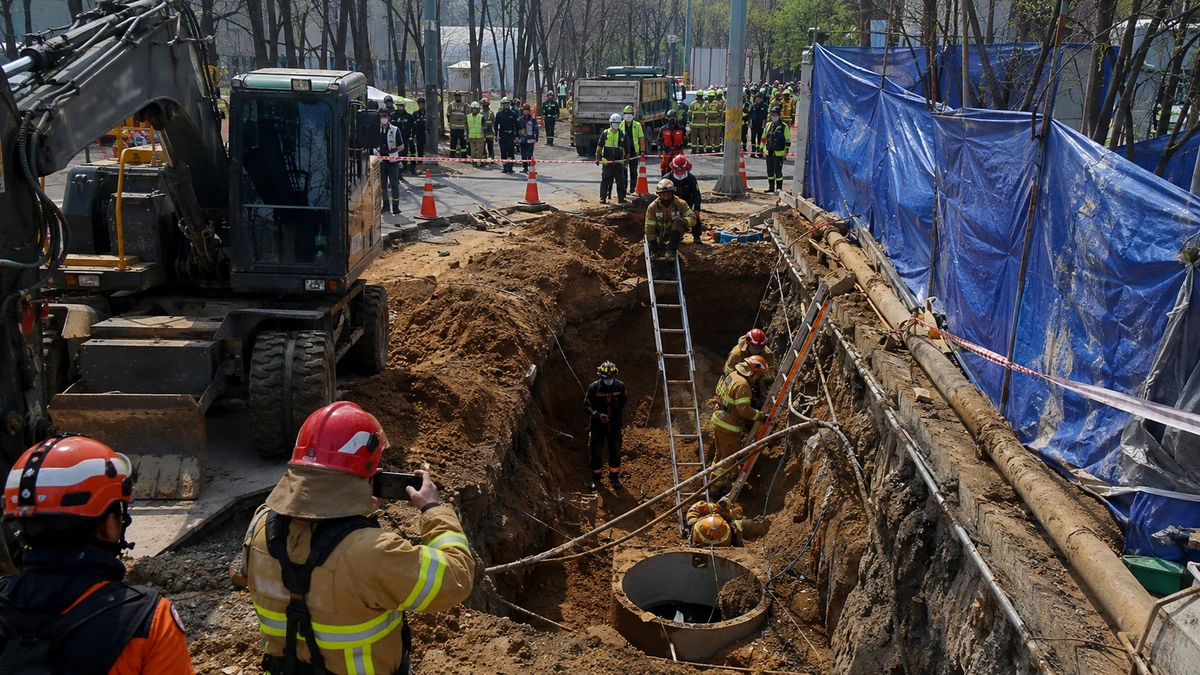
A deadly collapse in the middle of an ordinary workday
A worker was killed Tuesday after earth gave way at a sewer repair site near Suseo Station in southeastern Seoul, a stark reminder that some of the most dangerous jobs in a modern city happen far from public view, beneath the streets and alongside the daily rush of commuters.
According to South Korean authorities, the accident happened around 12:20 p.m. in Suseo-dong, a neighborhood in Seoul’s affluent Gangnam district, where crews were working on repairs to an aging sewer line. Three workers were buried when soil collapsed at the site. Two managed to get out on their own. A third worker, a man in his 60s, was rescued in cardiac arrest and taken to a hospital, where he was later pronounced dead.
The details, while brief, tell a clear and sobering story: a midday infrastructure job in one of the busiest urban areas of South Korea’s capital turned fatal in a matter of seconds. Police and fire authorities were still gathering facts, and officials had not publicly determined responsibility or said whether safety rules were violated. But even at this early stage, the incident has drawn attention for reasons that go beyond a single workplace death.
This was not a dramatic high-rise construction project or a spectacular development site tied to one of Seoul’s ever-changing skylines. It was maintenance work — the kind of routine, unglamorous labor that keeps a dense global city functioning. And it happened near one of the Seoul metro area’s important transportation nodes, a place associated less with danger than with movement, connection and ordinary urban life.
For readers in the United States, there is a familiar lesson here. The roads, rails, tunnels, pipes and drains that make daily life possible rarely become headlines until they fail — or until the people sent to fix them are hurt or killed. From water main breaks in aging American cities to trench cave-ins at utility sites, infrastructure maintenance can seem invisible right up until it becomes a public tragedy.
Why Suseo Station matters
To understand why this accident has resonated, it helps to understand the location. Suseo Station is not just a neighborhood stop. It is a major transit point in southeastern Seoul, connecting local subway traffic with wider regional and intercity travel. In South Korea, where public transportation is deeply woven into everyday life, stations like Suseo serve as more than platforms and tracks. They are civic arteries, moving office workers, students, families and travelers through one of the world’s most densely populated metropolitan regions.
American readers might think of a place like Union Station in Washington, Penn Station in New York, or a large commuter-rail transfer point in the suburbs of Chicago or Boston — not identical in scale or layout, but similar in the sense that the location is part of the everyday machinery of urban life. An accident near such a site feels jarring precisely because it breaks the assumption that transportation hubs are carefully controlled spaces where order prevails.
That symbolism matters in Seoul. Gangnam, long familiar to many Americans because of the global pop-cultural afterlife of “Gangnam Style,” is often associated abroad with wealth, polished development and hyper-modern city living. But even the most modern urban districts rely on underground systems that may be decades old. Sewers, drainage channels and utility corridors do not share the shine of luxury towers or sleek train platforms. They age quietly, below sightline, until repairs become urgent.
That is one reason a sewer line repair project near Suseo Station carries broader meaning. It points to a reality that cities from Seoul to Los Angeles to Philadelphia all face: the era of nonstop expansion eventually gives way to an era of upkeep. And upkeep, while less visible than new construction, can be just as dangerous — sometimes more so, because it often unfolds in tight spaces, around unstable soil, under traffic pressure, or inside older systems whose condition is not always fully predictable.
In that sense, the site of the collapse matters almost as much as the collapse itself. This was not a remote industrial yard closed off from public life. It was a work zone embedded in the living body of the city, near a place where thousands of people move through the day without thinking much about what lies underneath the pavement.
What appears to have happened underground
South Korean reports offered one especially important clue from a worker at the scene: the collapse occurred while crews were installing formwork for a manhole, and soil fell from a vertical slope. That description is technical, but the implication is fairly straightforward. The accident appears to have taken place in or around an excavation area where the side of the cut earth was steep — possibly nearly straight up — and that soil face gave way onto workers below.
In construction and utility work, trenches and excavations can become deadly with startling speed. A collapse is not like a simple slip or trip. Soil is heavy, unpredictable and capable of exerting crushing force almost instantly. In the United States, federal safety regulators have repeatedly warned that trench cave-ins are among the deadliest hazards in construction because workers often have little or no time to escape once the ground begins to fail.
Nothing in the reported facts yet establishes exactly why the slope collapsed in Seoul or whether adequate protective systems were in place. It would be premature to draw firm conclusions before an official investigation. Still, the mechanics of this kind of accident are widely understood in the construction world. Excavation work involves constant tension between speed, space and safety. Crews need access to the work area, but the very act of digging can destabilize surrounding soil. Water, weather, nearby traffic vibration, soil composition and the geometry of the cut can all affect whether an excavation remains safe.
The report that three workers were buried at once is also revealing. It suggests the job was being done in close coordination, with multiple workers operating in the same narrow zone or along the same sequence of tasks. Two were able to free themselves, while the third was not. That difference can come down to only a few feet of position, a split-second delay or the direction of the collapse. In excavation accidents, small differences in where a person is standing can become the difference between survival and death.
The description of the victim’s rescue also underscores how violent the incident may have been. Authorities said he was found in cardiac arrest and transported to a hospital, where he later died. That wording is common in emergency reporting, but it carries weight. It means rescue did happen; this was not a case where no one reached him. Yet rescue alone was not enough to reverse the damage. In many such cases, that is exactly why prevention becomes the central issue: once the collapse begins, the window to save a worker may be vanishingly small.
The hidden danger of maintenance work
Public attention often gravitates toward giant construction projects: a new bridge, a new rail line, a flashy tower, a stadium, a redevelopment district. Maintenance work rarely commands the same interest. It is quieter, more routine and less photogenic. But maintenance is where a mature city reveals what it values, because preserving old systems is every bit as essential as building new ones.
That is especially true in South Korea, a country whose postwar transformation is often described in terms of astonishing speed. In a matter of decades, South Korea built advanced transportation networks, industrial systems and urban infrastructure that helped turn it into one of the world’s leading economies. Seoul, in particular, became synonymous with efficient transit, dense development and technological sophistication.
Yet all infrastructure ages. Pipes corrode. Drains weaken. Underground lines crack, shift or deteriorate. What was installed in one generation becomes the maintenance burden of the next. For Americans, that dynamic is easy to recognize. The United States has spent years debating aging bridges, century-old water lines and the consequences of deferred maintenance. The difference is often one of visibility. A pothole or a train delay is easy to notice. Sewer rehabilitation work is not — until something goes wrong.
There is also a social dimension to this kind of labor. The workers who maintain underground infrastructure are often physically exposed to risk while performing tasks the broader public rarely sees or fully understands. Their work supports sanitation, drainage, traffic flow and public health. In everyday terms, they help ensure toilets flush, streets do not flood and roads do not suddenly collapse into sinkholes. Yet because the work happens out of sight, it can be undervalued until an accident exposes its stakes.
This Seoul collapse makes that contradiction hard to ignore. The project was reportedly aimed at repairing an “old and defective” sewer line — exactly the kind of preventive work city governments are supposed to carry out before problems become emergencies. But the act of preventing a future civic failure created an immediate danger at the worksite itself. That is the paradox of urban maintenance: a city cannot function safely without it, but carrying it out safely requires vigilance, planning and enforcement at every stage.
For American readers, it may be useful to think of utility crews repairing a storm drain below a busy intersection, or workers replacing compromised sewer pipe beneath a commuter corridor. The public benefit is obvious. So is the hazard. Cities need these repairs, but workers should not have to gamble with their lives to complete them.
An older worker’s death raises broader labor questions
The man who died was identified in Korean reports only by his surname and age bracket, a common practice in South Korean crime and accident coverage. He was a man in his 60s. Even without more biographical detail, that fact alone gives the story additional resonance.
South Korea, like the United States and many other advanced economies, is grappling with an aging population and a labor force under pressure. Older workers remain present across many sectors, including physically demanding ones. Sometimes that reflects experience and skill. Sometimes it reflects economic necessity, especially for workers who continue laboring later in life because retirement security is limited or uneven.
In the American context, readers may recognize a similar conversation around warehouse work, delivery jobs, custodial labor, home care and construction trades, where older workers often continue in demanding roles long after white-collar peers have retired. A fatal accident involving a worker in his 60s naturally prompts questions that extend beyond the immediate site: How is dangerous labor distributed by age? Who ends up doing the hardest maintenance work? What protections exist for veteran workers whose bodies may be more vulnerable to trauma, even if their experience is extensive?
The available facts do not tell us how long the victim had worked in the field, what his employment status was, or whether he was a direct employee, subcontractor or day laborer. Those distinctions matter in labor reporting because contracting arrangements can affect training, oversight and accountability. But those details were not included in the initial reports, and responsible reporting requires acknowledging what is not yet known.
Even so, one point is clear. The loss of one worker is not rendered minor simply because the total casualty count was small. Industrial accidents are often reported through numbers: three buried, two escaped, one dead. Numbers matter, but they can flatten the human dimension. In reality, one death on a routine maintenance shift is a profound event — for a family, for co-workers, and for the larger society that depends on labor like his while rarely seeing it.
What investigators will likely examine next
At this stage, the official record remains limited. Police and fire authorities confirmed the timing, location and casualties. The underlying cause, potential legal responsibility and any regulatory consequences had not yet been publicly laid out in the information available from early reports.
Still, accidents of this kind tend to generate two immediate lines of inquiry, in South Korea as in the United States. First: why did the soil collapse? Second: why did that collapse become fatal? Those questions sound similar, but they are not identical. The first is about triggering conditions — excavation design, slope angle, ground stability, moisture, protective systems and work sequencing. The second is about mitigation — whether safeguards, escape routes, supervision and emergency response were sufficient to prevent a death once the failure occurred.
Investigators may also look at whether the worksite had appropriate reinforcement or protective measures for the excavation area, whether risk assessments had been completed, and how closely actual field conditions matched the plan. In U.S. reporting on trench and excavation deaths, similar questions routinely arise: Was shielding used? Were slopes properly cut? Was the area inspected? Did someone recognize warning signs before the cave-in?
It is important not to leap from those standard questions to assumptions about wrongdoing in this case. The facts currently available do not support a definitive judgment. But the framework matters because it shows what societies are really trying to learn after a preventable-seeming industrial death. The goal is not only to identify fault. It is to understand how the chain of events moved from routine maintenance to fatal collapse, and whether that chain could have been broken earlier.
Accuracy matters especially in the first hours after a disaster. In both Korean and American media environments, breaking-news coverage can quickly produce speculation. But the most responsible approach is often the most restrained one: separate verified fact from interpretation, identify what remains unknown, and allow the investigation to establish details that early eyewitness statements alone cannot settle.
A broader warning for global cities
What happened near Suseo Station is, on one level, a local accident in Seoul. On another level, it is part of a much wider urban story. The world’s major cities increasingly face the same challenge: how to maintain aging infrastructure under the pressure of dense populations, heavy transit use and constant demand for uninterrupted service.
That challenge is easy to underestimate because success is mostly invisible. When sewer systems work, nobody notices. When drainage functions properly during a storm, the public simply continues with daily life. When underground repairs are completed without incident, there is no headline. The public mostly sees maintenance only in the form of traffic cones, narrowed lanes and temporary inconvenience.
But beneath those inconveniences is a workforce managing some of the most consequential and least celebrated tasks in urban life. They protect sanitation, mobility and public safety in environments where a single failure of soil, pipe or structural support can become catastrophic. In that sense, the Seoul collapse is not just a Korean labor story. It is a case study in the hidden fragility of modern cities.
There is also an irony worth noting. South Korea is often internationally associated with futuristic imagery — high-speed trains, advanced electronics, cultural exports, polished cityscapes. Yet modernity is never only about what is new. It also depends on how societies care for what is old. Sewer lines, unlike sleek stations or gleaming towers, do not symbolize national prestige. But they are just as essential to public life. When they fail, or when workers die repairing them, the myth of frictionless urban efficiency gives way to a more complicated truth.
That truth should feel familiar to American readers. Whether in Seoul, Baltimore or San Francisco, cities are sustained by people doing difficult work in dangerous places so that everyone else can move through the day without interruption. When one of those workers dies, it forces a reckoning not only with a single worksite but with the values embedded in urban governance: what gets funded, what gets inspected, what gets postponed and whose safety is treated as negotiable.
For now, the confirmed facts remain narrow but powerful. Just after noon on the 27th, at a sewer repair site near a major Seoul transit hub, soil collapsed. Three workers were buried. Two escaped. One man in his 60s did not survive. That is enough to establish the immediate tragedy. It is also enough to raise a harder and more lasting question: in cities that pride themselves on efficiency and growth, are the people maintaining the foundations of daily life being protected as seriously as the infrastructure they are sent to preserve?
Comments
Post a Comment